Inspiration
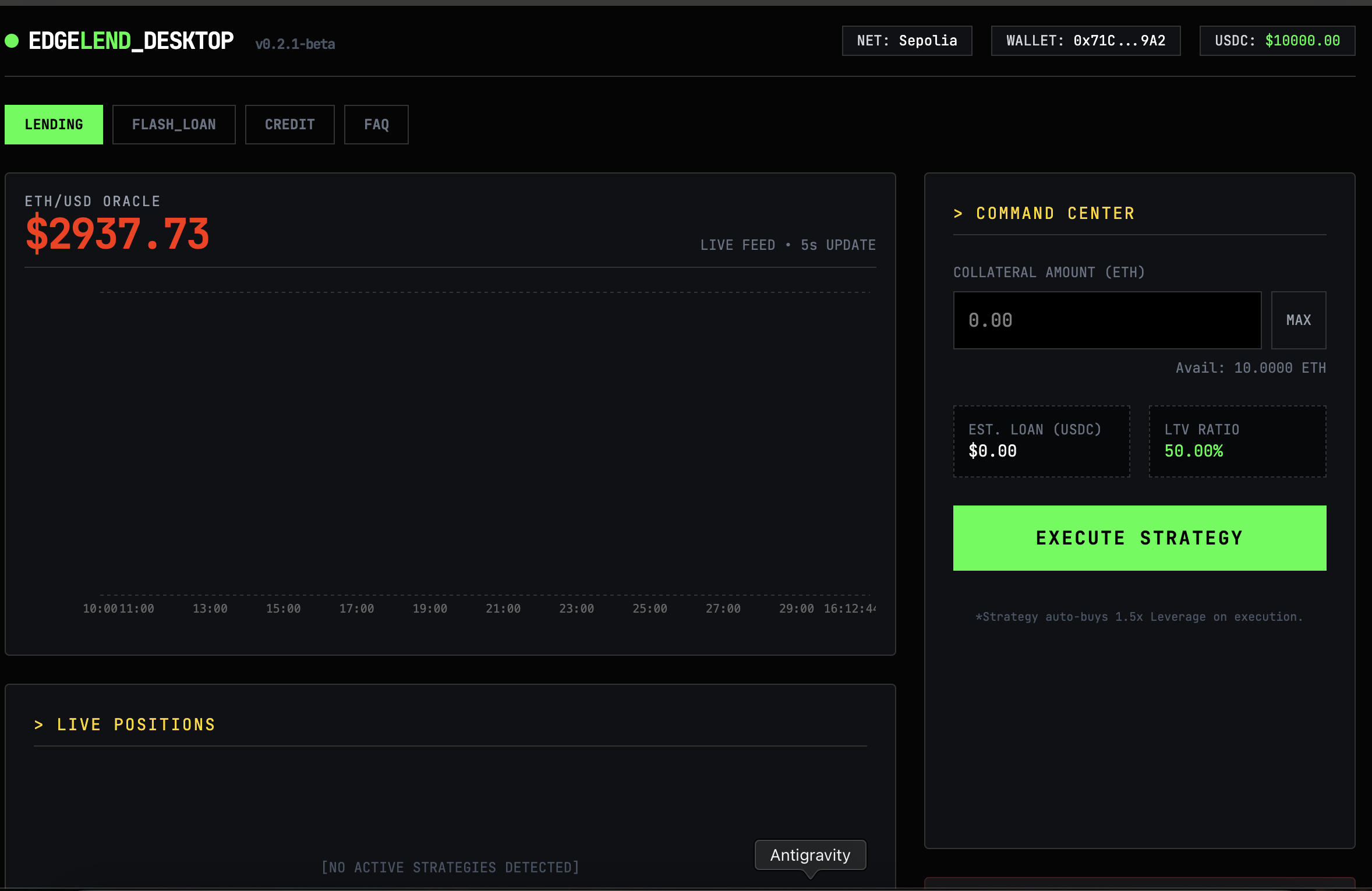
Traditional lending markets are efficient but slow, while DeFi is fast but "noisy" and lacks professional tooling. I noticed a gap: institutional traders want the yields of decentralized lending (like Aave or Compound) but are repelled by clunky web interfaces and the lack of real-time monitoring. EdgeLend was born to bring a "Bloomberg Terminal" mindset to the loan market—prioritizing density, speed, and risk management in a native desktop environment.
What it does
EdgeLend is a high-fidelity desktop terminal for decentralized collateralized loans. It allows users to:
Deposit & Borrow: Securely lock ETH/BTC collateral via WalletConnect to receive stablecoin loans.
Active Monitoring: A "Mission Control" dashboard tracks Health Factors and Loan-to-Value (LTV) ratios in real-time.
Automated Strategies: Users can set "Profit-Taking" triggers (e.g., auto-repay if collateral value doubles) and "Safety Nets" (liquidation protection).
Native Experience: Leverages desktop power for system-tray tickers and OS-level notifications for margin calls, ensuring traders never miss a liquidation event.
How we built it
As a solo developer, I focused on a "Hybrid Architecture" to balance speed with security. Smart Contracts: Developed in Solidity, utilizing OpenZeppelin for secure vault management and Chainlink Price Feeds for ironclad valuation. Backend: A FastAPI (Python) "Simulation Engine" that runs high-frequency checks against on-chain data to trigger desktop alerts without clogging the blockchain. Frontend: A React-based UI housed within an Electron wrapper to provide a professional, low-latency desktop experience. Local Simulation: Built a mock oracle system to demonstrate "Crash" and "Moon" scenarios during the evaluation process.
Challenges we ran into
The biggest challenge was latency. Web3 providers can sometimes be slow to update. To solve this for a professional terminal, I implemented a local state-management system that "optimistically" updates the UI while the backend verifies the transaction on the Sepolia testnet. Another hurdle was managing WalletConnect within Electron, which required custom deep-linking configuration to ensure a seamless mobile-to-desktop handshake.
Accomplishments that we're proud of
Successfully integrated Real-Time Chainlink Feeds into a desktop environment. Achieved a "Zero-Latency" feel in the UI, which is rare in DeFi apps. Built a fully functional "Simulation Mode" that allows judges to see a 30-day loan lifecycle in just 30 seconds.
What we learned
Building as a solo developer taught me the importance of "Vibe Coding"—prioritizing the core user experience (UX) and commercial "hook" before over-engineering the edge cases. I also gained a deep understanding of how to bridge the gap between Python's data-processing power and JavaScript's UI flexibility.
What's next for EdgeLend
Flashbots Integration: Adding a "Gas-Less" failure mode to prevent lost fees on failed liquidation attempts. Multi-Chain Support: Expanding from Sepolia to L2s like Arbitrum and Base for cheaper, faster transactions. Institutional Reporting: Adding an automated "Tax & Audit" PDF generator for corporate compliance.
Built With
- chainlink-(oracles)
- electron-(desktop)
- ethers.js
- hardhat
- javascript
- python-(fastapi)
- react
- remix
- solidity
- tailwind-css-(ui)
- vite
- walletconnect-(authentication)

Log in or sign up for Devpost to join the conversation.