-
-
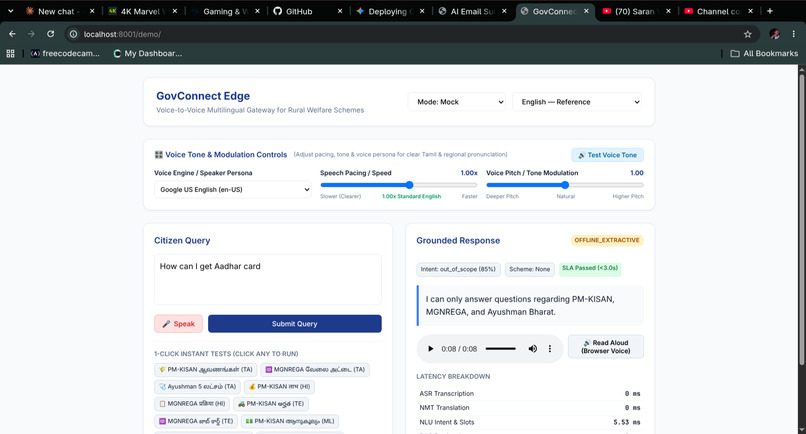
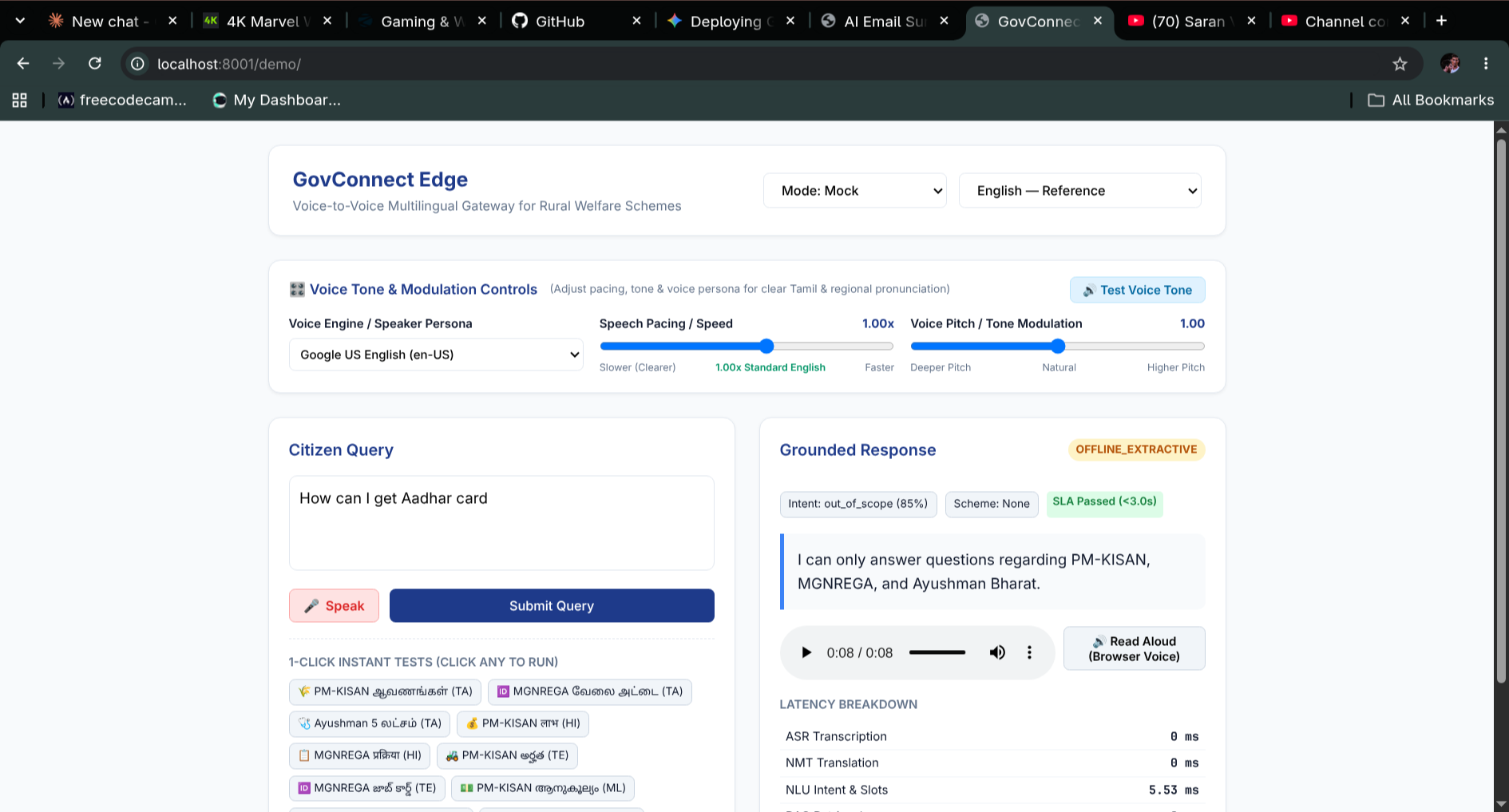
Web page of demo
Inspiration
Accessing government welfare schemes should not depend on a person's literacy level, language proficiency, or ability to navigate complex websites and applications. However, many rural citizens in India face difficulties understanding official information about schemes such as PM-KISAN, MGNREGA, and Ayushman Bharat because of language barriers, unfamiliar terminology, and text-heavy interfaces.
This inspired us to build GovConnect Edge, a dialect-adaptive voice-to-voice gateway that makes government information more accessible. Our vision is simple: citizens should be able to ask questions naturally in their native dialect and receive clear, spoken answers without needing to type, read lengthy documents, or understand technical language.
What it does
GovConnect Edge is a dialect-adaptive, voice-to-voice gateway designed to make Indian government welfare information accessible to everyone, especially rural citizens and people with limited digital literacy.
Instead of navigating complex websites or reading lengthy documents, users can ask questions naturally in their preferred language or dialect and receive spoken responses in simple, understandable language.
The system focuses on helping citizens discover and understand welfare schemes such as PM-KISAN, MGNREGA, and Ayushman Bharat. It combines speech recognition, query understanding, reliable information retrieval, dialect adaptation, and speech synthesis to create a more natural way to interact with government services.
Our goal is to reduce language and literacy barriers so that citizens can access relevant public-service information through a simple conversation.
How we built it
We designed GovConnect Edge around a voice-first AI pipeline that transforms a spoken question into a relevant, spoken answer.
Voice input: Captures the user's spoken query in their preferred language or dialect.
Speech-to-text: Converts speech into text for further processing.
Query understanding: Identifies the user's intent and the relevant welfare scheme or service.
Information retrieval: Retrieves relevant information from trusted government sources to ground the response in factual content.
Dialect-adaptive response generation: Produces an answer in simple language suited to the user's linguistic needs.
Text-to-speech: Converts the response into spoken audio, completing the voice-to-voice interaction.
The architecture is designed to keep the interaction simple for users while making accuracy, accessibility, and trustworthy information central to the experience.
Challenges we ran into
One of our biggest challenges was addressing India's linguistic diversity. People may use regional dialects, local expressions, and different pronunciations that conventional speech-recognition systems do not always handle effectively.
Another challenge was maintaining the reliability of government-related answers. Welfare schemes can have specific eligibility requirements, documentation rules, and application procedures, so providing unsupported or outdated information could mislead users.
We also had to consider usability for people who may not be comfortable with smartphones, text-based interfaces, or complicated navigation. The experience needs to be conversational and straightforward, even for first-time users.
These challenges highlighted the importance of combining language adaptation with reliable information retrieval and a user-centred design.
Accomplishments that we're proud of
A voice-first approach to digital inclusion: We designed an interaction that does not require users to depend on text-heavy interfaces.
A focus on regional language accessibility: The project addresses the practical gap between standard-language digital services and the dialects people use in everyday life.
Grounded government information: Our approach prioritizes retrieving relevant information from trusted sources instead of relying entirely on free-form AI-generated answers.
A reusable architecture: The voice-to-voice workflow can potentially support multiple welfare schemes and expand to additional languages and public services.
A citizen-centred vision: We focused on a real accessibility problem and explored how AI can make essential public information easier to understand.
What we learned
We learned that building a useful AI assistant involves much more than connecting a speech-recognition model to a language model. Each stage—from understanding spoken input to retrieving reliable information and generating natural speech—affects the overall user experience.
We also learned that accessibility must be considered from the beginning. A technically sophisticated system is not truly inclusive if it cannot understand local speech patterns or explain information in language that people can follow.
Most importantly, we recognized that trust is essential when AI communicates information about government benefits. Reliable sources, clear responses, appropriate uncertainty handling, and validation against official information are important for building a system people can depend on.
What's next for Edge-Connect
Our next steps are focused on improving the system's accuracy, accessibility, and real-world usefulness.
Expand dialect coverage: Improve support for regional dialects and language variations, beginning with the communities we aim to serve.
Improve speech recognition: Evaluate performance with different accents, background noise, and everyday conversational speech.
Strengthen information grounding: Integrate verified government sources and mechanisms to identify outdated or conflicting information.
Add conversational follow-ups: Allow users to ask additional questions about eligibility, required documents, application procedures, and relevant schemes.
Support low-connectivity environments: Explore lightweight processing, caching, and edge-based capabilities to improve usability in areas with limited internet access.
Test with real users: Gather feedback from rural citizens and community stakeholders to identify misunderstandings and improve the interaction.
Measure real-world impact: Evaluate speech-recognition accuracy, answer reliability, response time, dialect comprehension, and user satisfaction.
Our long-term vision is to evolve Edge-Connect into an inclusive voice gateway for public services, helping citizens interact with government information naturally, confidently, and in the language they understand best.
Built With
- data
- ispeech-text-to-speech
- llm
- natural-language-processing
- python
- retrieval-augmented
- stt

Log in or sign up for Devpost to join the conversation.