-
-
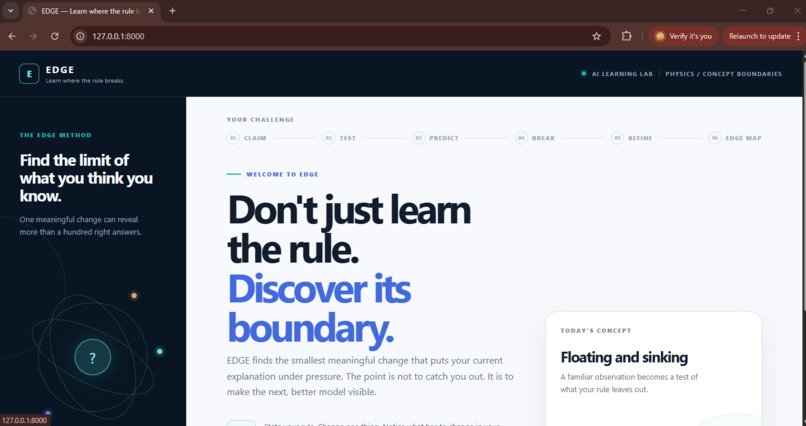
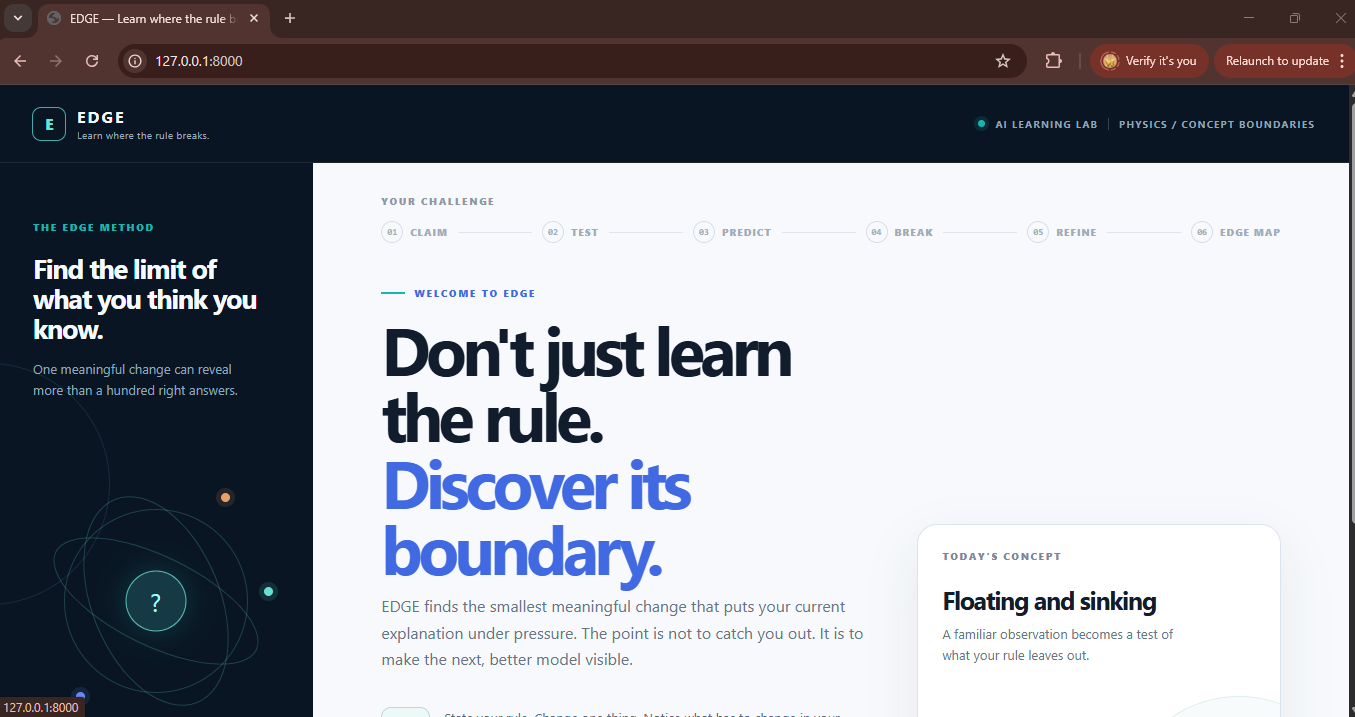
Learn where the rule breaks.
-
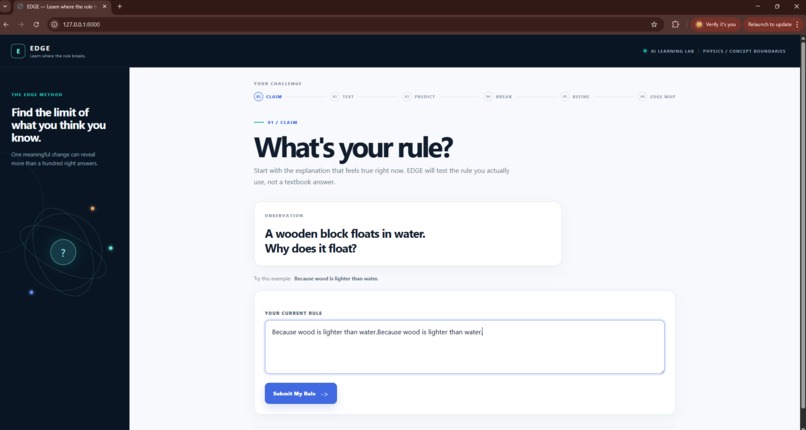
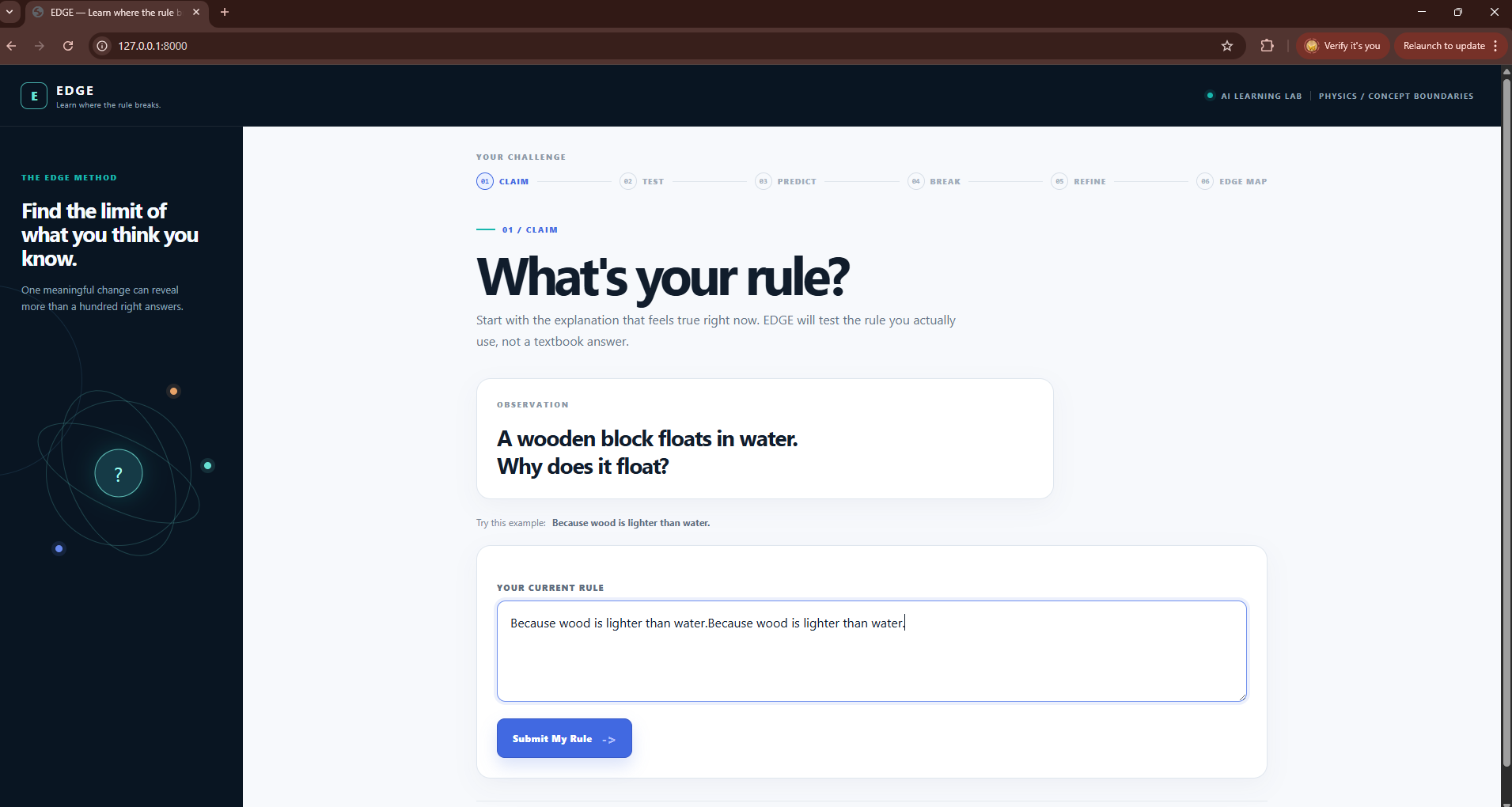
Because wood is lighter than water.
-
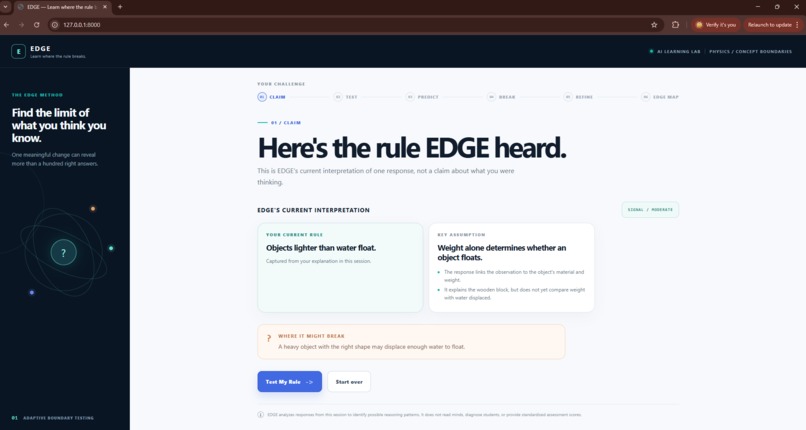
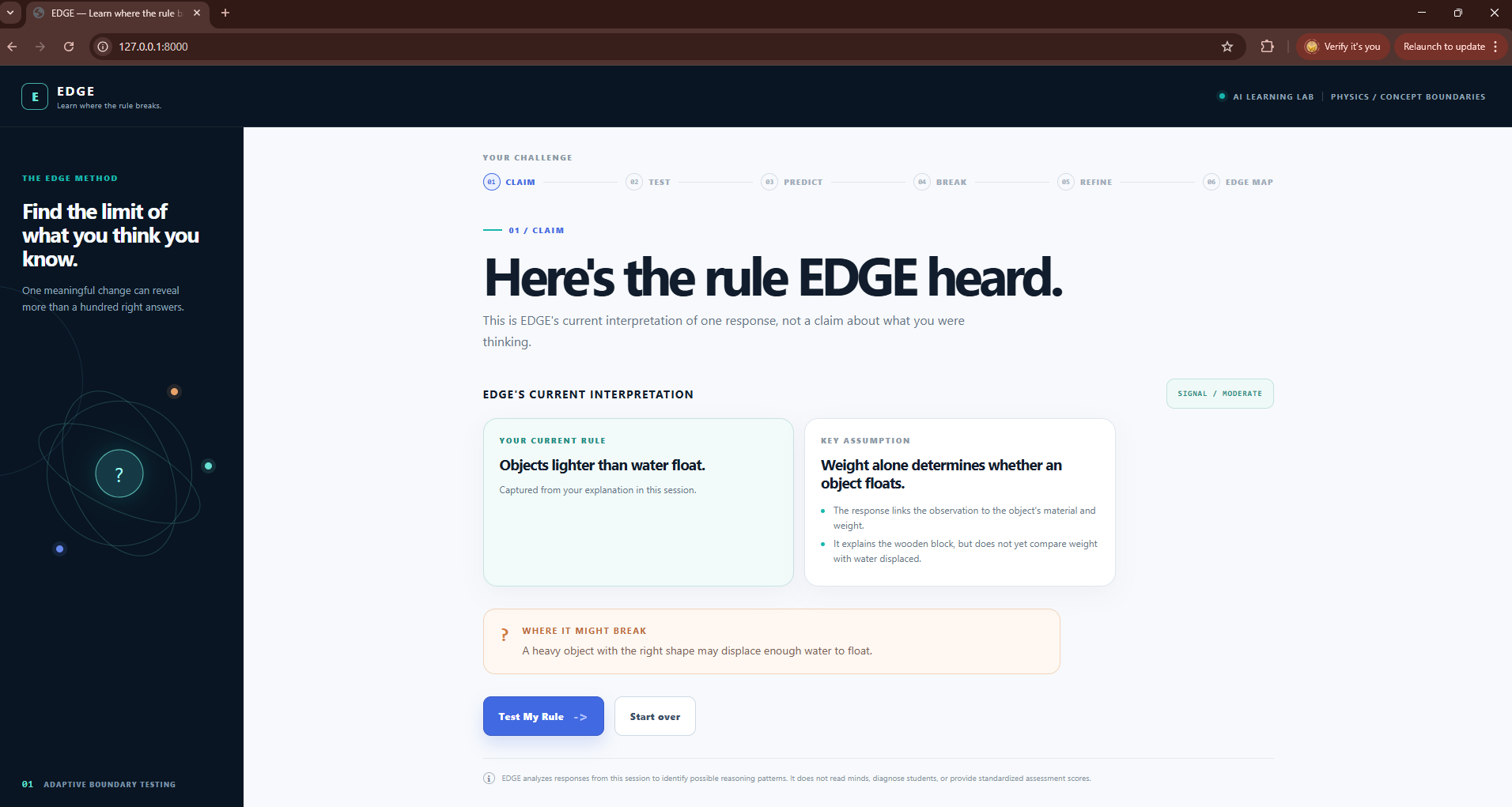
EDGE — Rule Interpretation
-
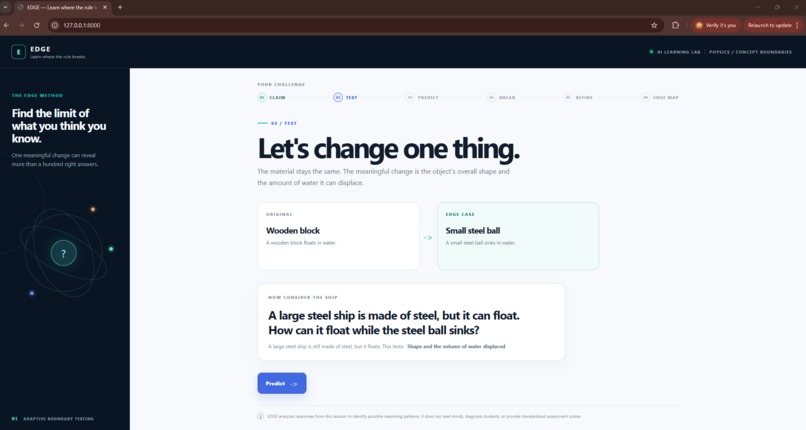
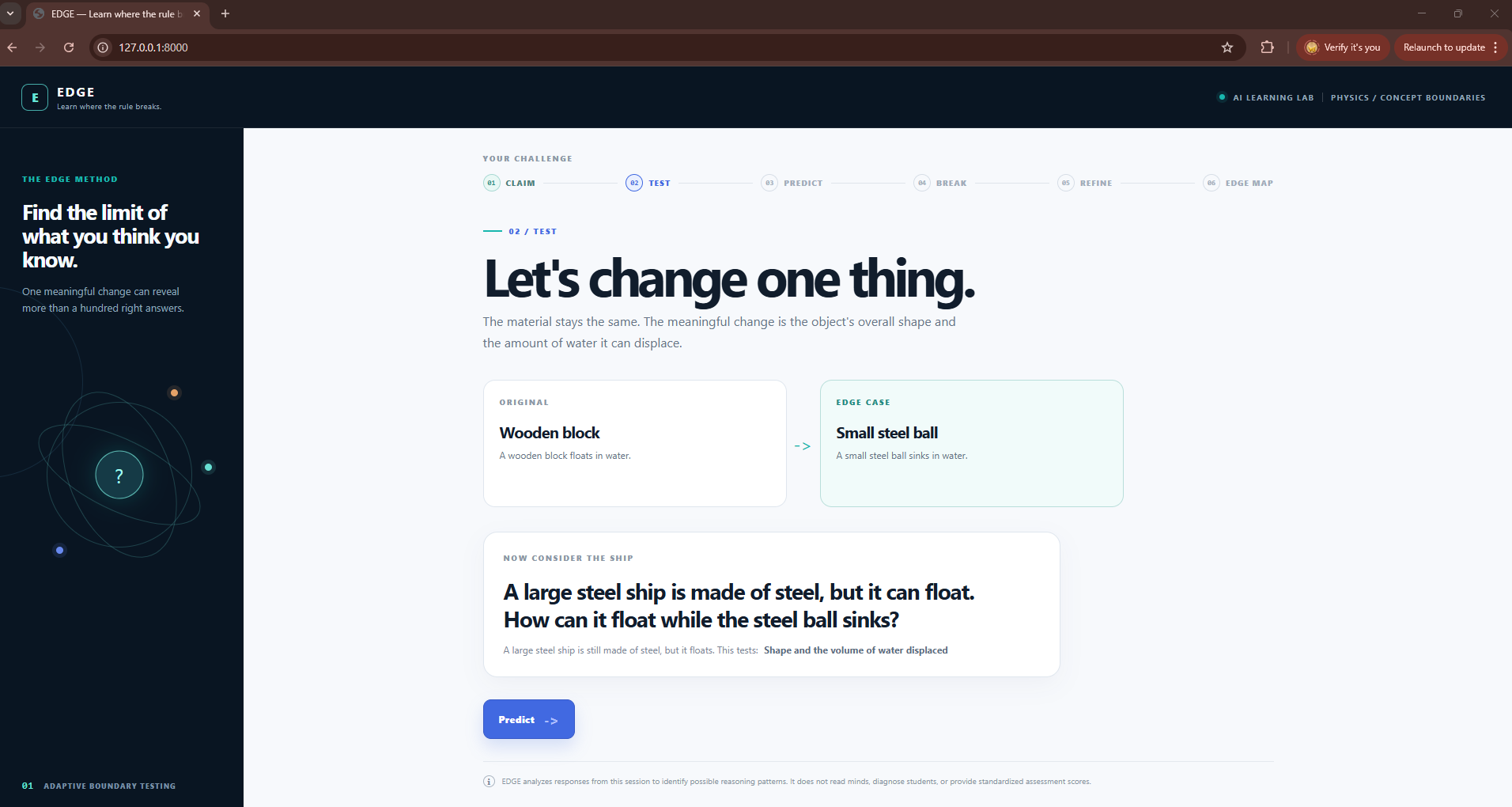
EDGE — Minimal Change Test
-
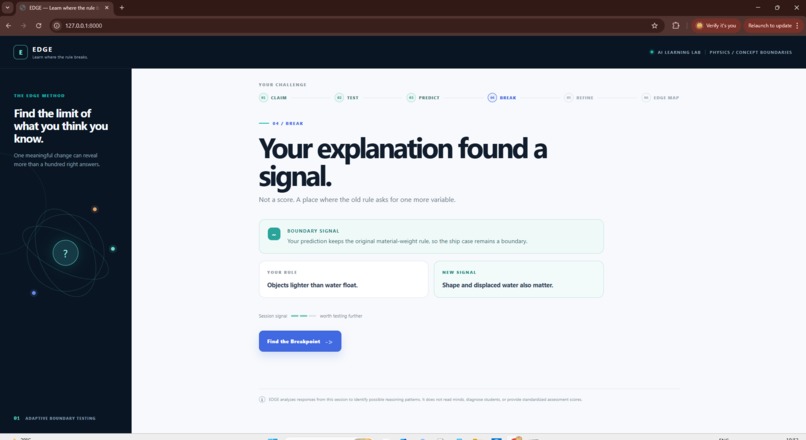
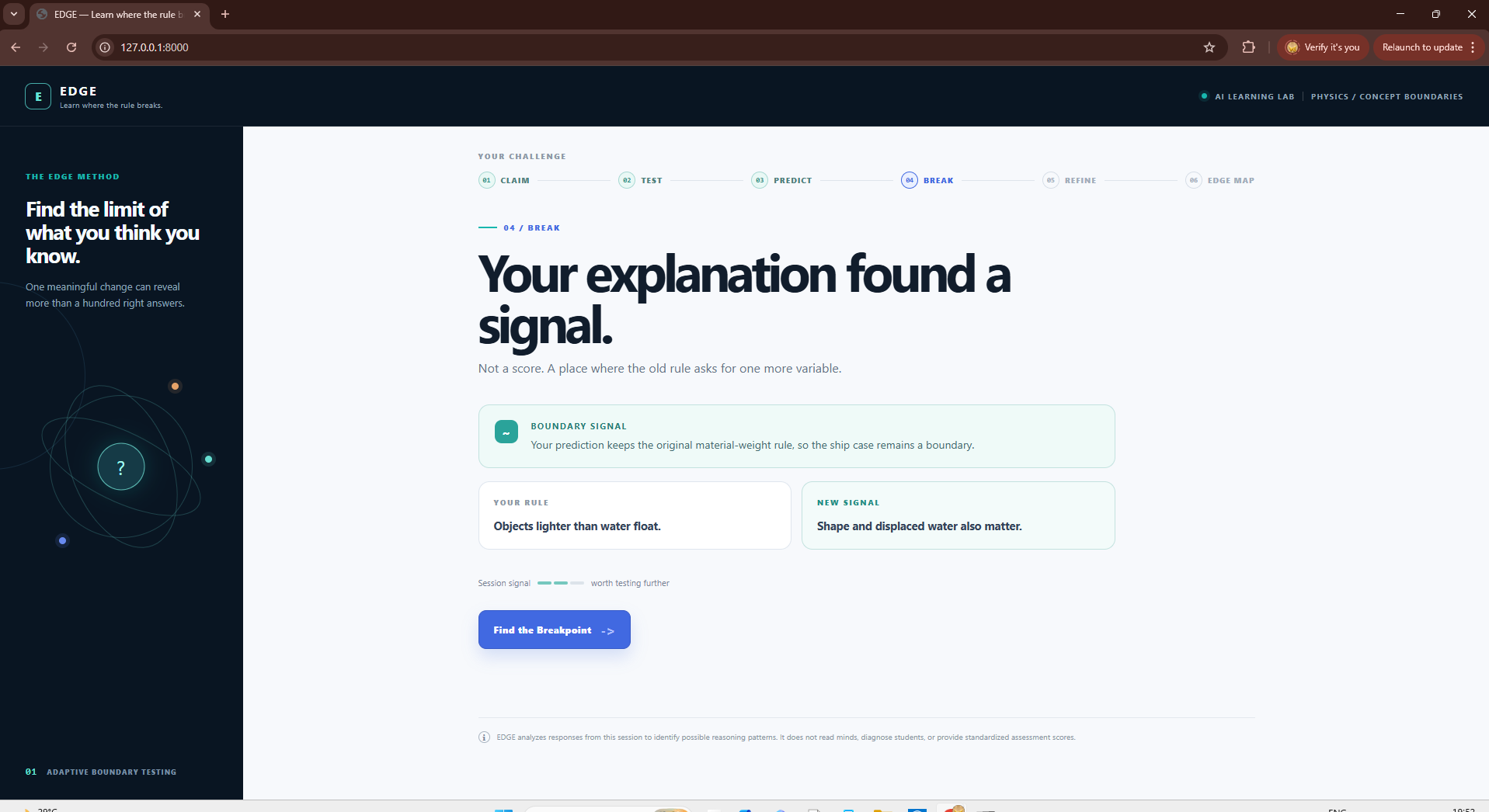
EDGE — Boundary Signal
-
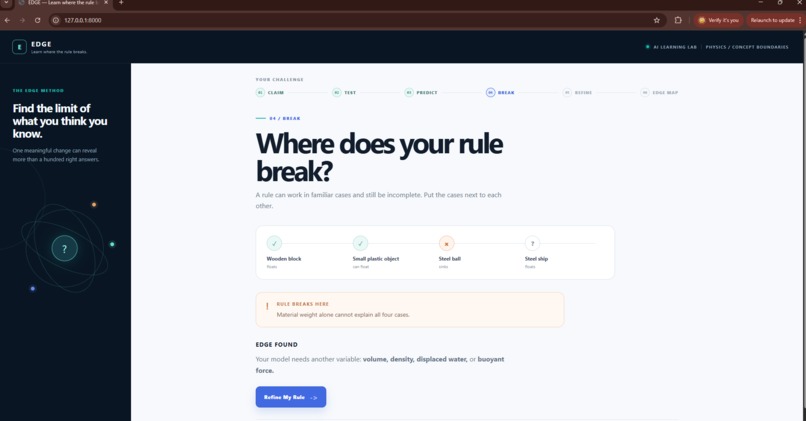
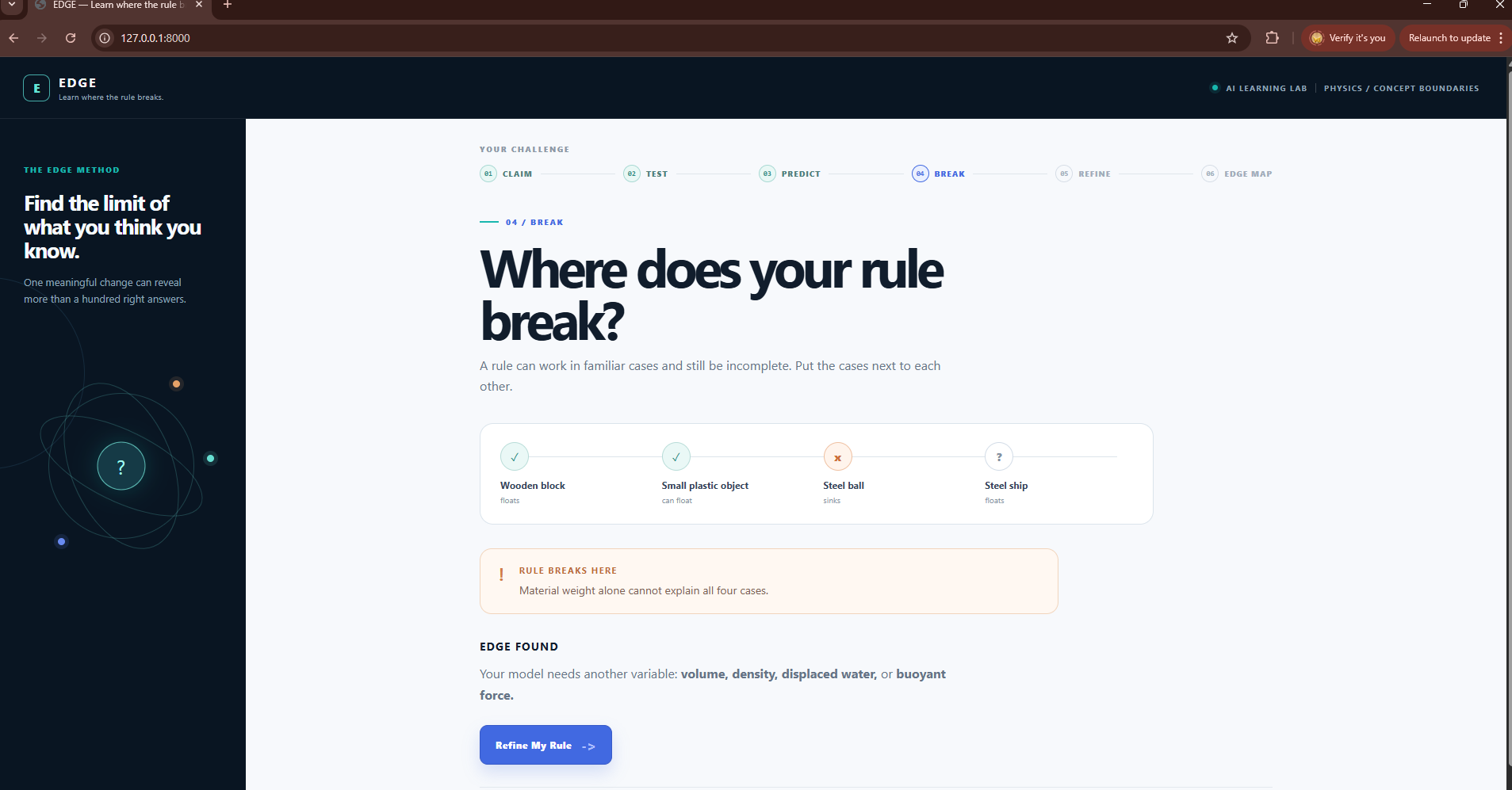
EDGE — Breakpoint Map
-
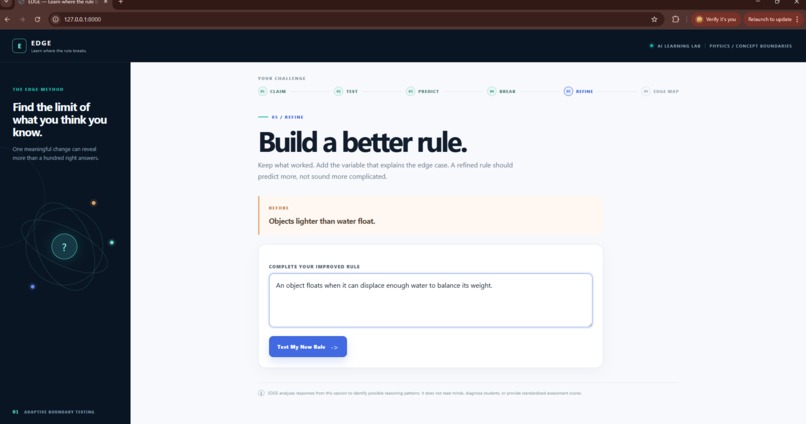
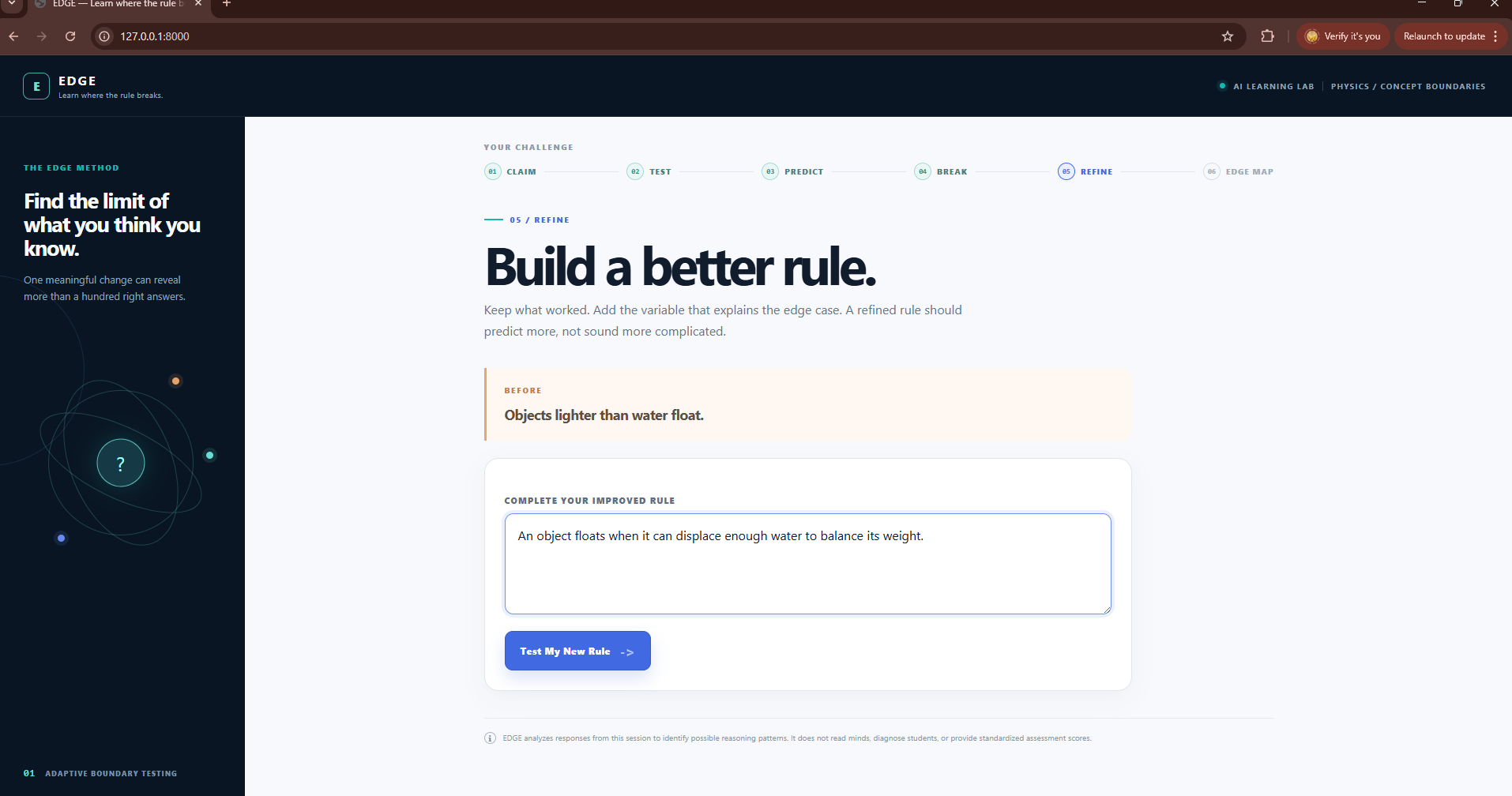
EDGE — Refined Rule+
-
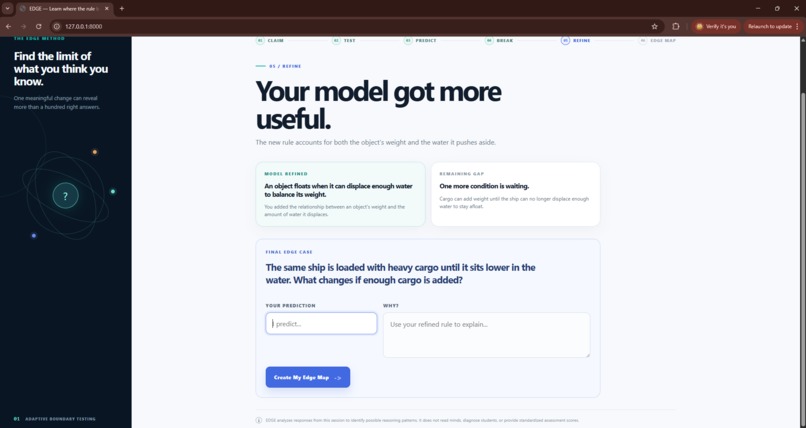
EDGE — Transfer Test
-
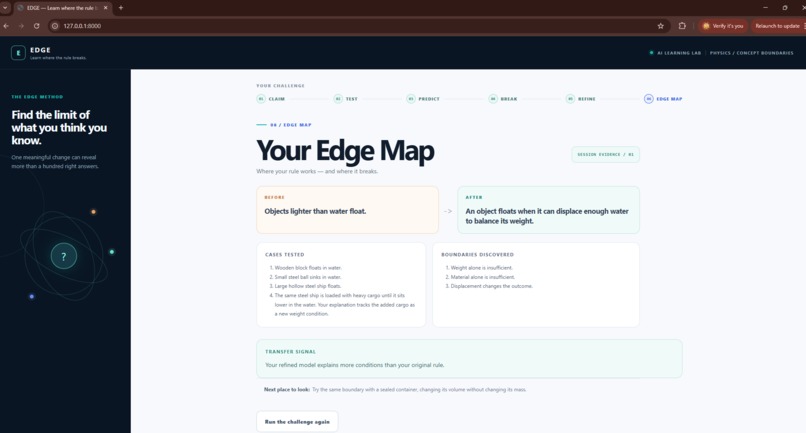
EDGE — Final Edge Map
Inspiration
A student can get the right answer without actually understanding the rule behind it.
Traditional quizzes often tell us whether an answer is correct, but they rarely show where a student's mental model stops working. We wanted to build something different: an AI learning system that does not simply give another explanation or generate another quiz.
That idea became EDGE.
Learn where the rule breaks.
EDGE starts with a student's own claim, then changes one meaningful condition at a time to find the boundary of that reasoning.
What EDGE Does
EDGE follows a six-step reasoning loop:
Claim → Test → Predict → Break → Refine → Edge Map
- Claim — The student states what they currently believe.
- Test — EDGE creates a meaningful edge case.
- Predict — The student predicts what should happen.
- Break — EDGE identifies where the original rule no longer explains the result.
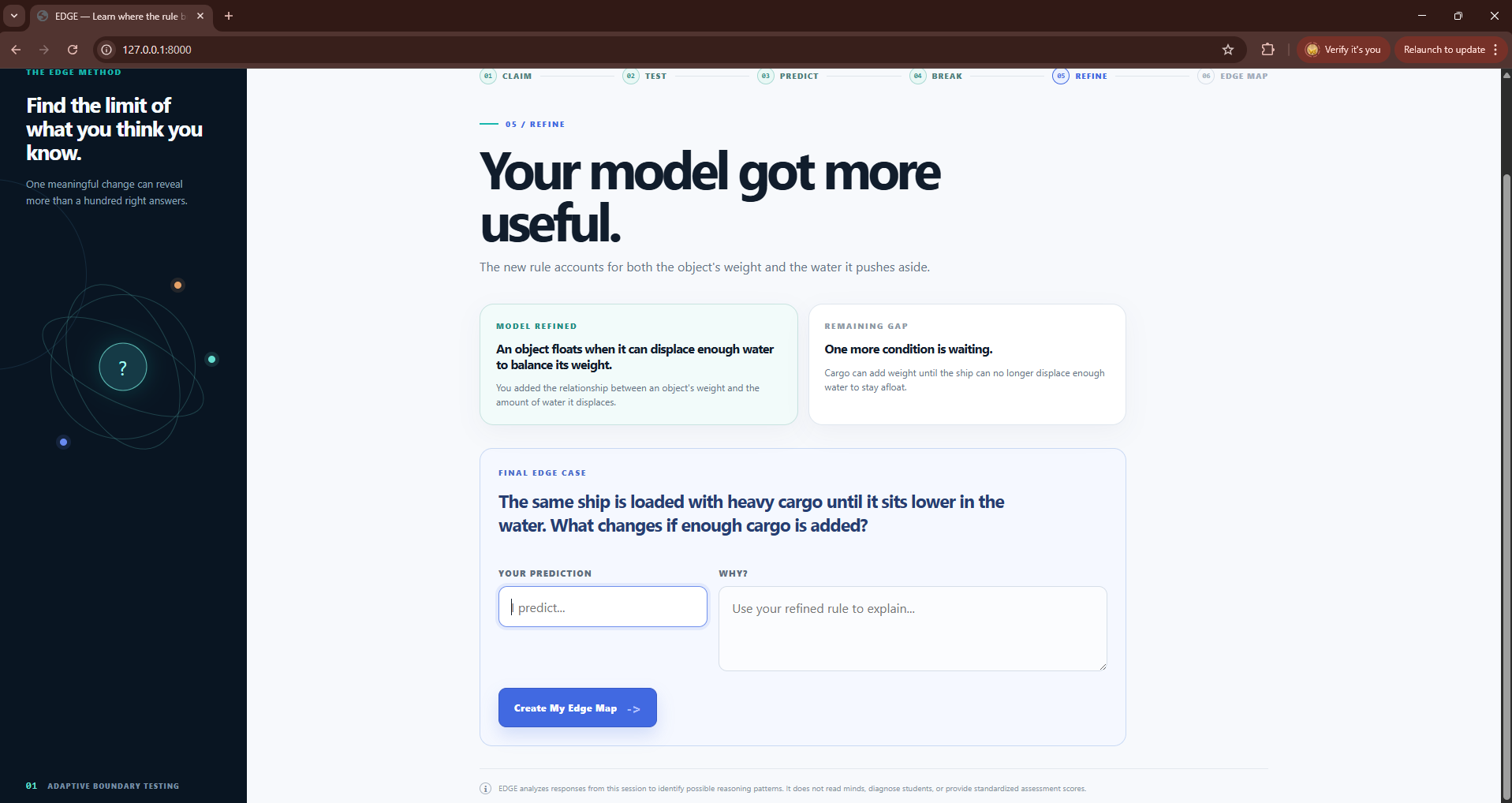
- Refine — The student builds a stronger version of the rule.
- Edge Map — EDGE records the cases tested and the boundary discovered.
The goal is not just to get more questions correct.
The goal is to help the learner discover:
“What does my rule explain, and where does it stop explaining?”
Example: Floating and Sinking
A student begins with:
“Objects lighter than water float.”
EDGE then changes one meaningful condition.
A small steel ball sinks, but a large hollow steel ship can float.
This creates a boundary in the student's original rule.
Instead of simply marking the answer wrong, EDGE helps the learner refine the model:
“An object floats when it can displace enough water to balance its weight.”
The learner then encounters another condition: the same ship is loaded with heavy cargo.
The refined model now has to explain why the ship sits lower in the water and why enough additional weight could eventually cause it to sink.
The student is therefore testing the rule itself, not just memorizing another answer.
Why It's Different
EDGE is not designed as another generic AI tutor, chatbot, flashcard system, or quiz generator.
Its core interaction is minimal meaningful change.
Instead of changing everything at once, EDGE changes one important condition and asks the learner to reason about the result.
This makes the boundary of a mental model visible.
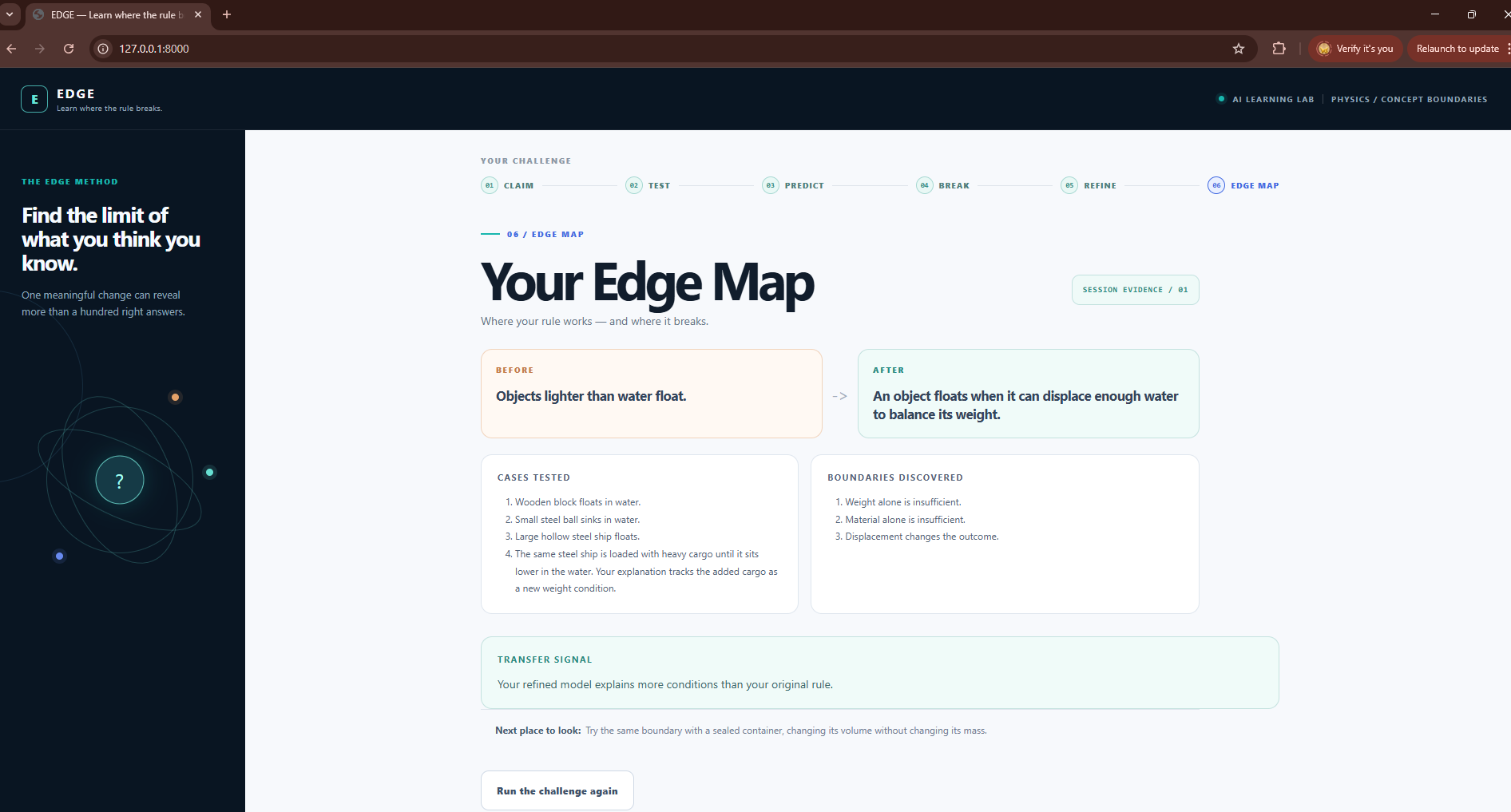
The final Edge Map shows:
- What the learner originally believed
- Which cases supported the rule
- Which case broke it
- What new condition mattered
- How the learner refined the rule
- Whether the refined model transfers to a new condition
How We Built It
EDGE is a lightweight web application built with:
- Python
- FastAPI
- Pydantic
- Uvicorn
- Vanilla JavaScript
- HTML5
- CSS3
- Pytest
The application uses structured models and API endpoints to maintain the reasoning session.
We also created a provider abstraction with a deterministic fixture mode. This allows the complete learning flow to be tested reliably while keeping the architecture ready for an AI provider.
The current MVP keeps session state in memory and does not require authentication or a database.
AI/ML Approach
EDGE uses AI as a reasoning-learning layer rather than simply as an answer generator.
The system analyzes the student's stated rule and response patterns, generates or evaluates boundary conditions, and helps structure the transition from an initial rule to a refined model.
Importantly, EDGE does not claim to read a student's mind.
It analyzes evidence from the current learning session and identifies possible reasoning patterns.
EDGE analyzes responses from this session to identify possible reasoning patterns. It does not read minds, diagnose students, or provide standardized assessment scores.
Challenges
One of the biggest challenges was making the interaction feel like genuine reasoning rather than a normal AI tutoring conversation.
We had to make the system focus on one meaningful change at a time.
Another challenge was making the learning progression understandable. The learner needs to see why their original rule worked in some cases, where it broke, and why the refined rule is stronger.
We also focused on keeping the MVP dependency-light, testable, and easy to run locally.
What We Learned
We learned that a wrong answer is not always the most useful learning signal.
Sometimes the more valuable signal is the boundary between the cases a learner can explain and the cases their current model cannot explain.
That boundary can become the starting point for deeper learning.
Future Direction
Future versions of EDGE could support:
- More subjects beyond physics
- Personalized edge-case generation
- Long-term learner reasoning profiles
- Teacher dashboards
- Classroom-level insights
- More sophisticated transfer testing
- Persistent learning histories
- Additional AI providers
The long-term goal is to make learning less about collecting correct answers and more about understanding why a rule works, when it works, and where it stops working.
Built for Learning at the Edge
EDGE
See where you think you know.
Discover where the rule breaks.
Built With
- artificial
- css3
- fastapi
- html5
- intelligence
- javascript
- learning
- machine
- pydantic
- pytest
- python
- uvicorn

Log in or sign up for Devpost to join the conversation.