-
-

Logo
-
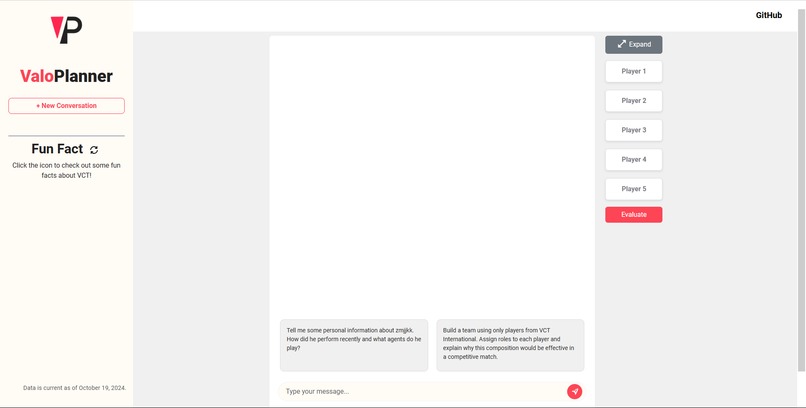
Home page
-
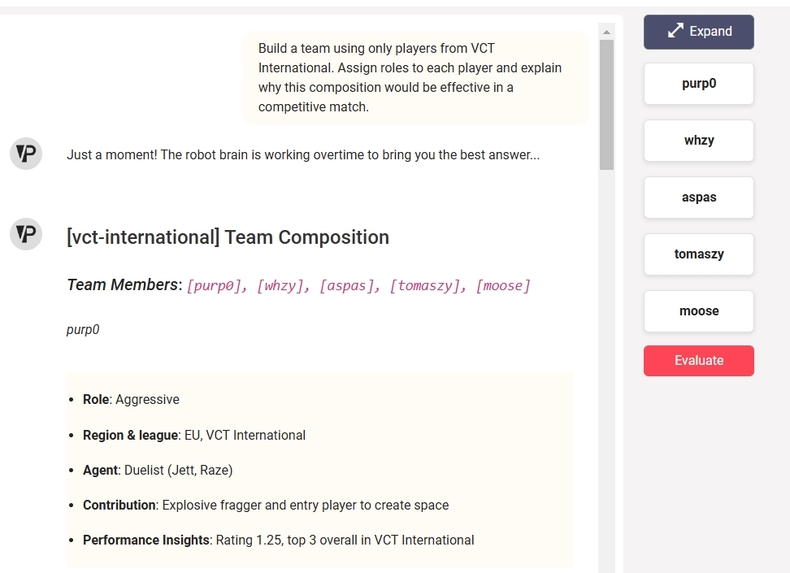
Response
-
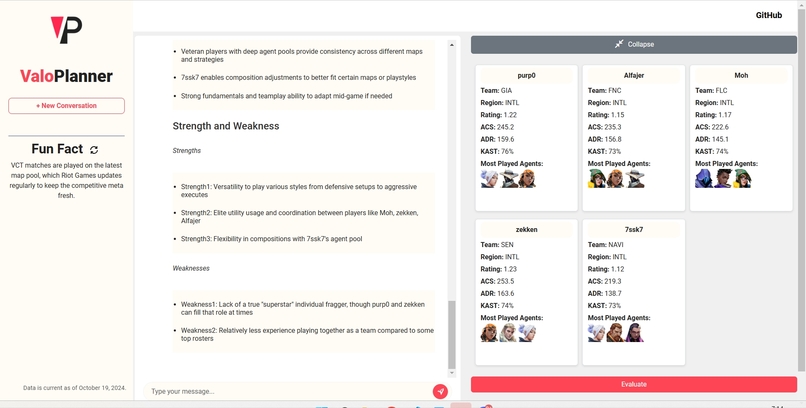
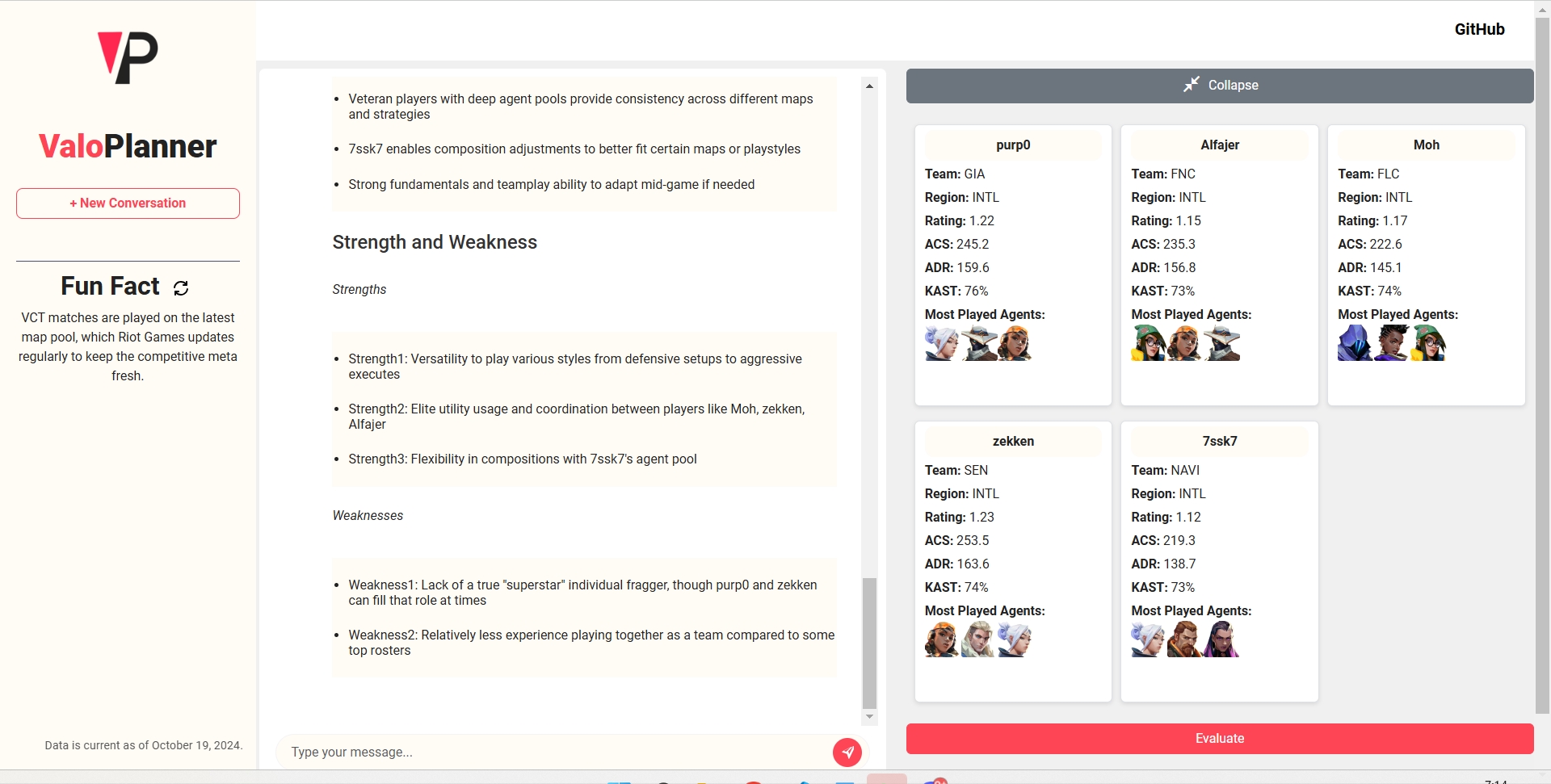
Eval and Team Planner


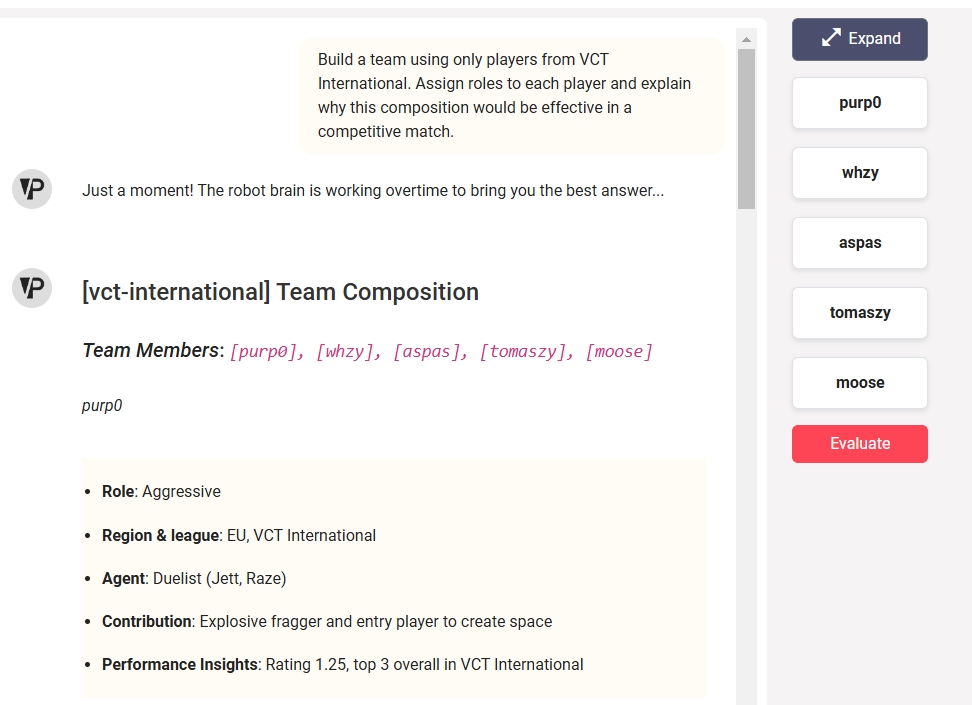
Update Patch - VCT Hackathon Finalist 24/11/05
If you cannot access the model due to network or AWS quota limitation, please checkout the Finalist Prompt Responses Folder!
(For detailed changes and reasoning, please check out Section 9 in our Report as stated in the README or the project description.)
Front-end Changes:
Agent Icons:
- Added visual agent icons to each player card.
New Conversation/Refresh History Button:
- Introduced a "Refresh History" button to clear previous conversations, giving users a new session in Bedrock Agent Invoke.
Color Theme and Logo:
- Updated the site's color scheme and logo to align with the new design.
Back-end Changes:
Session Management:
- Enhanced Flask session management to persist chat history across cookie-based user sessions. This allows users to ask follow-up questions after formulating a team.
Recent Performance of Player Data:
- Integrated recent Valorant competition data from vlr.gg and implement it in our Lambda and knowledge base.
- Select 2024 VCT for international, game changer, and challengers tournaments respectively as recent data to evaluate performance
Map Analysis: Map-Agent Data available for specific downstream tasks:
- Added the capability to analyze and provide insights on agents based on their performance on specific maps, utilizing data from high-level matches.
- Invited Valorant high-rank players friends to write originated articles of game-understanding for knowledge base.
IGL (In-game Leader) Logic Update:
- Refined logic for making in-game leader choices based on recent competitive match data.
Rollback and Self-Revision:
- Change model inference logic to pick ”all 5 players all at once” approach instead of ”choosing three first and two remaining in the next trace” approach.
- Implemented rollback and self-revision (double-check) logic for the recommendation engine.
Inspiration
The inspiration for ValoPlanner came from the need for a comprehensive tool that supports both professional and semi-professional Valorant players in optimizing their team compositions. With the growing competitive landscape of Valorant esports, players require advanced analytical tools that not only assess individual performance but also enhance team synergy and strategy.
What it does
Our project, ValoPlanner, is developing an AI agent specifically designed for professional and semi-professional VALORANT games. Our AI offers a Team Planner tool to help users build and evaluate teams based on performance, synergy, and strategy, making it easier to optimize their rosters. Additionally, for a bit of fun and engagement, we’ve included a Fun Fact feature that shares interesting tidbits related to VALORANT, keeping users informed and entertained.
How we built it
We developed ValoPlanner using a multi-step approach, leveraging AWS cloud infrastructure for scalability and efficiency. Key components of our system include:
- Data Collection and Processing: We collected extensive data from official Riot sources and VLR.gg, utilizing AWS S3 for storage. Our team implemented rigorous data analysis to create performance lookup tables and integrate diverse datasets for comprehensive player insights.
- AI Model Integration: The chat-bot utilizes advanced AI techniques, including embedding news articles and player performance data to enhance decision-making and recommendations. AWS Lambda helped us with this by enabling customized query functions to assist our Claude 3 Sonnet agent. By utilizing Lambda, Bedrock and detailed prompt engineering, we manage to get a professional team analyst for VCT, our ValoPlanner.
- User Interface: The front-end is built from scratch using HTML/JS/CSS and bootstrap.The UI interface allows for intuitive interaction with the AI, supporting functions such as team composition analysis and engaging trivia.
- Detailed Information: For more information, please check out our report: link
Challenges we ran into
During development, we faced several challenges, including:
- Data Size and Complexity: Managing over 60GB of data required efficient storage solutions and effective data processing techniques.
- Data Integration: Reconciling inconsistencies between different data sources was challenging. We had to implement matching techniques to ensure accurate player information.
- User Experience: Designing an intuitive and responsive user interface that meets the needs of a diverse user base required extensive iteration and testing.
- Model is stupid at first: We need a really detailed and fine-tuned prompting for our agent otherwise the agent responses are of no sense. We need to teach him about team composition, agent roles, and many other stuff.
- AWS Account Suspended: We have our account suspended for three days and get our service quota decrease to zero for 3 days, which wastes us 1 week of no progress on modeling.
Accomplishments that we're proud of
- The seamless integration of multiple data sources, resulting in a robust dataset for performance analysis.
- The implementation of the Team Planner tool, which provides actionable insights for team optimization.
- Positive feedback from our end-user questionnaire experiment, which indicated that our AI effectively meets the needs of Valorant lovers.
- Well tuned prompting for our model, which is presented at the end of our report.
What we learned
- Usage of AWS Bedrock, as well as how to integrate knowledge base and lambda functions.
- Code deployment automation with help of CodeDeploy and CodePipeline from AWS
- Limit and advantage of LLM, including how to make them better fit our task by prompting
- The design of bedrock agents include a multi-trace calling of a model instead of one single call.
What's next for ValoPlanner
Looking ahead, we plan to enhance ValoPlanner by:
- Implementing a data compensation strategy for unmatched players, ensuring that all players are represented in our system.
- Developing methods to analyze historical performance data for inactive players, allowing for a more comprehensive evaluation of player dynamics.
- Continuously iterating on our AI model and user interface to incorporate new features and improve user engagement.
Built With
- amazon-web-services
- aws-bedrock
- aws-codedeploy
- aws-codepipeline
- aws-ec2
- aws-lambda
- beautiful-soup
- bootstrap
- boto3
- css
- flask
- html5
- javascript
- pytoch


Log in or sign up for Devpost to join the conversation.