-
Slide Page 1
-
Slide Page 2
-
Slide Page 3
-
The Business Plan

Inspiration
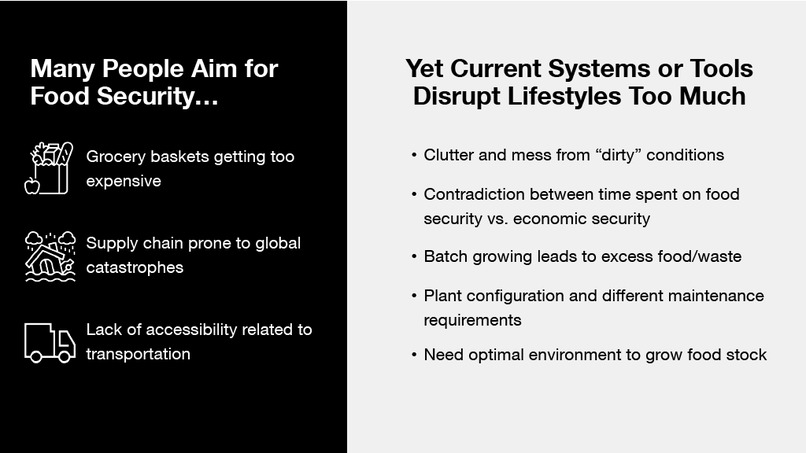
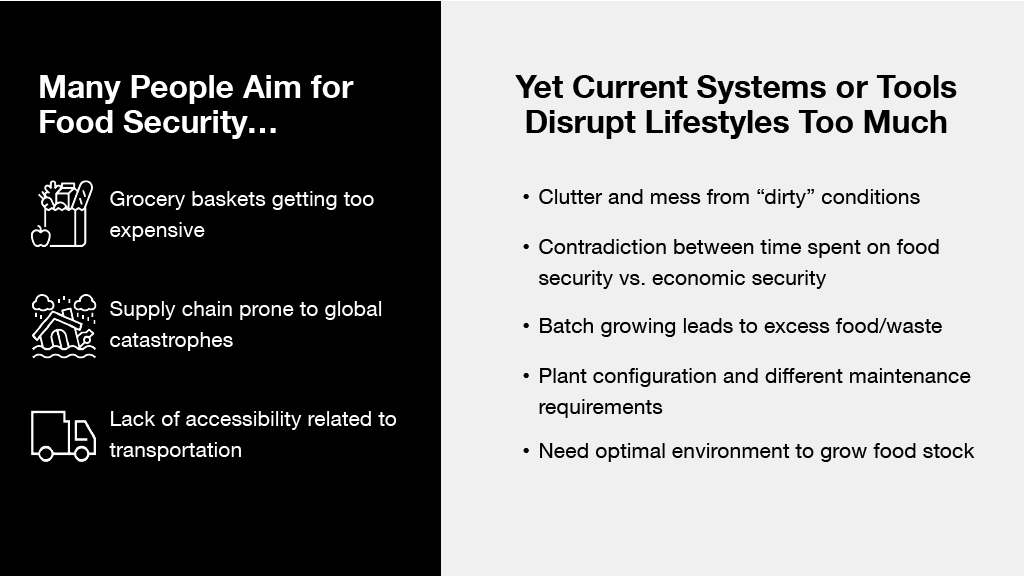
Food security is increasingly threatened by rising grocery prices, vulnerable supply chains, and accessibility issues. Current systems often disrupt lifestyles due to clutter and excess waste, highlighting the need for a more efficient solution.
The Problem We Are Solving
EdenHouse addresses the pressing issue of food security in an increasingly complex world. The challenges we face include:
- Rising Grocery Prices: As food costs escalate, many families struggle to afford nutritious options.
- Vulnerable Supply Chains: Global catastrophes can disrupt food availability, leading to shortages and increased prices.
- Accessibility Issues: Transportation barriers prevent many communities from accessing fresh produce.
- Disruption from Current Systems: Traditional food production methods often lead to clutter and waste, with batch growing resulting in excess food that goes unused. Additionally, these systems require optimal environments that are not always achievable.
Connection to Distributed AI and Power Generation
The challenges faced in food production are strikingly similar to those encountered in distributed AI and power generation:
Distributed AI: Just as AI models require efficient distribution across nodes to process data effectively, food production must also be decentralized to meet local demand. Both systems benefit from localized solutions that reduce latency and improve responsiveness.
Distributed Power Generation: Similar to how power generation is moving towards decentralized sources (like solar panels), food production can also thrive through localized systems. This decentralization allows communities to generate their own food supply, reducing reliance on centralized farms and long supply chains.
Common Challenges
Scalability: Both food production and AI systems need to scale efficiently to meet increasing demands. Just as Kubernetes can spin up more containers for applications, EdenHouse can generate additional hydroponic units as food demand rises.
Fault Tolerance: In distributed systems, resilience is crucial. Food production must also be fault-tolerant; if one community experiences a setback, others can continue to supply fresh produce, ensuring overall stability.
Regulatory Compliance: Localization is important for both AI and food production due to legal constraints. Data must often remain within specific geographical boundaries, just as certain foods must be grown locally to comply with regulations.
By addressing these interconnected challenges through innovative solutions like EdenHouse, we aim to create a sustainable ecosystem that enhances food security while leveraging the principles of distributed systems found in AI and power generation.
What It Does
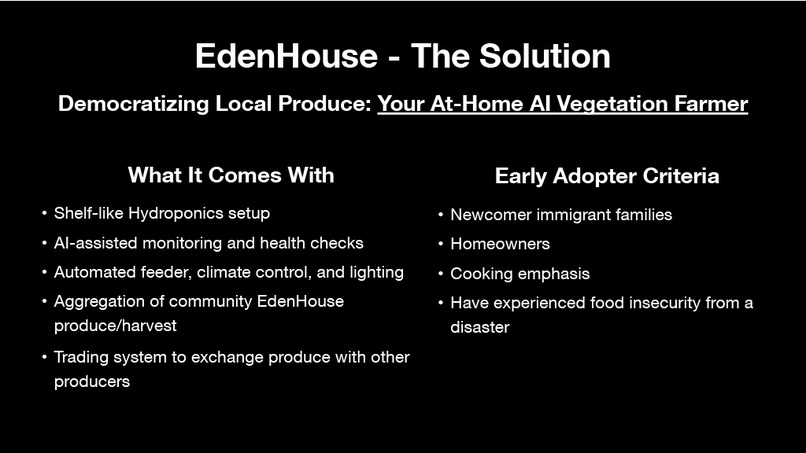
EdenHouse is the ultimate hydroponics orchestrator, combining the power of hydroponics and distributed economics with cloud-native technology to revolutionize food production. Much like Kubernetes orchestrates containerized applications, EdenHouse serves as the Kubernetes for farming.
Key Features:
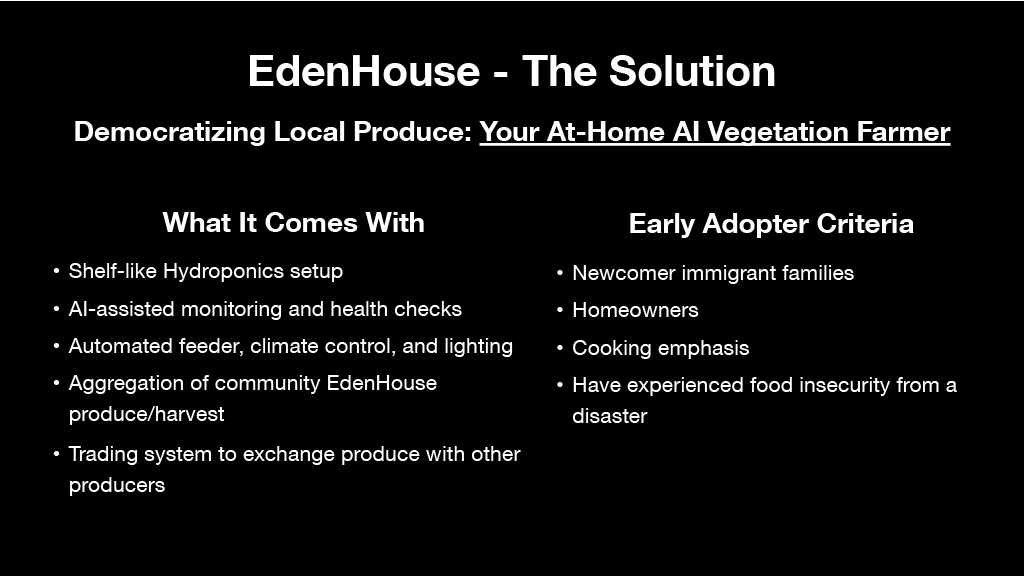
- Shelf-like Hydroponics Setup: The hydroponic system acts like Docker containers, providing a modular and efficient way to grow plants in various environments.
- AI-Assisted Monitoring: Just as Kubernetes manages resources across containers, EdenHouse utilizes AI to monitor plant health, automate feeding, climate control, and lighting.
- Community System: EdenHouse facilitates a trading and selling system where users can exchange and sell homegrown produce, fostering community engagement and sustainability.
- Unlimited Scalability: Just like how Kubernetes can spin up more containers when demand increases, EdenHouse can generate more hydroponic units to meet the growing food demand.
Cloud-Native Agriculture
EdenHouse brings cloud-native principles to the agricultural world. The name "EdenHouse" reflects this vision:
- Eden represents a paradise where everyone has access to fresh food, akin to the abundance experienced by Adam and Eve.
- House signifies the integration of agriculture into urban living spaces, freeing residents from the limitations of traditional land-based farming. It allows for food production in places where it is hard to produce food.
By democratizing local produce and optimizing food production in urban areas, EdenHouse aims to create a sustainable food ecosystem that can thrive regardless of location.
In essence, EdenHouse transforms how we approach agriculture by leveraging technology to ensure that everyone can enjoy the benefits of fresh, homegrown food while contributing to a more resilient food system.
How we built it
We developed EdenHouse using advanced hydroponic technology combined with AI algorithms for real-time monitoring and health checks. The system integrates automated features to simplify the growing process for users.
Coming from an SRE background, I was inspired by the concepts of Kubernetes and container orchestration, cloud-native AI, and distributed computing. We all know AI is very compute-hungry, much like humans being food hungry, and a centralized infrastructure often collapses under the high demand for AI models. This led to innovations like Nvidia's NIMS, which runs AI models in containers orchestrated by Kubernetes.
| Feature | Hydroponics | Docker Containers |
|---|---|---|
| Portability | Can be set up in various environments (homes, urban areas) without traditional farming constraints. | Can run on any machine with the necessary resources, making applications portable. |
| Resource Efficiency | Uses less water and space compared to traditional farming methods, optimizing resource use. | Maximizes computational resource allocation by running multiple applications on the same machine. |
| Isolation | Each hydroponic unit maintains controlled conditions, isolating plants from external factors. | Each container operates independently, ensuring applications do not interfere with one another. |
| Scalability | Additional hydroponic units can be added to increase production without significant disruption. | Applications can be easily scaled by adding more containers to handle increased demand. |
| Automated Management | Utilizes AI for monitoring and automating feeding, climate control, and lighting. | Container orchestration tools automate deployment, scaling, and management of containers. |
| Dependency Management | Hydroponic systems can be tailored to meet the specific growth requirements of different plants. | Applications have dependencies that dictate their performance and functionality within containers. |
Overall EdenHouse is akin to Nvidia NIMS but for hydroponic farming. It allowes decentralized and localized production of food. While remaining maintaining scailability and communication between the farmers.
What It Does
EdenHouse is the ultimate hydroponics orchestrator, designed to revolutionize food production by combining the power of hydroponics, distributed economics, and cloud-native technology. Much like Kubernetes orchestrates containerized applications, EdenHouse serves as the Kubernetes for farming.
Key Features:
- Shelf-like Hydroponics Setup: Provides a modular and efficient way to grow plants in various environments, similar to Docker containers.
- AI-Assisted Monitoring: Utilizes AI to monitor plant health and automate feeding, climate control, and lighting, ensuring optimal growth conditions.
- Community Trading System: Facilitates a trading system where users can exchange homegrown produce, fostering community engagement and sustainability.
- Unlimited Scalability: Just like Kubernetes can spin up more containers when demand increases, EdenHouse can generate more hydroponic units to meet growing food demand.
- Distributed Orchestration: Inspired by Kubernetes and distributed systems, communities act as nodes that contribute to food production across municipalities. This decentralized approach reduces food mileage and enhances local food systems.
- Localized Production: Allows food to be produced closer to consumers, complying with local regulations and preferences while minimizing transportation costs.
- Fault Tolerance and High Availability: Ensures that the system remains operational even if individual nodes experience issues, creating a resilient food production network.
By democratizing local produce and optimizing food production in urban areas, EdenHouse aims to create a sustainable food ecosystem that thrives regardless of location. It transforms how we approach agriculture by leveraging technology to ensure everyone can enjoy the benefits of fresh, homegrown food while contributing to a more resilient food system.
Challenges we ran into
We faced challenges related to ensuring user-friendly design, minimizing maintenance requirements, AI integration, understanding the problem, providing a relatable solution, connecting the cloud native terminologies with down to ground agriculture and creating an effective community trading platform that encourages participation among users.
Accomplishments that we're proud of
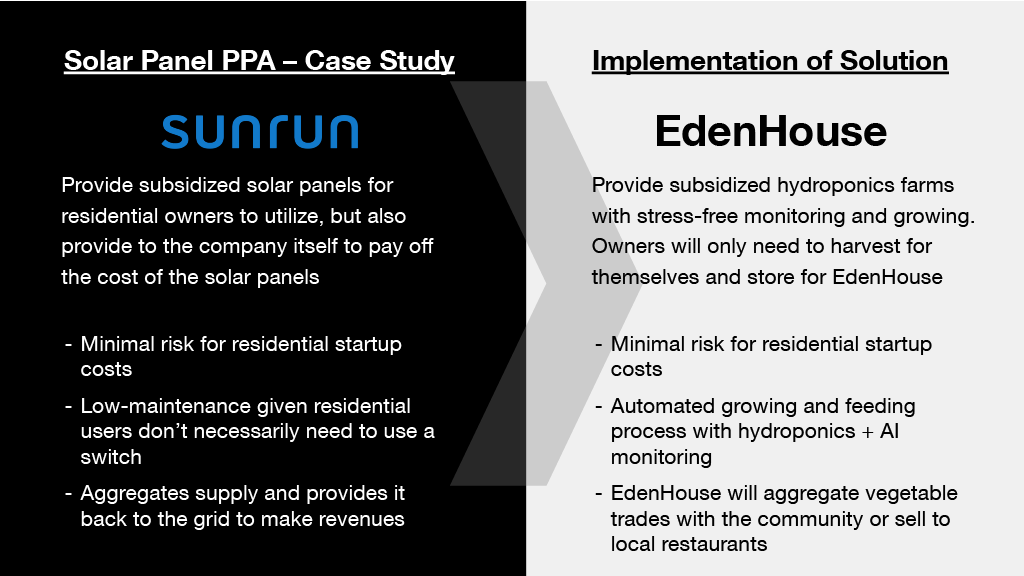
We successfully created a low-maintenance hydroponics system that allows users to grow their own food with minimal risk. Additionally, we established a framework for community engagement through produce trading.
What we learned
We learned the importance of designing intuitive systems that cater to diverse user needs, especially for newcomers and those who have experienced food insecurity. Collaboration and feedback from potential users were crucial in refining our approach.
What's next for EdenHouse: The AI Powered K8s For Food
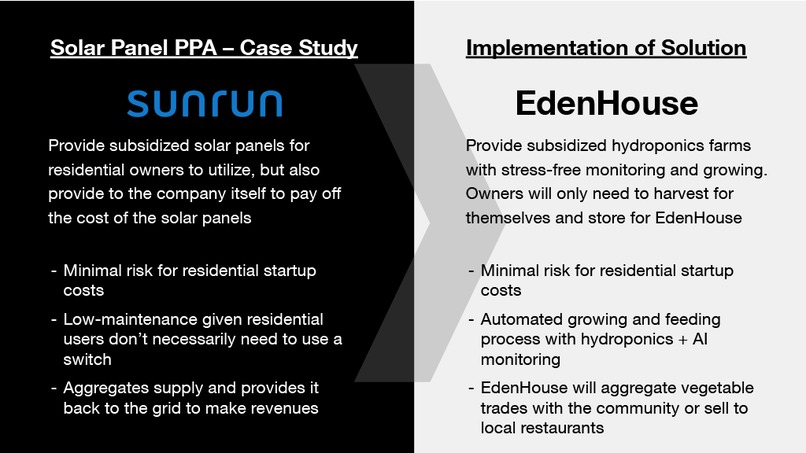
Moving forward, we plan to expand our outreach to target newcomer immigrant families and homeowners. We aim to enhance our AI capabilities, develop partnerships with local restaurants for produce sales, and explore subsidized solar panel options to further reduce costs for users.
Here’s the corrected Markdown format for your content:
Check Out Our Website.
Built With
- kubernetes
- langchain
- minecraft-spigot
- nvidia
- pytorch

Log in or sign up for Devpost to join the conversation.