Inspiration
It’s estimated that up to 90% of CCTV footage is never reviewed, despite billions spent on surveillance networks. Even when video is available, studies show it is only useful in about 29% of investigations — meaning most security footage contributes nothing to real-time safety or prevention.
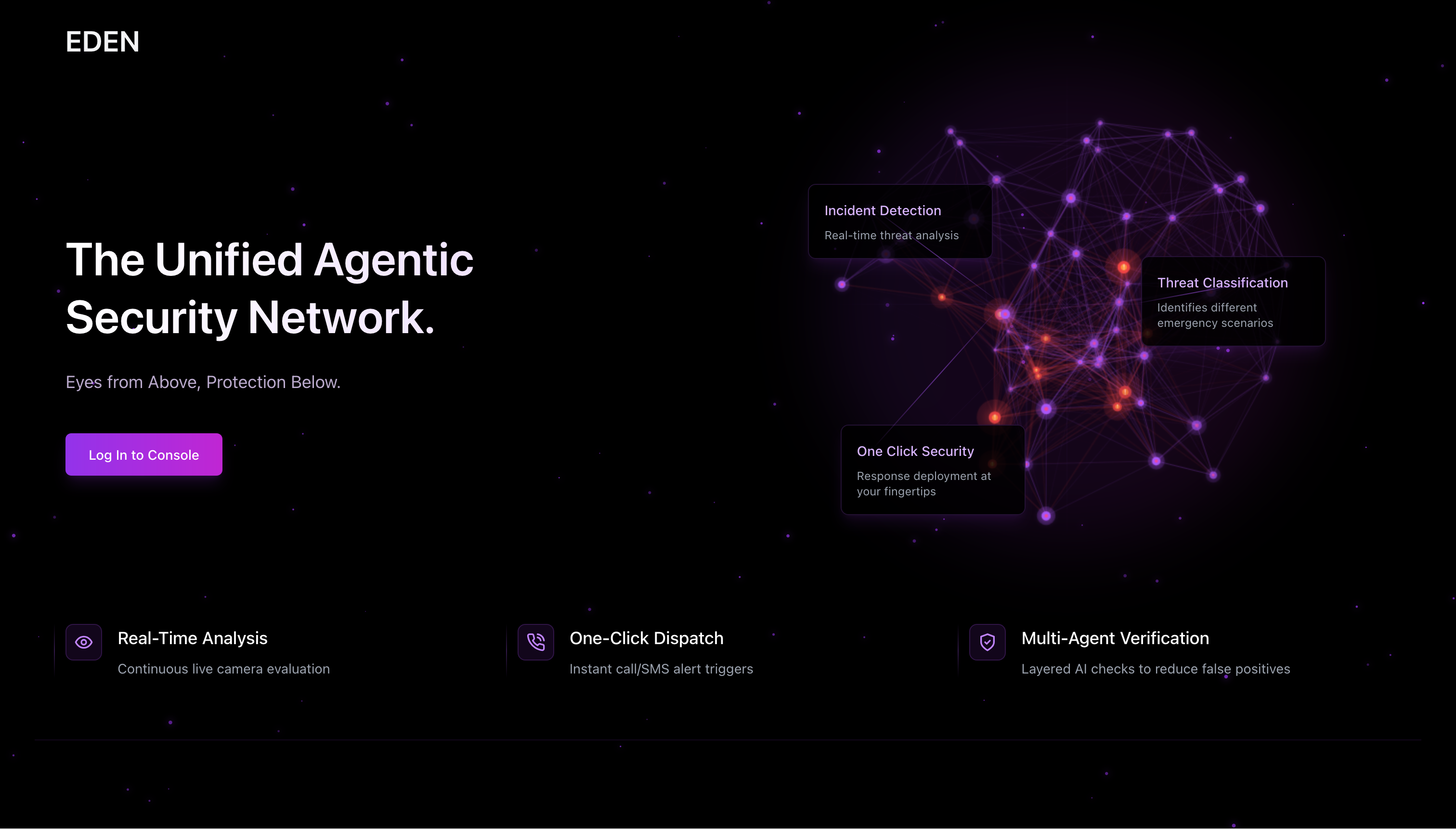
We wanted to change that. EDEN (Enhanced Detection Emergency Network) transforms passive camera systems into intelligent, proactive safety networks that detect, analyze, and respond to incidents — before they go unnoticed.
What it does
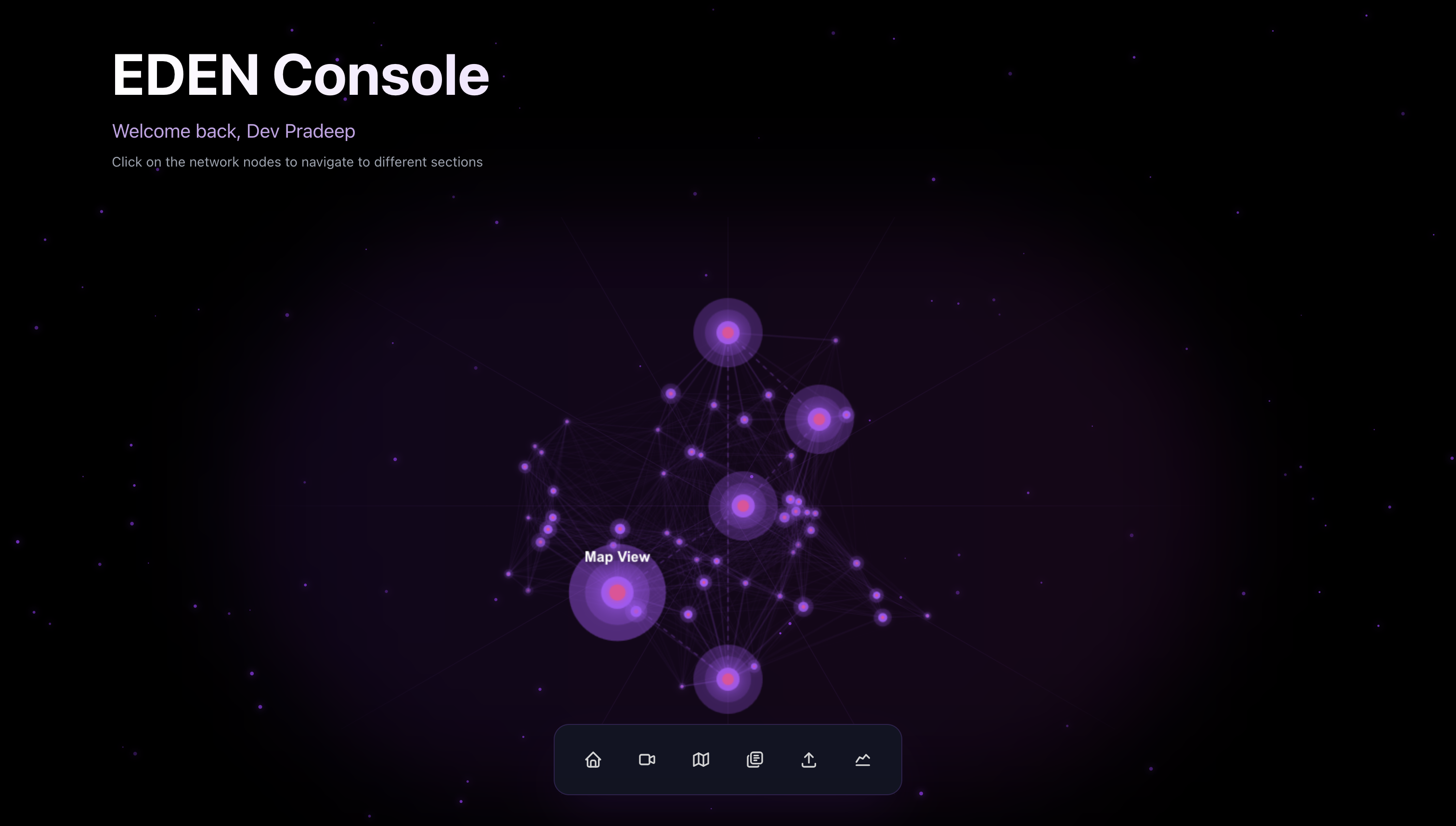
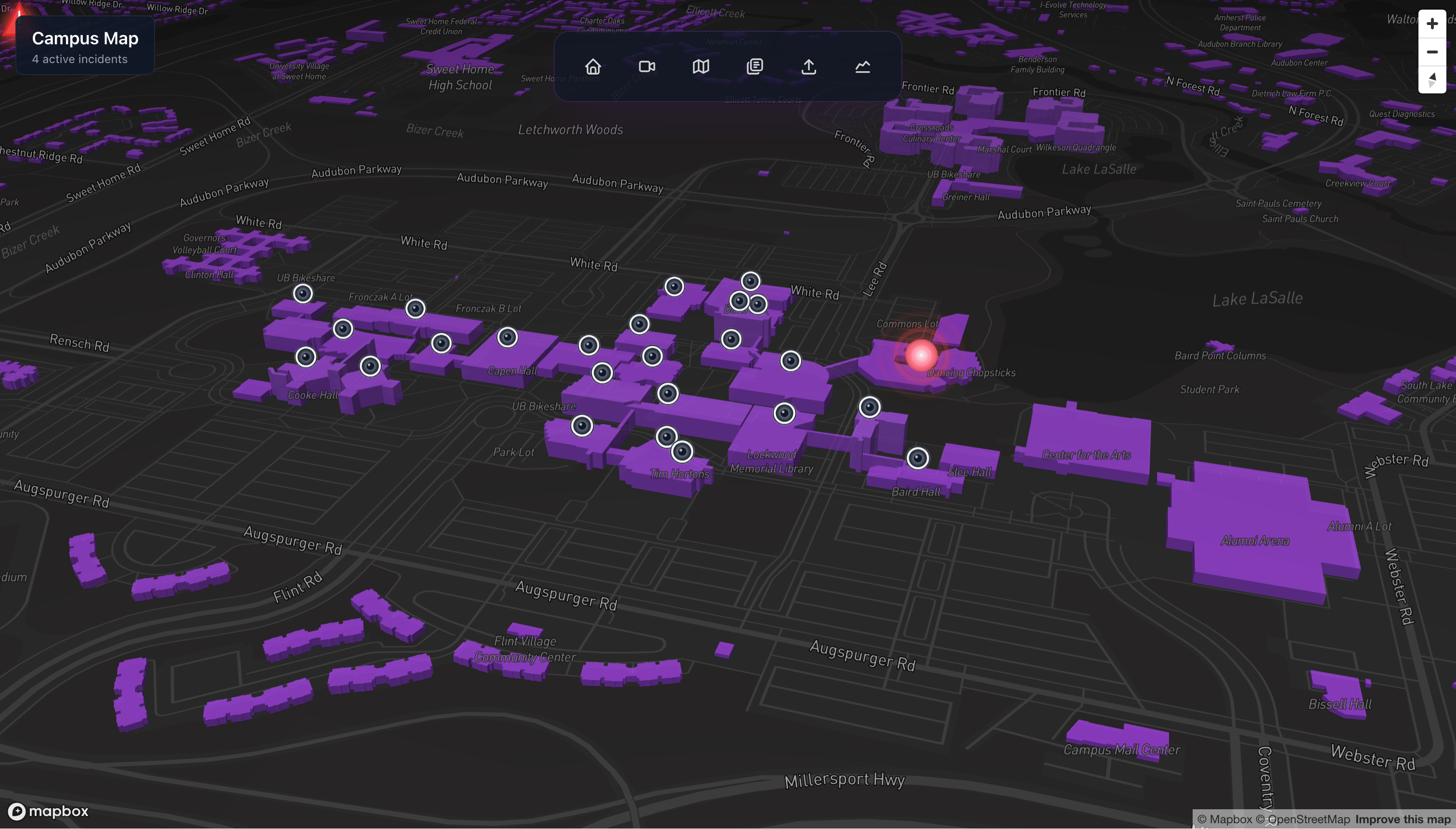
EDEN is a multi-agent AI security system that monitors CCTV footage and visualizes real-time incidents on a 3D campus map.
When an incident is detected, the corresponding camera pin flashes red, and the operator can:
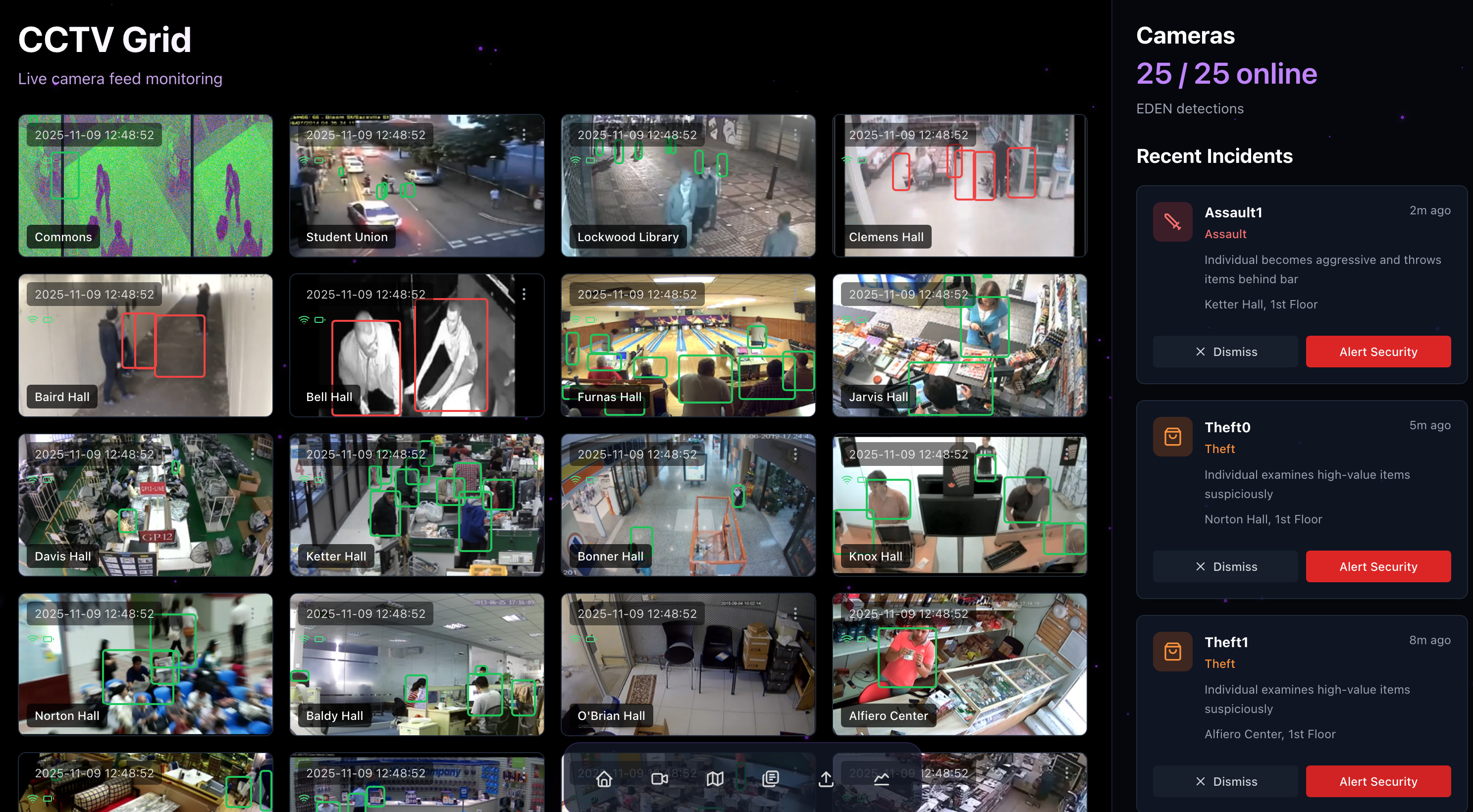
- View live footage directly from that camera.
- Report or dismiss the event with one click.
- Automatically save and analyze footage of the incident.
If reported, EDEN’s voice agent immediately calls the appropriate authority (e.g., campus police) with a synthesized alert like: “A fight was detected inside Commons at the University at Buffalo.”
Each incident is then processed by EDEN’s analysis engine, which generates a timestamped breakdown, summary, and video highlight reel for review.
How we built it
Frontend & UI
- Next.js 14 (React framework) with React 18 + TypeScript 5.2
- Tailwind CSS, PostCSS, Autoprefixer, clsx, and tailwind-merge for styling
- Lucide React & Tabler Icons for dynamic iconography
Mapping & Visualization
- Mapbox GL JS (3D tilted map) displaying camera pins and flashing incident markers
- GeoJSON for spatial data (camera and incident locations)
Backend & APIs
- Next.js API Routes (REST endpoints)
- Twilio for voice alerts
- Google OAuth 2.0 for authentication
AI & Computer Vision
- YOLOv8 (Ultralytics) with PyTorch and Torchvision
- OpenCV and NumPy for frame processing
- LAP for multi-object tracking logic
Data & Storage
- JSON (incident metadata), GeoJSON (spatial data), and MP4 (video files)
Challenges we ran into
One of the hardest parts of building EDEN was getting the three AI agents to collaborate seamlessly in real time — each handling a different stage of the incident pipeline.
- The Detection Agent continuously scans live CCTV feeds using YOLOv8 to identify and track people across frames.
- The Classification Agent takes those detections and determines what type of incident is occurring — such as fighting, loitering, or suspicious movement.
- The Analysis Agent then reviews the full event window, generating timestamps, confidence scores, and a readable summary for the dashboard.
The main challenge was ensuring that each agent’s output fed accurately into the next, without introducing major latency or false positives. Early versions struggled to keep detections synchronized across multiple feeds, leading to overlapping or missing incident reports.
Accomplishments that we're proud of
- Built a live, interactive 3D campus map UI where each CCTV camera is represented as an icon that flashes red on detection.
- Created a live video dashboard (using looping MP4s) with bounding boxes simulating real detections.
- Developed an automated incident analyzer that generates timestamped descriptions and summaries of each clip.
What we learned
- Building multi-agent AI systems requires well-defined data interfaces and timing budgets — even small sync issues compound fast.
- In real-time systems, perceived intelligence matters just as much as actual intelligence — fluid UI transitions and realistic alerts make users trust the system.
What's next for EDEN - The Unified Agentic Security Network.
- Add weapon/fire/intrusion detection with continual model training.
- Implement heatmaps and incident trend dashboards for campus analytics.
- Introduce privacy modes with face-blurring and retention policies.
Built With
- google-gmail-oauth
- mapbox
- next.js
- numpy
- opencv
- python
- pytorch
- react
- tailwind
- twilio
- typescript
- yolo


Log in or sign up for Devpost to join the conversation.