-
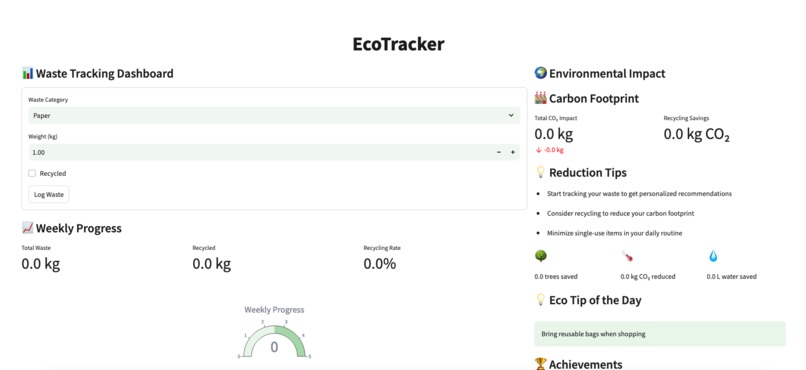
Displayed: Waste tracking dashboard, carbon footprint calculator, reduction tips, weekly progress, eco tip of the day
-
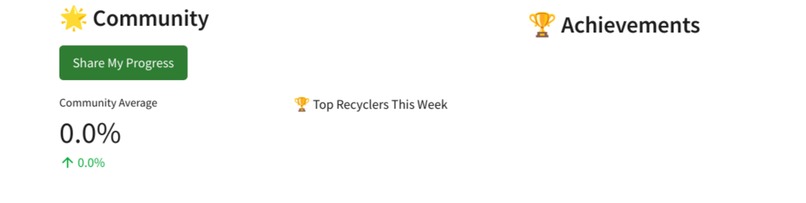
Displayed: Community, achievements

Inspiration
Building EcoTracker stems from my passion of sustainability and a desire to empower individuals to make a positive impact on our planet. In a world where environmental issues are increasingly pressing, EcoTracker serves as a vital tool for raising awareness about waste reduction and how communities can work together to make society more environmentally friendly!
What it does
EcoTracker consists of many different pieces, all contributing to this amazing environmental resource:
-Waste Tracking Dashboard: Click on a "Waste Category" (This could be paper, electronics, plastics, etc), and put in the weight of the waste in kilograms in the "Weight (kg)" box. If the waste is being recycled, mark the "Recycled" check-box and click "Log Waste" to track your data.
-Environmental Impact: The carbon footprint calculator calculates your total CO~2 impact in kilograms and recycling savings also in kilograms. A bar chart is also shown with the category and CO~2 impact.
-Weekly Progress: Goes over total waste in kilograms, amount recycled in kilograms, and your recycling rate as a percentage. Also shown is a plot for weekly progress.
-Waste Composition: Shows a pie chart based on the category you chose and weight.
-Reduction Tip and Eco Tip of the Day: "Reduction Tip" gives you tips for how to reduce your waste, "Eco Tip of the Day" gives you a random tip each day. For example, one day the tip could be "Use cloth napkins instead of paper."
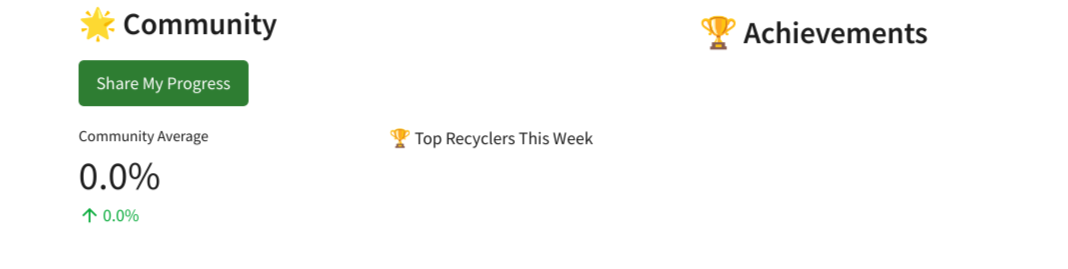
-Community: Helps communities track their waste. Consists of community average calculated as a percentage and "Top Recyclers This Week," where a community member's name will be displayed based on how much they have recycled. You can share your progress by clicking the "Share My Progress" button.
-Achievements: Your achievements will be listed underneath the "Achievements" area.
How I built EcoTracker
Used python and CSS to develop the program. Also used Streamlit to operate program through Replit.
Challenges I ran into
Due to my limited experience with Replit, I found it challenging to run and share the program within the application. To overcome this obstacle, I opted to use GitHub to store my files and code instead.
What I learned
Building this project helped me gain a further understanding of Python and how CSS can be implemented in Python programs.
What's next for EcoTracker
With improvements to the website, along with added features that are even more complex than ones already existing, EcoTracker has so much potential for exciting developments and enhanced user experiences. These new additions can lead to expanding EcoTracker's functionality, increasing community engagement, and eventually achieving the goal of working together to make our planet an environmentally friendly place for all!


Log in or sign up for Devpost to join the conversation.