EcoTrack AI About the Project EcoTrack AI is a multi-agent environmental incident and cleanup coordination platform built primarily using Jac and the Jaseci ecosystem.
The main problem we wanted to solve is that environmental issues such as illegal dumping, water pollution, blocked drains, local flooding, and overflowing waste can be reported multiple times by different citizens. These reports may actually describe the same real-world problem, but they can be handled separately, causing duplicate work, poor coordination, and inefficient use of volunteers and environmental organizations.
EcoTrack AI solves this by separating a Report from a confirmed Incident.
Citizens submit environmental reports with information such as category, description, and location. These original reports are always preserved. The Incident Intelligence Agent analyzes reports using deterministic spatial, temporal, and category-based filtering together with Jac-native LLM reasoning to identify reports that may describe the same real-world incident.
Instead of automatically creating an Incident, the AI creates an Incident Cluster Proposal. The Central Authority then reviews the proposal and decides whether to confirm or reject it. This gives the system a human-in-the-loop workflow where AI assists decision-making without taking full control.
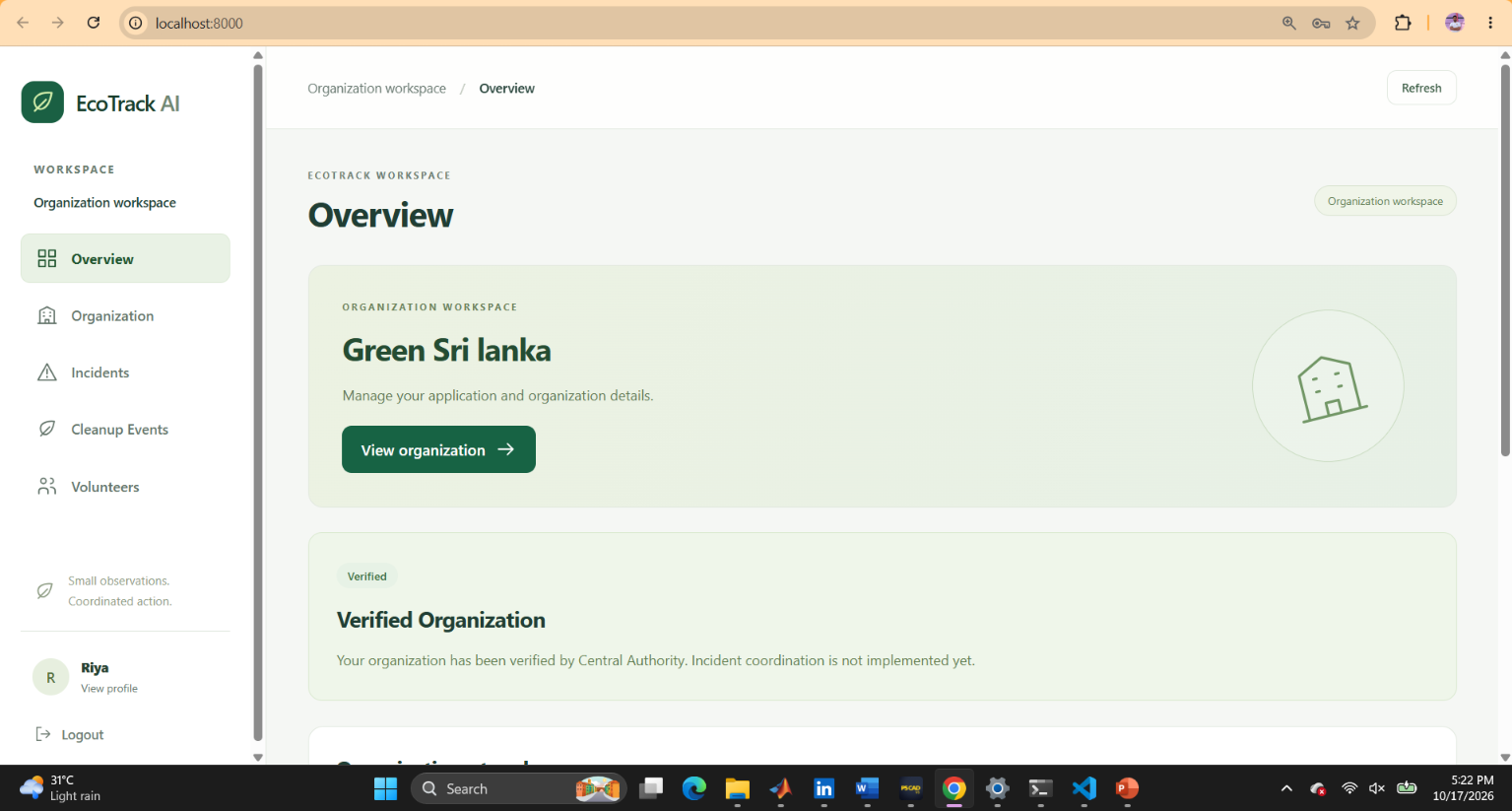
Once an Incident is confirmed, EcoTrack coordinates verified environmental organizations. The system ensures that an Incident can have only one active Lead Organization, while multiple Supporting Organizations can assist. This reduces duplicate organizational response and clearly defines responsibility.
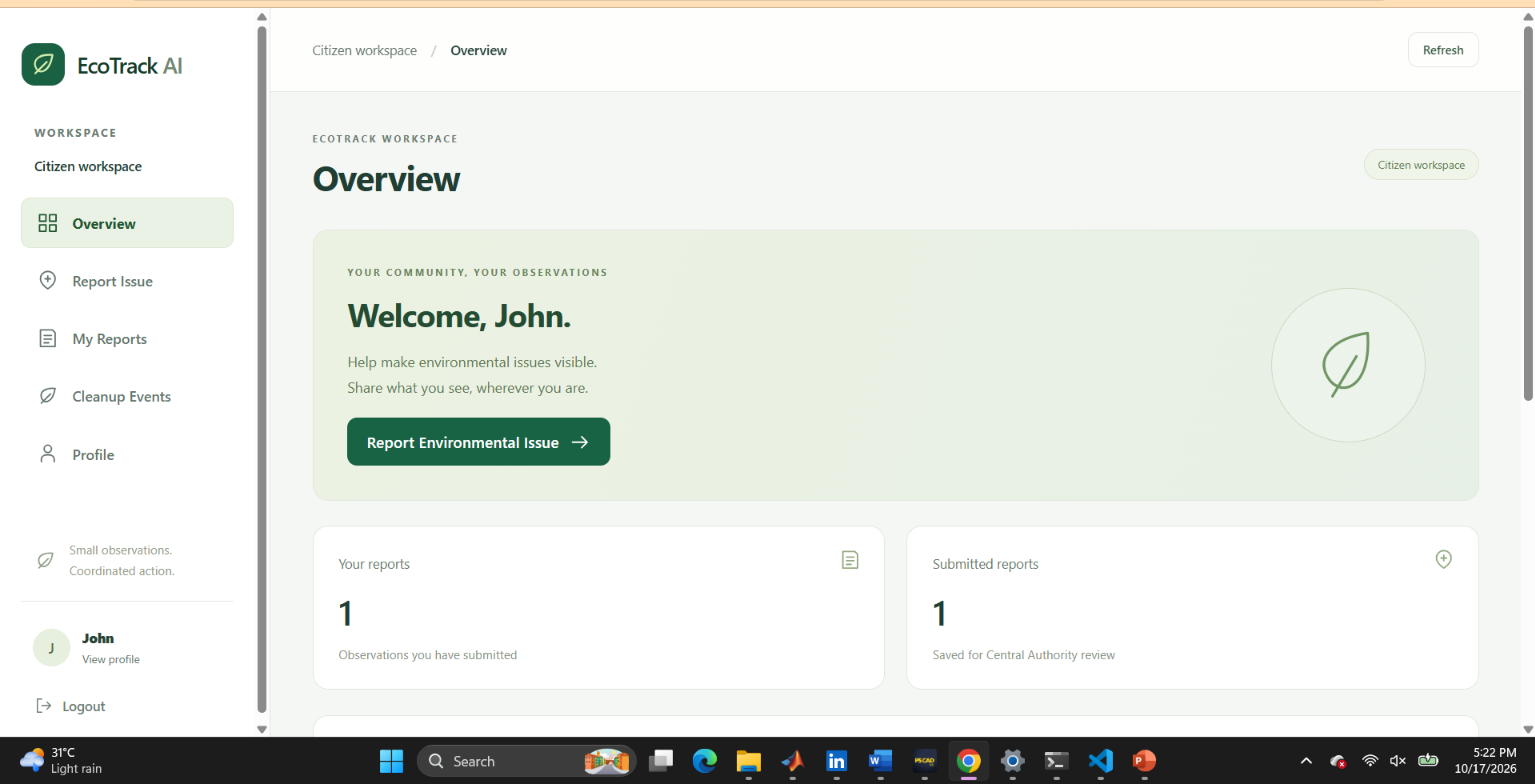
The Lead Organization can then create an official Cleanup Event. Citizens can view these events and join or withdraw as volunteers.
EcoTrack keeps track of the real cleanup state, for example:
Required volunteers: 8 Joined volunteers: 3 Remaining volunteers: 5
The Cleanup & Volunteer Agent observes this live state and uses Jac-native byLLM reasoning to produce a structured risk assessment and recommendation. If the situation changes, such as when a volunteer withdraws, the agent rereads the latest persisted state and replans using the new values instead of relying on a previous result.
The Coordinator Agent connects the specialist workflows together. It observes system events and decides which specialist workflow should handle the current situation.
Incident confirmed ↓ Coordinator Agent ↓ Response Coordination
Volunteer state changed ↓ Coordinator Agent ↓ Cleanup & Volunteer Agent
This gives EcoTrack a clear multi-agent architecture with specialist responsibilities and controlled handoffs.
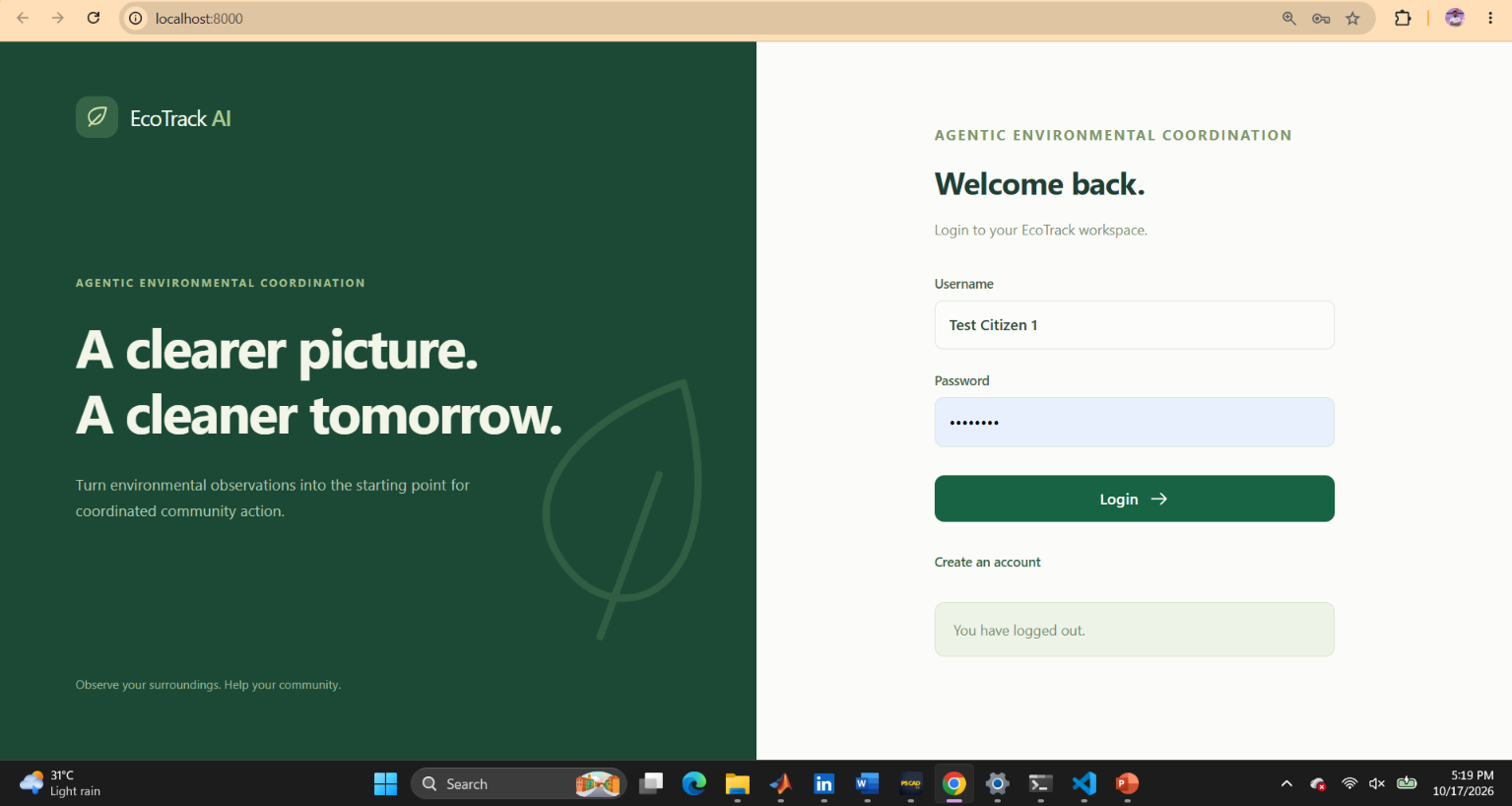
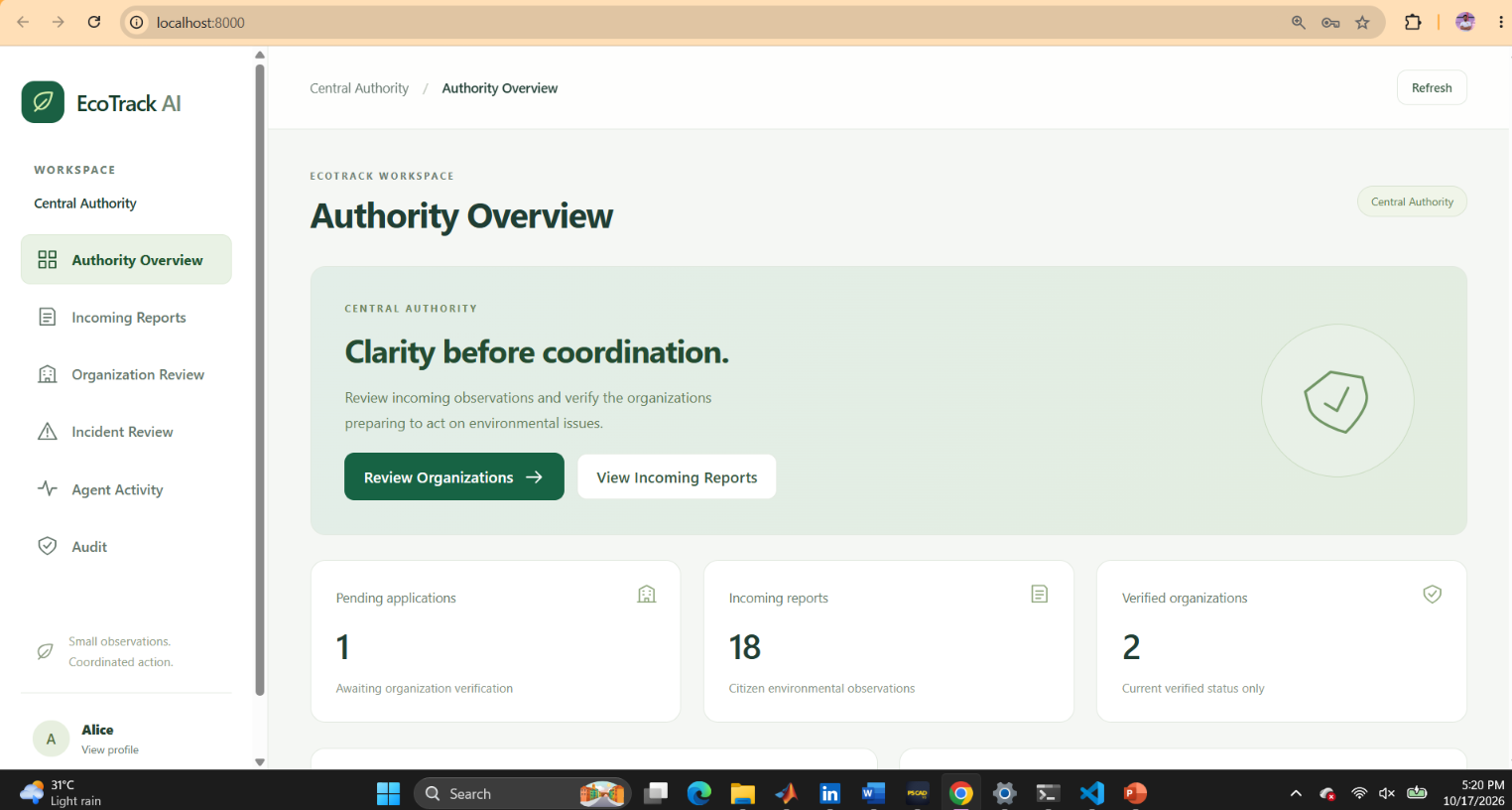
User Roles Citizen / Volunteer Submit environmental reports Provide location information View previous reports Browse cleanup events Join and withdraw from cleanup events Environmental Organization View confirmed incidents Participate in official incident response Act as Lead or Supporting Organizations Create cleanup events when assigned as the active Lead Monitor volunteer participation Run cleanup planning AI Central Authority Review organization applications Verify, reject, or suspend organizations Inspect incoming citizen reports Review AI-generated incident cluster proposals Confirm or reject Incidents Coordinate Lead and Supporting Organizations Run the Coordinator Agent Inspect cleanup events Review Agent Activity and decisions How We Used Jac and Jaseci Jac and Jaseci form the core technical foundation of EcoTrack AI.
We used Jac for:
domain models persistence authentication capability-based RBAC application logic API endpoints frontend integration incident workflows organization response workflows cleanup events volunteer participation AI agent workflows multi-agent coordination automated testing We did not build a separate traditional backend using frameworks such as FastAPI or Express.
For AI reasoning, we used Jac-native byLLM.
Our main pattern is:
Observe ↓ Collect trusted state in Jac ↓ LLM reasoning ↓ Validate structured output in Jac ↓ Persist safe result
The LLM never directly controls sensitive operations. Jac remains responsible for validation, authorization, and trusted state changes.
Multi-Agent Architecture Incident Intelligence Agent Analyzes citizen reports Identifies likely duplicate reports Proposes incident clusters Generates structured AI reasoning Response Coordination Checks verified organizations Coordinates Lead and Support roles Enforces the one-Lead rule Prevents duplicate organizational response Cleanup & Volunteer Agent Observes volunteer capacity Detects shortages Assesses cleanup risk Recommends recovery actions Replans after volunteer state changes Coordinator Agent Observes system events Decides which specialist should run Validates the selected action Delegates to one allowed specialist workflow Records the handoff and result Human-in-the-Loop Design A major design principle in EcoTrack is that AI recommends while trusted Jac rules and authorized users control important decisions.
Multiple Reports ↓ Incident Intelligence Agent ↓ Cluster Proposal ↓ Central Authority Review ↓ Confirmed Incident
The AI cannot silently create an official Incident. This improves transparency, accountability, and safety.
Testing The project currently passes 87 automated tests.
These tests cover:
authentication role-based access control organization verification citizen report creation report persistence duplicate-report intelligence incident confirmation preservation of original reports Lead and Support organization rules cleanup event creation volunteer joining and withdrawal volunteer-count calculations AI output validation replanning after state changes Coordinator Agent routing failure handling protected-state preservation We also used:
jac check --nowarn JAC_TEST_JOBS=0 jac test jac build --as client jac run
Automated AI tests use mocked LLM outputs so that tests do not depend on live API availability.
Challenges We Faced Distinguishing Reports from Incidents Several citizens may report the same environmental problem. We solved this by preserving every Report and creating separate Incident Cluster Proposals and confirmed Incidents.
Preventing Duplicate Organizational Response We enforce a maximum of one active Lead Organization per Incident, while still allowing multiple Supporting Organizations.
Making AI Safe We separated AI reasoning from trusted Jac validation and authorization so LLM output cannot directly change protected application state.
Handling LLM Quotas and Reliability We reduced unnecessary LLM calls by using deterministic Jac preprocessing before sending compact structured data to the model.
Client Type Consistency We fixed client bundle issues by introducing canonical shared contracts so the frontend and endpoints use consistent type definitions.
What We Learned Building EcoTrack showed us that an agentic application is more than connecting an LLM to a UI.
A reliable multi-agent system needs:
specialized responsibilities trusted persistent state deterministic validation strict permissions human oversight safe agent handoffs auditable decisions strong integration and regression testing We also learned that Jac and Jaseci can support the complete application architecture, including persistence, security, UI integration, workflow logic, testing, and multi-agent orchestration.
Future Improvements Automatic event-driven agent execution Push notifications for nearby volunteers Email and messaging integration Smarter volunteer recruitment Organization capability and geographic matching Equipment and resource planning Environmental severity prediction Cleanup evidence verification using computer vision Incident heatmaps and analytics Historical trend analysis Municipality and government integrations Installable PWA/mobile experience Offline reporting Automated environmental impact reports Conclusion EcoTrack AI transforms environmental reporting into a coordinated response process.
Citizens ↓ AI Incident Intelligence ↓ Human Authority Review ↓ Verified Organizations ↓ Cleanup Events ↓ Volunteers ↓ AI Replanning
By combining Jac/Jaseci, multi-agent orchestration, structured LLM reasoning, human oversight, deterministic safety rules, and automated testing, EcoTrack demonstrates how agentic AI can support real-world environmental response in a transparent, auditable, and controlled way.
Built With
- jac

Log in or sign up for Devpost to join the conversation.