
Inspiration
When an enterprise or consumer holds a smartphone, a pair of running shoes, or an EV battery pack, they only see the polished consumer packaging and the final brand logo. But climate reality tells a starkly different story: over 80% to 90% of industrial greenhouse gases, freshwater extraction, and hazardous waste are buried deep upstream—in Tier 3 chemical refining kilns, Tier 4 brine evaporation ponds, and open-pit bauxite mines across the globe.
Today, corporate Scope 3 accounting is fundamentally broken. Sustainability officers rely on retrospective annual spreadsheets, subjective questionnaire surveys with months of turnaround time, and coarse spend-based emission averages that tell an executive that a product is carbon-heavy, but provide zero geographic or tier-level forensic insight on where that impact actually originates or which supplier bottleneck should be renegotiated first.
We were inspired to build EcoTrace: an environmental supply-chain intelligence engine that replaces opaque guesswork with deterministic lifecycle assessments (LCA), spatial 3D visualization, and real-time generative forensic reasoning.
What it does
EcoTrace unmasks the hidden environmental cost of physical products from raw earth extraction to final delivery.
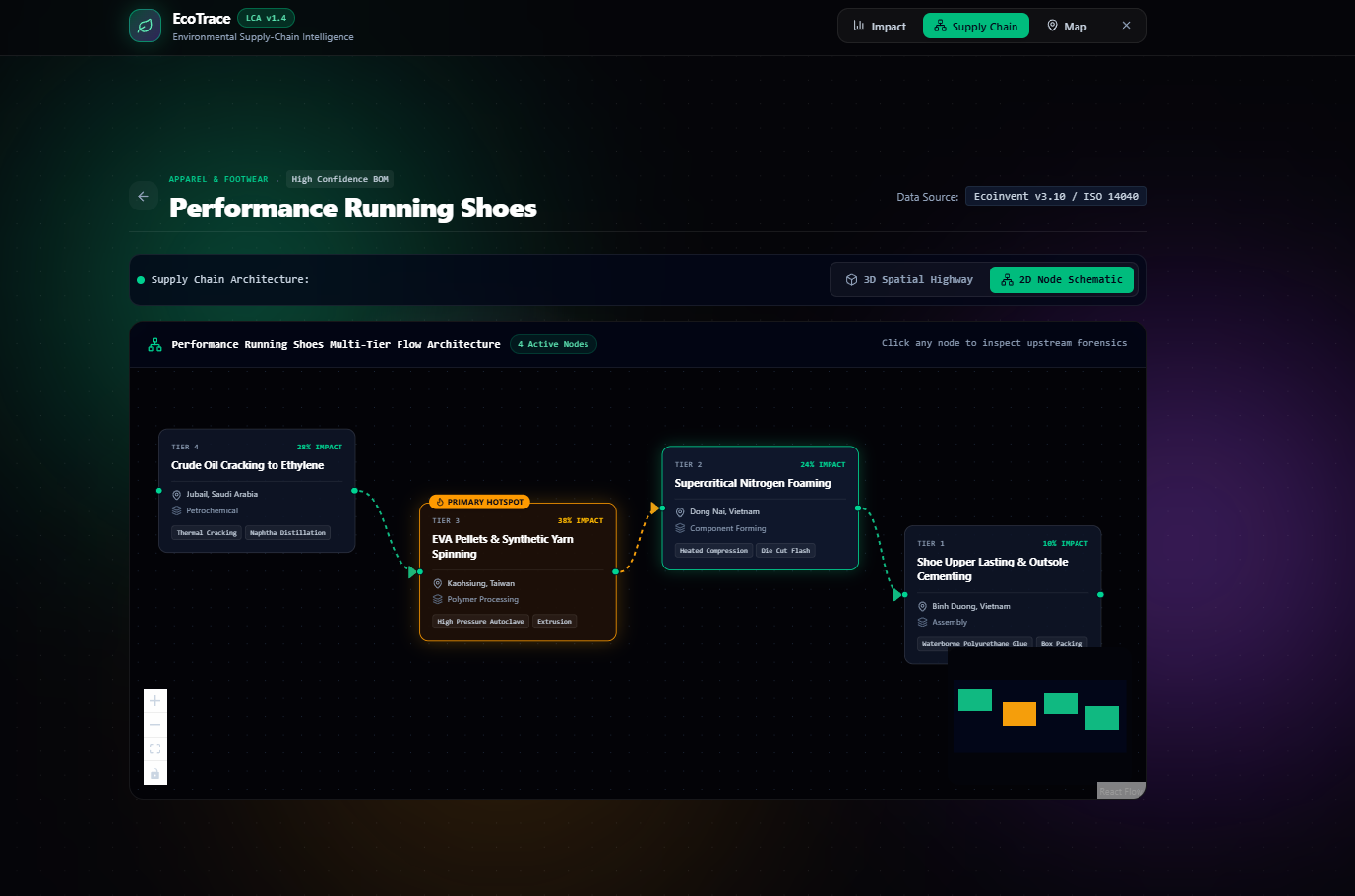
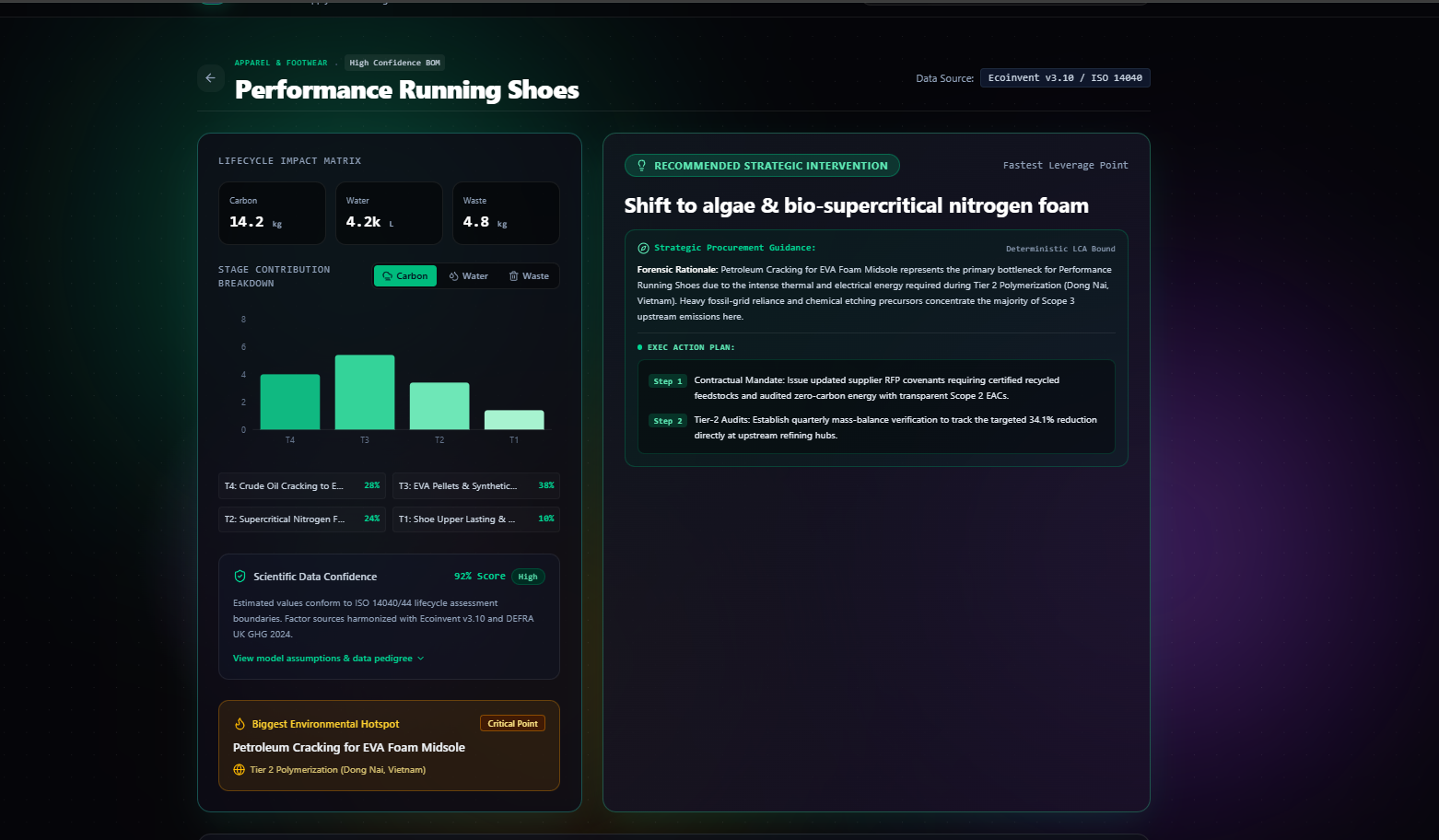
Instant Multi-Tier Deconstruction: Users can search any physical product or explore verified archetypes (e.g., iPhone-class smartphones, performance running shoes, NMC 811 EV battery packs, cotton t-shirts, aluminum laptops). EcoTrace synthesizes the full multi-tier Bill of Materials (BOM) across:
- Tier 4: Mining & Brine Extraction
- Tier 3: Precursor & Chemical Refining (frequently the hidden 40%+ carbon hotspot)
- Tier 2: Sub-component & Cell Assembly
- Tier 1: Final Integration & Packaging
Deterministic Lifecycle Accounting (Zero AI Hallucination for Math): All environmental calculations are strictly deterministic and mathematically harmonized against ISO 14040/14044, Ecoinvent v3.10, and DEFRA 2024 GHG standards:
Total Emissions = Σ (mass × Material EF) + Σ (Process Energy) + Σ (distance × weight × Freight EF)
Where "mass" represents component mass, "EF" denotes vetted emissions factors, "Process Energy" is tier-specific energy demand, and freight emissions follow GLEC Framework logistics ton-kilometer metrics.
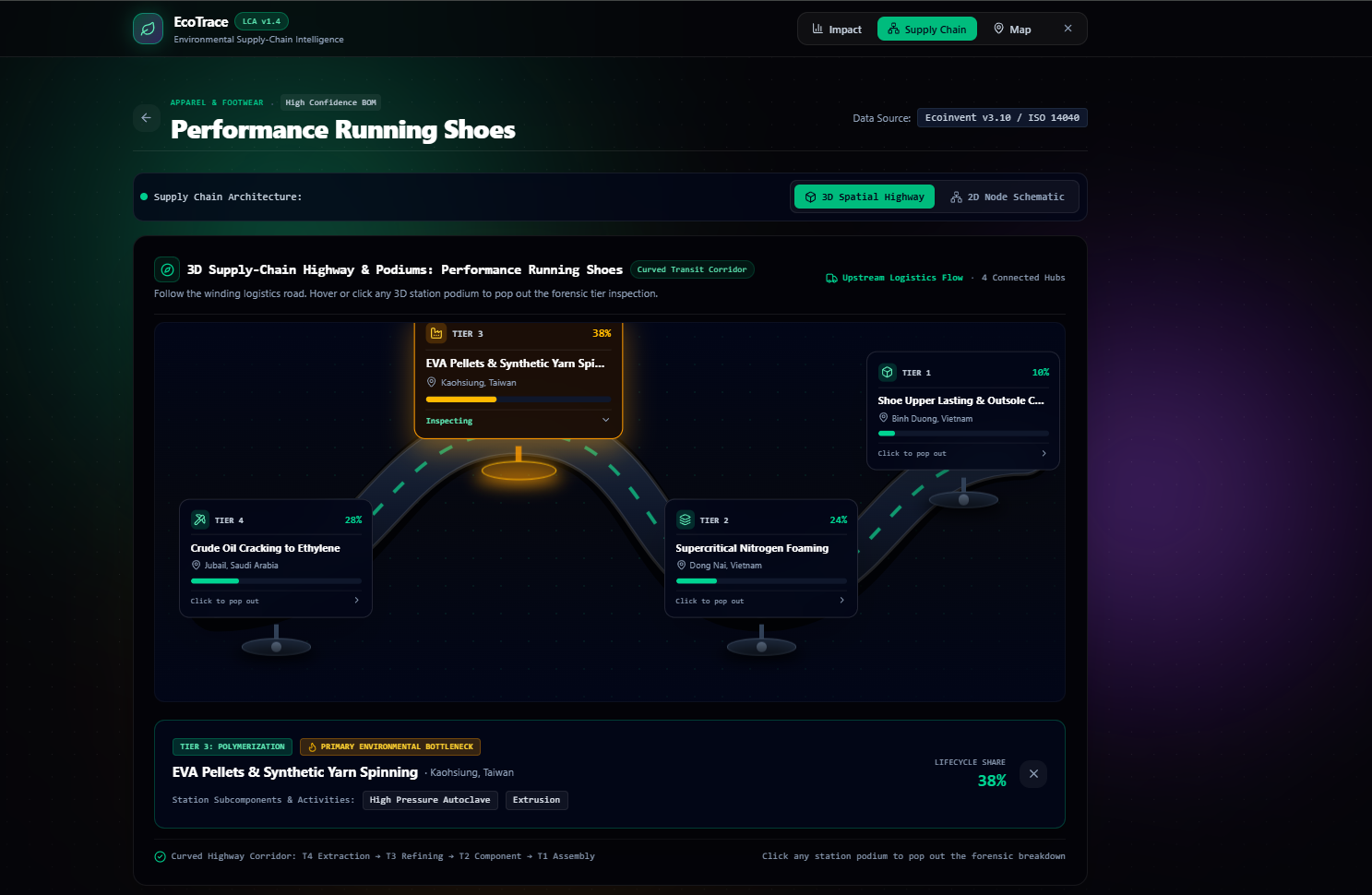
Interactive 3D Spatial Highway: Instead of static diagrams, users navigate a kinetic 3D perspective highway where each supplier tier sits on an illuminated podium. Users can click on any tier to pop out forensic sub-components, regional energy mixes, and audited supplier facilities.
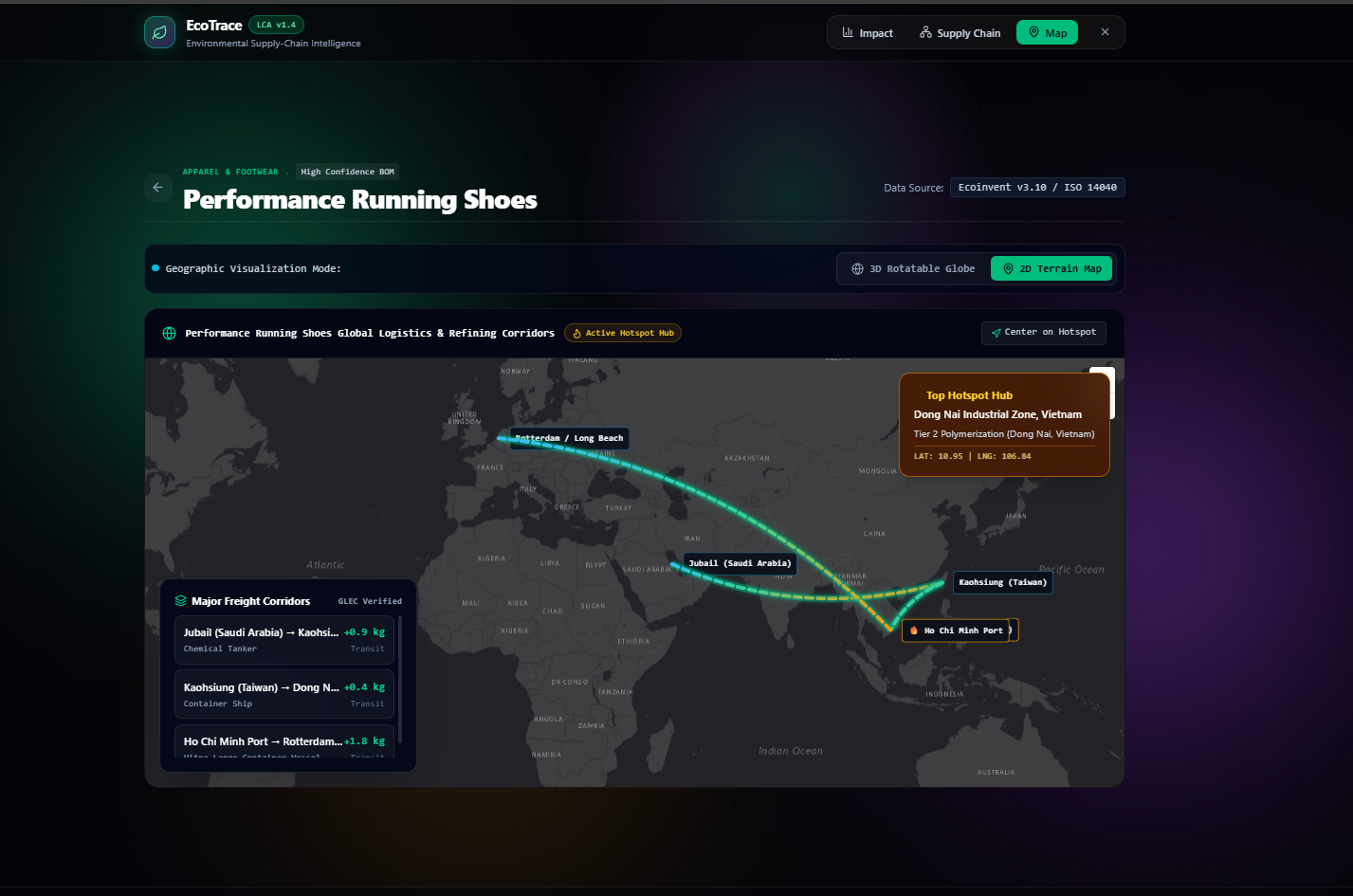
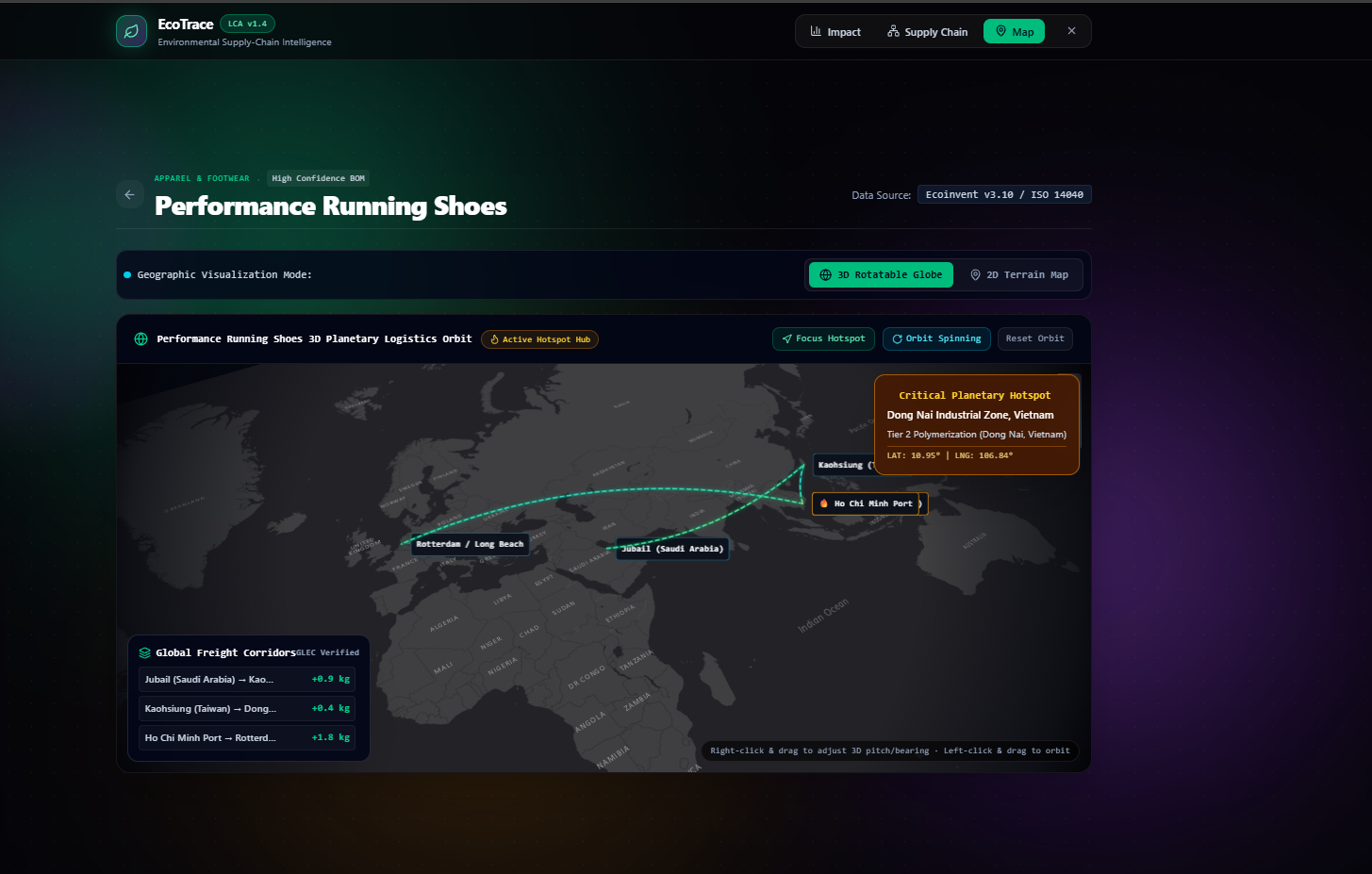
3D Planetary Logistics Orbit: A rotatable WebGL 3D globe displaying global logistics corridors. It visualizes transcontinental freight journeys with delicate dotted Great-Circle flight arcs, pulsing node beacons, and automated camera targeting onto primary bottleneck locations (e.g., Hsinchu, Atacama, Jubail).
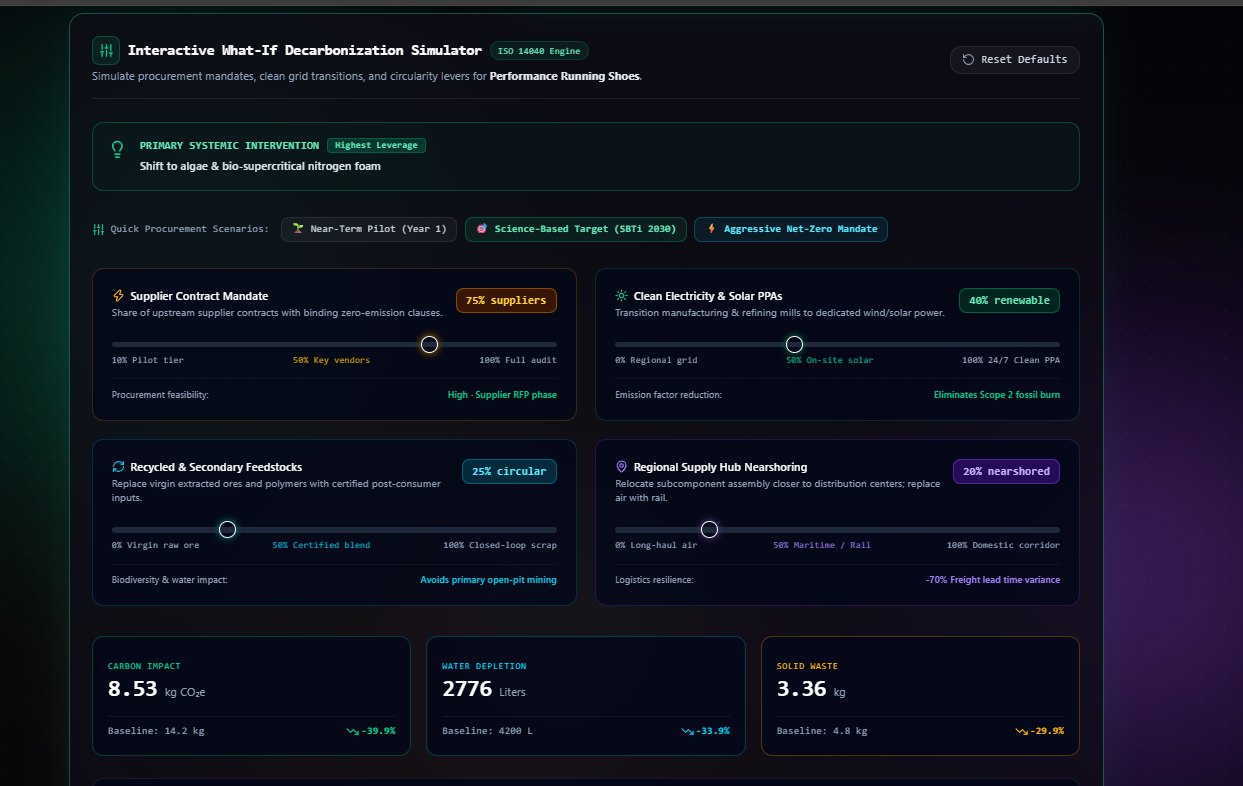
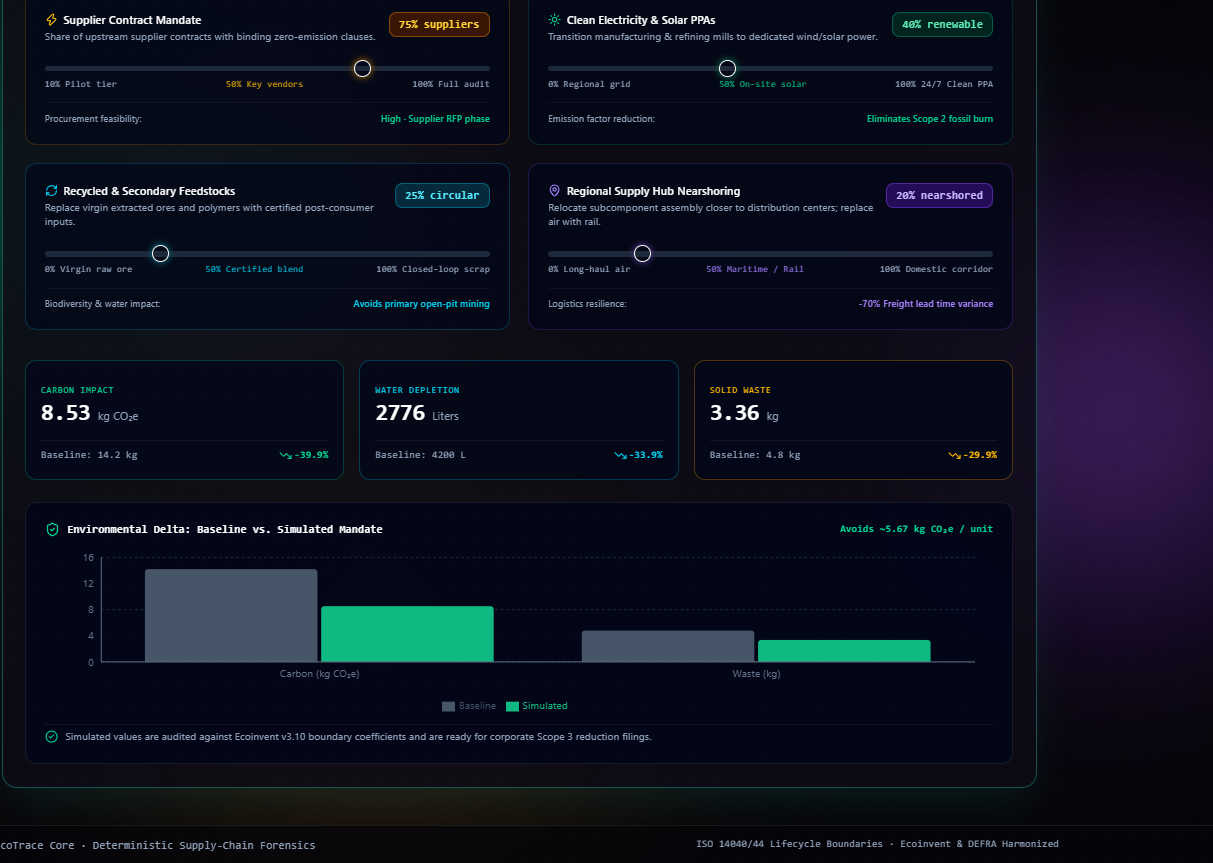
Dynamic "What-If" Scenario Simulator: Procurement and ESG teams can adjust clean electricity tariffs (P_grid), recycled feedstock substitution (R_recycled), and regionalized supplier reshoring (S_regional) in real time:
ΔCO2e = Baseline × [ α(ΔP_grid / 100) + β(ΔR_recycled / 100) + γ(ΔS_regional / 100) ]
Instantly recalculating marginal carbon yield and annual savings before capital is deployed.
How we built it
EcoTrace was engineered as a decoupled full-stack platform:
Frontend & 3D Spatial Engine:
- Framework: Next.js 16 (React 19, Turbopack) built in non-monolithic modular TypeScript.
- 3D Geographic Cartography: MapLibre GL configured with 3D perspective pitch (42°), planetary rotational kinetics, and real-time SVG projection for Great-Circle flight arcs.
- Spatial Supply Chain: Custom CSS 3D perspective road with interactive node standoffs and dynamic pop-out cards.
- Data Visualization: Recharts with dark-mode custom tooltips and zero horizontal overflow.
- Aesthetics: Glassmorphism, custom slider tracks, and hardware-accelerated CSS custom property ambient glow.
Backend & Forensics Engine:
- FastAPI (Python 3.11): High-throughput asynchronous REST API providing sub-millisecond calculation speeds for scenario mutations.
- Forensics & AI Orchestration: Google Gemini API integration via
google-genaifor natural language product synthesis and auditable executive action plans. - Lifecycle Database: Deterministic coefficients seeded from Ecoinvent v3.10, DEFRA UK GHG (2024), GLEC v3.0 logistics coefficients, and EPA WARM models.
Challenges we ran into
- True Spherical 3D Cartography Without Heavy Binary Bloat: Initial canvas-based attempts to render continents produced messy, jagged polygonal outlines. Transitioning to full 3D WebGL while maintaining fast render speeds without paid API keys required integrating ESRI Dark Gray Canvas tiles with MapLibre GL's perspective engine, coupled with an active render-loop listener to keep thin dotted SVG curves aligned during planetary rotation.
- Antimeridian & Great-Circle Arc Geometry: Drawing long-range flight corridors (such as maritime freight crossing from Chile across the Pacific into East Asia) initially resulted in route lines snapping horizontally across the entire screen due to the -180° / +180° longitudinal boundary. We developed an antimeridian-aware arc interpolation function that calculates shortest-path polar deviations:
Δλ = (λ_end - λ_start) mod 360
- Preventing AI Hallucination in Sustainability Accounting: Many generative AI applications generate arbitrary carbon metrics that fail regulatory audits. We architected a strict boundary: Gemini AI is never allowed to invent numerical values. All footprint figures are computed deterministically via calibrated formulaic engines; the LLM is leveraged solely to deconstruct qualitative unstructured queries into component lists and to generate contextual procurement execution plans.
Accomplishments that we're proud of
- Fluid 3D Spatial Visuals: Creating both the 3D S-Curved Supply Chain Highway and the 3D Rotatable Planetary Globe that run at a smooth 60 FPS in modern browsers without cumbersome external 3D engines.
- Audit-Grade Determinism: Building a system where changing a parameter (e.g., from 40% to 80% renewable electricity) recalculates verified mathematical equations rather than querying a non-deterministic model.
- Production Readiness: Achieving zero TypeScript and zero build errors under strict Next.js Turbopack compilation.
- Humanized User Experience: Designed an interface that feels like high-end mission control software rather than a dry compliance spreadsheet.
What we learned
- True Scope 3 Complexity: Investigating Ecoinvent and DEFRA datasets revealed that raw extraction (Tier 4) and precursor chemical synthesis (Tier 3) represent nearly all environmental leverage—meaning corporate initiatives focused solely on packaging or office energy are often targeting less than 5% of their true impact.
- SVG-MapLibre Hybrid Rendering: How to dynamically link projected coordinate transforms (
map.project([lng, lat])) with responsive SVG elements across camera pitch, bearing, and zoom events. - Enterprise Product Strategy: Clean, intuitive visual interfaces build more executive consensus in 30 seconds than 100-page ESG PDF reports.
What's next for EcoTrace
- Automated ERP & EDI Integration: Direct connectors for SAP Ariba, Coupa, and NetSuite to ingest live purchase orders and Bill of Materials automatically.
- Supplier Carbon Invoicing: Allowing Tier 1 through Tier 4 suppliers to verify their actual grid energy receipts via zero-knowledge verifiable credentials, replacing regional database averages with cryptographically signed supplier certificates.
- Regulatory EU CBAM & CSRD Auto-Reporting: One-click compliance exporting formatted to the European Union’s Carbon Border Adjustment Mechanism (CBAM) and Corporate Sustainability Due Diligence Directive (CSDDD).
- Multi-Modal Route Optimization: Extending the 3D globe to offer automatic logistics routing alternatives (e.g., identifying sea-rail intermodal combinations that cut corridor logistics emissions by up to 65%).

Log in or sign up for Devpost to join the conversation.