-
-
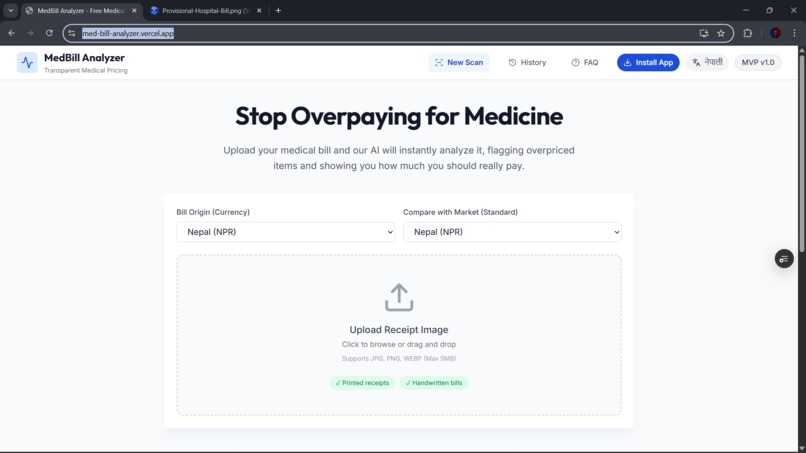
Upload Section
-
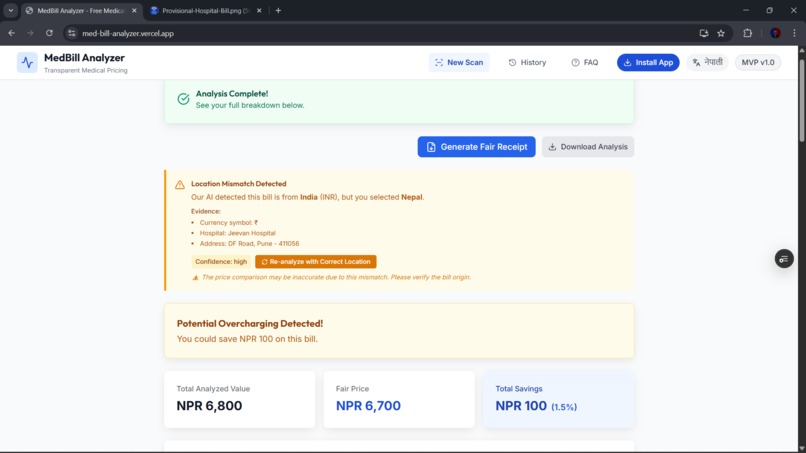
Dashboard
-
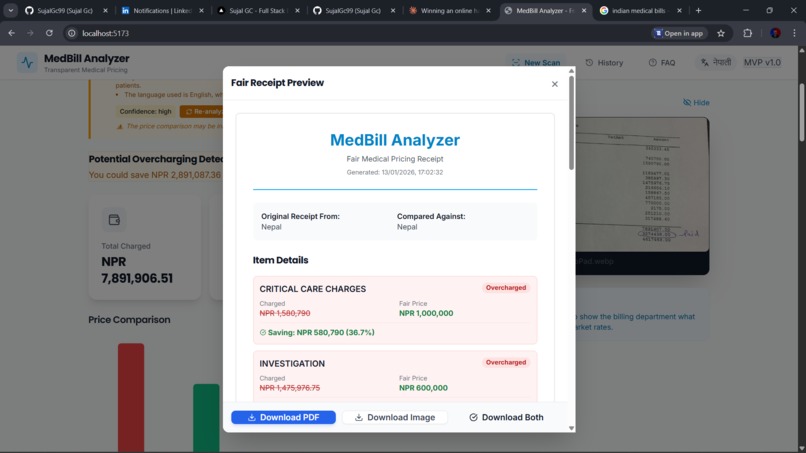
Fair Bill Download
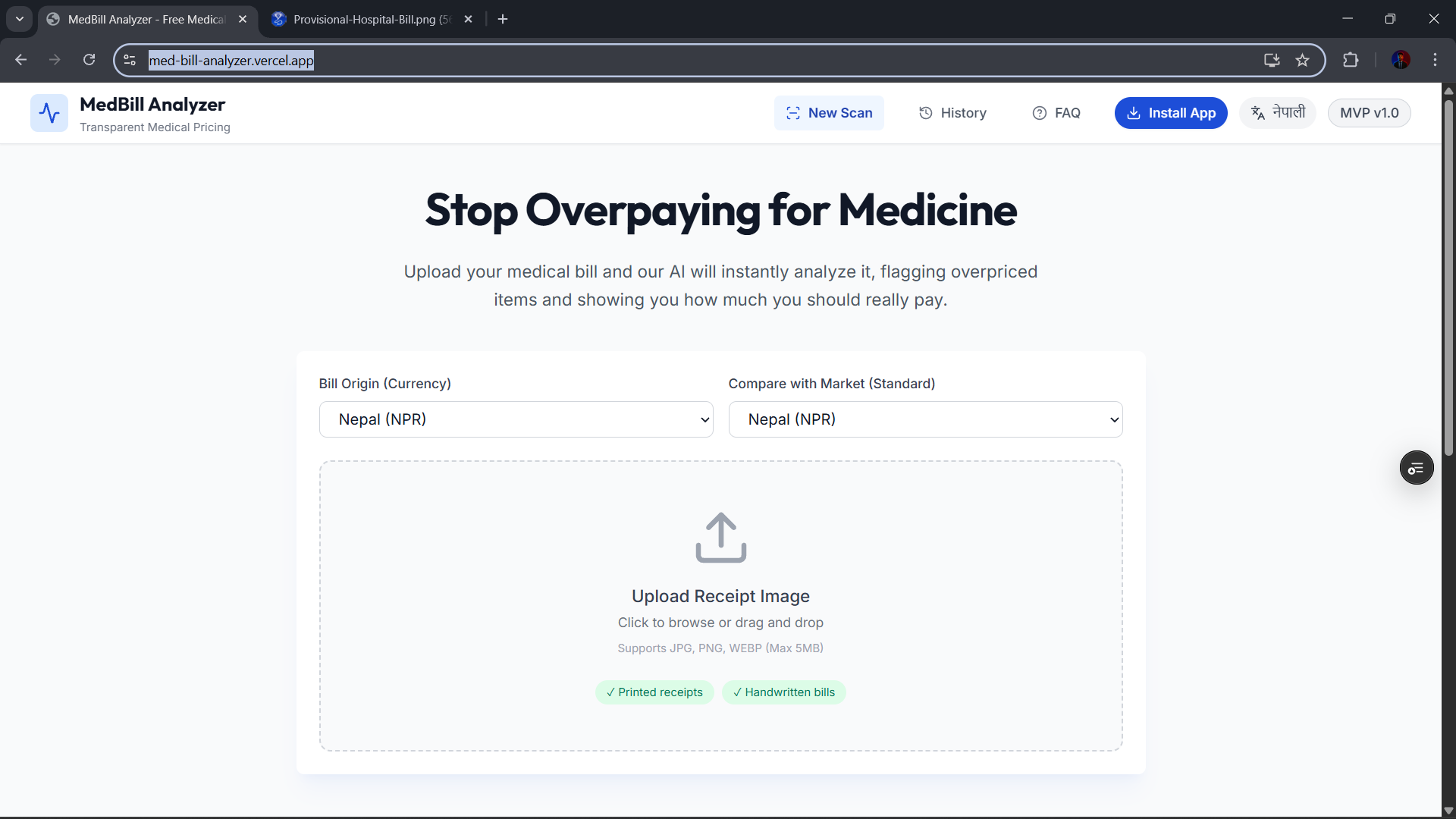
:
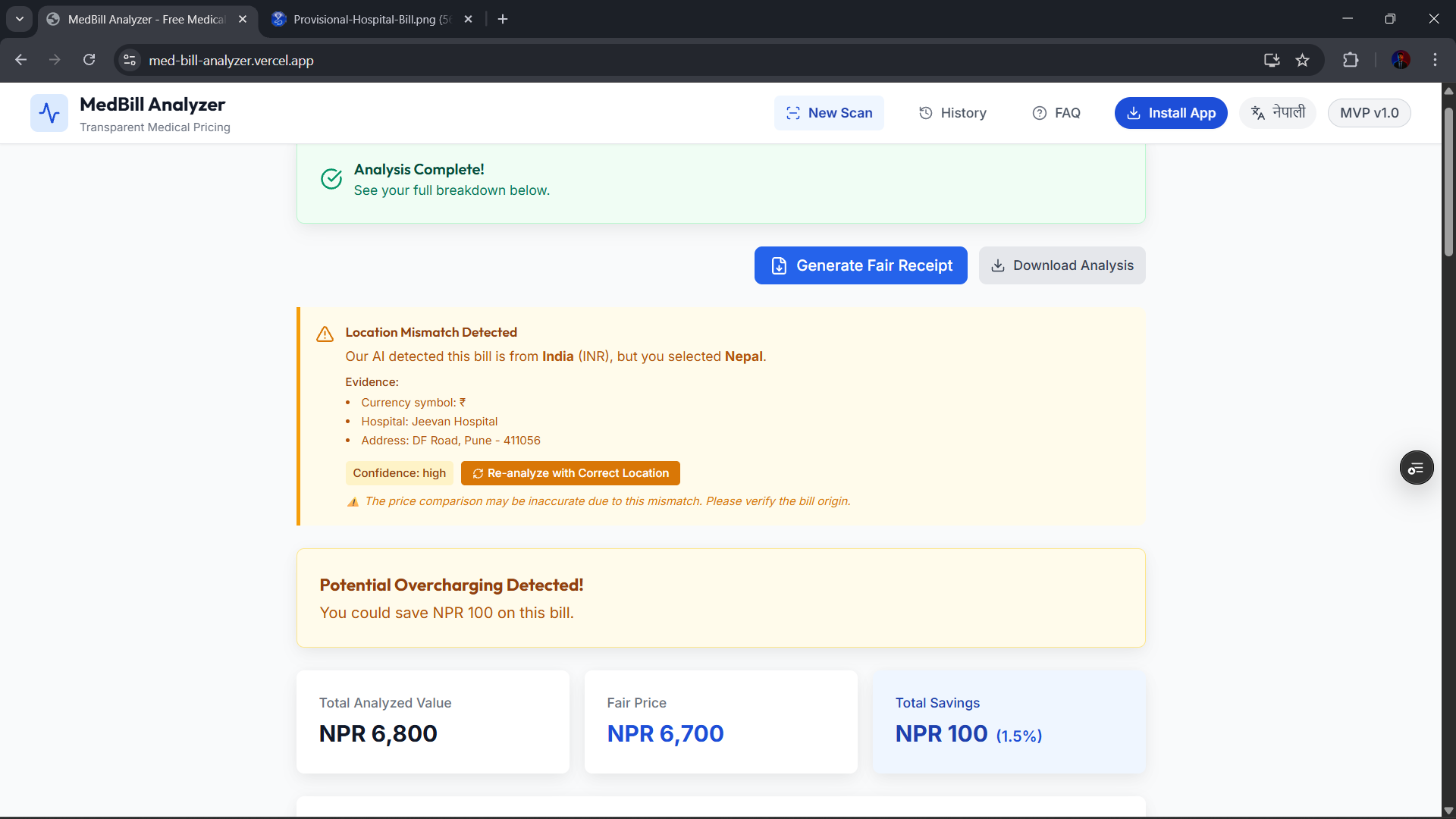
💡 Inspiration Growing up in Nepal, I witnessed firsthand the anxiety and confusion families face when handed medical bills they can't decipher. A simple clinic visit could result in charges that seemed arbitrary, with no way to verify if the prices were fair. I watched my own relatives struggle to understand whether they were being overcharged, especially when comparing costs between Kathmandu and rural areas, or even internationally. This isn't just a Nepal problem—it's global. Medical billing opacity affects billions of people worldwide, from small villages to major cities. I realized that what patients desperately need is a trusted ally: a tool that instantly translates medical jargon into plain language and reveals whether their charges are fair. That's why I built MedBill Analyzer—to democratize medical billing transparency and give every patient, regardless of their medical or financial literacy, the power to advocate for themselves. 🩺 What it does MedBill Analyzer is a privacy-first AI-powered web application that audits medical bills in seconds, bringing unprecedented transparency to healthcare costs. Core Features:
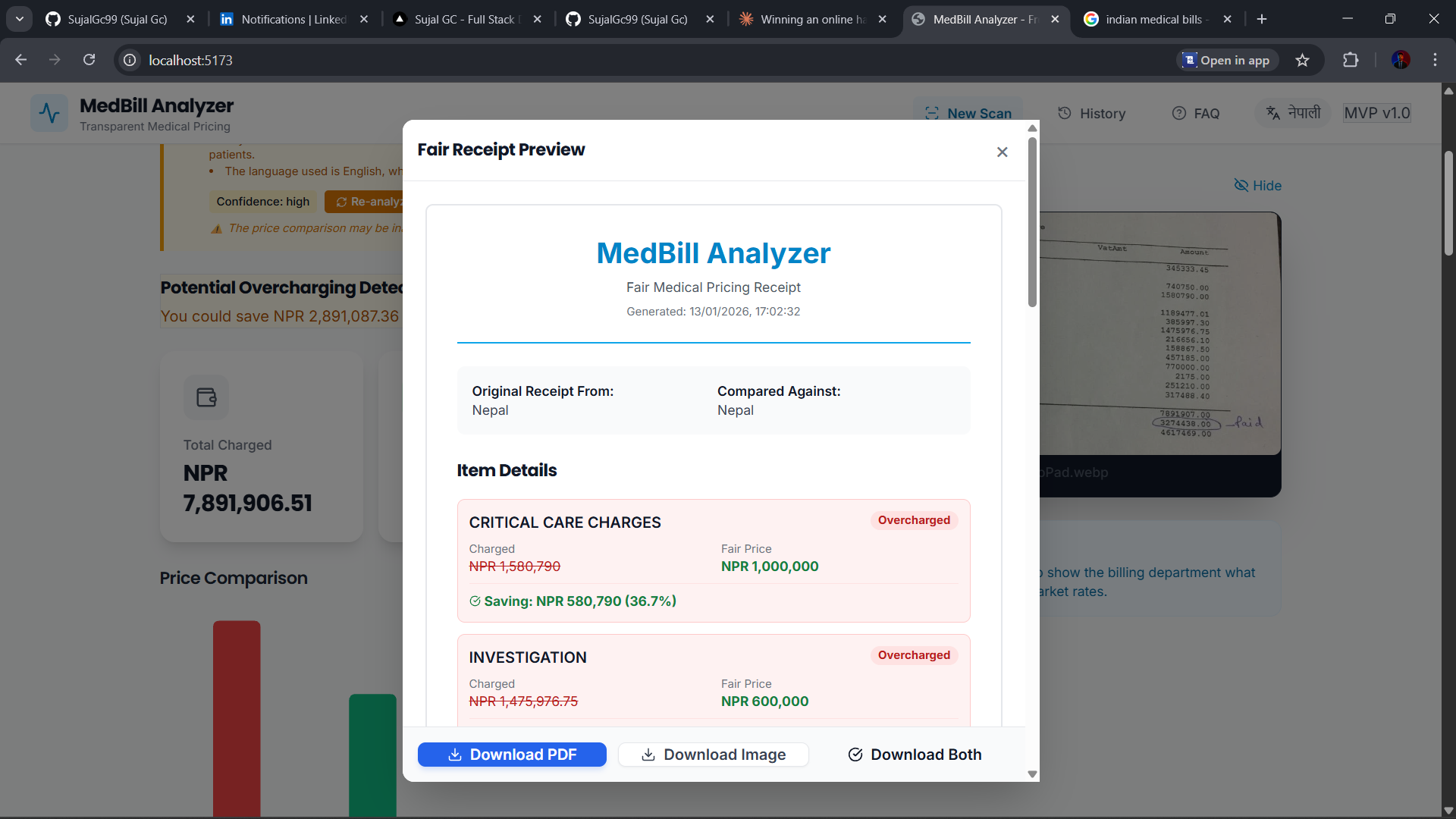
Instant Upload & Analysis: Users simply snap a photo or upload a PDF of their medical bill—no matter how crumpled, handwritten, or complex. Intelligent Geographic Detection: The AI automatically identifies the bill's country of origin (Nepal, USA, India, UK, and more) and adapts its analysis to local pricing contexts, currencies, and medical systems. Fair Market Price Comparison: Each line item is cross-referenced against region-specific fair market rates. The system understands that an X-ray in Manhattan costs vastly different from one in Pokhara—and adjusts accordingly. Visual Overcharge Alerts: Items priced above fair market value are flagged with color-coded warnings (yellow for moderate, red for severe), with clear explanations of why the charge might be inflated. Corrected Fair Receipt Generation: Users can generate a professional "Fair Market Receipt" showing what they should have been charged—perfect for negotiations with billing departments or insurance appeals. Bilingual Interface: Seamlessly switches between English and Nepali (नेपाली), ensuring accessibility for my local community and setting the foundation for global expansion. Educational Insights: Beyond just numbers, the tool explains medical codes, procedure names in plain language, and provides context for pricing variations.
🛠️ How we built it Frontend Architecture:
React 18 + Vite: Lightning-fast development and optimal production builds Tailwind CSS: Modern, responsive design system ensuring accessibility across devices Framer Motion: Smooth animations that keep users engaged during AI processing
AI & Intelligence Layer:
OpenRouter API (Claude 3.5 Sonnet): Leveraged state-of-the-art vision and reasoning capabilities for:
Advanced OCR on poor-quality images (crumpled bills, handwritten notes, faded receipts) Medical code interpretation (ICD-10, CPT codes) Contextual price analysis with geographic and currency awareness Natural language explanation generation in multiple languages
Privacy-First Architecture:
100% Client-Side Processing: No backend servers storing sensitive medical data Direct API Communication: Secure, encrypted API calls with zero data retention Local Storage Only: User data never leaves their device except for transient API processing
Document Generation:
jsPDF + html2canvas: Professional PDF export functionality for fair receipts Custom Templates: Region-specific receipt formats mimicking official medical documents
Development Workflow:
Git + GitHub: Version control and collaboration Vercel Deployment: Continuous deployment with automatic previews Responsive Testing: Ensured compatibility across mobile, tablet, and desktop
🚧 Challenges we ran into
- OCR Accuracy in Real-World Conditions Medical bills aren't pristine documents—they're often folded, stained, handwritten, or poorly photocopied. Training the AI to reliably extract structured data from these challenging inputs required extensive prompt engineering and iterative testing with hundreds of sample bills.
- Cross-Regional Price Intelligence A chest X-ray costs $370 in New York, $50 in Kathmandu, and ₹500 in Mumbai. Building a system that understands these massive regional variations—while accounting for currency conversion, local economic factors, and quality-of-care differences—was incredibly complex. We had to develop context-aware pricing logic that doesn't just compare numbers but understands why prices differ.
- Privacy vs. Functionality Trade-offs Medical data is among the most sensitive information people share. We made the deliberate choice to build a completely client-side application with zero data storage, which meant we couldn't use typical backend optimizations like caching, user accounts, or historical analysis. Every feature had to be re-architected with privacy as the primary constraint.
- Multi-Language Medical Terminology Medical terms don't translate directly—a "complete blood count" in English becomes "पूर्ण रक्त गणना" in Nepali, but the bill might use abbreviations like "CBC" or local terminology. Building a system that handles this linguistic complexity across multiple languages required careful data structuring.
- AI Hallucination Prevention Early versions sometimes "hallucinated" prices or procedures that weren't on the bill. We implemented strict validation checks, confidence scoring, and source-tracing to ensure every output is grounded in the actual document data. 🏆 Accomplishments that we're proud of ✅ True Accessibility: Built the first bilingual (English/Nepali) medical bill analyzer, directly serving my community while setting a template for global expansion. ✅ Privacy Leadership: Achieved full functionality without compromising user privacy—proving that powerful AI tools don't need to sacrifice data security. ✅ Real-World Impact: Moved beyond theoretical "analysis" to generating actionable outputs (fair receipts) that users can immediately use for negotiations, disputes, or insurance claims. ✅ Technical Excellence: Successfully integrated cutting-edge AI (Claude 3.5 Sonnet) with real-time visual feedback, maintaining smooth UX even during complex processing. ✅ Speed & Responsiveness: Reduced analysis time from "send bill to expert, wait days" to "upload and get results in 30 seconds." ✅ Cross-Cultural Design: Built a system that respects regional medical practices, currencies, and languages—not a one-size-fits-all Western-centric solution. 📚 What we learned Technical Growth:
Advanced Prompt Engineering: Learned how to craft prompts that reliably extract structured data from unstructured, real-world documents. Discovering the balance between specificity (for accuracy) and flexibility (for handling edge cases) was a breakthrough. Client-Side AI Integration: Mastered the art of building powerful AI-driven applications without traditional backend infrastructure. This taught me creative solutions for state management, API optimization, and error handling in constrained environments. Computer Vision Challenges: Gained deep appreciation for the complexity of OCR in real-world conditions. A 99% accurate system sounds great until you realize that 1% error might misread a "$500" as "$5000" and cause real harm.
Domain Expertise:
Healthcare Economics: Developed understanding of how medical pricing works globally—insurance negotiations, geographic cost variations, billing code systems (ICD-10, CPT), and the economics behind hospital pricing. Cross-Cultural Product Design: Learned that "translation" isn't enough—true localization means understanding cultural contexts, local medical practices, and even how people in different regions photograph and share documents.
Product & Impact Thinking:
Privacy-First Design Philosophy: Learned that privacy isn't a feature you add—it's an architectural decision you make on day one. This constraint actually forced more creative, user-respecting solutions. The Gap Between "Cool Tech" and "Real Impact": Building an analyzer is impressive; building something that generates a receipt someone can actually use for negotiation is transformative. I learned to always ask: "What happens after the user sees my output?"
Personal Growth:
Advocacy Through Technology: Realized that code can be a form of activism. This project taught me that developers have a responsibility to build tools that level playing fields and empower the underserved. Iterative Development Under Pressure: Learned to ship imperfect v1s quickly, gather feedback, and iterate rapidly—rather than waiting for a "perfect" product that never launches.
🚀 What's next for MedBill Analyzer Short-Term (Next 3 Months):
Community-Driven Price Database: Launch a crowdsourced platform where verified users can submit anonymized pricing data, creating the world's largest decentralized medical pricing database. Insurance Integration: Add support for insurance EOB (Explanation of Benefits) analysis, helping users verify that their insurance paid correctly. Enhanced Mobile Experience: Develop a progressive web app (PWA) with offline capabilities, allowing use in rural areas with limited connectivity.
Medium-Term (6-12 Months):
Native Mobile Apps: Launch iOS and Android apps with optimized camera scanning and local AI processing for faster results. Dispute Letter Generator: AI-powered tool that writes professional appeal letters to hospitals and insurance companies when overcharges are detected. Multi-Country Expansion: Add support for 20+ countries with region-specific pricing intelligence and language support.
Long-Term Vision:
Hospital Partnership Program: Work directly with transparent hospitals to earn "MedBill Verified Fair Pricing" badges, incentivizing honest billing. API for Healthcare Advocates: Provide free API access to patient advocacy groups, legal aid organizations, and NGOs fighting for medical billing transparency. Predictive Cost Estimator: Before procedures happen, give patients estimated costs with confidence intervals—bringing transparency before the bill arrives. Global Medical Pricing Index: Publish annual reports on medical cost fairness across regions, creating accountability and driving policy change.
Ultimate Goal: Make medical billing so transparent that overcharging becomes impossible, and every patient worldwide can trust that they're paying a fair price for their care.
Ready to change healthcare billing forever? Try MedBill Analyzer and join the transparency revolution. 🌍💙
Built With
- openrouter
- qwen
- react
- vite

Log in or sign up for Devpost to join the conversation.