-
ECO Trace B2B
Inspiration
Every year, businesses write off billions in dead stock inventory — products sitting idle in warehouses that silently drain capital through depreciation, storage costs, and operational inefficiencies. At the same time, other businesses struggle with procurement shortages, rising sourcing costs, and ESG pressure to reduce waste.
We saw a hidden contradiction:
What one company considers waste is another company’s opportunity.
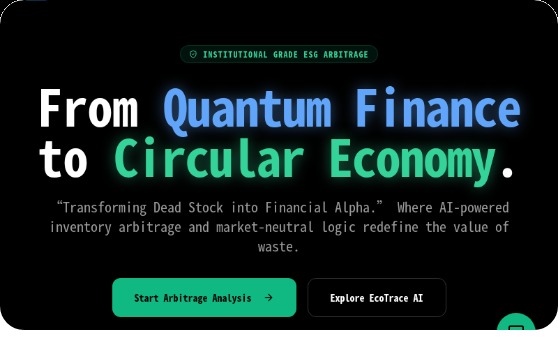
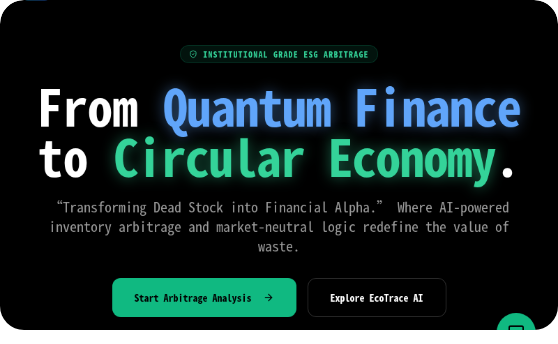
That realization inspired EcoTrace B2B — The Inventory Arbitrage Engine, a platform that reframes surplus inventory not as a liability, but as untapped financial alpha. We wanted to combine institutional finance logic, AI-driven redistribution, and sustainability intelligence into a single ecosystem where businesses can recover value, reduce waste, and generate measurable ESG impact simultaneously.
Our vision was to build the “Bloomberg Terminal for Circular Economy Arbitrage.”
What it does
EcoTrace B2B is an AI-powered institutional-grade platform that identifies and monetizes arbitrage opportunities hidden inside surplus inventory ecosystems.
The platform enables businesses to:
- Detect dead stock and underutilized inventory using AI
- Calculate recovery value and arbitrage spread opportunities
- Simulate redistribution scenarios in real time
- Access a smart B2B redistribution marketplace
- Exchange or liquidate inventory using AI-recommended pricing
- Track ESG impact metrics including CO2 savings and waste diversion
- Validate model performance using the Train/Test period financial logic
- Monitor alpha generation through institutional-style analytics dashboards
Core Modules
AI Arbitrage Engine
Analyzes inventory datasets to identify:
- Carrying-cost liabilities
- Depreciation exposure
- Recovery potential
- Hidden arbitrage spread
Quantum Finance Intelligence Panel
Applies institutional finance validation methods:
- Train Period (Blue) vs Test Period (Orange)
- Overfitting prevention logic
- Market-neutral alpha validation
- Risk-adjusted return metrics
Smart Redistribution Marketplace
A B2B exchange layer where companies can:
- Liquidate surplus inventory
- Perform barter-based exchanges
- Match with businesses needing similar stock
- Coordinate redistribution opportunities
ESG & Sustainability Dashboard
Measures:
- CO2 emissions avoided
- Waste diverted from landfills
- Circular economy impact score
- Estimated carbon credit value
Interactive Poll Analytics
Captures real-time industry sentiment and operational challenges from supply-chain professionals and institutional users.
How we built it
We designed EcoTrace B2B as a modern AI-fintech web platform with a premium dark-mode experience inspired by:
- Bloomberg Terminal
- Institutional hedge-fund dashboards
- AI-native analytics platforms
- Circular economy intelligence systems
Frontend
- React / Next.js architecture
- Tailwind CSS for responsive UI
- Glassmorphism design system
- Framer Motion for cinematic animations
- Dynamic dashboards and financial heatmaps
Backend
- Node.js service architecture
- Python-based AI analytics engine
- Inventory arbitrage scoring algorithms
- ESG impact computation models
AI & Analytics
We implemented:
- Predictive recovery value estimation
- Arbitrage spread calculations
- Confidence interval modeling
- Marketplace matching algorithms
- Overfitting prevention using Train/Test validation logic
Data Intelligence
The system evaluates:
- Carrying costs
- Storage depreciation
- Redistribution premiums
- Geographic logistics efficiency
- Market liquidity adjustment factors
ESG Layer
We built sustainability logic directly into the financial engine, so every redistribution action automatically computes:
- Carbon reduction
- Waste diversion
- Circular economy contribution
- Estimated carbon credit value
Challenges we ran into
One of the biggest challenges was balancing two worlds that rarely intersect cleanly:
- Institutional finance analytics
- Circular sustainability systems
We needed to make ESG metrics feel financially actionable rather than purely environmental.
Other major challenges included:
Designing realistic arbitrage logic
Creating meaningful spread calculations required aligning:
- Liability cost models
- Recovery value prediction
- Redistribution efficiency
- Marketplace liquidity
Preventing AI overfitting
Since recovery predictions can become misleading without validation, we implemented Train/Test period separation and model rejection thresholds to maintain institutional credibility.
Translating complex finance into intuitive UX
We wanted advanced analytics to feel understandable to:
- CFOs
- Supply chain operators
- ESG officers
- Institutional investors
Achieving that balance between sophistication and usability was difficult but rewarding.
Marketplace matching complexity
Building intelligent redistribution matching required considering:
- Geography
- Industry compatibility
- Pricing ranges
- Inventory categories
- Logistics feasibility
Accomplishments that we're proud of
- Successfully reframed dead inventory as a financial alpha opportunity
- Built a cohesive fusion of AI finance + sustainability intelligence
- Designed institutional-grade validation logic with Train/Test methodology
- Created a cinematic fintech-inspired interface with premium UX
- Developed a scalable B2B redistribution marketplace concept
- Integrated ESG metrics directly into financial analytics workflows
- Built a system capable of generating both economic and environmental value simultaneously
We’re especially proud that EcoTrace B2B does not treat sustainability as an add-on feature — it is embedded into the platform’s core financial logic.
What we learned
Throughout this hackathon, we learned that:
Waste is fundamentally a data problem
Most surplus inventory persists because businesses lack visibility into:
- Recovery pathways
- Redistribution demand
- Financial upside
ESG adoption accelerates when tied to profitability
Companies move faster when sustainability initiatives directly improve margins, reduce losses, or generate measurable returns.
Financial storytelling matters
Positioning dead stock as “hidden alpha” resonated far more strongly than traditional sustainability messaging.
Validation is critical in AI-finance systems
Institutional users need transparency, confidence intervals, and overfitting prevention before trusting AI-generated recommendations.
UX can make complex systems approachable
Even highly technical analytics become intuitive when paired with strong visual hierarchy, storytelling, and thoughtful interaction design.
What's next for EcoTrace B2B — The Inventory Arbitrage Engine
Our next vision is to evolve EcoTrace B2B into a full-scale circular economy intelligence network.
Planned Future Features
- Enterprise ERP integrations
- Real-time inventory synchronization
- AI-powered demand forecasting
- Blockchain-backed transaction verification
- Automated logistics coordination
- Carbon credit marketplace integration
- Institutional portfolio analytics for inventory-backed alpha strategies
- Cross-border redistribution intelligence
- Predictive procurement optimization
- Multi-tenant enterprise deployment
Long-Term Vision
We envision EcoTrace becoming:
- The operating system for surplus inventory intelligence
- A global B2B redistribution exchange
- An institutional ESG analytics layer
- A new financial infrastructure for circular commerce
Ultimately, we believe the future economy will reward businesses not just for producing assets, but for intelligently redistributing existing ones.
Built With
- amazon-web-services
- chart.js
- docker
- express.js
- figma
- framermotion
- github
- mongodb
- next.js
- node.js
- numpy
- pandas
- plsql
- python-package-index
- react.js
- redis
- scikitlearn
- tailwindcss
- typescript
- vercel


Log in or sign up for Devpost to join the conversation.