Inspiration
"What if people could actually see the environmental cost of AI — in real time?"
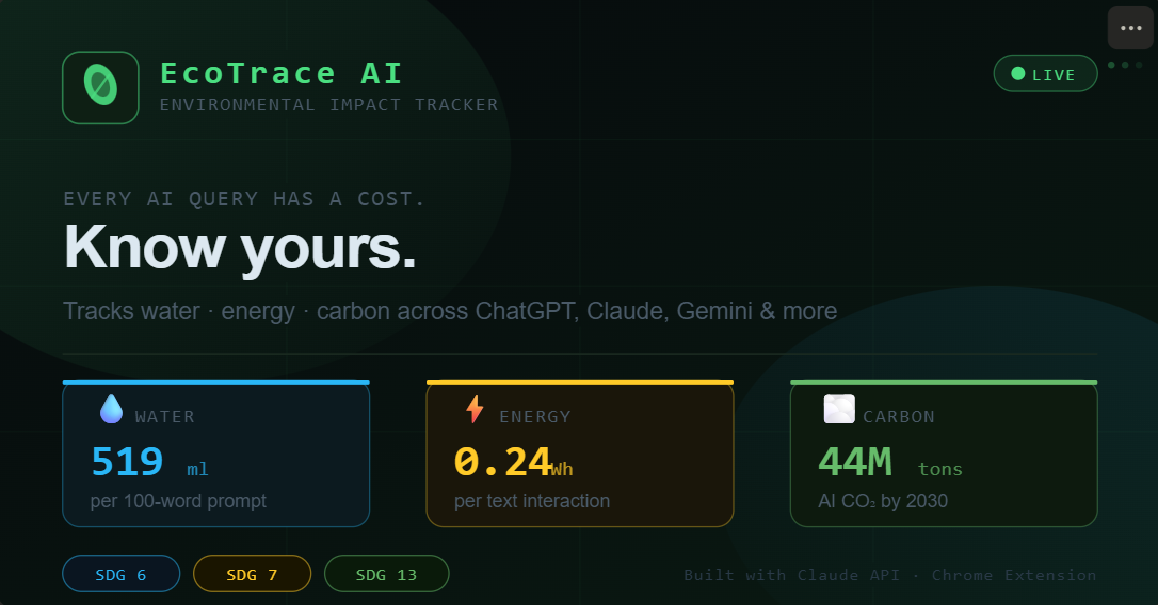
- A single 100-word ChatGPT prompt consumes 519ml of fresh water just to cool servers
- AI data centers projected to use 12% of all US electricity by 2028
- AI could emit 44 million metric tons of CO₂ annually by 2030
- No platform talks about this at the personal level — we wanted to change that
- Framework: UN SDGs 6 (Clean Water) · 7 (Clean Energy) · 13 (Climate Action)
What it does
A Chrome extension that silently tracks your AI environmental footprint across every major platform — without changing a single habit.
Tracks across: ChatGPT · Claude · Gemini · Midjourney · Perplexity · GitHub Copilot
For every prompt it calculates:
- 💧 Water consumed for server cooling
- ⚡ Electricity used
- 🌫️ CO₂ emitted
Converts numbers into human comparisons: water bottles · lightbulb minutes · meters driven
Dashboard features:
- Today / Session / All-time breakdown
- Platform-by-platform cost ranking
- Personalized Eco Score (A+ to D)
- Claude API-powered green suggestions based on your actual patterns
- Prompt optimizer — rewrites prompts to be shorter before you hit send
How we built it
Three-layer architecture:
| Layer | What it does |
|---|---|
| 🔍 Detection | Content script detects prompt submissions via DOM listeners across each platform |
| ⚙️ Calculation | Background service worker maps interactions to research-backed impact constants |
| 🧠 Intelligence | Claude API (claude-sonnet-4-20250514) powers tips, narratives, and prompt optimization |
Stack: Vanilla JS · Chrome Manifest V3 · chrome.storage.local · Claude API · Space Mono + DM Sans
Challenges we ran into
- DOM detection — every AI site uses different button selectors, content-editable structures, and shadow DOM patterns that change with every update
- Water vs. energy trade-off — evaporative cooling saves energy but uses more water; air cooling does the opposite — hard to represent accurately without oversimplifying
- UX tone — early versions felt preachy; took several rewrites to land on data-forward and empowering rather than guilt-inducing
- Manifest V3 restrictions — no persistent background pages; all Claude API calls had to be routed through the service worker via
chrome.runtime.sendMessage
Accomplishments that we're proud of
- ✅ Works entirely passively — zero behavior change required from users
- ✅ Prompt optimizer is the only tool in this space that intervenes before the resource is consumed
- ✅ Every number backed by peer-reviewed research — UC Riverside · Nature Sustainability · MIT · IEA · Cornell
- ✅ Fully demoable product built in under 24 hours addressing 3 UN SDGs simultaneously
What we learned
- The environmental cost of AI is invisible by design — no platform publishes per-query resource data; we stitched together 6 research papers just for baseline numbers
- Behavior change tools work best when ambient, not interruptive — the quiet toast notification after each prompt is more effective than the dashboard
- Using the Claude API as a generative backend (not just a chatbot) unlocked patterns we hadn't considered before
What's next for EcoTrace AI
| Feature | Description |
|---|---|
| 📍 Regional carbon intensity | Adjust CO₂ in real time based on local grid energy mix |
| 🏢 Corporate dashboards | Team-level ESG reporting aligned with CSRD & SEC requirements |
| 🤖 Greener model recommendations | Flag when a smaller model (Haiku, GPT-4o mini) would do the same job |
| 📱 Mobile companion app | Extend tracking to Siri, Google Assistant, and AI-embedded apps |
| 🔌 Open API | REST endpoint so any app can get environmental cost per interaction |

Log in or sign up for Devpost to join the conversation.