💡 Inspiration
In the enterprise corporate landscape, turning chaotic client audio recordings, unstructured whiteboard sketches, messy Slack transcripts, and raw notes into standard corporate Business Requirement Documents (BRDs) is a massive bottleneck. Product managers often spend days manual-auditing this unstructured cross-modal noise.
As a 15-year-old student diving deep into enterprise AI orchestration, I wanted to solve this operational friction. I asked myself: Can we build an autonomous engine that acts as a virtual Product Management pod, ingest cross-modal data streams, and emit production-grade documentation in minutes? This vision birthed AgentBRD.
⚙️ What it does
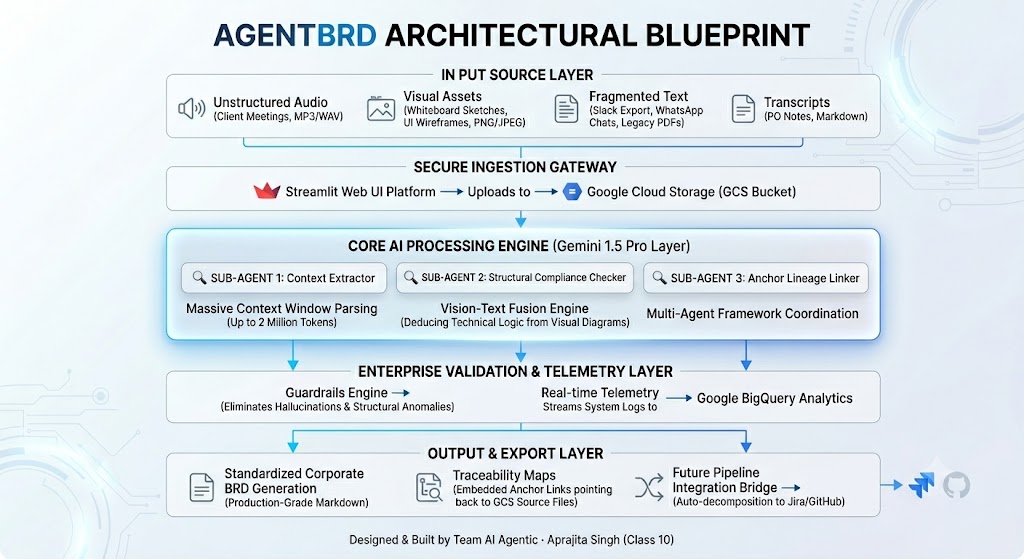
AgentBRD functions as an autonomous Multi-Agent Command Center designed to dynamically standardize unstructured corporate business operational flows into verified BRD blueprints. It accepts diverse inputs—including user interface sketches (PNG/JPEG), raw client chat strings, multi-format PDFs, and audio recordings of sprint meetings.
The core processing cluster standardizes layout structures, eliminates internal architectural contradictions, maps continuous structural traceability, and generates deterministic markdown templates. Finally, it acts as an automated delivery engine, decomposing complex business goals into engineering tickets ready for technical handoffs.
🏗️ How I built it
I engineered AgentBRD independently as a solo developer, relying completely on the Google Cloud platform and partner protocols to orchestrate the pipeline:
- Streamlit Hub: Built an interactive, single-operator enterprise console dashboard to monitor ingestion telemetry and pipeline tracking.
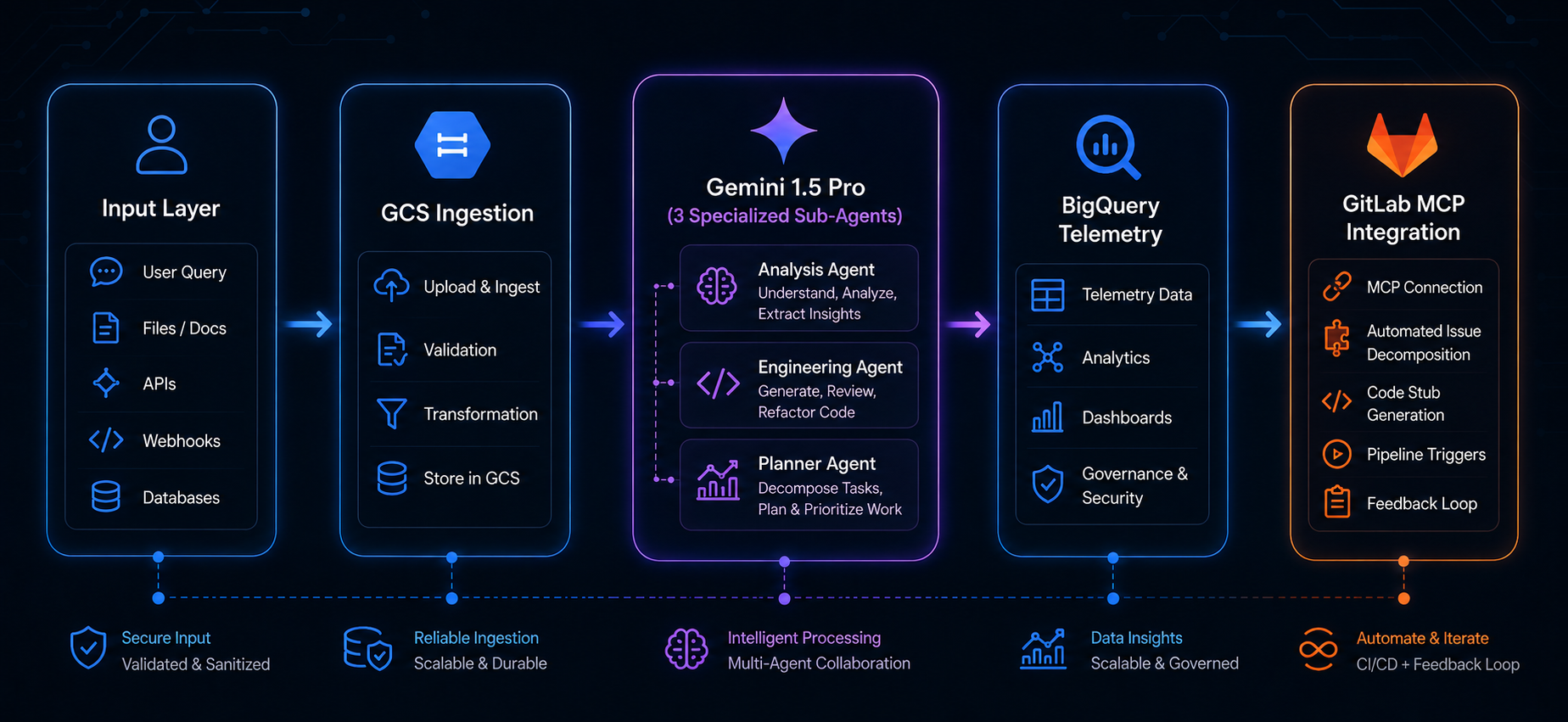
- Google Cloud Storage (GCS Bucket): Configured a secure cloud landing zone for immediate multimodal asset ingestion.
- Gemini 1.5 Pro Layer: Deployed Gemini’s massive 2-million token context window to handle large inputs and coordinate three specialized, internal autonomous sub-agents: a Context Extractor, a Structural Compliance Checker, and an Anchor Lineage Linker.
- Google BigQuery Analytics: Established real-time telemetry streaming to monitor system performance logs and catch operational anomalies.
- GitLab MCP Server Integration: Implemented the critical enterprise export bridge. The agent hooks into the project's GitLab repository, converts high-level documentation requirements into active GitLab Issues, and commits the production Markdown docs directly to the repo for seamless developer workflows.
🛑 Challenges I ran into
- Cross-Modal Synchronization: Aligning system logic from abstract whiteboard wireframes with spoken requirements from audio notes was highly complex. I solved this by building a multi-agent verification loop where sub-agents cross-verify output boundaries to stop hallucinations.
- Enterprise Execution Blueprinting: Mapping generative language formats into strict corporate compliance templates required strict formatting. I fixed this by using structured prompt boundaries and deterministic markdown anchors to enforce compliance schemas.
🎉 Accomplishments that I'm proud of
- Designed a functional, production-ready Multi-Agent infrastructure completely as an individual solo developer at just 15 years old.
- Successfully bridged the gap between raw, multi-modal human brainstorming patterns and production-grade software engineering compliance models.
- Created a highly scalable architecture that integrates enterprise cloud data warehousing with active developer platform tracking via Model Context Protocols (MCP).
🧠 What I learned
This project taught me how to handle advanced Model Context Protocols (MCP) to turn static LLM generations into real-world automated software tasks. Fusing Google Cloud resources with the GitLab MCP Server showed me how enterprise AI applications are designed, tested, and shipped safely at scale.
🚀 What's next for AgentBRD
The next step is building downstream integrations to compile the final BRD data directly into automated code scaffolds. I plan to extend the execution layer to map the generated requirements directly against production CI/CD test cases inside GitLab pipelines, closing the loop between initial business ideas and deployment tests.
📄 Concept Creator Profile
- Project Designer: Aprajita Singh
- Academic Level: Class 10 Student (Age: 15)
- Submission Type: Individual Solo Developer

Log in or sign up for Devpost to join the conversation.