-
-
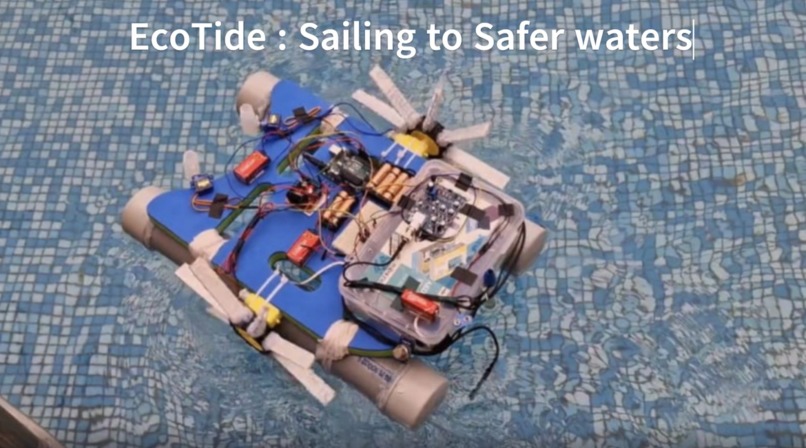
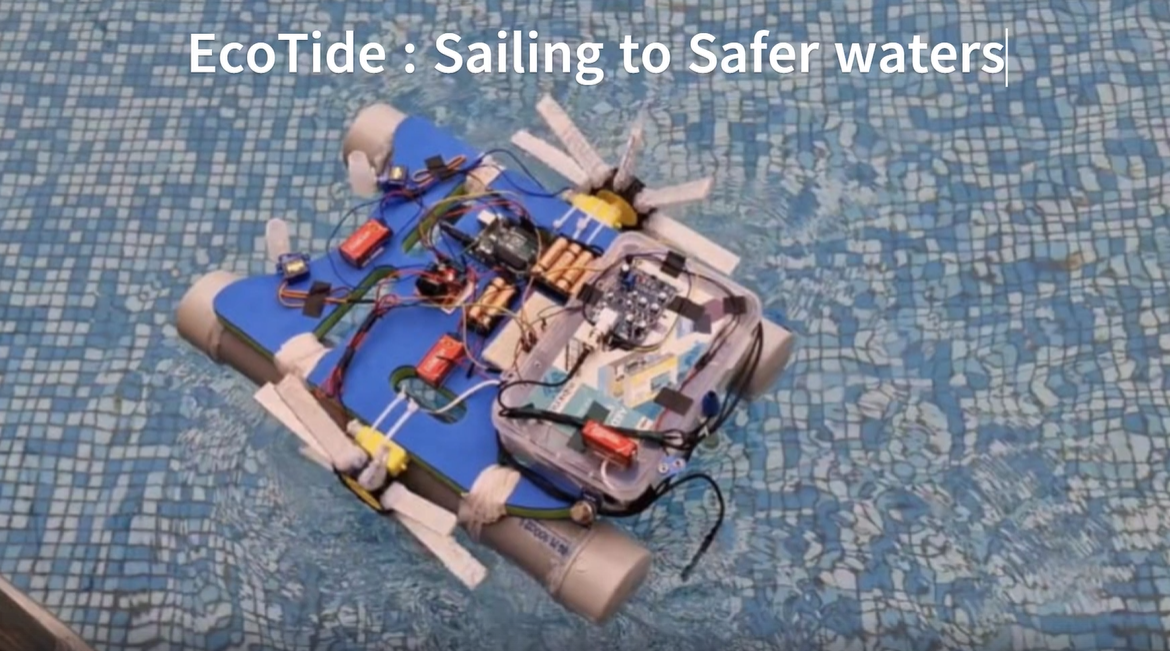
EcoTide floating prototype deployed in water, showcasing autonomous navigation and integrated sensor system for real-time monitoring.
-
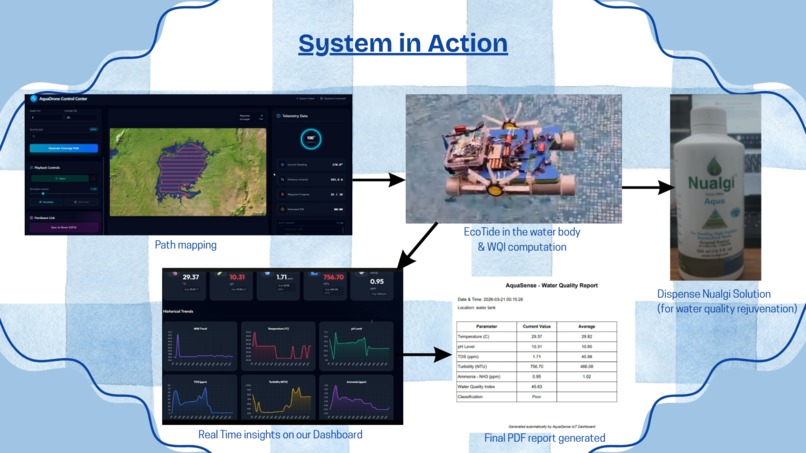
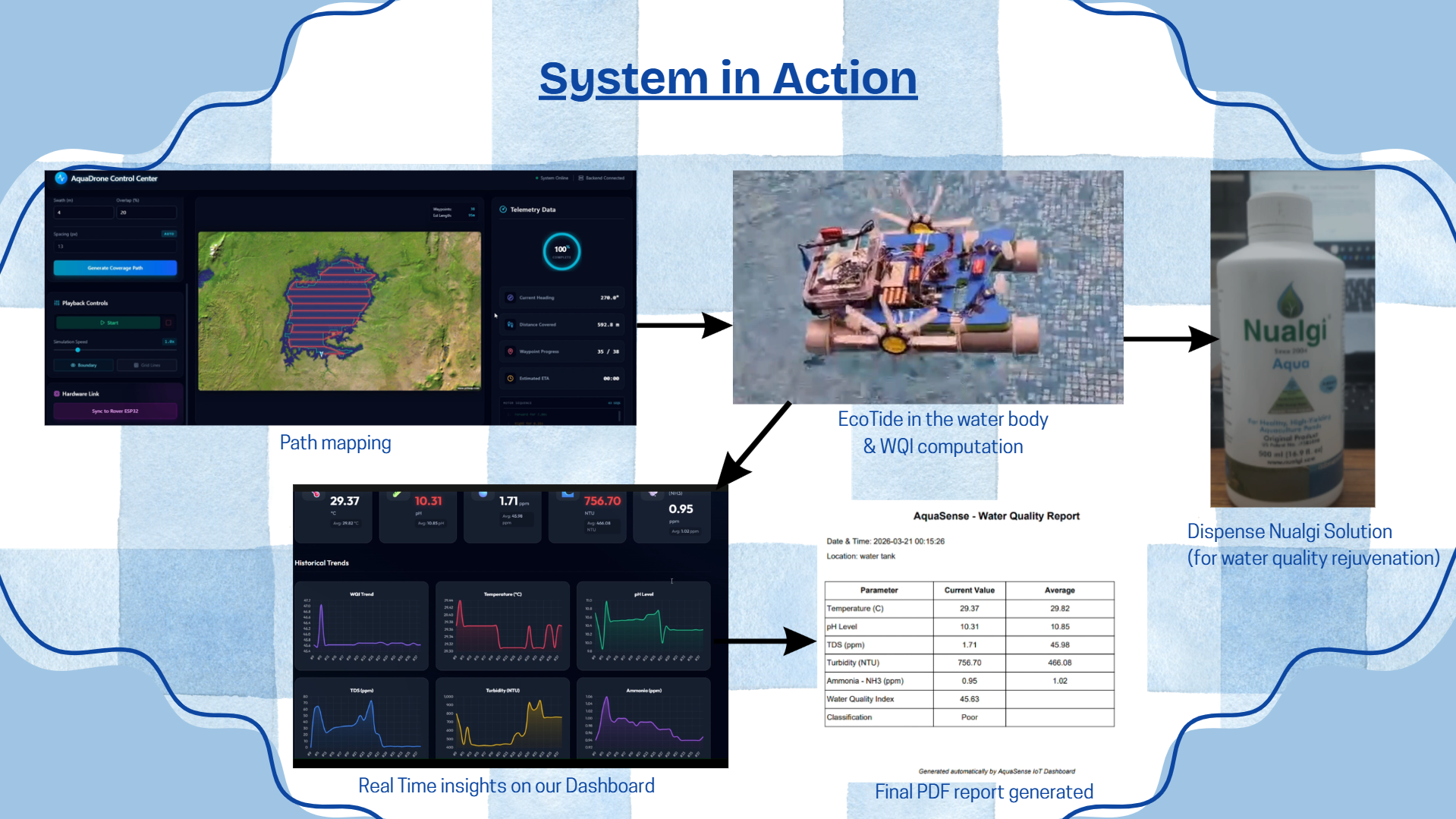
EcoTide workflow: sensing, WQI analysis, smart decisions, and automated water treatment.
-
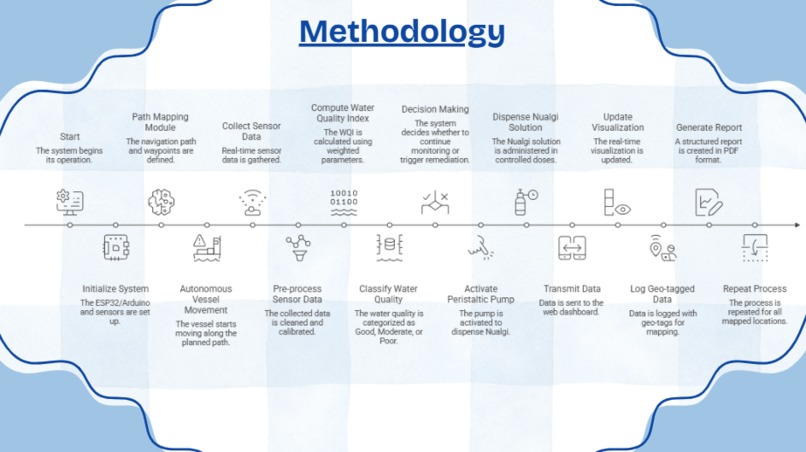
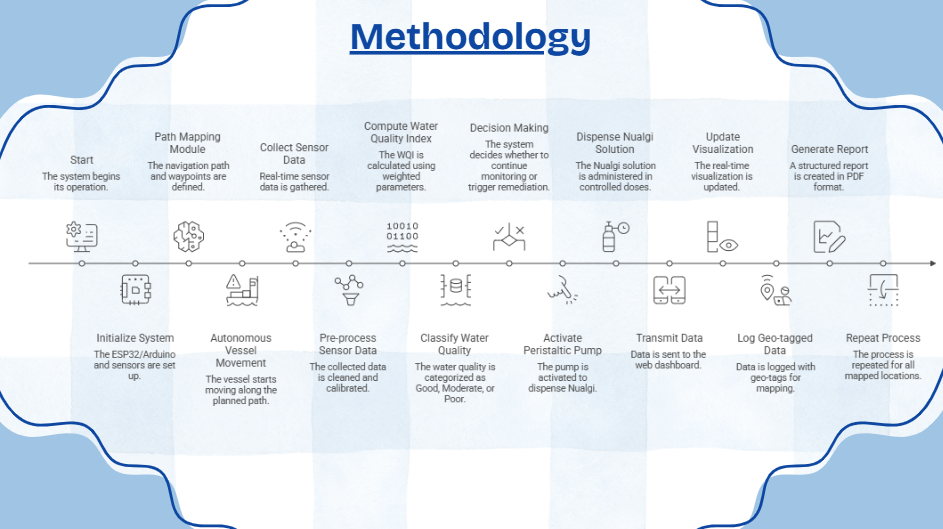
EcoTide methodology: end-to-end process from sensing and analysis to decision-making and restoration.
-
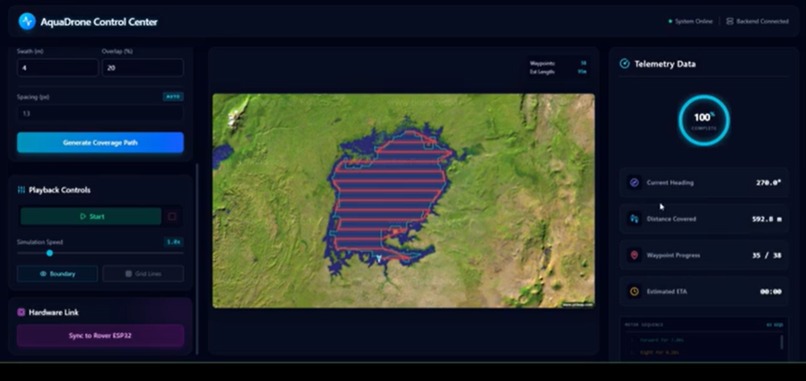
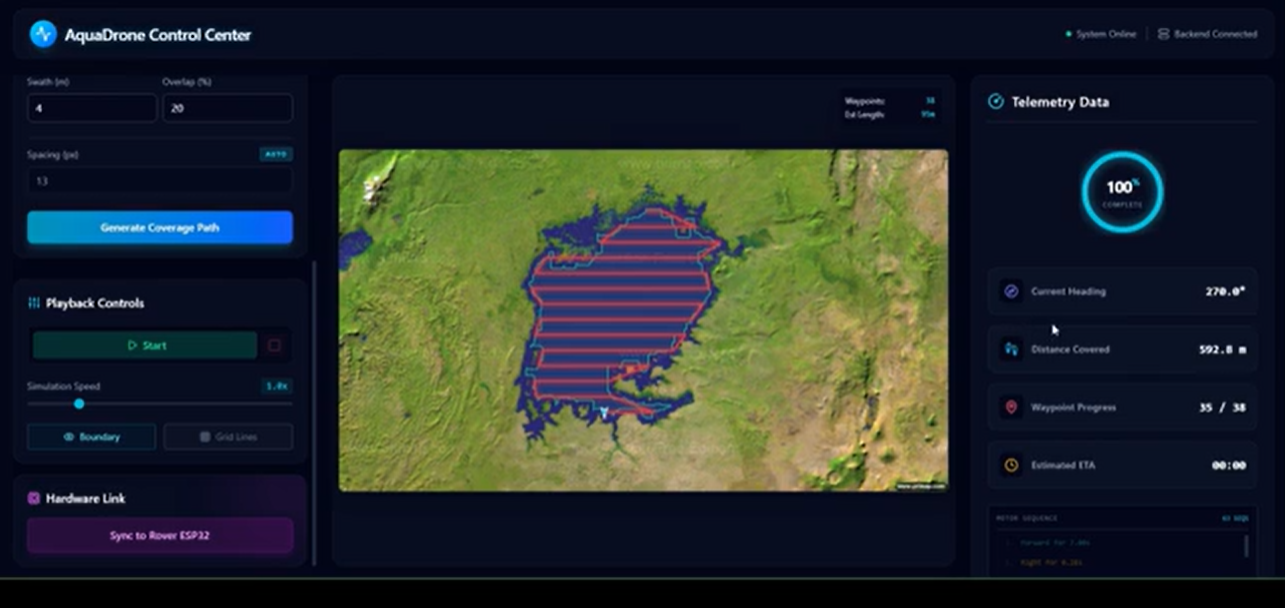
Control center interface showing autonomous path planning, telemetry data, and real-time navigation tracking of EcoTide across a water body.
-
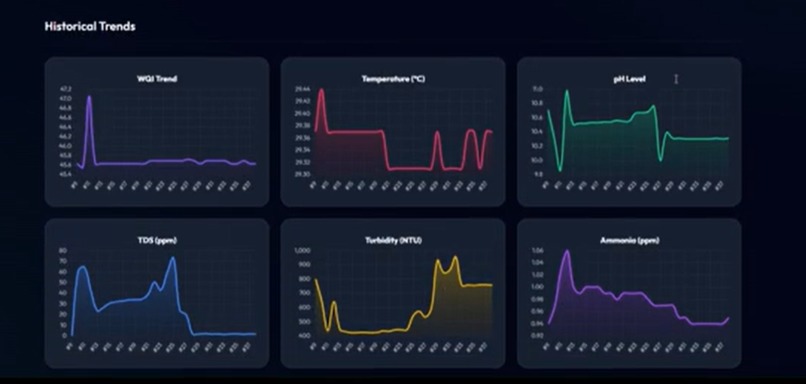
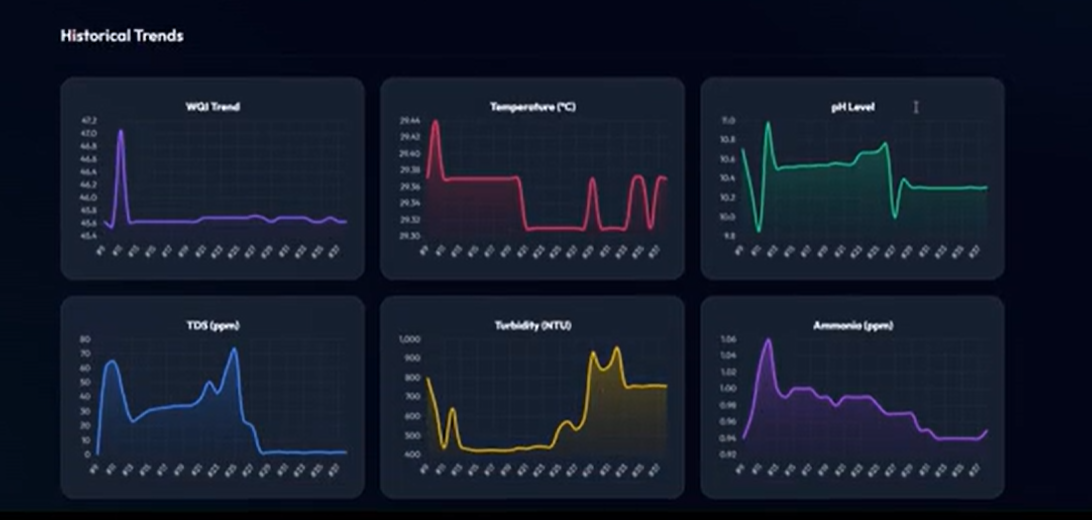
Real-time dashboard displaying historical trends of key water quality parameters including the WQI (Water Quality Index)
Inspiration
Water pollution in urban lakes, reservoirs, and community water bodies has become an increasingly visible and urgent problem. In many cities, once-thriving lakes are now contaminated with industrial discharge, sewage inflow, and organic waste, leading to foul odors, reduced biodiversity, and unsafe water conditions. Despite this, the way we monitor water quality has not evolved significantly — most systems rely on manual sampling, periodic testing, or expensive stationary installations that fail to capture real-time variations across large water bodies.
We were particularly inspired by the gap between detection and action. Most existing solutions stop at identifying pollution levels, leaving remediation as a separate, often delayed process. We wanted to create something that bridges this gap — a system that not only understands the health of a water body continuously but also responds intelligently to restore it.
Additionally, we were motivated by the idea of making environmental monitoring more accessible and scalable. Many advanced solutions are too costly for widespread deployment, especially in developing regions. EcoTide was conceptualized as a low-cost, mobile, and intelligent alternative that could be deployed across multiple water bodies with minimal human intervention. The inspiration ultimately came from combining environmental responsibility with engineering innovation — building something that could actively contribute to restoring ecosystems rather than just studying their decline.
What it does
EcoTide is an intelligent, floating, and autonomous system designed to monitor and rejuvenate polluted water bodies in real time. It moves across the surface of the water, collecting data from multiple sensors that measure critical parameters such as pH, turbidity, total dissolved solids (TDS), temperature, and air–water interface pollution using an MQ135 gas sensor.
The system processes this data using an ESP32 microcontroller to compute a consolidated Water Quality Index (WQI), which simplifies complex environmental data into a single, easy-to-understand indicator of water health. This WQI is continuously updated and transmitted to a web-based dashboard via Wi-Fi, allowing users to monitor water conditions remotely, analyze trends over time, and make informed decisions.
What truly differentiates EcoTide is its closed-loop functionality. Instead of being a passive monitoring system, it actively responds to deteriorating water conditions. When the WQI falls below a predefined safe threshold, EcoTide automatically activates a peristaltic pump to dispense a biological solution (Nualgi Lakes) into the water. This solution promotes the growth of beneficial phytoplankton, particularly diatoms, which increase dissolved oxygen levels, break down pollutants, and suppress harmful algal blooms.
Over time, this process leads to improved water clarity, reduced odor, and restoration of aquatic life. By combining real-time monitoring, intelligent decision-making, and automated remediation, EcoTide transforms water management from a reactive process into a proactive and sustainable system.
How we built it
EcoTide was built through the integration of embedded systems, IoT technologies, and environmental science principles. At the core of the system is an ESP32 microcontroller, chosen for its processing capabilities and built-in Wi-Fi support. Sensor interfacing was handled using an Arduino-based setup, enabling seamless integration of multiple water quality sensors.
We incorporated sensors to measure pH, turbidity, TDS, and temperature, along with an MQ135 gas sensor to detect harmful gases at the air–water interface. These sensors continuously collect data, which is then processed by the ESP32 to calculate the Water Quality Index.
For mobility, the system uses DC motors controlled via motor driver modules. These motors are mounted on a floating platform, allowing EcoTide to navigate across water surfaces. We implemented basic navigation logic to enable the system to patrol predefined zones, ensuring wider coverage compared to stationary systems.
The restoration mechanism was implemented using a relay-controlled peristaltic pump, which dispenses the Nualgi Lakes solution when triggered by low WQI values. This required careful synchronization between sensing, processing, and actuation to ensure timely and effective intervention.
On the software side, we developed a web dashboard to visualize real-time data, track historical trends, and provide actionable insights. The ESP32 transmits data over Wi-Fi, making the system accessible remotely. The entire system was designed with modularity in mind, allowing future upgrades and scalability.
Challenges we ran into
One of the biggest challenges we faced was ensuring accurate and reliable sensor readings in a real-world water environment. Unlike controlled lab conditions, natural water bodies introduce variability such as floating debris, temperature fluctuations, and inconsistent flow, all of which can affect sensor performance. Calibration and noise filtering became critical aspects of our development process.
Designing a stable floating platform was another significant challenge. The system needed to remain balanced while carrying multiple components, including sensors, motors, batteries, and the pumping mechanism. Achieving stability while maintaining mobility required several design iterations and testing cycles.
Autonomous navigation on water also proved to be complex. Controlling direction and movement using DC motors in a fluid environment is inherently less predictable than on land. We had to fine-tune motor control logic to ensure smooth and controlled movement.
Integrating the closed-loop system added another layer of complexity. The system had to seamlessly transition from monitoring to action, requiring precise threshold detection, reliable relay activation, and consistent pumping performance.
Additionally, understanding the biological aspect of water rejuvenation was a learning curve. We had to ensure that the chosen solution (Nualgi Lakes) was not only effective but also safe and sustainable for long-term use.
Accomplishments that we're proud of
We are proud to have successfully developed a working prototype that combines multiple complex functionalities into a single cohesive system. EcoTide is not just a monitoring device — it is a complete ecosystem restoration solution that integrates sensing, computation, mobility, and actuation.
One of our biggest achievements is the implementation of the Water Quality Index, which simplifies complex sensor data into an intuitive metric. This makes the system accessible even to non-technical users, enabling broader adoption.
We are also proud of our collaboration with an industry expert, which allowed us to incorporate a scientifically validated biological solution into our system. This ensured that our approach to water rejuvenation is not only innovative but also grounded in real-world effectiveness.
The development of a closed-loop system that can autonomously detect and respond to pollution is a major milestone. It represents a shift from passive monitoring to active intervention, which is critical for addressing environmental challenges at scale.
What we learned
Working on EcoTide was an interdisciplinary learning experience that went beyond traditional engineering boundaries. We gained hands-on experience in embedded systems, including microcontroller programming, sensor integration, and hardware interfacing.
We also learned about IoT systems, including real-time data transmission, cloud-based dashboards, and remote monitoring. Designing a system that operates in a dynamic and unpredictable environment taught us the importance of robustness, fault tolerance, and iterative testing.
Beyond technical skills, we developed a deeper understanding of environmental science. Learning about water pollution, aquatic ecosystems, and biological restoration techniques gave us a new perspective on how engineering can be used to solve real-world problems.
We also learned the value of collaboration — both within our team and with external experts. Combining knowledge from different domains was essential to building a system like EcoTide.
What's next for EcoTide
Looking ahead, we plan to enhance EcoTide by incorporating advanced navigation capabilities using GPS and path optimization algorithms. This will allow the system to cover larger areas more efficiently and operate with greater autonomy.
We also aim to integrate AI and machine learning models to enable predictive analysis of water quality trends. This would allow EcoTide to anticipate pollution events and take preventive action rather than reactive measures.
Energy efficiency is another area of focus. We plan to integrate solar panels to enable long-term, sustainable operation without frequent battery replacements.
In the future, we envision deploying multiple EcoTide units that can communicate and collaborate as a network, enabling large-scale monitoring and restoration of water bodies.
We also plan to improve the web dashboard by adding advanced visualization tools, alerts, and analytics, making it a comprehensive platform for water resource management.
Ultimately, our goal is to transform EcoTide into a scalable and deployable solution that can be used by municipalities, environmental organizations, and communities to restore and protect water bodies on a larger scale.
Built With
- arduino
- arduino-based-sensor-interfacing
- autonomous-navigation
- closed-loop-control-system
- css
- dc-motors
- esp32-microcontroller
- firebase
- floating-platform
- html
- iot
- javascript
- lakes
- motor-driver-module
- mq135-gas-sensor
- node.js
- nualgi
- peristaltic-pump
- ph-sensor
- real-time-data-processing
- relay-module
- tds-sensor
- temperature-sensor
- turbidity-sensor
- water-quality-index-(wqi)
- wi-fi-(iot-communication)

Log in or sign up for Devpost to join the conversation.