-
-
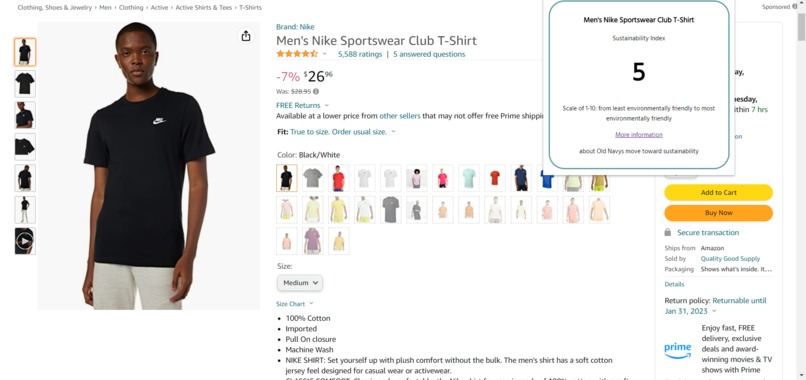
Demo image of product
-
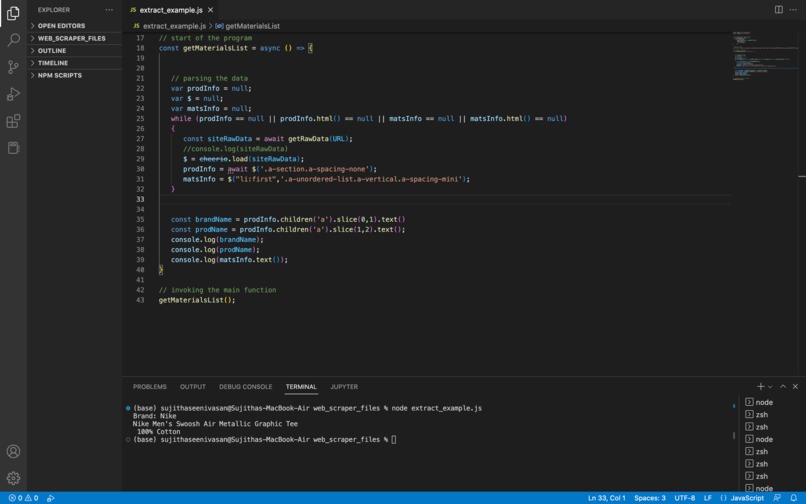
web scraper demo 1
-
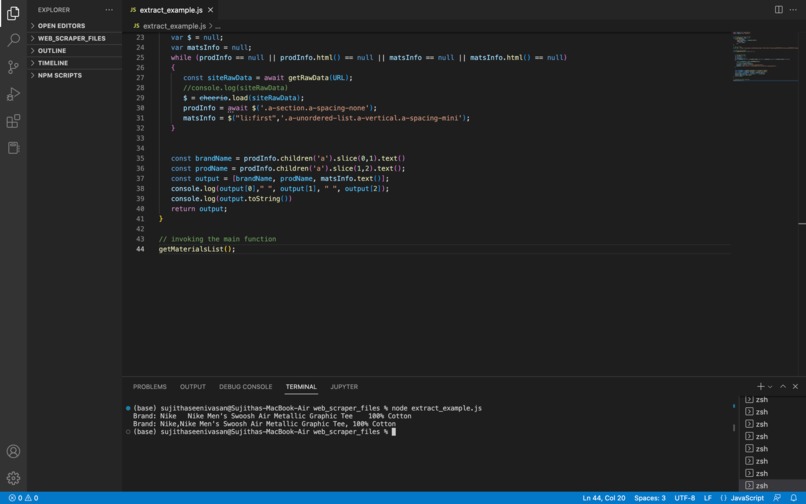
web scraper demo 2


Inspiration
We were inspired by the growing need for more sustainable lifestyle choices. Clothing plays a huge role in sustainability, especially when it comes to the types of fabric being used. We thought that building an index value that measures how sustainable an article of clothing is would be beneficial to a user that’s trying to be more environmentally conscious.
What it does
We built a google chrome extension that was meant to web-scrape clothing websites and extract data about the fabrics used in the clothing, and the percentage composition of each. Common types of fabrics were given an arbitrary “sustainability index” ranging from 1-10, with 1 being the least sustainable and 10 being the most sustainable index based on information such as recyclability, synthetic fibers, natural fabrics, etc. Functionally, the code runs for a dummy set of data for a piece of Nike clothing, and displays an index to the screen. However, we do have a complete data-scraping code using node.js that parses pages on Amazon and extracts fabrics and the percentage of the composition of each fabric in the article of clothing, along with the name and brand of the clothing. The issues we ran into with the data-scraping program are detailed below.
How we built it
We used javascript for the backend, and then used a combination of javascript and html for the frontend. We used a bit of CSS to format all the content in our popup for the extension.
Challenges we ran into
As freshman students and first time hackers, we all had very minimal experience when it came to HTML, JavaScript, and CSS, so building a google chrome extension that attempted to use data scraping was a very steep learning curve. We had to learn how to split our work in an efficient way so that we were all able to accomplish a good amount before trying to integrate frontend and backend programming. One of the largest challenges we faced was the web scraping program. We firstly had to limit the functionality of the program to functioning on Amazon sites to account for variability in website html structure. Additionally, we ran into several issues on connecting the web scraper to the chrome extension, as while it was fully functional (with a slight efficiency issue), due to security issues with cookies on the browser which didn't allow the chrome extension to run the requests we needed.
Accomplishments that we're proud of
I think one of the main accomplishments we’re all proud of is building a functioning extension, even if it is on such a small scale. We were able to research our sustainability index thoroughly and implement at least a small part of it in our code.
What we learned
Each one of us contributed to the code so we all came away with a much better understanding of JavaScript, CSS, and HTML, as well as how to work with other people on a timed coding project when we’re juggling different coding languages and environments to create a singular product.
What's next for EcoSure
Although we were able to calculate the index based on the types of common fabrics used in clothing, there were many other factors we weren’t able to implement such as company reputation, a company’s sustainability statement, and their actions towards sustainability in recent years. Also, each of these categories was weighted, so the type of fabric has a bigger impact on the sustainability index than the company’s sustainability statements, but we also wanted to include these other factors to have a more well-rounded index. This was very important to us, because the Higgs Index (the index that our sustainability index was inspired from) focused very heavily on synthetic fabrics and didn’t give enough weightage to other categories. Along with this, the database for the types of common fabrics can be improved, and we can streamline what factors we are considering for a type of fabric to be an “environmentally-friendly” fabric or an “unsustainable” fabric.


Log in or sign up for Devpost to join the conversation.