Inspiration
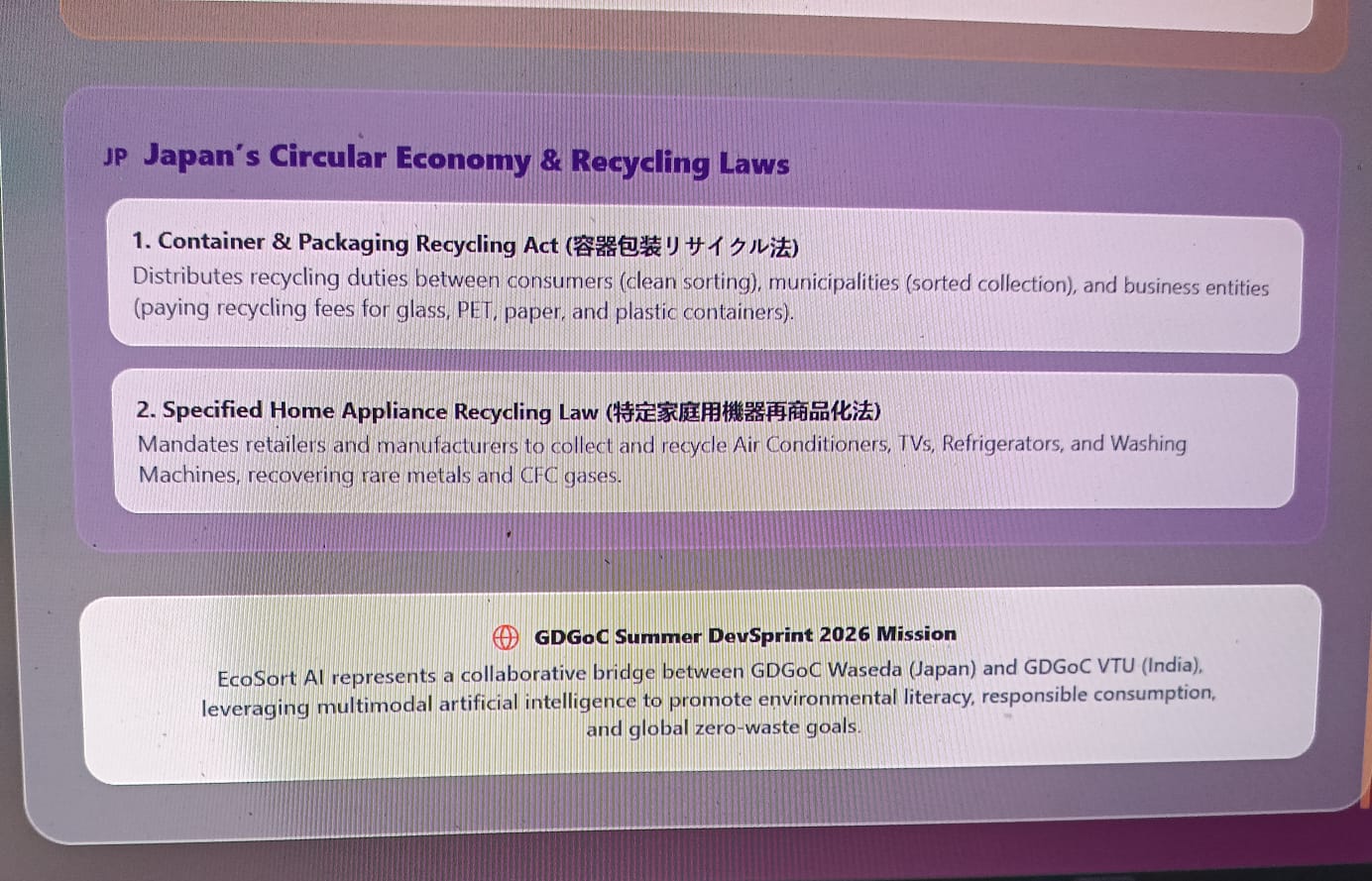
Google Developer Groups on Campus – Waseda University (Japan) and VTU (India) rarely get a chance to collaborate directly on technical work. When we saw the GDGoC Summer DevSprint challenge asking us to solve local issues like waste management together, we realized both our communities face the same core problem — improper waste segregation — but handle it very differently. India's 2026 Extended Producer Responsibility (EPR) rules and Japan's strict, culturally ingrained sorting system inspired us to build something that doesn't just classify waste, but educates people on the "why" behind sorting rules in both countries.
What it does
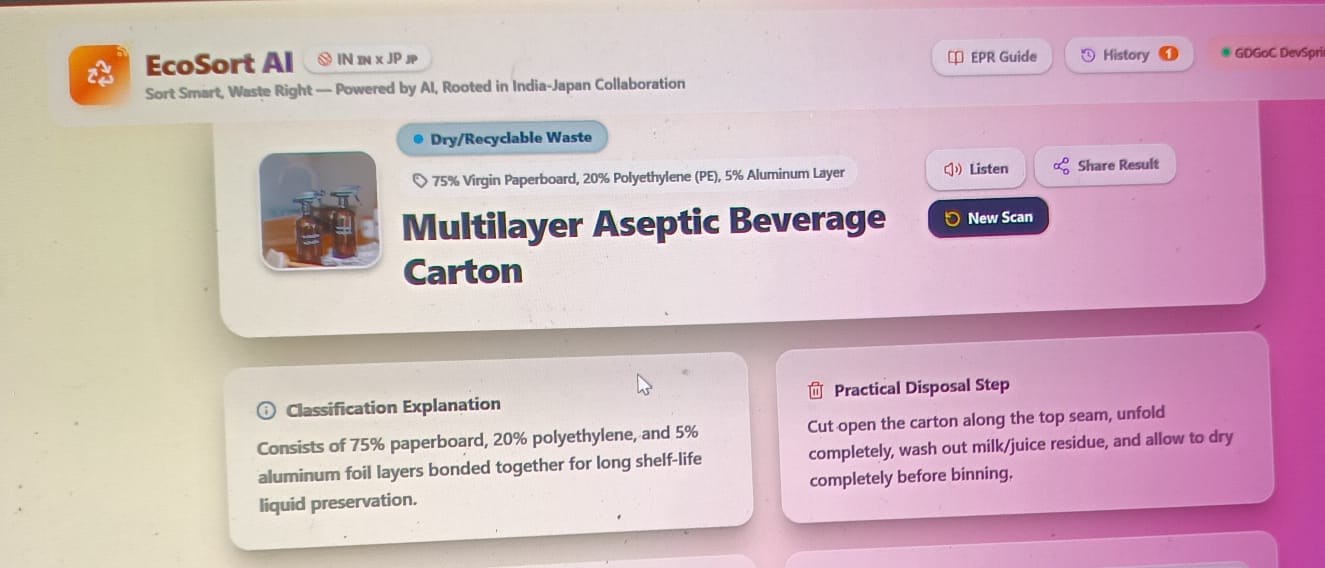
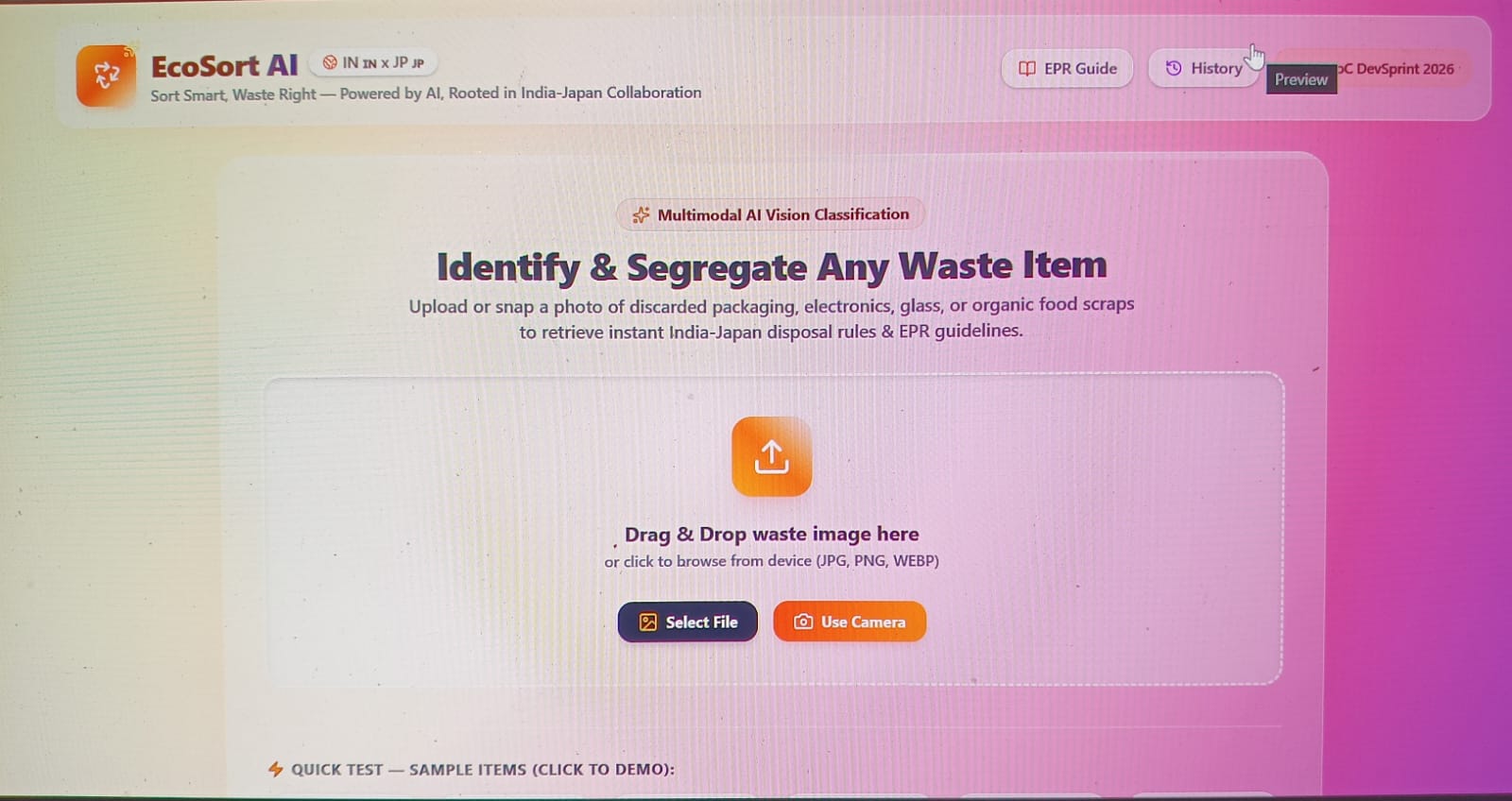
EcoSort AI lets a user upload or capture a photo of any waste item. Using Gemini's multimodal AI, it:
- Classifies the item (Wet/Organic, Dry/Recyclable, Plastic, E-Waste, Hazardous, Glass, Metal, Paper)
- Explains why it belongs to that category
- Gives a practical disposal tip and a creative reuse idea
- Shows the correct disposal rule for both India and Japan, side by side
- Connects the item to real environmental policy through our "EPR Connect" card — explaining how India's 2026 EPR regulations (Plastic/E-Waste/Solid Waste Management Rules) place responsibility on producers to ensure the item is properly recycled
How we built it
We built EcoSort AI using React with TypeScript on the frontend, bundled with Vite for fast development, and a lightweight Node.js server to handle Gemini API requests securely. The app sends the uploaded image with a structured prompt asking Gemini to return a JSON response (category, explanation, disposal tip, reuse idea, country-specific rules, and EPR note), which we parse and render in a custom glassmorphism UI with a light yellow–orange–orchid gradient theme. We used Google AI Studio to rapidly prototype the app structure and Gemini integration before refining it into the final build.
Challenges we ran into
- Getting Gemini to consistently return clean, structured JSON instead of free-form text
- Setting up the Node.js server layer correctly to keep the Gemini API key secure instead of exposing it on the frontend
- Balancing the amount of information shown per item without overwhelming the UI
- Making sure the India-Japan comparison and EPR policy information stayed factually accurate without the model fabricating specific numbers
- Designing a glassmorphism UI in React that stays readable and doesn't feel cluttered on mobile
Accomplishments that we're proud of
- A fully working end-to-end AI classification flow within the hackathon timeframe
- Successfully tying a real, current government policy (India's 2026 EPR framework) into a student hackathon project in a meaningful, non-generic way
- A genuinely cross-cultural feature that reflects the actual spirit of the Waseda x VTU collaboration
What we learned
We learned how to design effective structured prompts for multimodal AI models, how to structure a React + TypeScript + Vite project with a secure Node.js backend layer, how to translate real-world environmental policy into an accessible in-app feature, and how to collaborate effectively as a distributed India-Japan team under a tight deadline.
What's next for EcoSort AI
- Expanding country coverage beyond India and Japan
- Adding a location-based feature to find the nearest recycling center
- Building a lightweight leaderboard/rewards system to gamify correct waste sorting for schools and communities
Built With
- computer
- css
- gemini-api
- generative-ai
- github
- google-ai-studio
- google-gemini
- html
- javascript
- react
- vercel


Log in or sign up for Devpost to join the conversation.