-
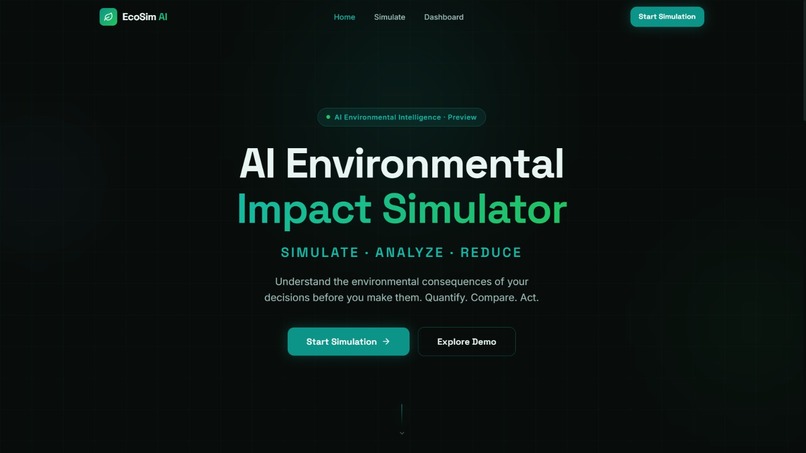
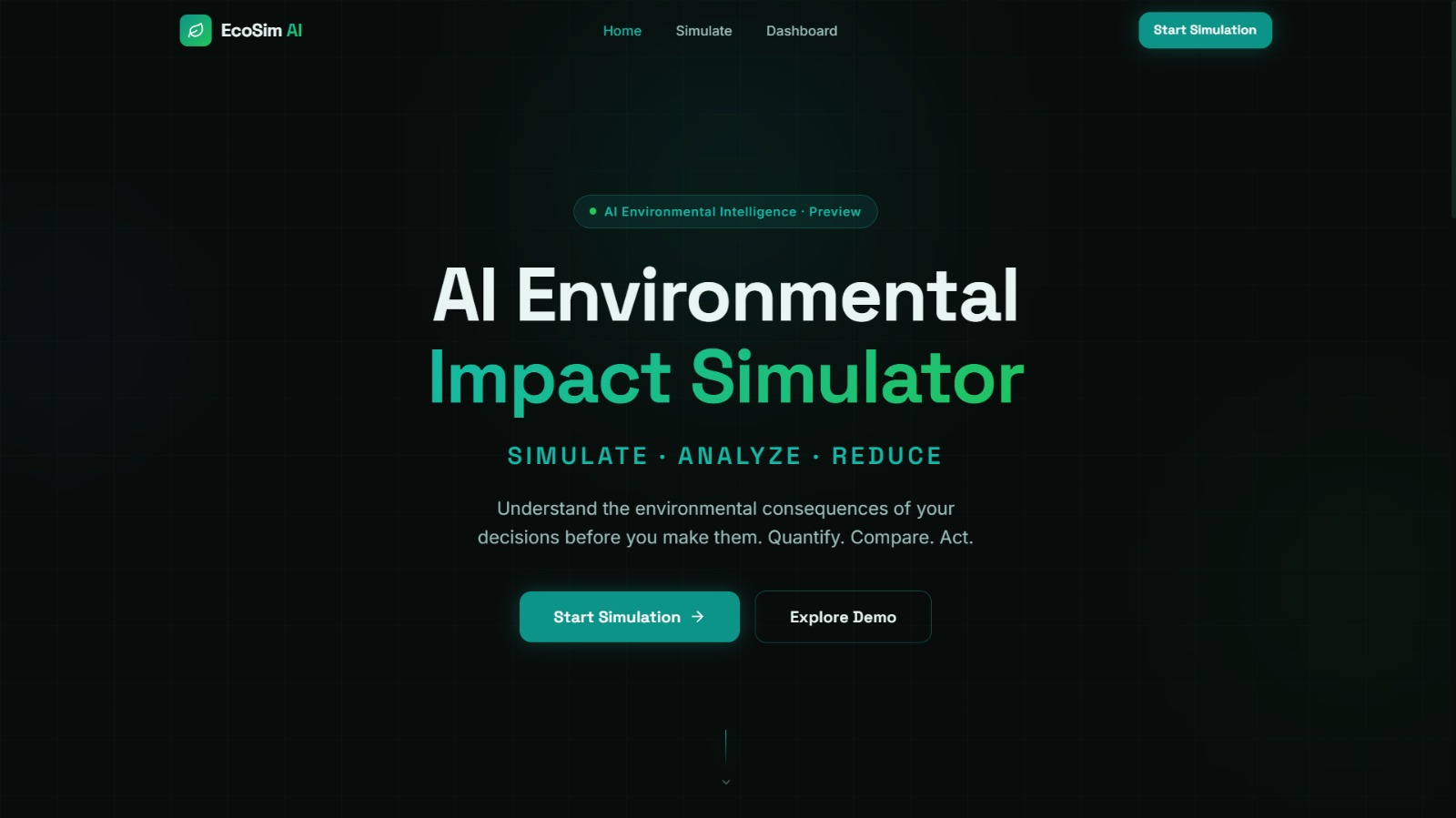
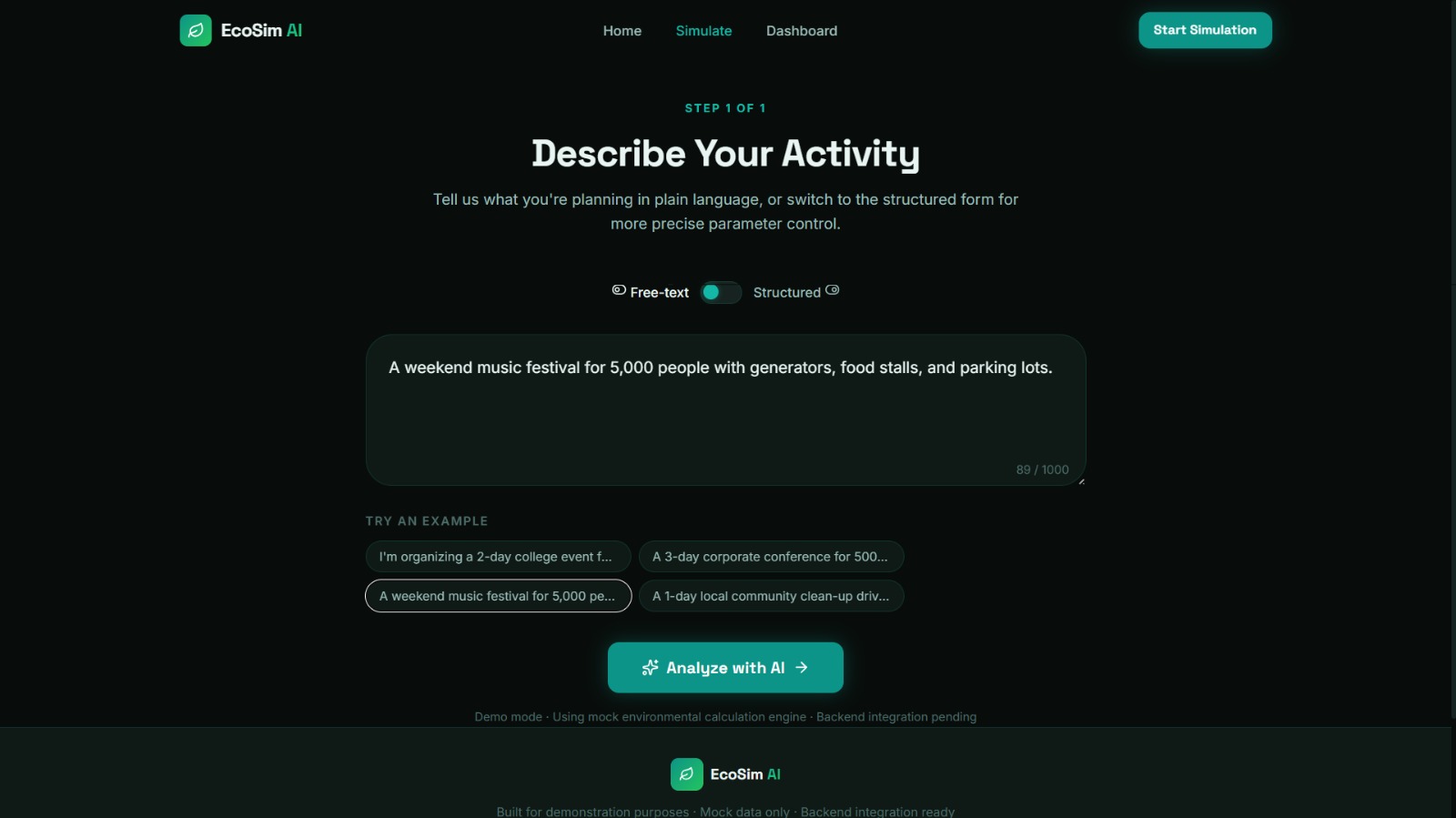
home page
-
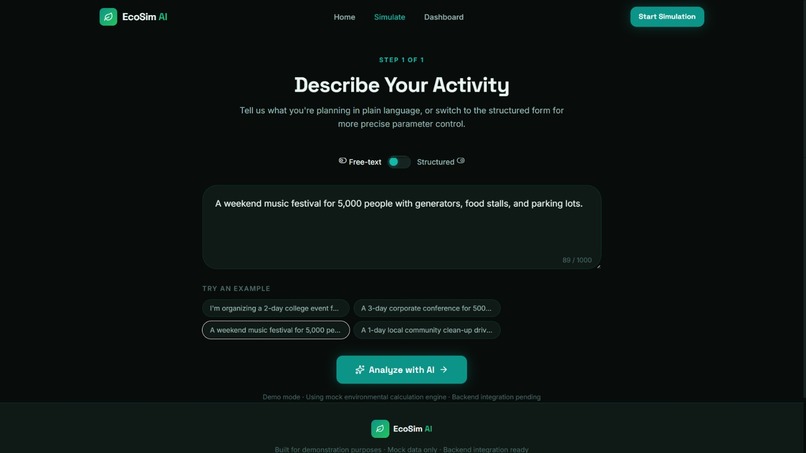
chat
-
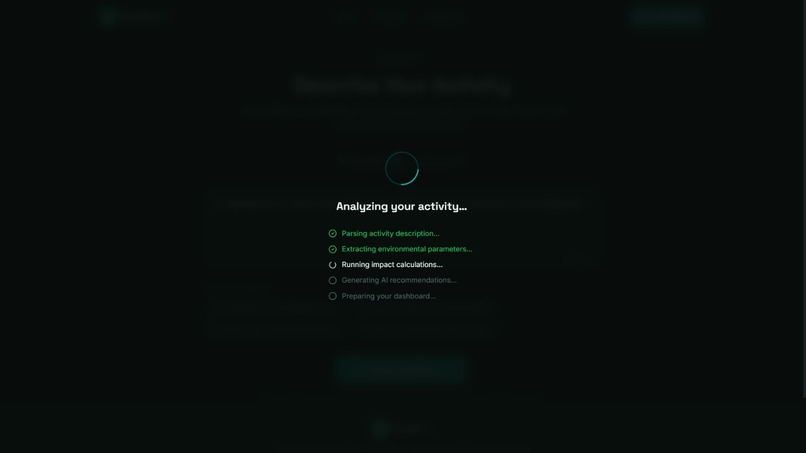
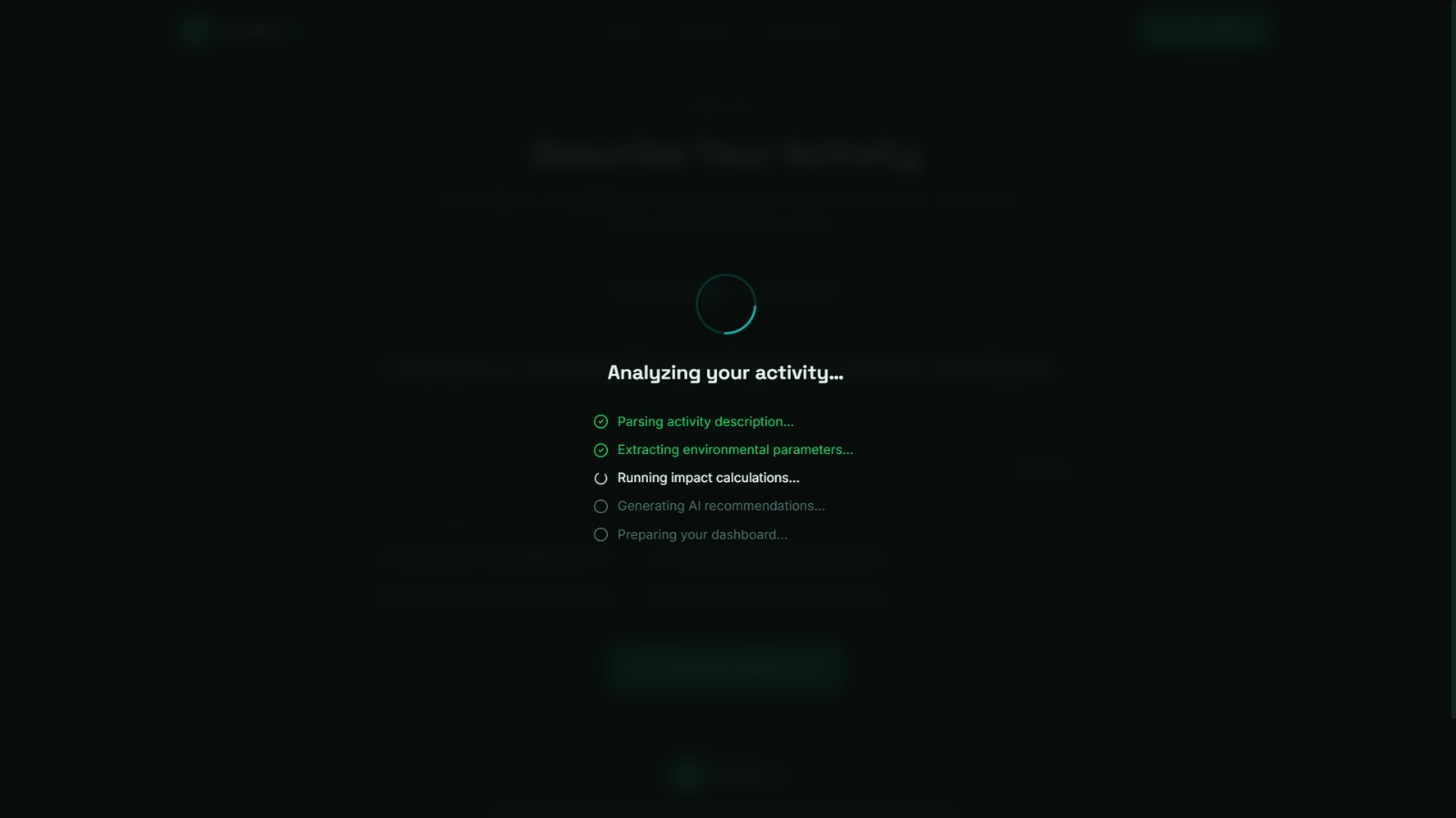
analyzing
-
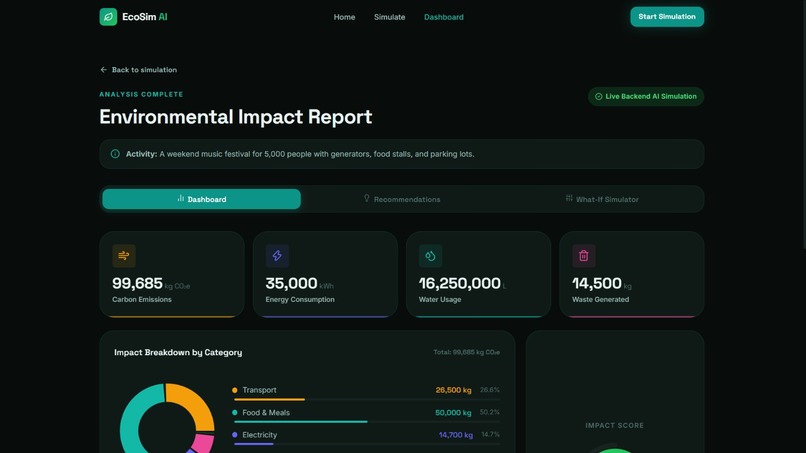
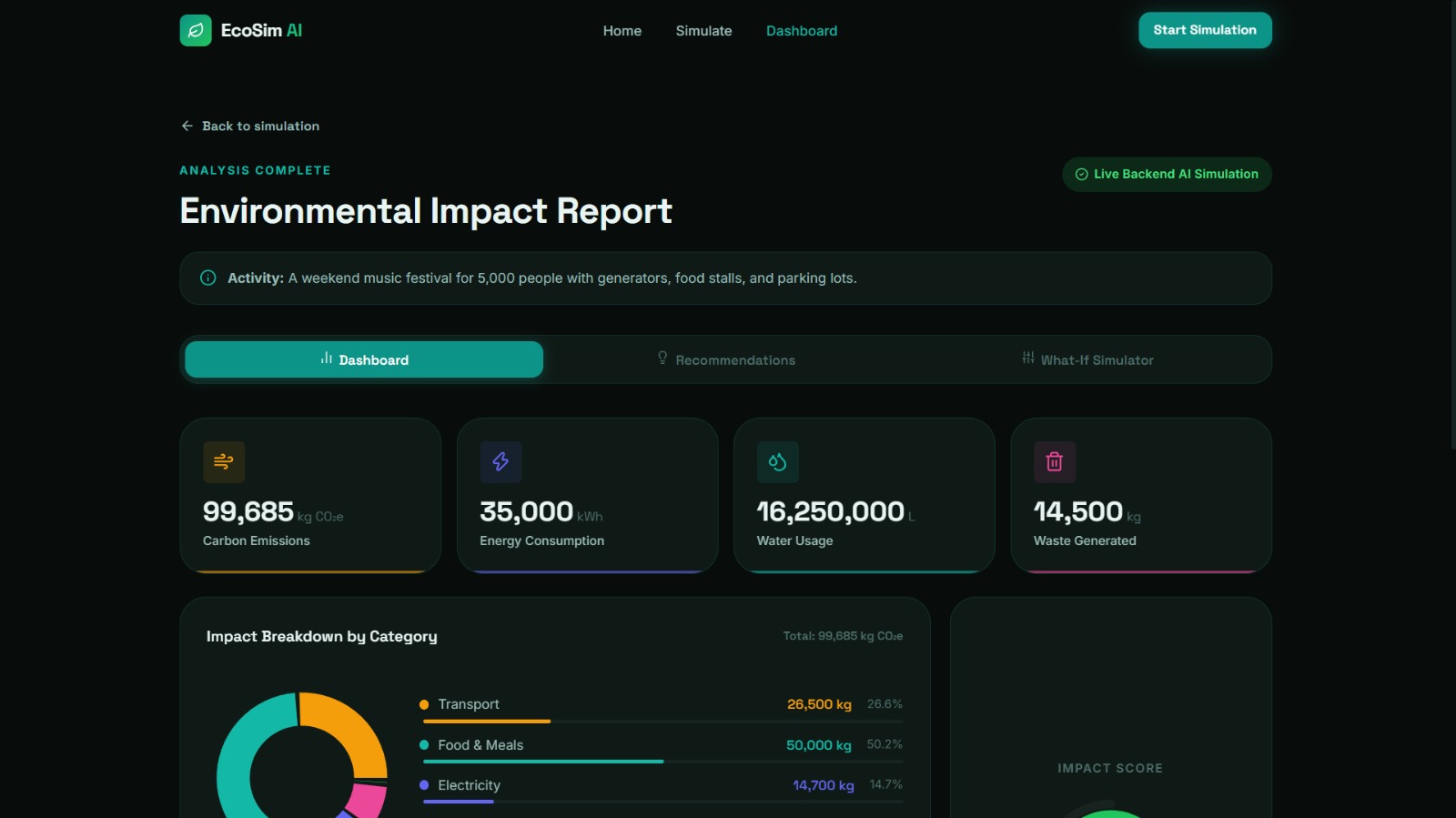
report
-
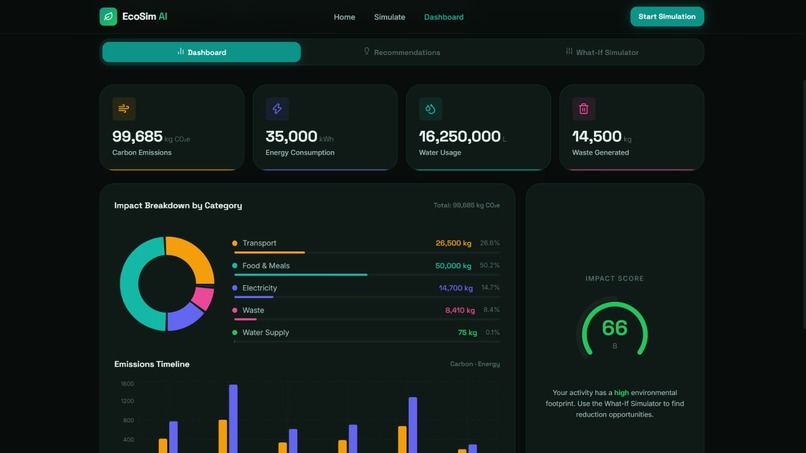
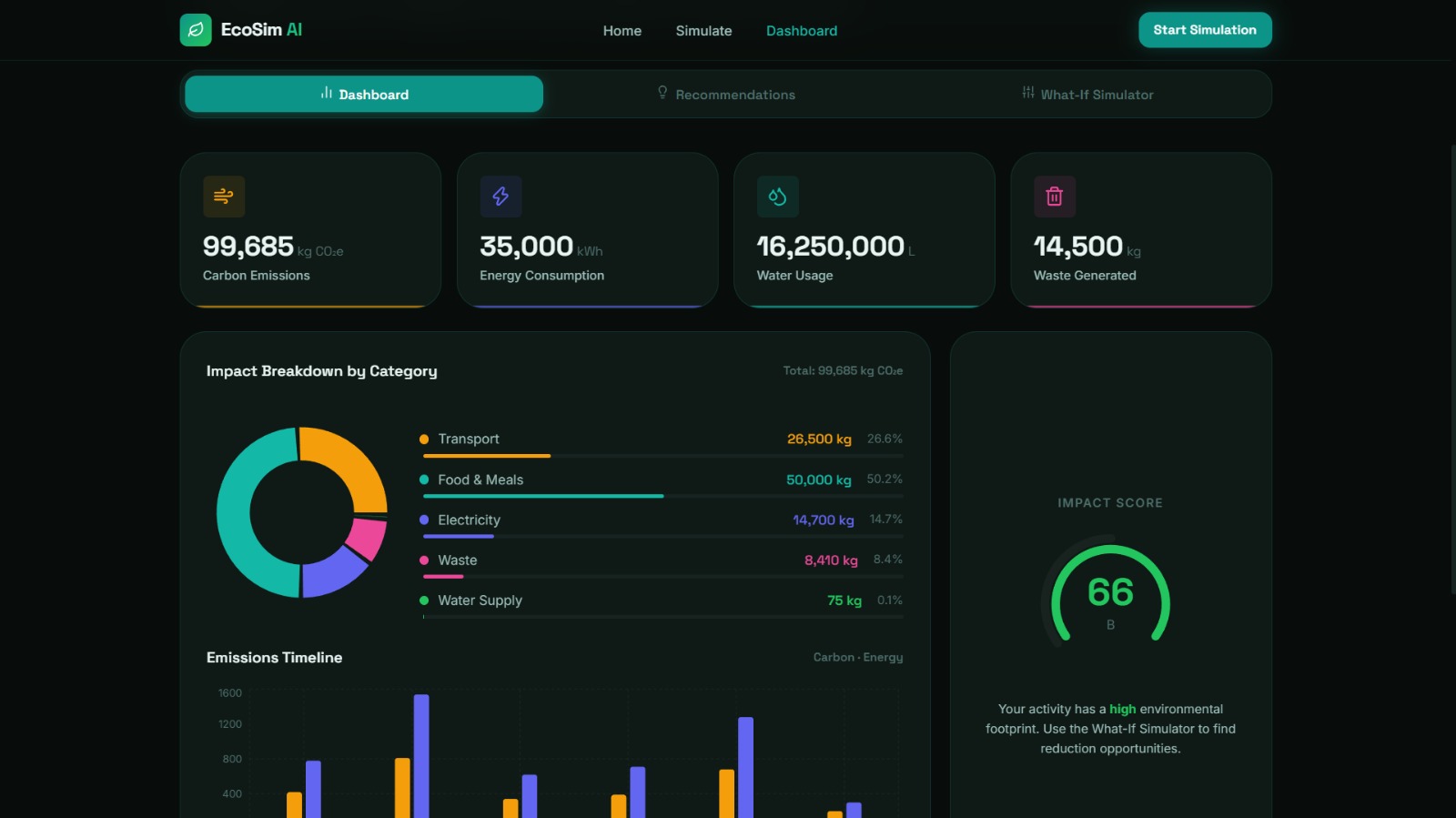
reports
-
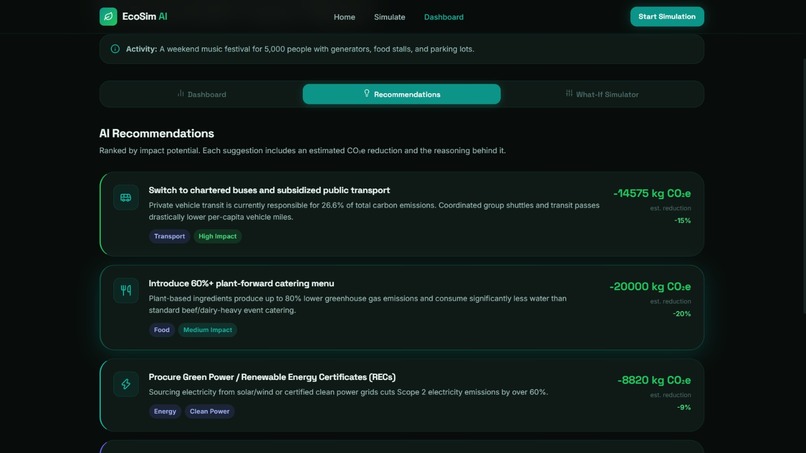
Recomendations
-
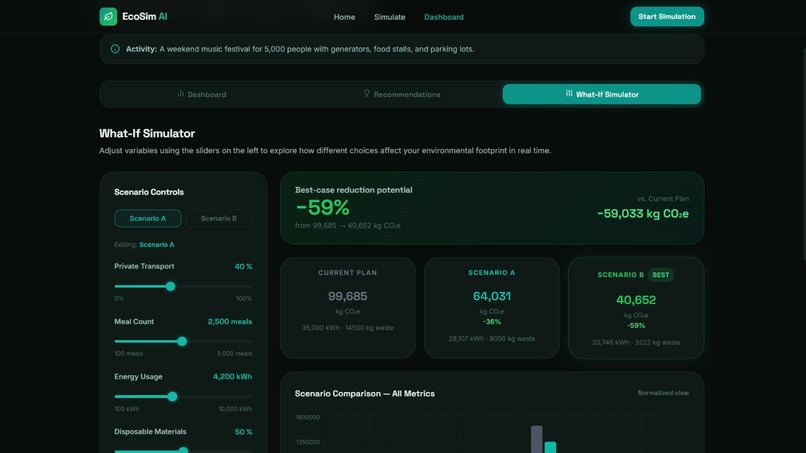
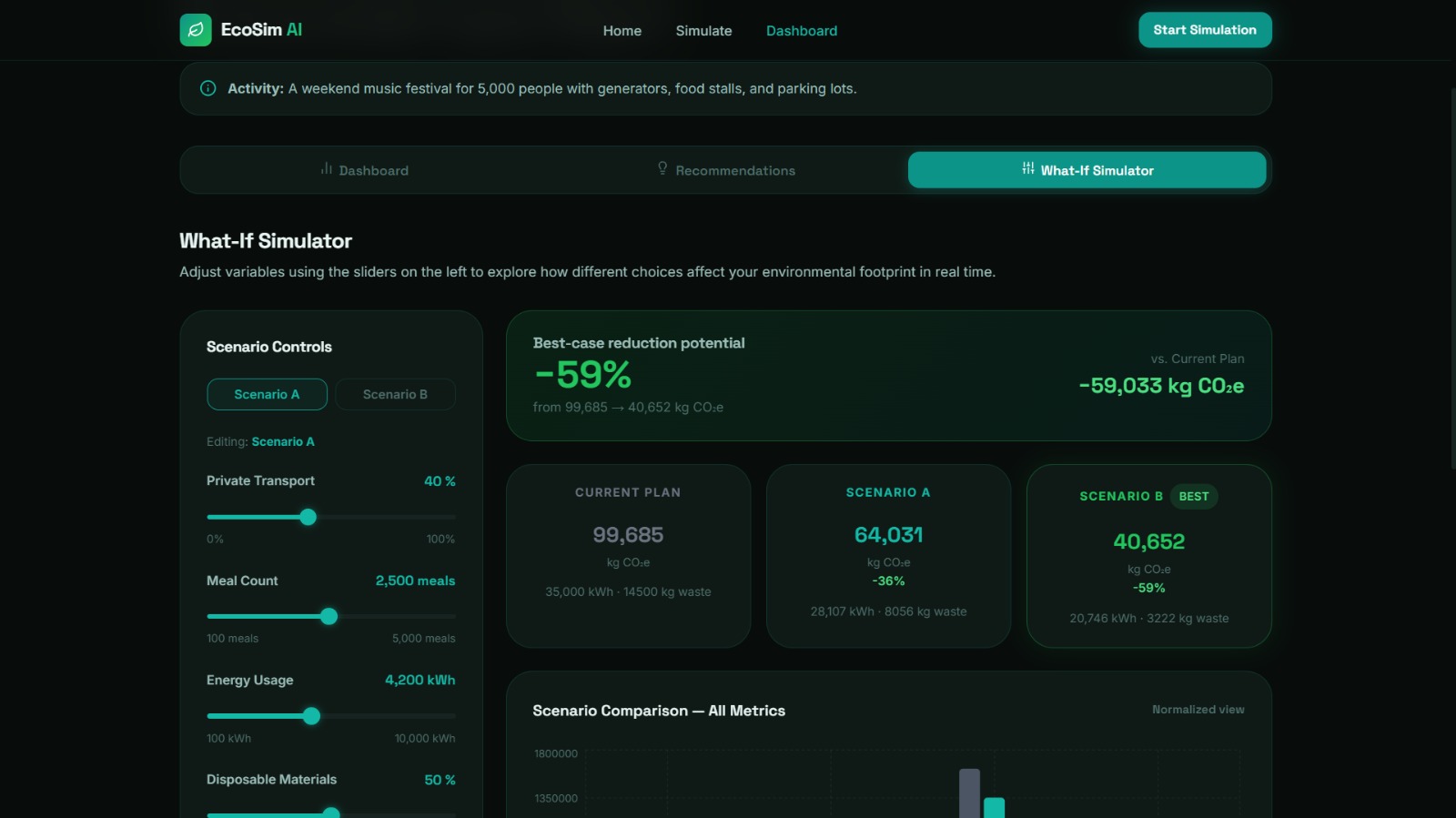
what-if simulator
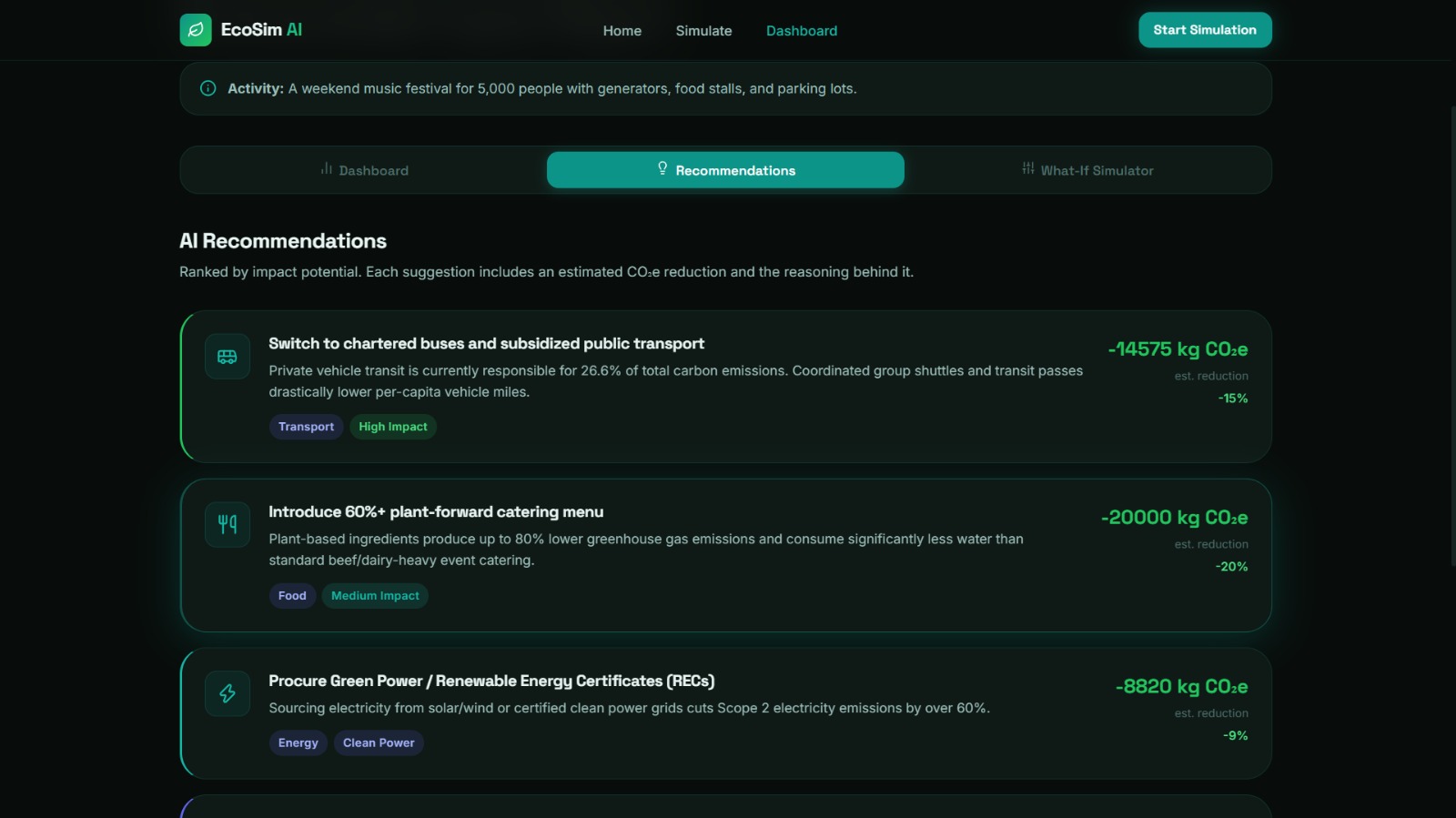
🌍 The Problem
Environmental decisions are often made without understanding their actual consequences.
Whether it's organizing an event, choosing transportation, planning energy usage, or managing resources, people usually see the environmental impact after the decision has already been made.
We wanted to explore a simple question:
What if we could simulate the environmental consequences before making the decision?
That question became the foundation of our project: an AI-powered Environmental Impact Simulator.
💡 The Idea
Our project allows users to describe a real-world activity in natural language and estimate its environmental impact across multiple dimensions, including:
- 🌫️ Carbon emissions
- ⚡ Energy consumption
- 💧 Water usage
- 🗑️ Waste generation
- 🚗 Transportation impact
Instead of only showing a single carbon-footprint number, the system identifies the major contributors to environmental impact and suggests practical ways to reduce them.
The most important part is the what-if simulation.
Users can modify decisions and compare scenarios:
What if more people use public transportation? What if single-use materials are replaced? What if energy consumption is reduced?
The system recalculates the impact and shows how the proposed changes could affect the overall outcome.
🤖 Where AI Comes In
We wanted AI to do more than simply generate text.
The system uses AI to understand natural-language descriptions of activities and convert them into structured environmental parameters.
For example:
"We're organizing a two-day college event for 1,000 students with meals, air conditioning, and transportation."
The AI can identify relevant factors such as:
- Number of participants
- Event duration
- Transportation
- Food requirements
- Energy usage
- Resource consumption
These parameters are then passed to the environmental calculation engine.
The calculation layer is responsible for the actual numerical computation, while AI helps with understanding, reasoning, scenario generation, and recommendations.
This separation is important because environmental calculations should be based on defined emission/resource factors rather than numbers simply generated by an LLM.
🔬 How It Works
The overall workflow is:
User's Activity Description
          ↓
     AI Interpretation
          ↓
Structured Parameters
          ↓
Environmental Calculation Engine
          ↓
Impact Analysis
          ↓
AI Recommendations
          ↓
What-If Scenario Simulation
          ↓
Impact Comparison
For example, a baseline scenario might produce:
$$ Impact_{total} = Impact_{transport} + Impact_{energy} + Impact_{food} + Impact_{water} + Impact_{waste} $$
The user can then modify one or more variables and compare the resulting scenarios.
This turns the system from a simple calculator into a decision-support tool.
🚀 What Inspired Us
The inspiration came from a common problem: environmental awareness does not always translate into environmental action.
People may know that transportation, excessive energy use, food waste, and disposable materials have environmental consequences. However, it is difficult to understand which decision matters most and what alternative would actually make a difference.
We wanted to make environmental impact more interactive.
Instead of saying:
"Your activity produced X kg of CO₂."
we wanted the system to say:
"Here is where the impact comes from, here is what you can change, and here is what could happen if you change it."
🛠️ How We Built It
We designed the project as a modular system consisting of:
- Natural-language input for describing an activity.
- AI interpretation for extracting relevant parameters.
- Environmental calculation engine for estimating resource usage and emissions.
- Scenario engine for modifying variables and recalculating impact.
- AI recommendation layer for identifying potential improvements.
- Visualization layer for comparing the baseline and alternative scenarios.
A key design decision was keeping the AI layer separate from the numerical calculation engine. This makes the system easier to validate and allows environmental factors to be updated independently.
🧠 What We Learned
One of the biggest lessons was that building an AI application is not simply about putting an LLM into a product.
The difficult part is deciding where AI is actually useful.
We learned that AI is well suited for interpreting messy human input and generating recommendations, while deterministic calculations are better handled by a dedicated calculation engine.
We also learned that environmental applications require careful attention to the quality and source of underlying data. A visually impressive prediction is meaningless if the environmental factors behind it are unreliable.
⚔️ Challenges
1. Making AI meaningful
Our first challenge was avoiding the common approach of using an LLM as a chatbot and calling the project "AI-powered."
We instead designed AI around specific tasks where it provides genuine value: input interpretation, reasoning, and recommendations.
2. Environmental data
Environmental impact depends heavily on factors such as location, energy sources, transportation type, consumption patterns, and assumptions.
Creating a system that provides useful estimates while clearly communicating uncertainty is therefore an important challenge.
3. Balancing simplicity and accuracy
A highly detailed environmental model can become extremely complicated.
Our goal was to find a balance between a model that is understandable and usable while still being meaningful enough to support real decisions.
🌱 Our Vision
We don't want this to become another dashboard that people look at once and forget.
Our vision is to make environmental impact something people can experiment with before making decisions.
From a college event to a business operation, the fundamental idea remains the same:
Understand the impact. Simulate the alternatives. Make the better decision.
We believe AI can help turn environmental awareness into something more practical:
not just measuring the damage, but helping people choose a better path before the damage happens.
Built With
- ai
- api
- apis
- boot
- data
- environmental
- java
- javascript
- llm
- postgresql
- react
- rest
- spring
- web

Log in or sign up for Devpost to join the conversation.