Inspiration
Consider a typical day: Riya books a cab during surge pricing, orders a quick meal without considering alternatives, and shops online with express delivery and extra packaging. At no point does she ask — was there a more sustainable option? Not because she doesn't care, but because she lacks the right information at the right moment.
We were inspired by this gap between intent and action. Sustainability data exists, but it's buried in reports and research papers — never available at the actual moment of decision. We wanted to build something that intercepts those micro-decisions and provides actionable intelligence, not guilt.
What it does
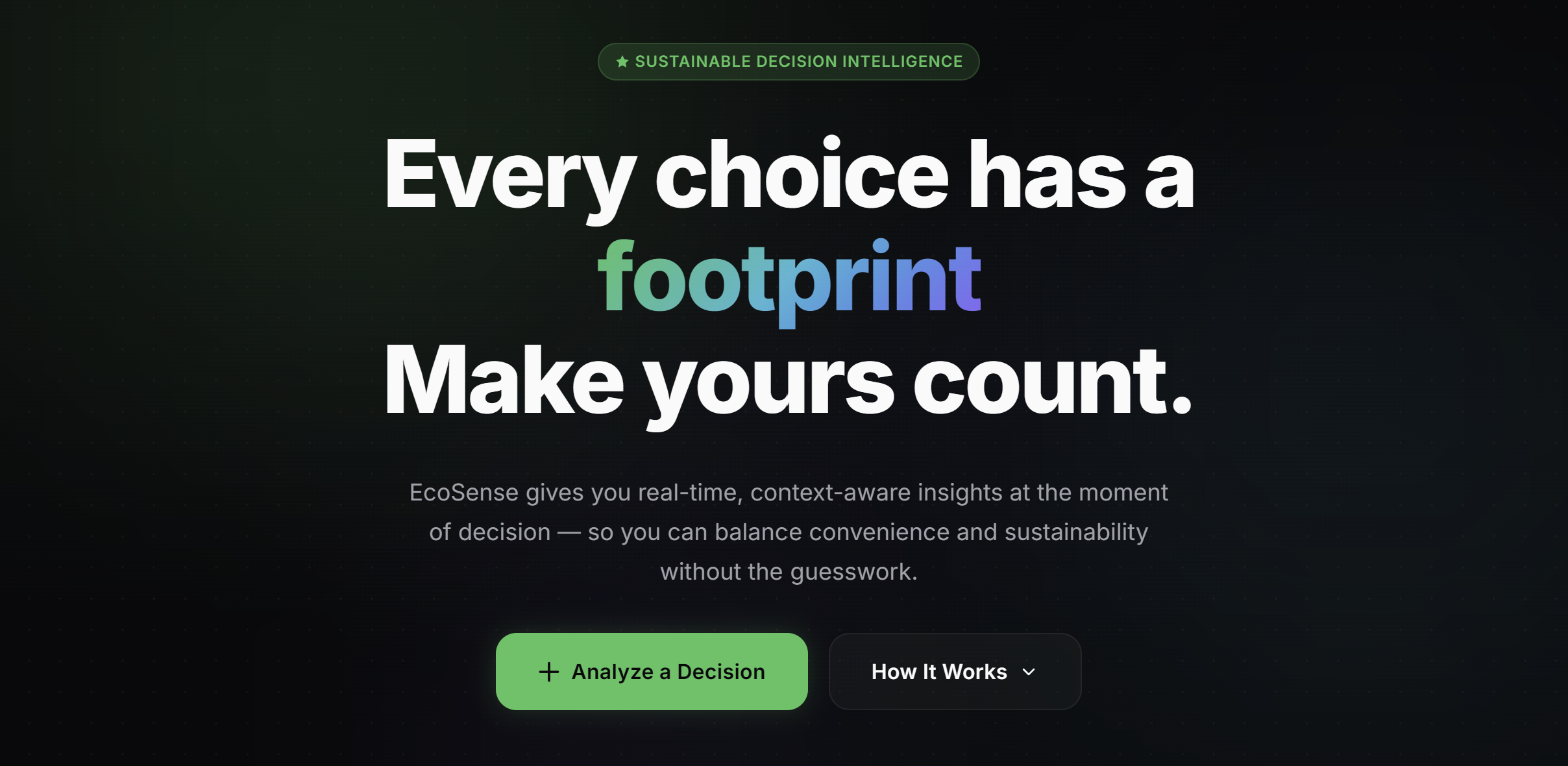
EcoSense is a real-time sustainable decision engine that analyzes three high-frequency daily decisions — commuting, food, and shopping — and delivers:
- Impact quantification using verified DEFRA/EPA emissions data (CO₂, water, energy)
- Ranked alternatives scored by both sustainability AND convenience — no forced trade-offs
- Equivalency framing that converts abstract CO₂ numbers into relatable terms ("= charging 80 phones", "= driving 4 km")
- Behavioral nudges — context-aware micro-copy that reframes impact without friction
For example, selecting a 15 km cab ride instantly shows you it produces 3.15 kg CO₂, that the metro would save 2.535 kg at ₹150 less, and that the difference equals 309 smartphone charges.
How we built it
We designed a 4-stage layered decision engine:
- Context Parser — extracts scenario parameters (distance, meal type, delivery method)
- Impact Quantifier — calculates CO₂e using peer-reviewed emissions factors from DEFRA 2024, EPA, and Poore & Nemecek (2018)
- Alternative Generator — ranks all options by emissions (ascending) with convenience trade-off scores
- Nudge Engine — generates severity-aware behavioral messages with equivalency framing
The frontend is built with Next.js 15 (App Router) using a premium Aceternity-inspired dark UI with glassmorphism, gradient borders, and micro-animations. All styling is vanilla CSS with a comprehensive design token system. Typography uses the Inter font family.
The emissions dataset is embedded directly — no external API dependencies — making the engine fast, reliable, and offline-capable.
Challenges we ran into
- Data accuracy: Finding consistent, comparable emissions factors across different categories (transport, food, logistics) required cross-referencing multiple sources (DEFRA, EPA, IPCC AR6, academic papers). Units vary — some report per-km, others per-trip, per-serving, or per-kg of product.
- Equivalency calibration: Making CO₂ equivalencies both accurate and intuitively meaningful. "= 309 smartphone charges" is more impactful than "= 2.535 kg CO₂" but the conversion factors need to be scientifically grounded.
- Balancing nudge tone: The nudge engine needed to be persuasive without being preachy. We calibrated four severity levels (low/medium/high/critical) with different messaging strategies — positive reinforcement for good choices, gentle reframing for moderate ones.
Accomplishments that we're proud of
- Real emissions data, not estimates: Every CO₂ factor is traceable to a published source (DEFRA 2024, EPA, Poore & Nemecek 2018 in Science)
- The equivalency engine: Converting abstract numbers into "= X phone charges" or "= Y km driven" makes impact genuinely tangible
- Zero-friction design: No sign-ups, no accounts, no databases — input a decision, get instant intelligence
- Trade-off transparency: We never hide the convenience cost. Every alternative shows both the sustainability gain AND the convenience trade-off, letting users make informed choices rather than forced ones
What we learned
- Behavioral design matters more than data: Having accurate emissions numbers is necessary but insufficient. The way you frame the data — equivalencies, nudge copy, visual severity cues — is what actually influences decisions.
- Convenience scoring is subjective but essential: Users won't adopt a "greener" option if it's wildly inconvenient. Acknowledging and quantifying the convenience trade-off builds trust.
- Small decisions compound: A single meal swap from beef to dal saves ~6 kg CO₂. Done daily, that's 2,190 kg/year — equivalent to a short-haul flight. The math is staggering when you project it.
What's next for EcoSense — Sustainable Decision Engine
- Gemini AI integration: Natural language input ("I'm taking a cab from Koramangala to Whitefield at 8:30 AM") with AI-powered context parsing and personalized recommendations
- Location-aware suggestions: GPS-based transit options with real-time availability (metro schedules, bike-share stations nearby)
- Habit tracking dashboard: Track cumulative impact over time with weekly/monthly sustainability reports
- Browser extension: Intercept decisions on food delivery apps (Swiggy/Zomato) and e-commerce sites (Amazon/Flipkart) with real-time sustainability overlays
- Community leaderboard: Gamified collective impact — "Your neighborhood saved 4.2T kg CO₂ this month"
Built With
- css
- data
- defra/epa
- emissions
- javascript
- next.js
