InspirationAs a project coordinator at ADE-CLIMATERRA RDC, I work daily with communities in Ituri, Sud-Kivu, Kinshasa, and Tshopo to combat deforestation and build climate resilience. But access to reliable, localized environmental data remains a major barrier. Field teams, farmers, and local leaders often struggle to make informed decisions due to fragmented or inaccessible information.
This inspired me to create EcoSearch Agent — a conversational AI tool that transforms how we interact with environmental data. By combining Elastic’s AI-powered search with Google Cloud’s natural language capabilities, I wanted to build a system that speaks the language of the field: intuitive, bilingual, and focused on impact.
My goal is to empower communities with insights they can trust — whether it’s identifying erosion-prone zones, tracking rainfall trends, or planning reforestation efforts. EcoSearch Agent is more than a tech demo; it’s a step toward democratizing climate intelligence in the Global South.
What it does EcoSearch Agent is a bilingual conversational AI that helps users explore environmental data through natural language queries. Built on Elastic’s AI-powered search and Google Cloud’s Vertex AI, it enables:
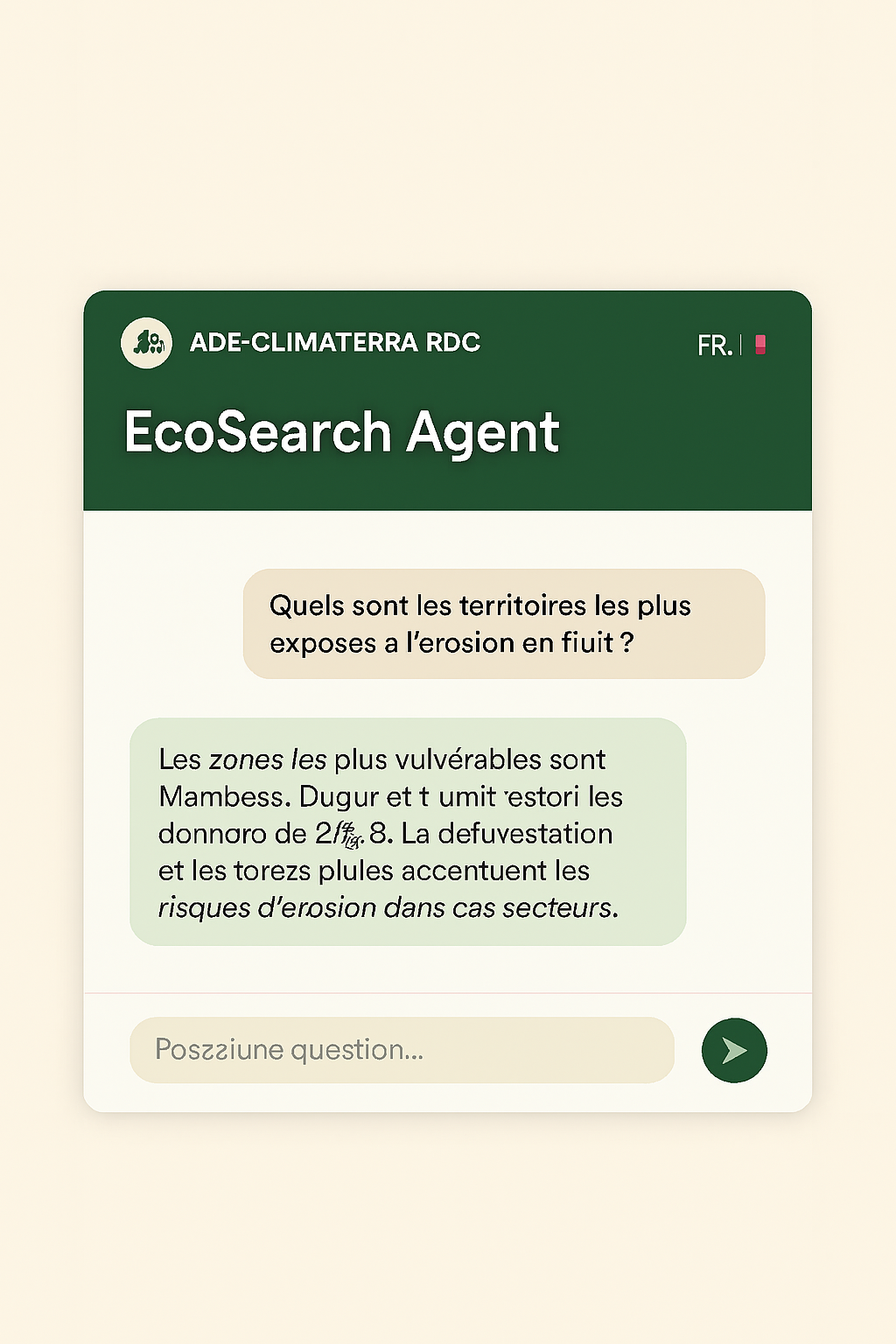
🔍 Semantic Search: Users can ask questions like “Quels sont les territoires les plus exposés à l’érosion en Ituri?” or “Show me rainfall trends in Sud-Kivu from 2018 to 2023.” The agent retrieves relevant insights using vector embeddings and contextual search.
🗣️ Conversational Interface: A lightweight web app lets users interact with the data in French or English, making climate intelligence accessible to field teams, NGOs, and decision-makers.
🌐 Real-Time Insights: The system connects to curated datasets (CSV, JSON, APIs) and delivers up-to-date responses on topics like deforestation, agroforestry zones, rainfall patterns, and soil vulnerability.
📊 Decision Support: EcoSearch Agent empowers local actors to plan reforestation, assess climate risks, and prioritize interventions based on data — without needing technical expertise.
How we built it
Challenges we ran into Building EcoSearch Agent solo within a tight timeframe came with several hurdles:
Data fragmentation: Environmental datasets were scattered across formats (CSV, JSON, APIs) and lacked consistent structure. Harmonizing them for semantic search required custom preprocessing and indexing strategies.
Language duality: Ensuring smooth bilingual interaction (French/English) was essential for accessibility in RDC. Fine-tuning prompts and responses to maintain clarity across languages was a challenge.
Relevance vs. precision: Balancing Elastic’s semantic search with factual accuracy in climate data was tricky. Some queries returned contextually relevant but technically imprecise results, requiring iterative tuning.
Solo development: Managing architecture, data ingestion, AI integration, and UI design alone meant prioritizing core features over polish. Time constraints limited deeper experimentation with advanced connectors or real-time updates.
Limited connectivity: Testing cloud-based tools in low-bandwidth environments highlighted the need for offline or lightweight deployment options — a future improvement area.
Accomplishments that we're proud of
Built a functional AI-powered search agent solo in under two weeks, integrating Elastic Search, Google Cloud, and Gemini — all while managing other climate project responsibilities.
Enabled bilingual interaction (French/English) to ensure accessibility for local communities, field teams, and international partners across RDC.
Structured and indexed real-world climate datasets (rainfall, erosion zones, reforestation maps) into a semantic search system that delivers relevant, actionable insights.
Designed a clean, intuitive interface that allows users to ask natural questions and receive contextual answers — no technical expertise required.
Aligned the project with real-world impact goals, including reforestation planning, agroforestry deployment, and climate risk mapping in vulnerable territories.
Demonstrated that solo innovators from the Global South
What we learned
Elastic’s AI-powered search is incredibly versatile — but tuning it for environmental data requires careful indexing, relevance scoring, and multilingual prompt engineering.
Natural language interfaces can democratize access to complex datasets, especially when designed for bilingual use in French and English. This reinforced the importance of inclusive design in climate tech.
Solo development is possible — and powerful. With the right cloud tools and a clear vision, one person can build a functional AI agent that addresses real-world challenges.
Environmental data needs context. Raw numbers aren’t enough; communities need insights framed around local realities, risks, and opportunities. This shaped how EcoSearch Agent responds to queries.
Hackathons are accelerators of innovation. The time pressure pushed me to prioritize impact, simplify architecture, and focus on what truly matters: empowering users with meaningful answers.
What's next for EcoSearch Agent
Expand dataset coverage: Integrate additional climate and agroforestry datasets from RDC and neighboring regions, including satellite imagery, soil maps, and biodiversity indicators.
Offline and mobile-first deployment: Develop a lightweight version of EcoSearch Agent that works in low-connectivity environments, enabling field teams and rural communities to access insights without internet dependence.
Community feedback loop: Launch pilot testing with local stakeholders in Ituri, Sud-Kivu, Kinshasa, and Tshopo to refine queries, improve relevance, and co-design new features based on real needs.
Multimodal search: Incorporate image-based queries (e.g., erosion photos, tree species) and geospatial search to enhance usability for agroforestry planning and climate risk mapping.
Grant integration: Align EcoSearch Agent with upcoming funding opportunities (UNICEF Climate Innovation Challenge, Giga Accelerator, Catapult Development) to scale its impact and reach.
Open-source roadmap: Prepare documentation and modular components to share EcoSearch Agent as an open-source tool for other climate innovators across the Global South.
Built With
- app-engine)-search-engine:-elastic-search-(vector-search
- cloud-storage
- csv/json-datasets-apis:-gemini-api
- data
- elastic-search-api
- figma-(for-ui-mockups)
- for
- gemini
- google-maps-api-(optional-for-geospatial-queries)-other-tools:-github
- here?s-a-solid-list-you-can-enter-under-built-with-for-your-ecosearch-agent-project:-languages:-python
- javascript-frameworks:-flask-(backend)
- postman
- react-(frontend)-cloud-services:-google-cloud-(vertex-ai
- semantic-relevance)-databases:-firebase-(for-lightweight-storage)
- sheets

Log in or sign up for Devpost to join the conversation.