-
-
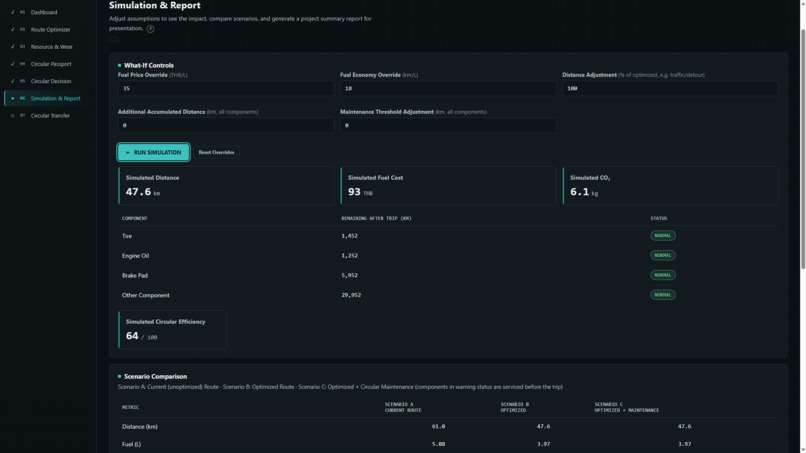
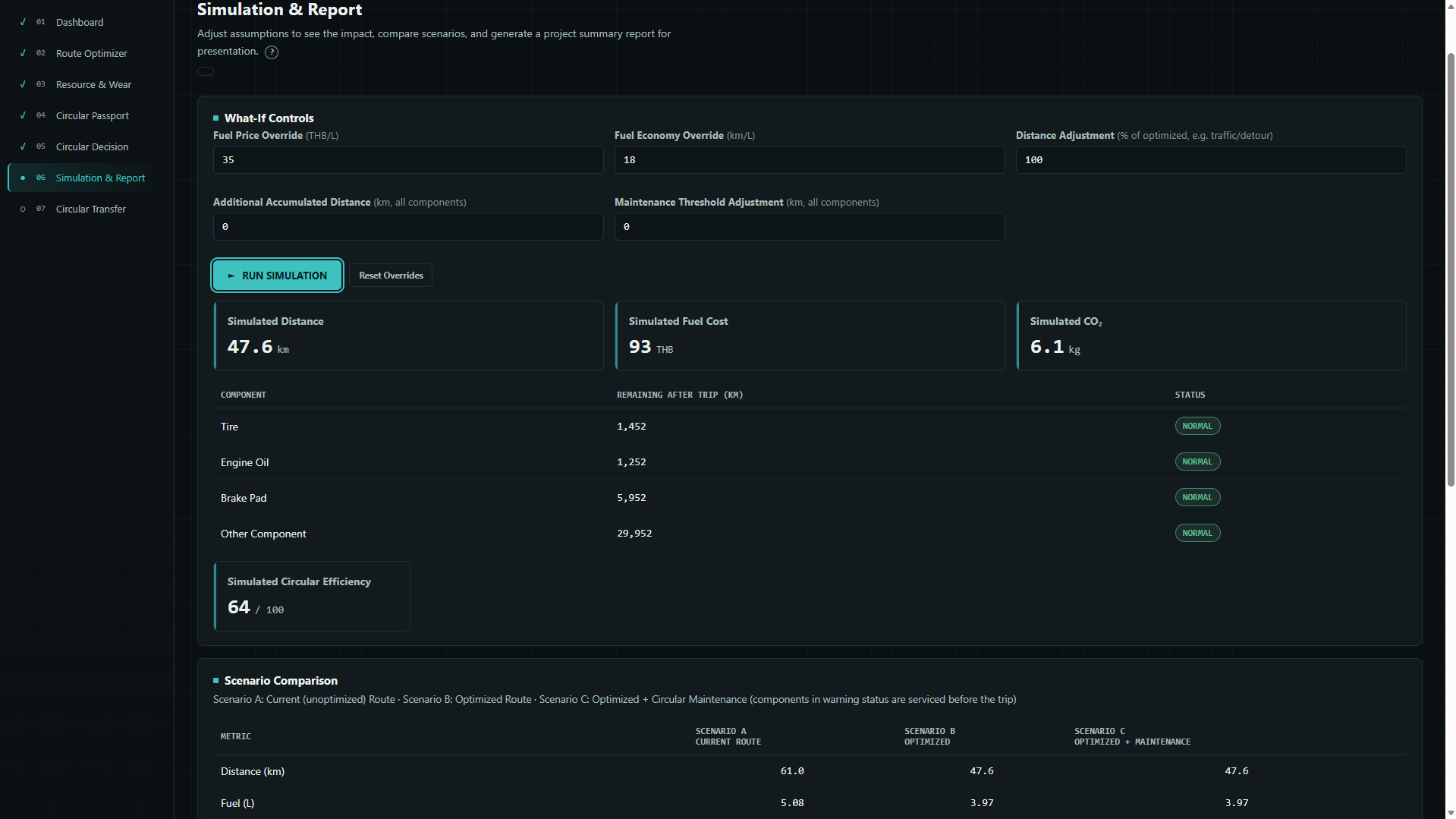
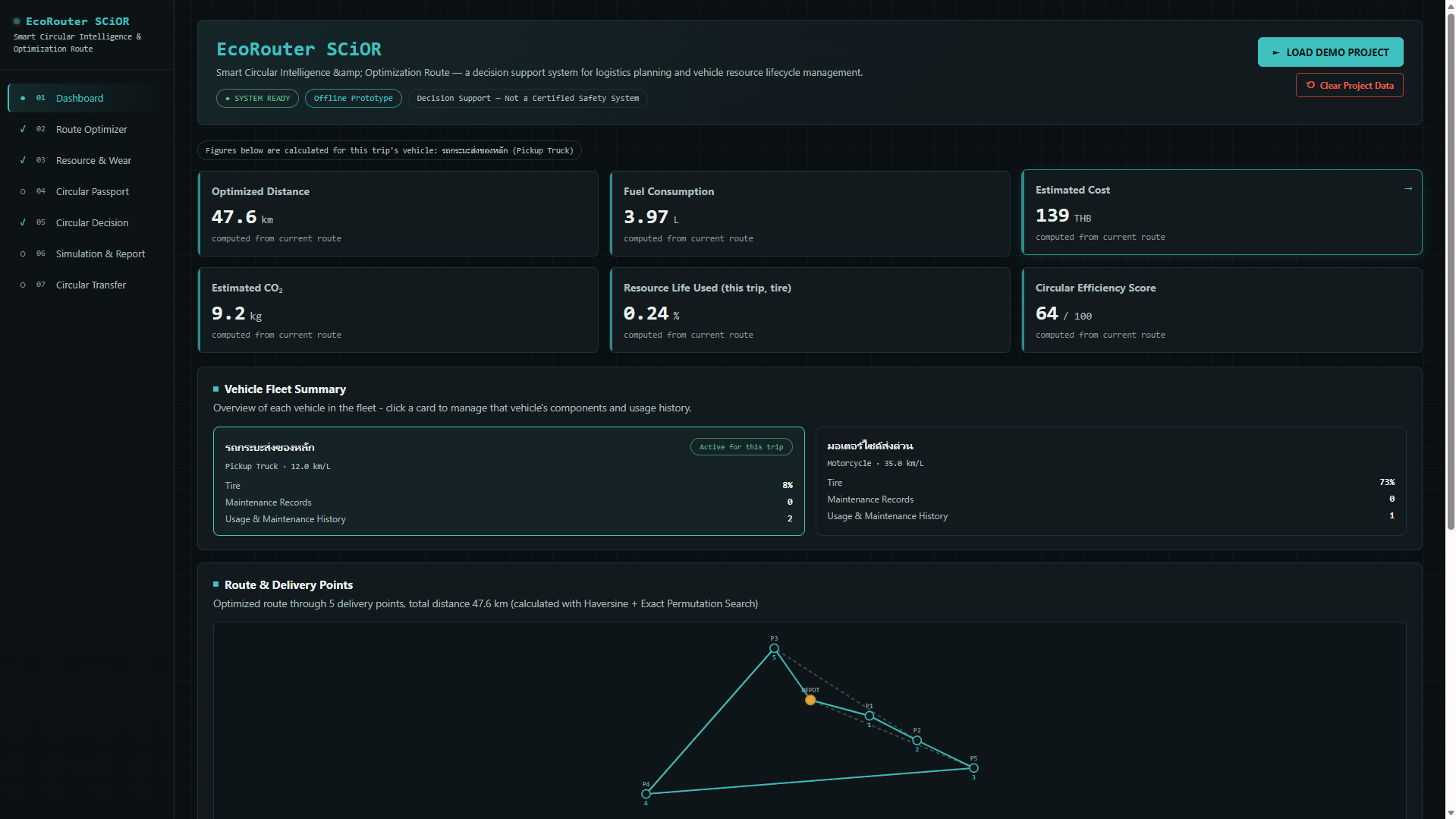
Simulation & Report: Comparing scenarios to evaluate distance, fuel cost, emissions, and circular efficiency.
-
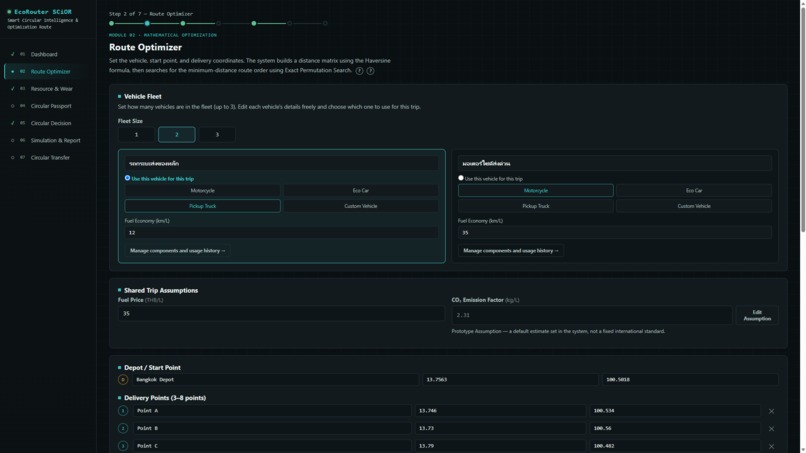
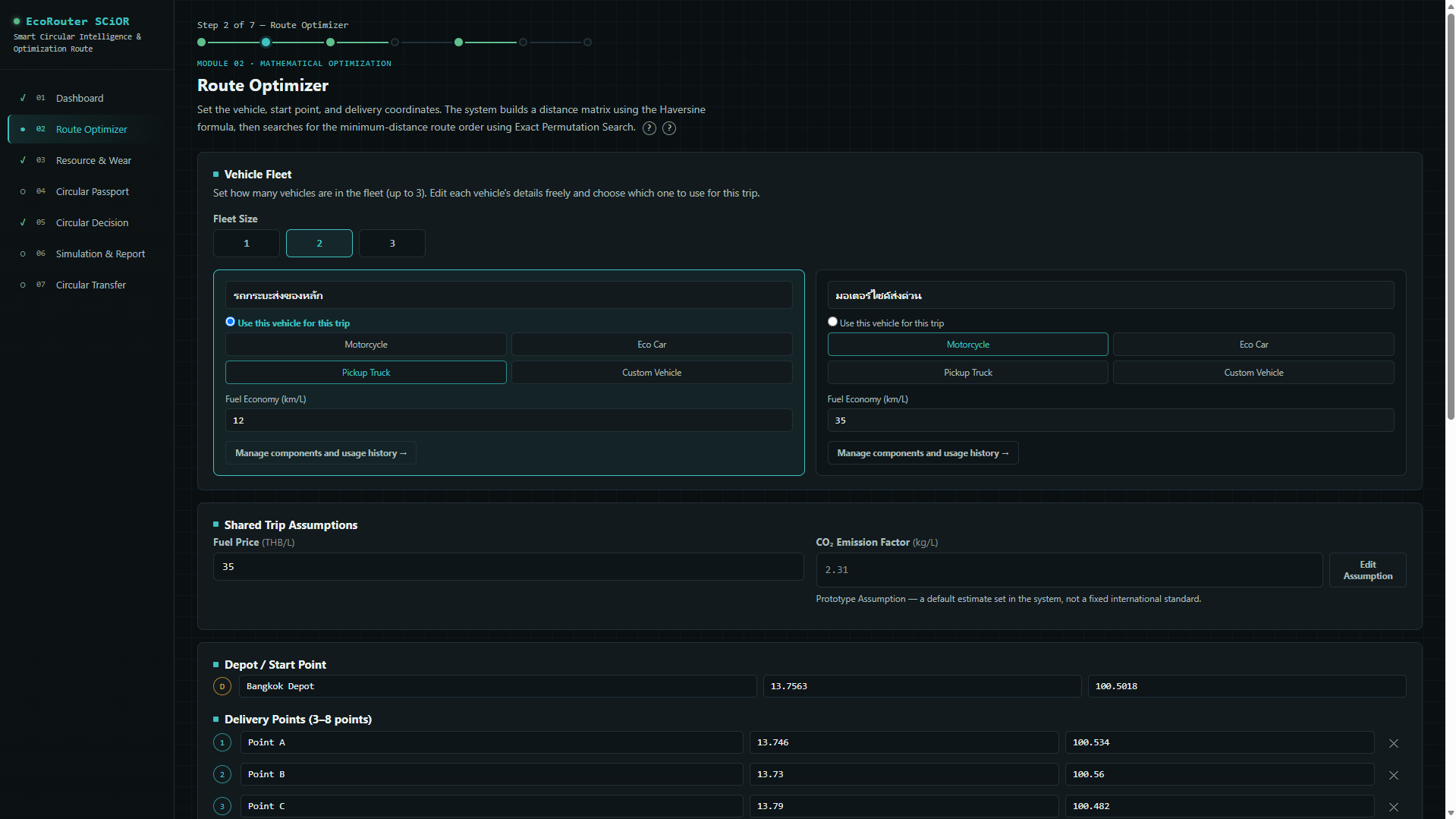
Route Optimizer: Optimizing delivery routes through mathematical distance modeling and exact route search.
-
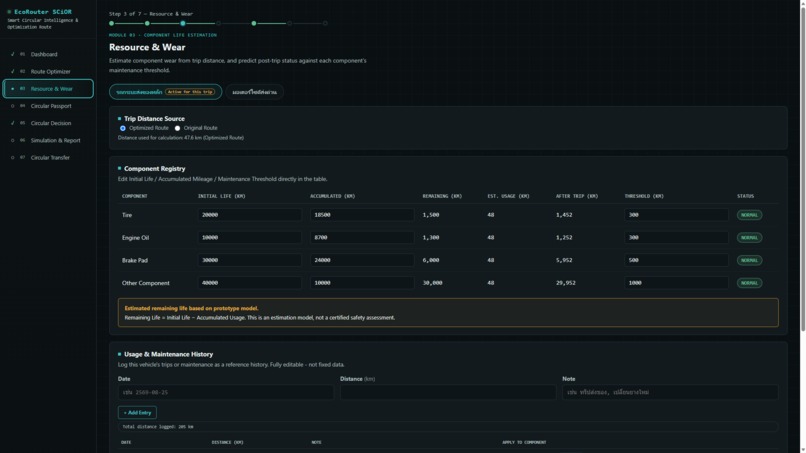
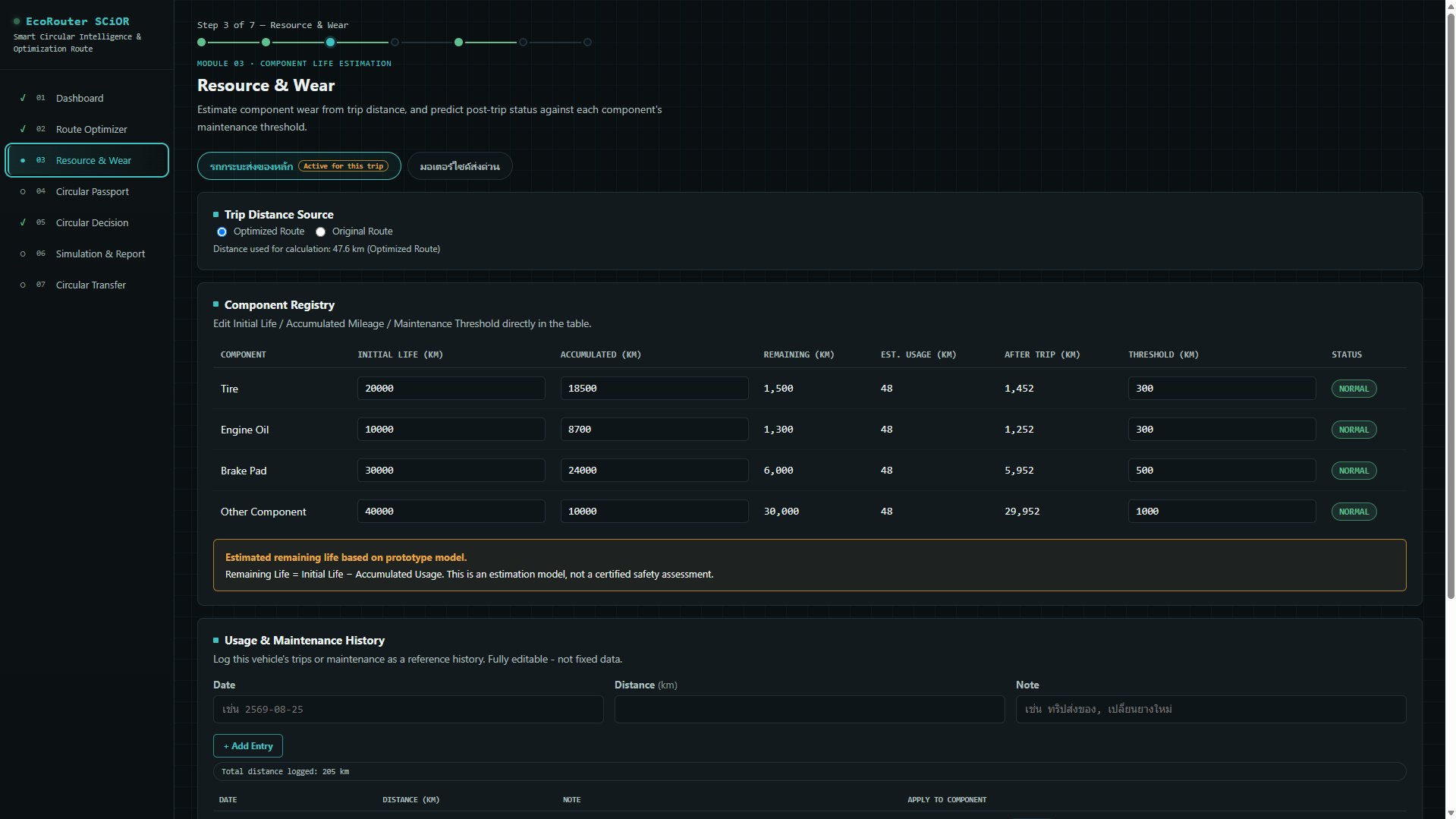
Resource & Wear: Monitoring component wear and estimating remaining service life from vehicle usage.
-
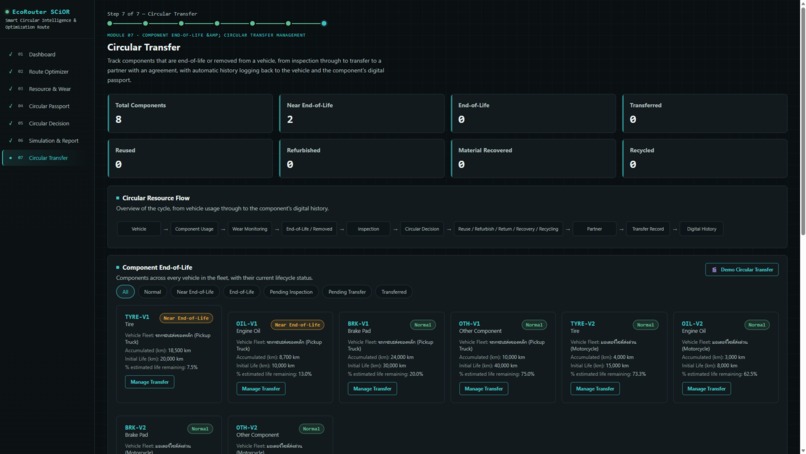
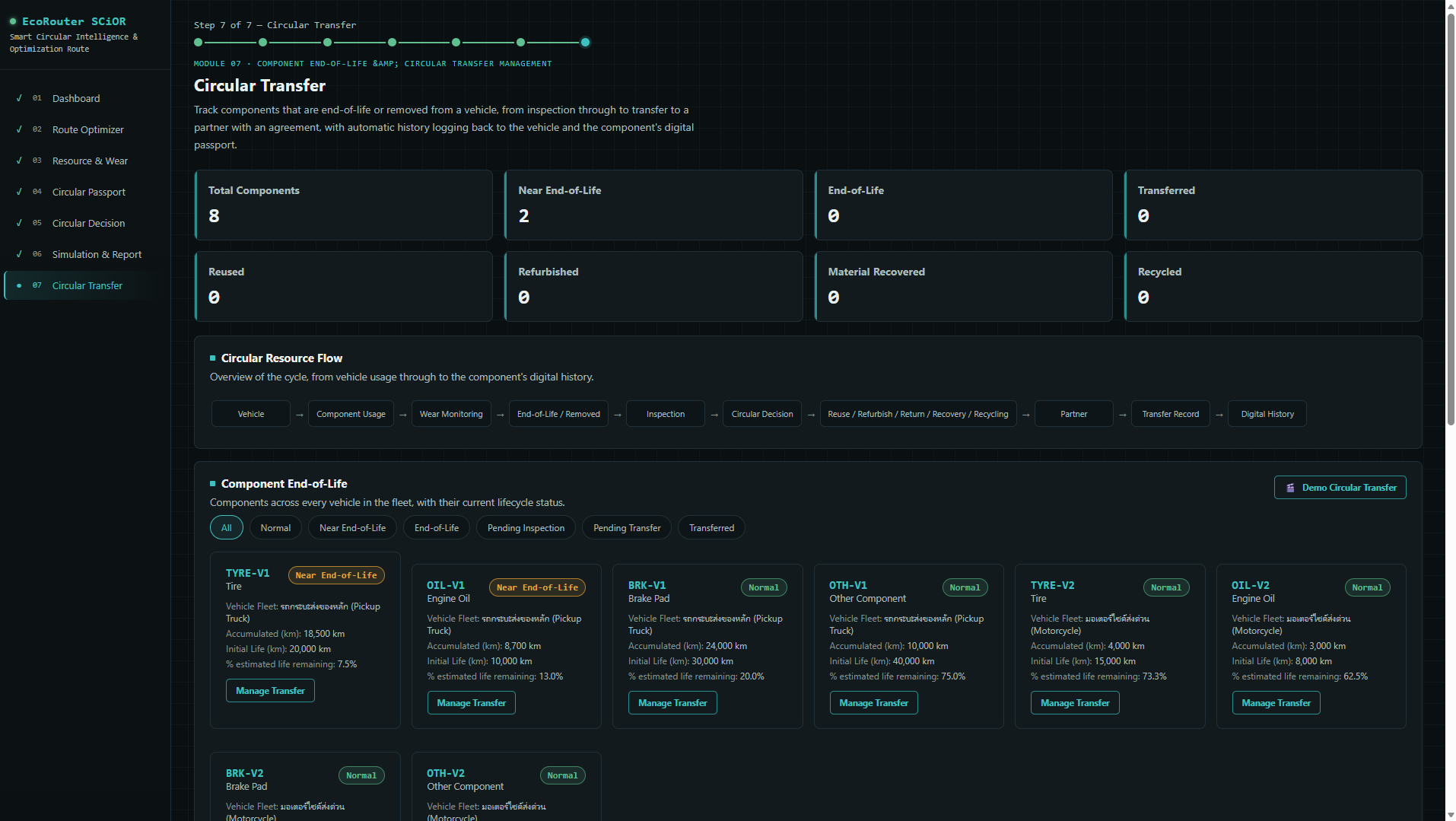
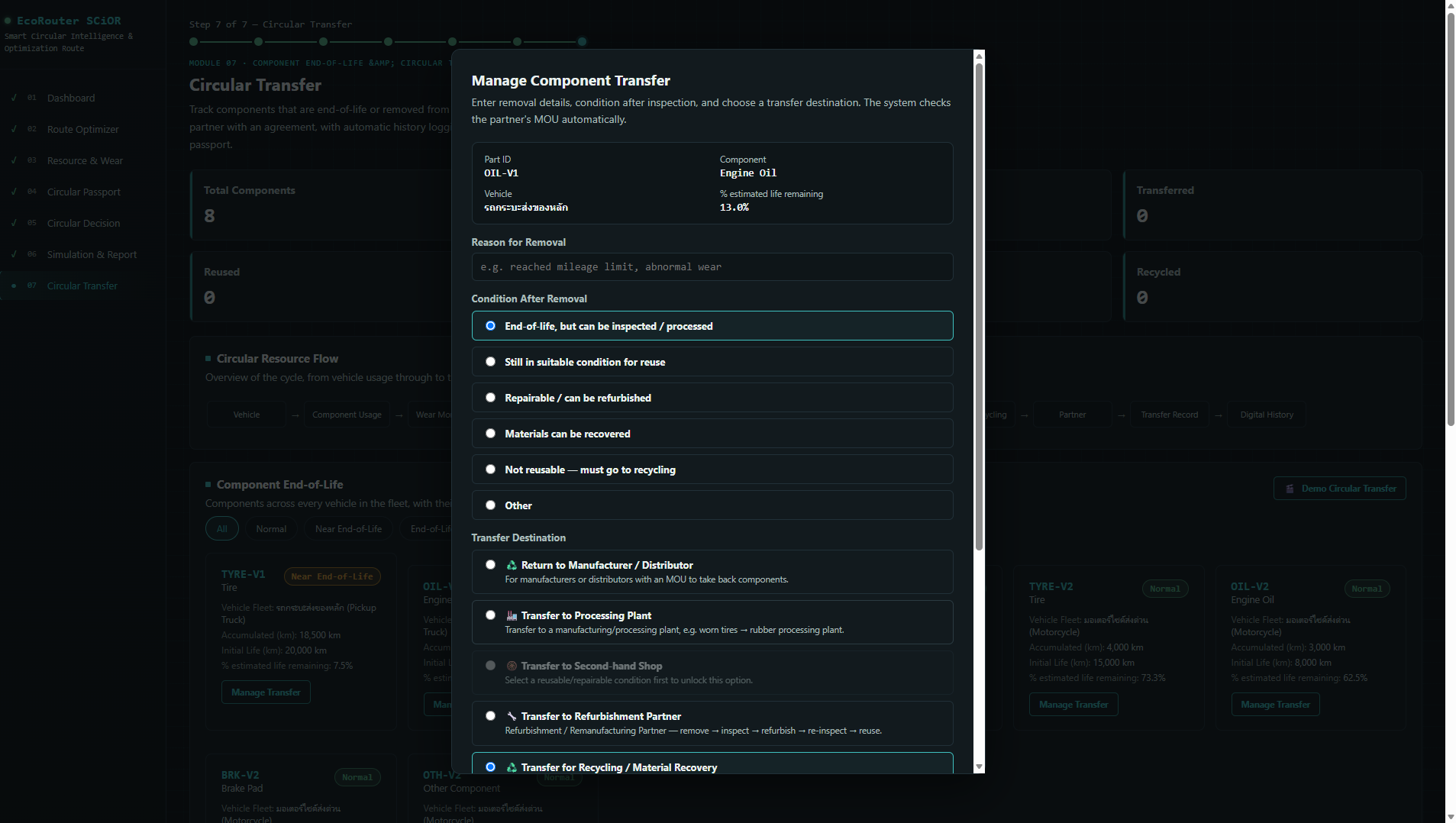
Circular Transfer: Managing the transition of end-of-life components into the circular economy.
-
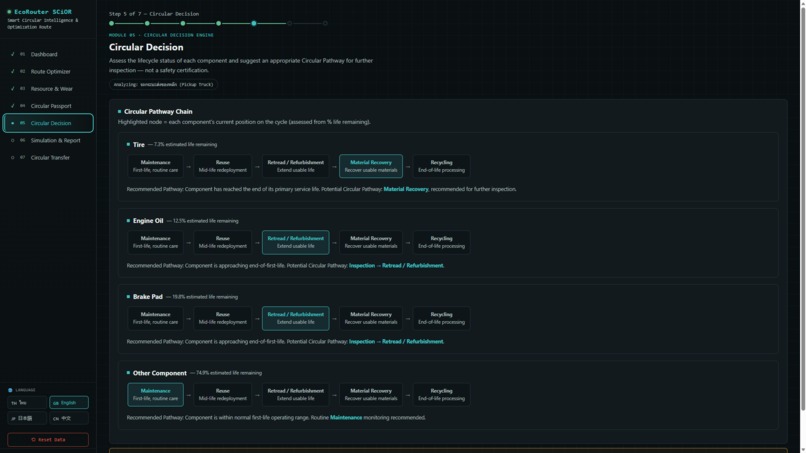
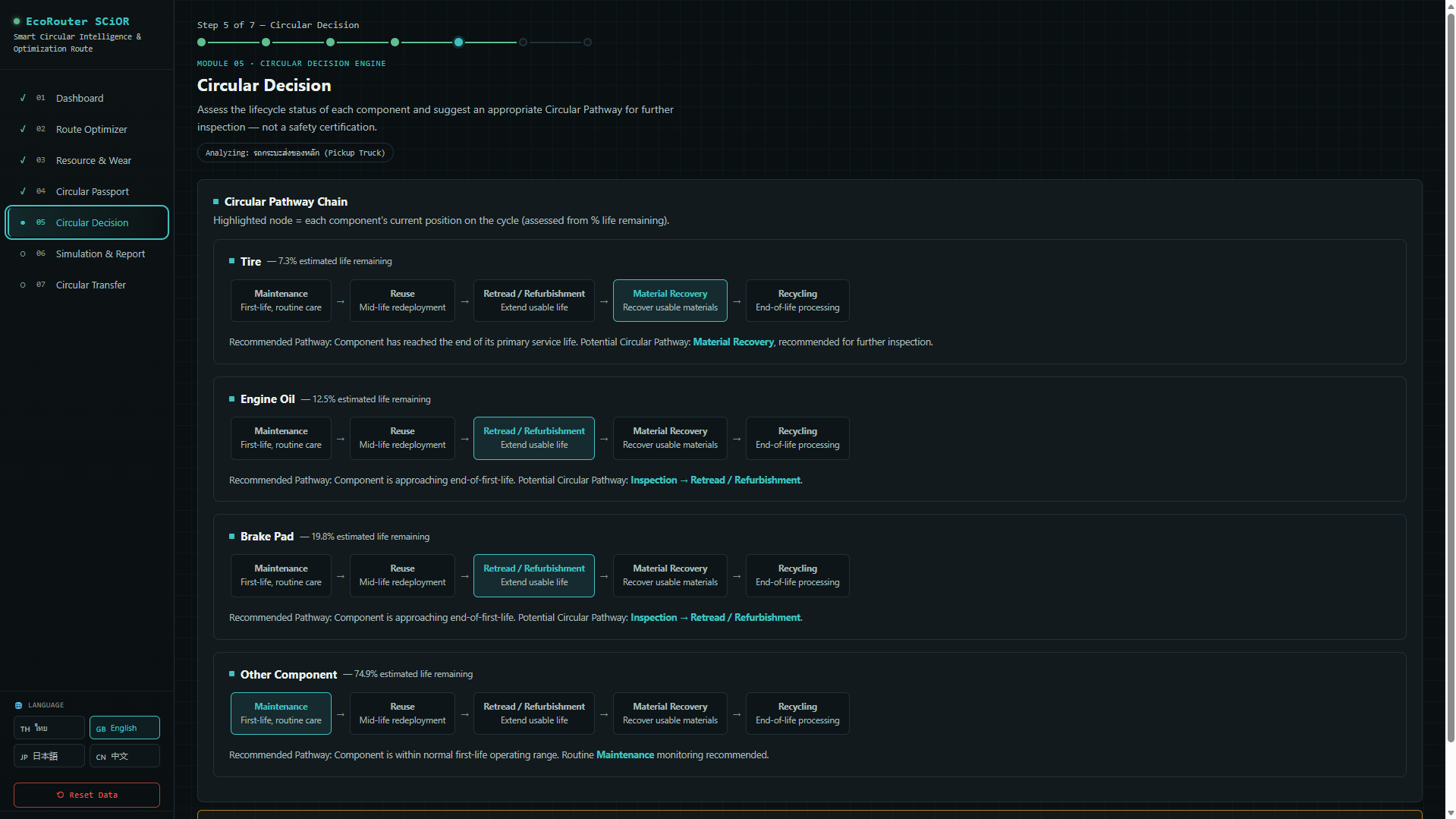
Circular Decision: Recommending circular pathways based on each component's lifecycle condition
-
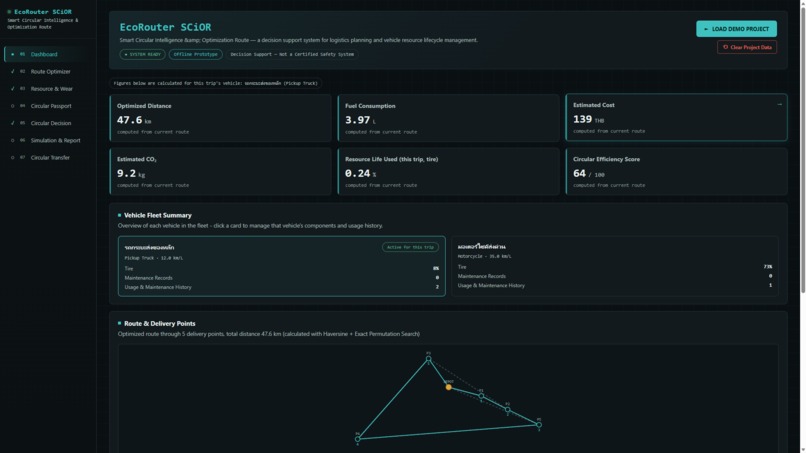
Dashboard: A unified overview of route efficiency, vehicle resources, emissions, and circular performance.
-
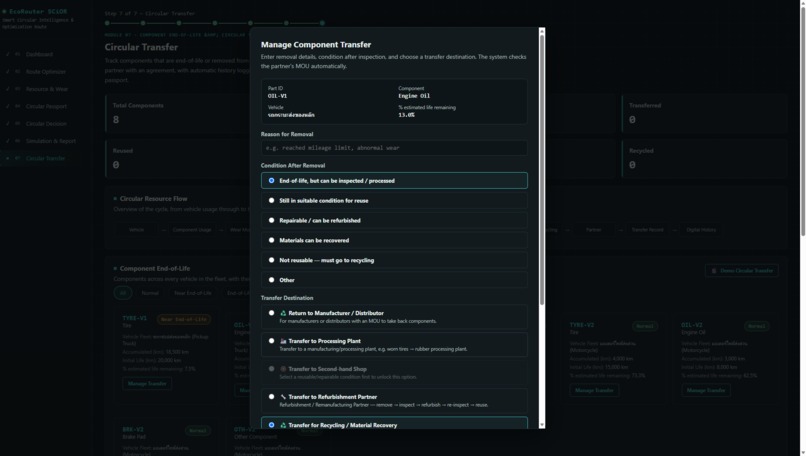
Transfer Workflow: Recording component condition, destination, and transfer history for full traceability.
-
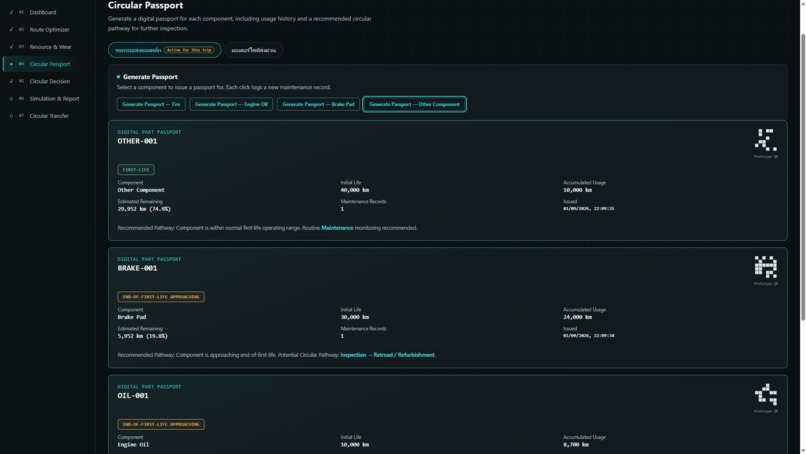
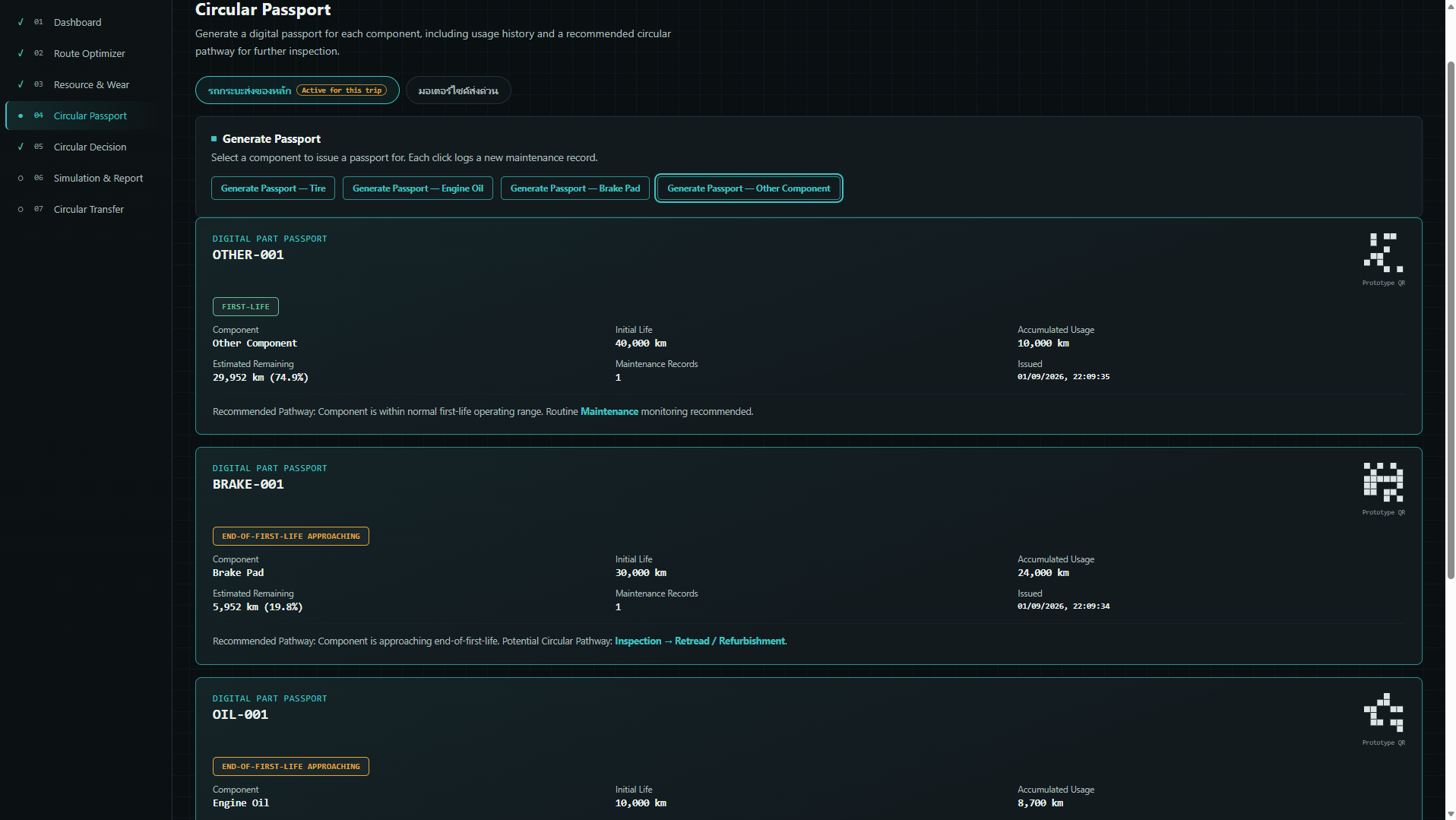
Circular Passport: Creating a digital identity and lifecycle history for every vehicle component.
EcoRouter SCiOR — Project Story Inspiration
The idea started from a simple observation: most "smart logistics" projects stop at route optimization — finding the shortest or fastest path from A to B. But real transportation systems don't end when a delivery is complete. Vehicles wear down, components reach the end of their service life, and those parts often get discarded or lost track of instead of being reused, refurbished, or recycled. We kept asking ourselves: why do route efficiency and resource lifecycle management live in two completely separate systems? That question became the seed for EcoRouter SCiOR — a system that treats "getting the delivery there efficiently" and "managing what happens to the vehicle and its parts afterward" as one connected problem, not two.
What it does
EcoRouter SCiOR is a functional prototype that combines:
Route Optimization — calculates efficient delivery paths using geographic distance and route-analysis algorithms Resource Calculation — estimates distance, fuel consumption, and transportation cost for each route Environmental Evaluation — estimates CO₂ emissions tied to transportation activity Component Lifecycle Monitoring — tracks the usage and service-life status of key vehicle parts (tires, battery, engine oil, brakes, and more), flagging them as Normal, Near Service-Life Limit, Inspection Required, or Expired Circular Management — when a component reaches end-of-life, the system helps route it to the right destination (manufacturer return, recycling facility, reuse, refurbishment, retreading, or material recovery) and keeps a digital record of that transfer
In short: input vehicle, delivery, fuel, and component data → the system analyzes routes and resources → supports decisions on route selection, maintenance, and end-of-life actions → and keeps a permanent digital history of everything, including a "Digital Part Passport" for each component (ID → usage → status → transfer → destination → history).
How we built it
We built EcoRouter SCiOR around a clear separation between mathematical optimization and future AI capability, because we wanted the judges to see we understood the technology rather than labeling every algorithm "AI":
Geographic distance calculation using the Haversine formula to estimate real-world distances between points Route optimization using a distance matrix combined with Dijkstra's algorithm to identify efficient paths Resource calculation logic that chains distance → fuel → cost → CO₂ into a single pipeline An intelligent decision layer that pulls together route data, vehicle status, and component lifecycle information to support real operational decisions A circular economy workflow (check → assess → select → transfer → trace) layered on top, so every component's fate is deliberate and recorded, not accidental
We also verified our implementation by manually cross-checking the application's calculations against hand-computed results, to make sure the math held up before we trusted the output.
Challenges we ran into Connecting two domains that don't normally talk to each other — logistics optimization and circular resource management have very different data shapes, and designing one coherent data model for both was harder than either problem alone. Being honest about what's AI and what isn't — it was tempting to call our optimization algorithms "AI," but we made a deliberate choice to clearly separate mathematical optimization (what we built now) from genuine AI decision support (what we're building toward), which meant more careful architecture and messaging. Designing a lifecycle model that's actually usable — deciding what status thresholds mean (Normal vs. Near Limit vs. Expired) and what pathway a component should follow required balancing real-world nuance against something a prototype could realistically compute and display. Keeping the system feeling like "one system" rather than a route optimizer bolted onto a separate maintenance tracker. Accomplishments that we're proud of Successfully building a working end-to-end prototype that takes a delivery scenario all the way from route input to a full digital lifecycle record — not just a slide concept. Designing the Digital Part Passport concept, which we think is genuinely one of our strongest differentiators from typical route-optimization projects. Being disciplined about not overselling our tech — clearly distinguishing current mathematical optimization from our AI roadmap, which we believe shows technical maturity. Getting the math verified: our application's calculations match manual calculations, so we know the core logic is sound. What we learned That efficiency and sustainability aren't separate goals — when you connect route data with component lifecycle data, you start finding trade-offs and opportunities (like scheduling maintenance around routes, or timing part replacement with delivery cycles) that neither system would surface alone. How much discipline it takes to build something real versus something that just looks good on a slide — verifying calculations, structuring data cleanly, and making the lifecycle status logic consistent taught us a lot about production-quality thinking. The value of naming things honestly — distinguishing optimization from AI forced us to actually understand our own algorithms more deeply. What's next for EcoRouter SCiOR Predictive Maintenance — using historical usage data to forecast when components will need attention, instead of just tracking current status Real-Time Optimization — integrating live GPS, traffic, and vehicle telemetry so routes adapt dynamically AI Decision Support — moving beyond mathematical optimization into models that actively recommend routes and lifecycle actions Cloud Fleet Management — scaling from a single-vehicle prototype to full multi-vehicle fleet operations Digital Circular Network — connecting manufacturers, operators, recyclers, and logistics providers into one shared ecosystem, so a component's digital passport can follow it across organizations, not just within one system
Built With
- ai
- css
- google-gemini
- html
- javascript
