-
-
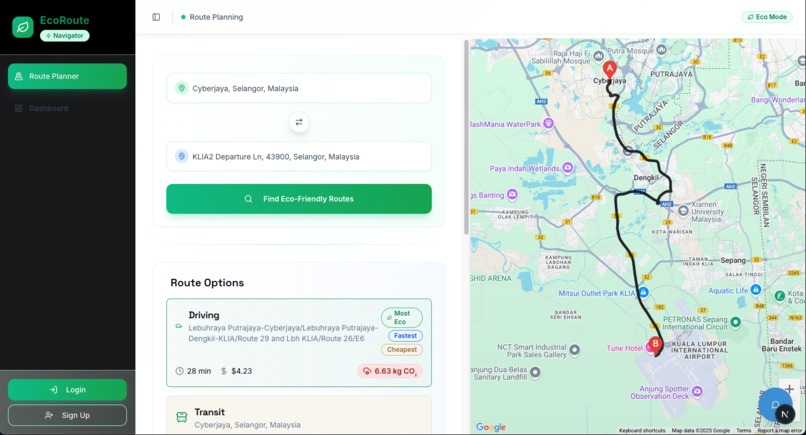
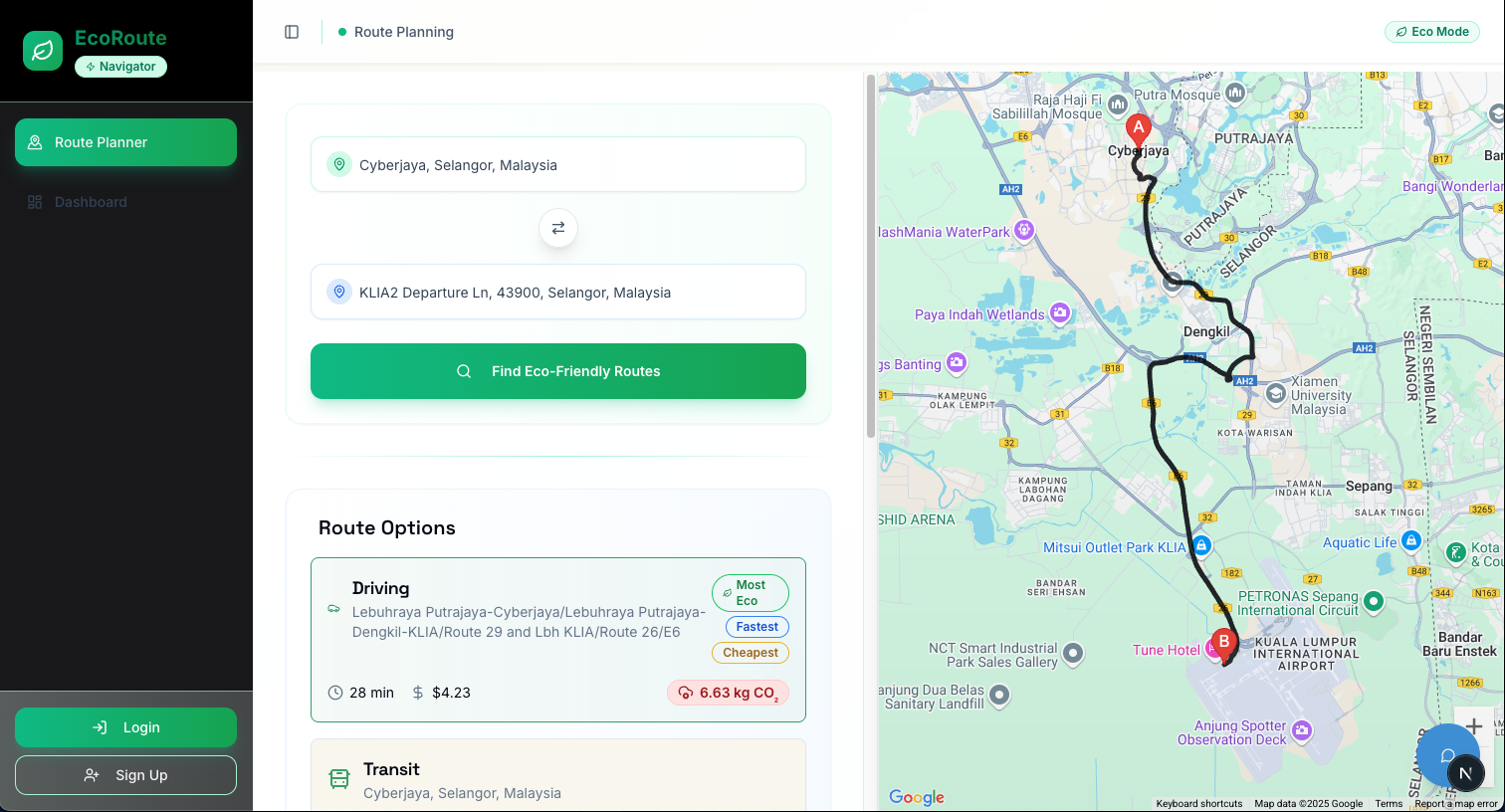
Home Page
-
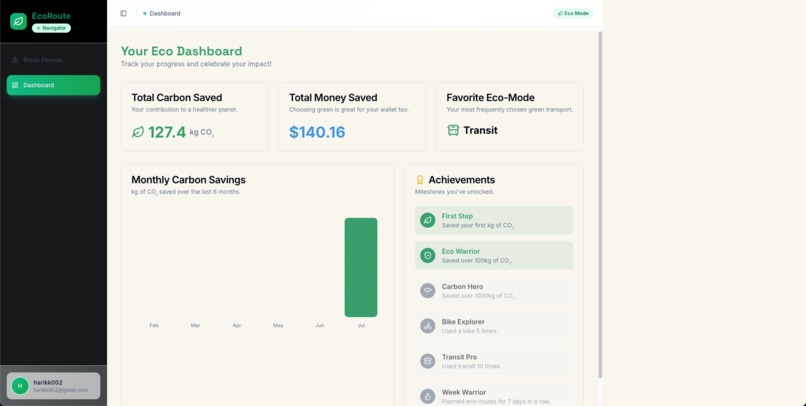
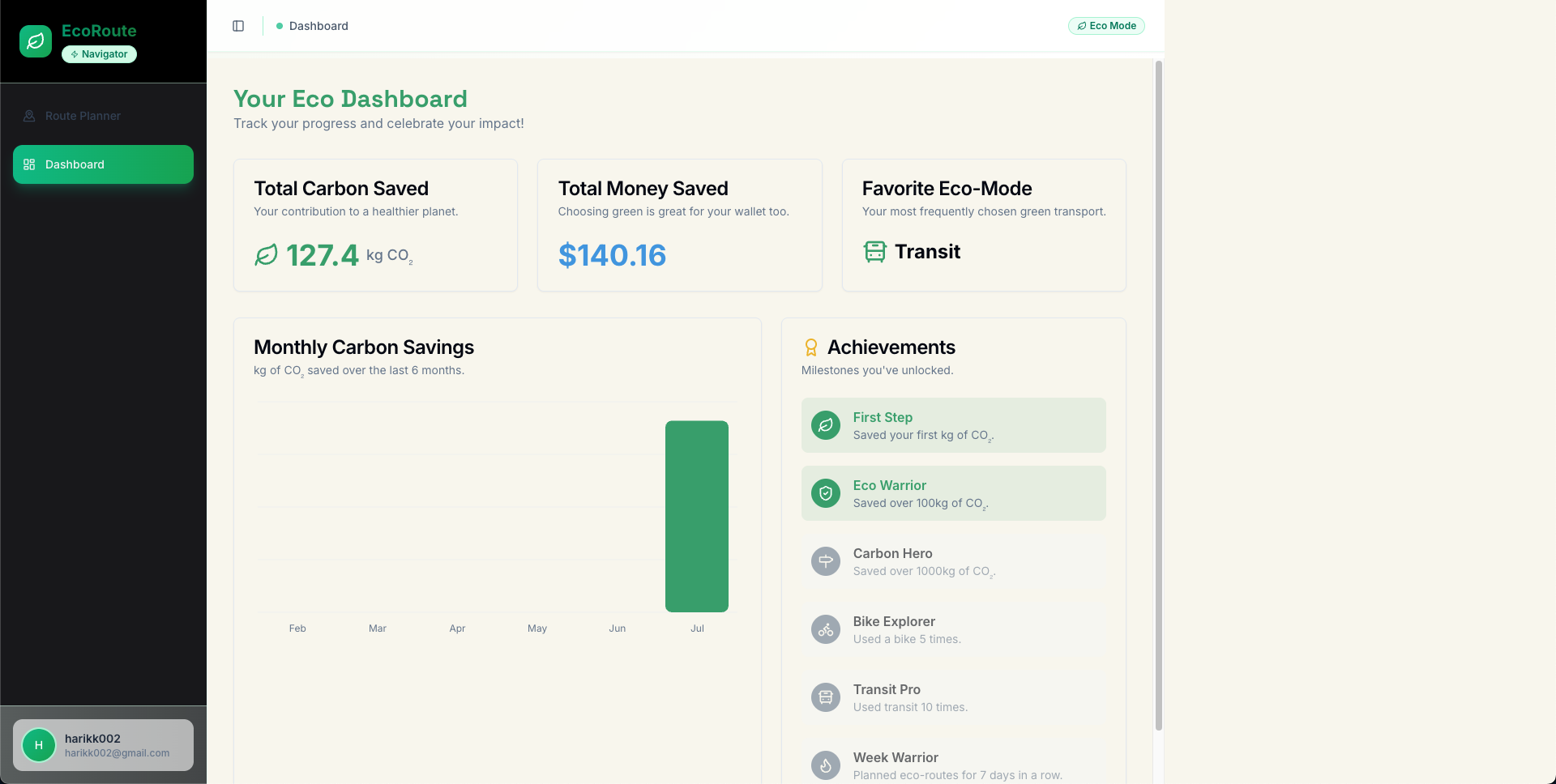
User Dashboard
-
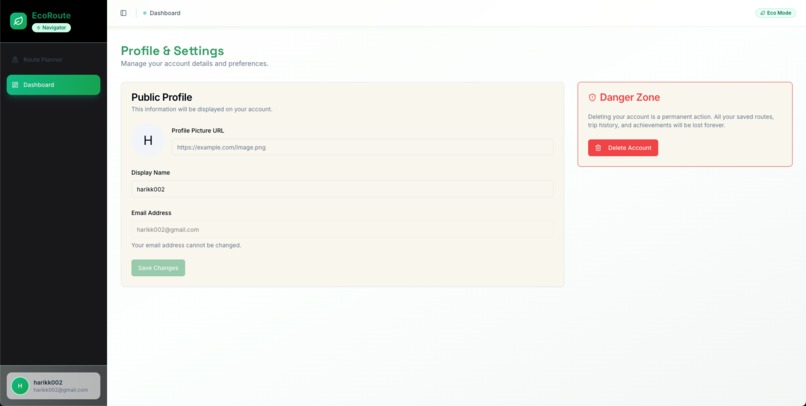
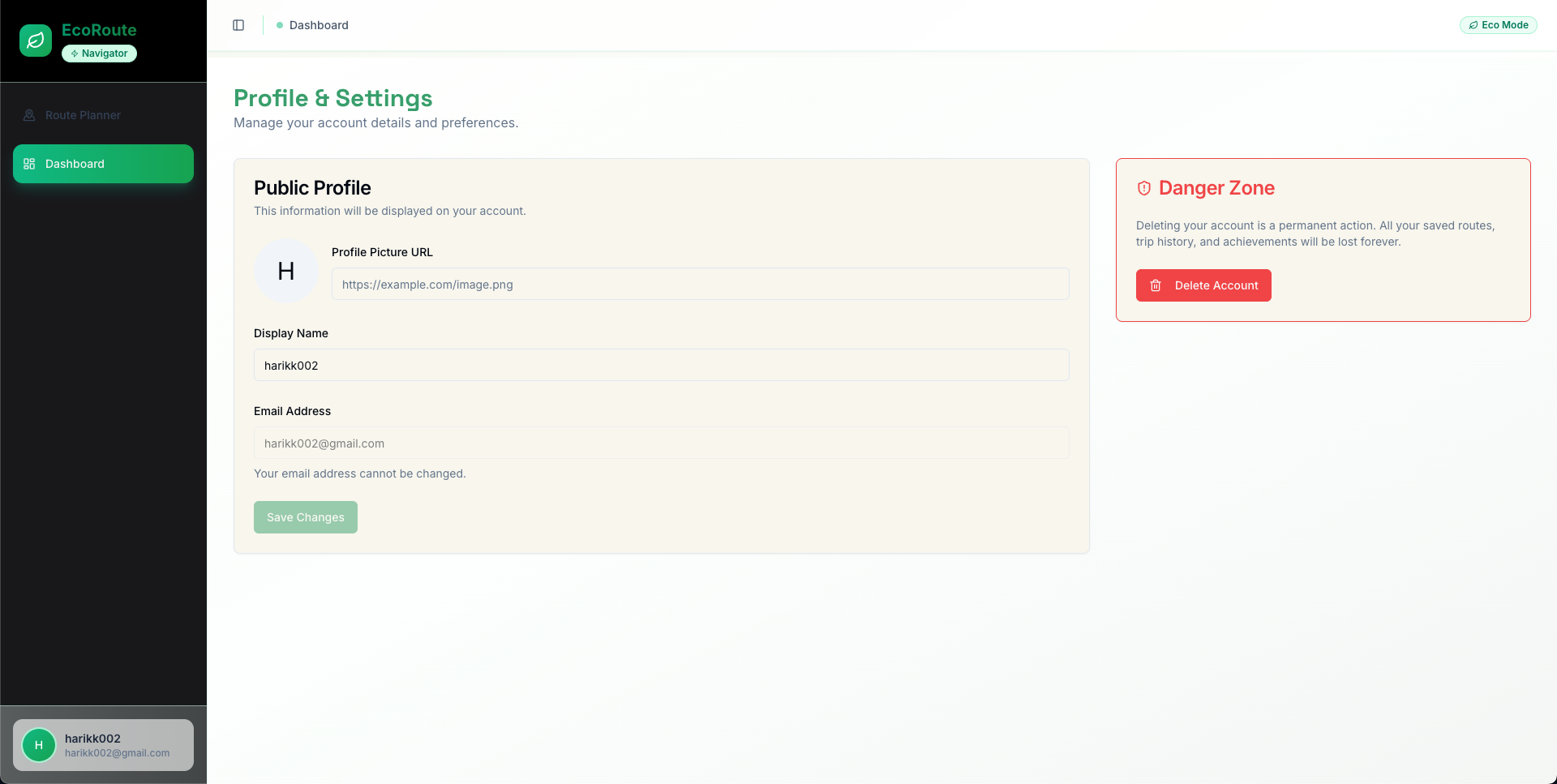
Profile Settings
-
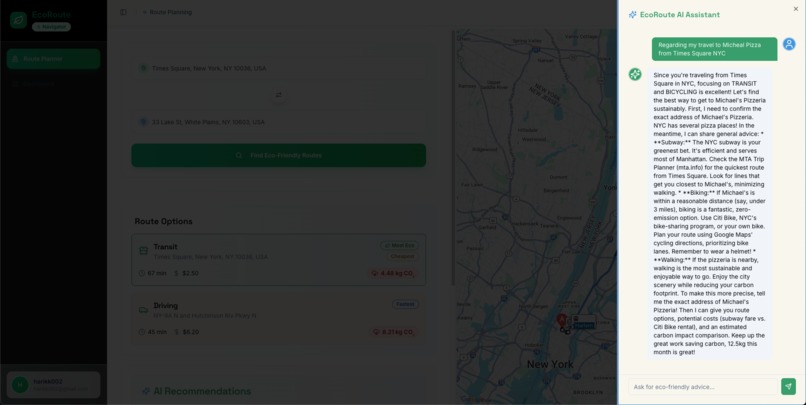
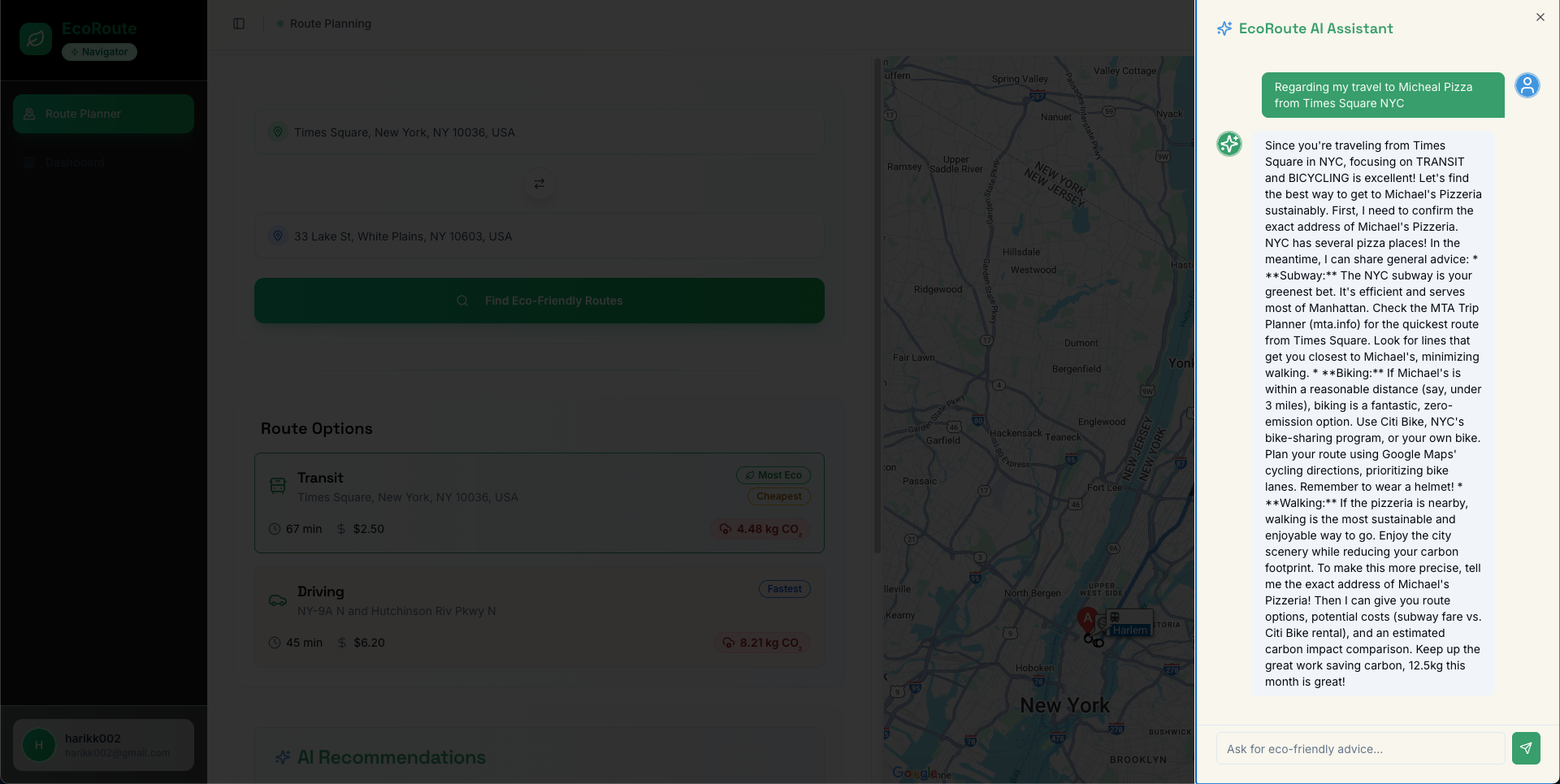
AI Chatbot
EcoRoute Navigator: Project Documentation
1. Project Inspiration
The inspiration behind EcoRoute Navigator stems from a growing global awareness of climate change and the environmental impact of daily activities, especially transportation. While many people are motivated to make more sustainable choices, they often lack the clear, accessible information needed to do so.
Our goal was to bridge this information gap. We envisioned an application that wouldn't just provide directions, but would empower users by clearly illustrating the environmental and financial trade-offs of their travel options. We wanted to make choosing the "green" route not just a possibility, but a simple, intuitive, and rewarding part of everyday life.
2. Project History
EcoRoute Navigator evolved significantly from its initial concept to its current state, driven by the goal of creating a genuinely useful and engaging tool.
Initial Concept: The project began as a simple web-based calculator. A user would input two addresses, and the tool would provide a rough estimate of the carbon emissions for a standard car journey between them.
V1: Map Integration & Route Comparison: The first major leap was integrating a visual map and providing more than one travel option. We added walking, biking, and public transit to the comparison. However, emissions and cost data were based on simple, hardcoded formulas, which lacked accuracy and real-world context.
V2: AI-Powered Estimations: Recognizing the limitations of static formulas, we integrated Genkit. This allowed us to replace our rigid calculations with a dynamic AI model. By feeding route data (like distance and duration from Google Maps) into our AI, we could generate far more realistic and context-aware estimates for both carbon emissions and cost.
V3: User-Centric Features: To transform the tool into a full-fledged application, we introduced user authentication with Firebase. This unlocked the ability to create personalized dashboards, track carbon savings over time, and introduce a gamification layer with achievements to encourage repeat use and long-term behavioral change.
V4: Enhanced User Experience: We added a conversational AI assistant for personalized travel advice and refined the user interface using ShadCN components to ensure a polished, modern, and responsive design across all devices.
3. Use of Google Maps Platform
The Google Maps Platform is the foundational data source for EcoRoute Navigator, providing the critical location and routing information that powers the entire application.
Places API (Autocomplete): To ensure a smooth user experience and accurate location entry, we use the Places Autocomplete service in our
AutocompleteInputcomponent. As a user types an origin or destination, the API provides real-time suggestions, preventing errors and frustration.Directions API: This is the core of our route-finding functionality. When a user performs a search, we make requests to the Directions API for multiple travel modes (Driving, Transit, Bicycling, Walking). The API returns detailed information, including:
- Polyline data for drawing the route on the map.
- Accurate distance and duration for each leg of the journey.
- Route summaries and details. This data is not only displayed to the user but is also a crucial input for our AI models to calculate emissions and cost.
Maps JavaScript API: We use this to render the interactive map in our
MapContainercomponent. TheDirectionsRendererservice takes the data from the Directions API and visually plots the selected route, providing users with a clear and familiar map interface.
4. Learnings & Key Differentiators
This project provided several key insights and resulted in a product with unique strengths.
Key Learnings:
- The Power of AI + Data: The most significant learning was that combining a rich data source like the Google Maps Platform with a flexible AI like Genkit creates a product that is far more intelligent and useful than the sum of its parts. The AI can infer and estimate what the raw data doesn't explicitly provide.
- Frontend Complexity: We encountered and overcame typical challenges in modern web development, such as managing state across components and handling React's hydration lifecycle. Resolving the map initialization issue taught us the importance of understanding the component lifecycle and using tools like the
onLoadcallback to ensure stability. - Iterative Development: Starting simple and progressively adding layers of complexity (from a basic calculator to an AI-powered, authenticated application) was a successful strategy that allowed us to build and test core functionality at each stage.
Key Differentiators:
- Holistic Decision-Making: EcoRoute doesn't just push the "greenest" option. By presenting a clear comparison of emissions, cost, and time, it respects the user's real-world constraints and allows them to make the best-balanced decision for their specific situation.
- AI-Driven Personalization: Through AI recommendations and a conversational chat interface, the app provides tailored insights that go beyond raw numbers. It offers tips and encouragement, acting as a sustainable travel companion.
- Engaging Progress Tracking: The user dashboard with its charts and achievements transforms the abstract concept of "saving carbon" into a tangible, personal, and rewarding journey. This focus on long-term engagement is a core part of our mission to foster lasting habits.
5. Accomplishments That We're Proud Of
- End-to-End Functionality: We successfully built a full-stack web application from scratch that not only calculates sustainable routes but also offers an intuitive and responsive user experience across devices.
- AI Integration for Real-World Use: The integration of Genkit allowed us to move beyond static formulas to generate dynamic, context-aware carbon and cost estimates—bringing a layer of intelligence that adds real user value.
- Gamified Sustainability: Introducing a dashboard with progress tracking, achievements, and visualizations added an engaging layer that transforms good habits into a rewarding experience.
- Seamless Google Maps API Integration: By leveraging multiple Google Maps services together, we created a cohesive, reliable, and informative travel tool.
- Conversational AI Assistant: Implementing a chatbot for sustainable travel advice helped bridge the gap between information and action, making green choices feel more guided and approachable.
- Team Collaboration: Coordinating design, backend, and frontend development across components and iterations allowed us to work efficiently and learn from each other throughout the build.
6. What We Learned
- Start Small, Build Smart: Starting with a basic version and incrementally layering on complexity helped us validate ideas and avoid overwhelming ourselves or the users.
- AI Can Fill the Gaps: Static formulas and hardcoded logic have limits. By integrating Genkit, we learned how AI can derive meaningful insights and adapt to varied real-world contexts.
- User Experience is Everything: Even the most useful tool needs a smooth interface. From error handling in address selection to responsive UI and intuitive navigation, every detail matters.
- The Value of Clean Architecture: Separating concerns across components, services, and utilities made our codebase easier to maintain and scale.
- Sustainability Needs Clarity: Many users want to travel sustainably but don’t know where to start. Clear data visualizations and simple comparisons are powerful motivators for change.
7. What's Next for EcoRoute Navigator
- Mobile App Launch: We're planning to develop a cross-platform mobile version (using React Native or Flutter) to make EcoRoute even more accessible for on-the-go planning.
- Carbon Offset Integration: Allow users to directly offset their emissions via verified carbon credit partners integrated into the app.
- Social Sharing & Challenges: Encourage friendly competition and community engagement through travel challenges, social impact sharing, and leaderboards.
- Expanded Data Sources: Incorporate data from local transport authorities, weather APIs, and real-time traffic feeds to improve accuracy and relevance of suggestions.
- More AI-Powered Features: Develop deeper personalization with trip history analysis, automated suggestions, and nudges for greener travel alternatives.
- Offline Mode: Support route planning with preloaded data in low-connectivity areas to ensure the app is reliable even during travel.
- Multi-Language Support: Expand access by supporting multiple languages to reach a more global and diverse user base.

Log in or sign up for Devpost to join the conversation.