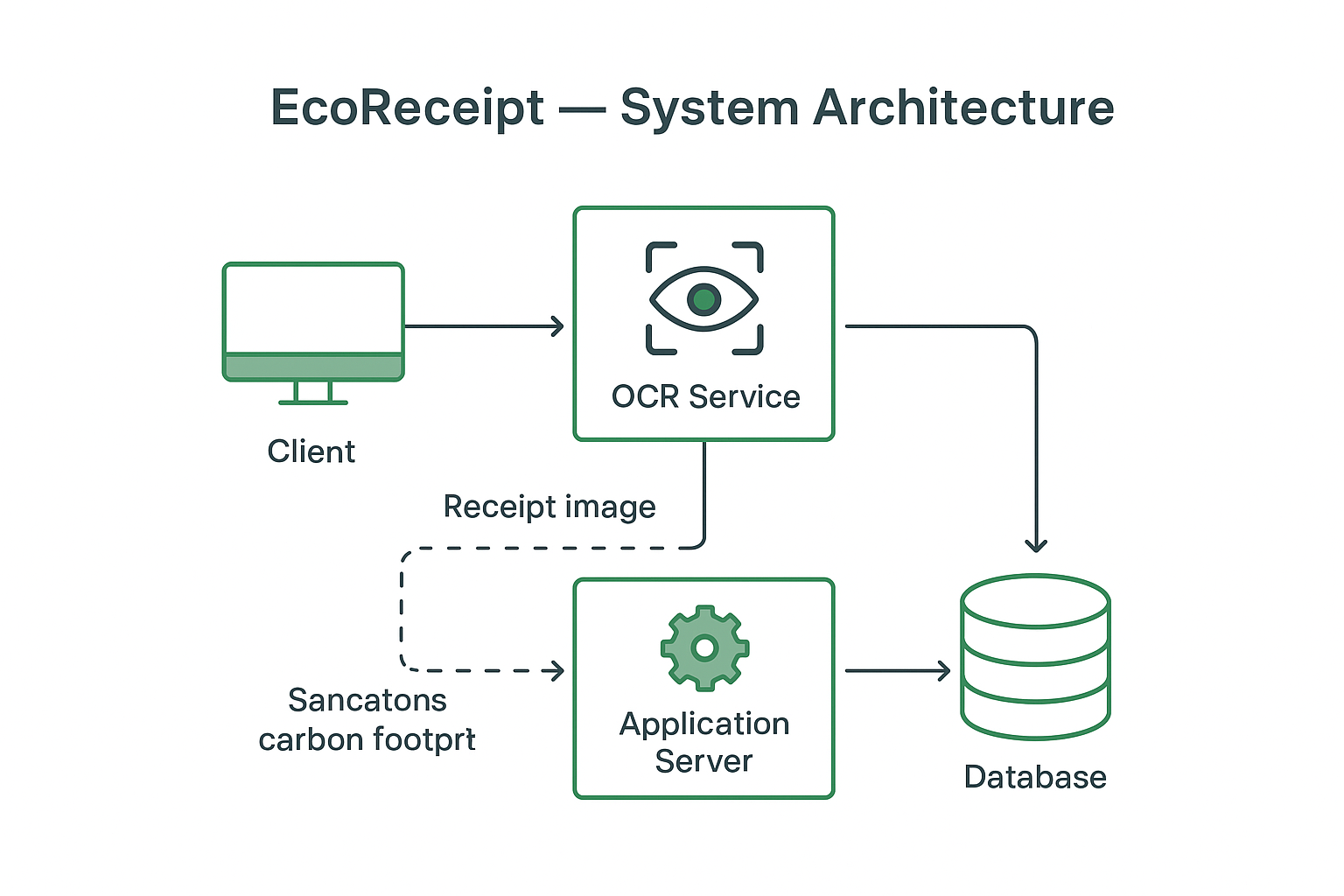
Inspiration Many people are unaware of the carbon footprint behind everyday purchases. Receipts are just numbers on paper or screens, but each item carries an environmental cost. We wanted to make carbon visible and actionable, turning a simple receipt into meaningful insights that help users make greener choices. What it does EcoReceipt allows users to snap a photo of a receipt or upload a digital invoice. The system extracts the items using OCR (Google Vision or Tesseract fallback), classifies them, and estimates the CO₂ emissions per item and for the total purchase. Users can track their monthly footprint, view category breakdowns, and earn EcoCredits for sustainable choices. How we built it Frontend: React + Vite PWA for fast, responsive UI with demo receipt previews and dashboards. Backend: Node.js + Express, orchestrating OCR, carbon estimation, and Supabase storage. OCR: Google Vision API if available, Tesseract.js fallback for local/offline processing. Carbon Estimation: Local lookup JSON for demo, with a Climatiq integration stub for real emission factors. Database: Supabase (PostgreSQL) storing users, receipts, receipt items, and EcoCredits. Deployment: Docker support with docker-compose for full-stack local testing; scripts ready for GitHub repo creation and release. Demo assets: Animated GIF and professional storyboard for a 2–3 minute hackathon demo video. Challenges we ran into Mapping diverse receipt items to categories and corresponding CO₂ estimates is tricky; product names vary widely. Ensuring OCR accuracy for receipts of different formats and lighting conditions required a robust fallback solution. Balancing a lightweight hackathon MVP with a future-ready architecture (Climatiq integration, Supabase, Docker, CI/CD). Accomplishments that we're proud of Fully functional end-to-end MVP in a short timeline. Multiple OCR options (Google Vision + Tesseract) ensuring offline/online flexibility. Animated demo and professional storyboard ready for a 2–4 minute submission pitch. Complete Dockerized setup for easy local testing and deployment. Structured project for future scalability: database, API integrations, and release-ready GitHub scripts. What we learned How to integrate multiple AI services (OCR, Climatiq) in a hackathon timeline. Importance of fallback solutions and mock data for rapid prototyping. Building with future extensibility in mind (supabase, Docker, CI/CD) makes scaling much easier. Crafting a clear, visually appealing demo (GIF + storyboard) greatly helps communication in a short pitch. What's next for EcoReceipt Enable Climatiq for authoritative carbon emission factors. Implement automatic syncing with digital invoices from banks or retailers. Add EcoCredits marketplace for rewards and greener alternatives suggestions. Improve classification accuracy with AI/NLP for diverse products. Expand analytics dashboards for personalized impact tracking and recommendations.
Built With
- all

Log in or sign up for Devpost to join the conversation.