-
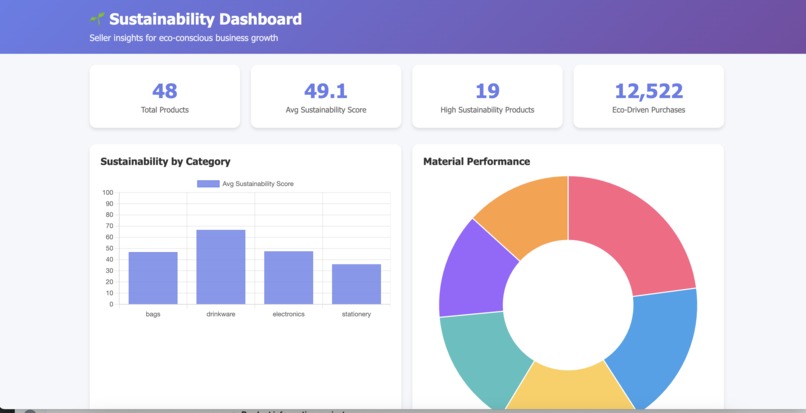
Sustainability Dashboard for the product seller or owner
-
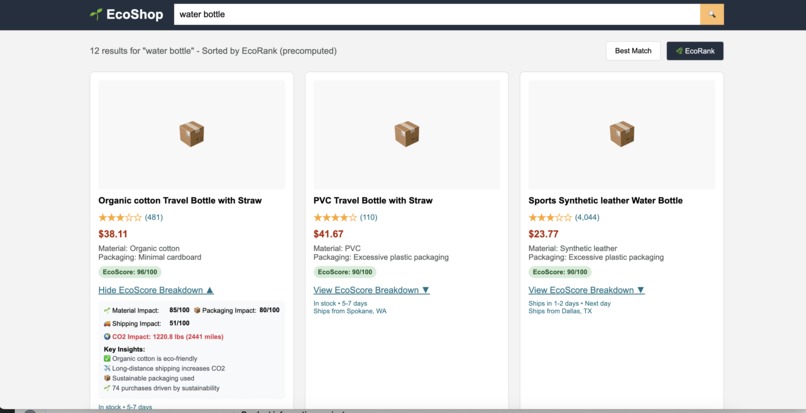
Eco Rank based Product Ranking
EcoRank: LLM-Powered Sustainable Product Reranking
🧠 What Inspired Us
While Amazon already offers sustainability certifications and filters like “Climate Pledge Friendly,” these features remain static and binary, lacking granular, ranked insights for users. There is currently no dynamic sorting that lets shoppers view products based on a quantitative sustainability score across multiple dimensions.
As environmentally conscious individuals, we saw an opportunity to go beyond simple filtering. We were inspired by Amazon’s own Climate Pledge and the broader shift toward carbon-aware, responsible consumerism. Our goal was to reimagine product discovery by making eco-friendliness a ranked, explainable, and user-controllable dimension—just like price or delivery speed.
EcoRank can fill this gap—providing consumers with actionable, AI-driven sustainability scores that help them shop smarter and greener at scale.
Key Idea & Innovation
EcoRank is an AI-powered reranking system for e-commerce search that uses Large Language Models (LLMs) to compute a product's Sustainability Score. This score is based on material usage, packaging, shipping emissions, and lifecycle factors—then used to reorder search results with an “EcoRank” toggle for customers.
Core Innovations:
- ✅ LLM-Driven EcoScore for every product
- ✅ Real-time Reranking based on sustainability
- ✅ AI-generated impact explanations for transparency
- ✅ Seller Dashboard with improvement insights
Technical Architecture
1. LLM Scoring Engine
- Model: Hugging Face’s Qwen-1.5B-Instruct
- Input: Product title, materials, packaging, shipping origin, buyer location
- Output: Score (0–100) + 1–2 line explanation
2. Backend Pipeline
- Extract product metadata from structured/unstructured data
- Send prompt to LLM and receive eco analysis
- Cache results for fast search reranking
3. Frontend Interface
- Amazon-style UI with toggle between "Best Match" and "EcoRank"
- Displays EcoScore and explanation in product card
- Dashboard view for sellers with sustainability suggestions
📊 EcoScore Calculation Methodology
Weighted Formula:
Should be tailored to established sustainability metrics leveraging the following factors EcoScore = (Material_Score × 0.35) + (Packaging_Score × 0.25) + (Shipping_Score × 0.20) + (Lifecycle_Score × 0.20)
Scoring Factors:
An example of scoring could be like following.
Material Impact (35%)
- High: Bamboo, Recycled plastic → 85–100
- Medium: Wood, Glass → 50–70
- Low: Virgin plastic, PVC → 10–40
Packaging Impact (25%)
- High: Plastic-free, compostable
- Medium: Recyclable cardboard
- Low: Styrofoam, excess plastic
Shipping Impact (20%)
- Based on distance between origin and buyer
- Local (<500mi): 90+
- Regional (500–1500mi): 50–80
- Long-haul (>1500mi): 10–50
Lifecycle Impact (20%)
- Based on durability, reusability, end-of-life disposal
- Inferred from product type, reviews, and materials
💼 Business Impact
- 🛍️ Improved Consumer Trust: Eco-conscious users can shop confidently
- 📈 Revenue Uplift for Green Sellers: High EcoScores can boost conversion
- 🧠 New Discovery Layer: Adds sustainability as a sorting/filtering dimension
- 💸 Data Monetization: Offer EcoRank insights as a premium feature or API
- 🛠️ Supports ESG Goals: Helps Amazon align with climate commitments
🌍 Sustainability & Social Impact
- 🌱 Carbon Reduction: Prioritizes local, low-emission shipping
- ♻️ Waste Reduction: Encourages compostable and minimal packaging
- 🧪 Sustainable Materials: Promotes adoption of eco-friendly materials
- 💡 Public Awareness: Increases consumer understanding of impact
- 🔁 Circular Economy: Supports reuse and recyclability through lifecycle data
🌟 Key Features
- ✅ EcoScore (0–100) with natural language explanation
- ✅ LLM-Driven Analysis using Qwen-1.5B-Instruct
- ✅ Dynamic Product Reranking toggle in UI
- ✅ Seller Dashboard with actionable improvement suggestions
- ✅ Multi-factor Scoring: Material, Packaging, Shipping, Lifecycle
📈 Key Metrics & KPIs
System Metrics
- ⚡ EcoScore Latency: <100ms (cached), <15s (live scoring)
- 🎯 Model Accuracy: Cross-validated with known eco-certifications
- 📊 Toggle Usage: % of users switching to EcoRank view
Business Metrics
- 📈 Sales Lift: Increase in high EcoScore product sales
- 🧮 Seller Adoption: Use of dashboard insights
- 💰 Revenue Impact: Premium pricing potential for top-ranked products
Sustainability Metrics
- 🌍 Estimated CO₂ Reduction from local shipping prioritization
- 🔁 Material Shift: Increase in sustainable inputs
- 📦 Packaging Improvement: Drop in plastic-based packaging
📚 What We Learned
- 🧠 Prompt Engineering: Careful formatting drives better LLM output
- 🏗️ Score Design: Scoring needs balance across diverse product types
- 🧾 LLMs as Scorers: Great for soft metrics like sustainability when structured inputs are lacking
- 🤝 Consumer-Seller Dynamic: Clear incentives help drive greener behaviors
Challenges We Faced
- ⏱️ LLM Response Time: Needed caching & async processing
- 🔍 Data Quality: Product listings vary in clarity and completeness
- 🧠 Score Interpretation: Ensuring AI explanations are trustworthy
- 🧪 Fairness Across Categories: Making the score formula generalizable
🔮 Future Enhancements
- ⚙️ Live Scoring Pipeline with user-based filters (e.g. vegan, plastic-free)
- 🖼️ Image Recognition for packaging/material detection
- 🔗 Blockchain Verification of sustainability certifications
- 🌐 Global Expansion with region-specific eco standards
- 📦 API-as-a-Service for third-party marketplaces and B2B sourcing

Log in or sign up for Devpost to join the conversation.