-
-
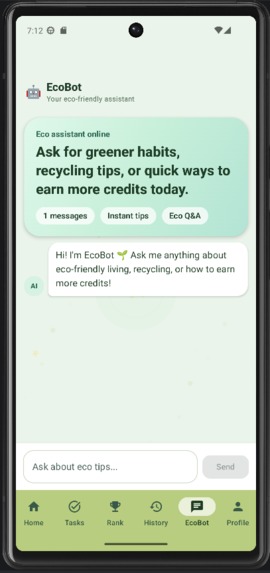
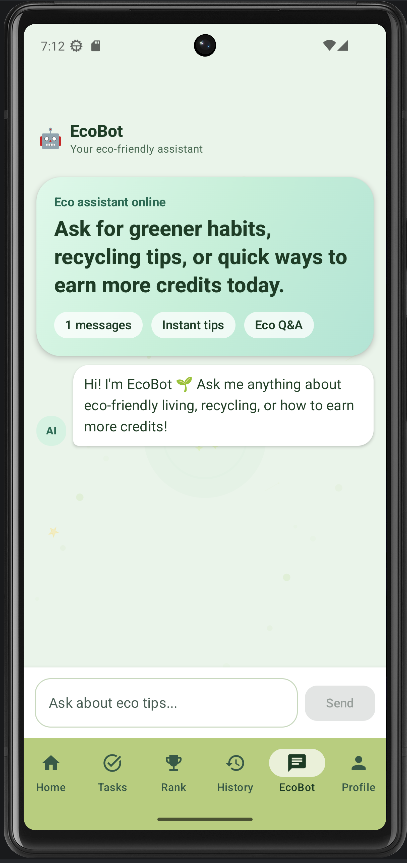
EcoBot is an AI assistant that provides instant eco tips, sustainability guidance, and in-app help for users.
-
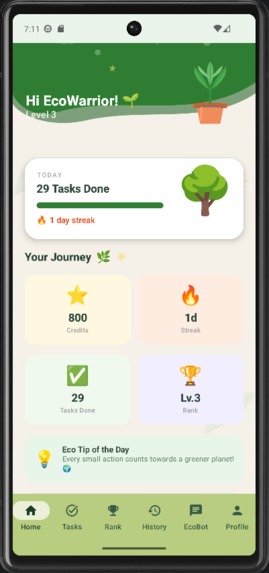
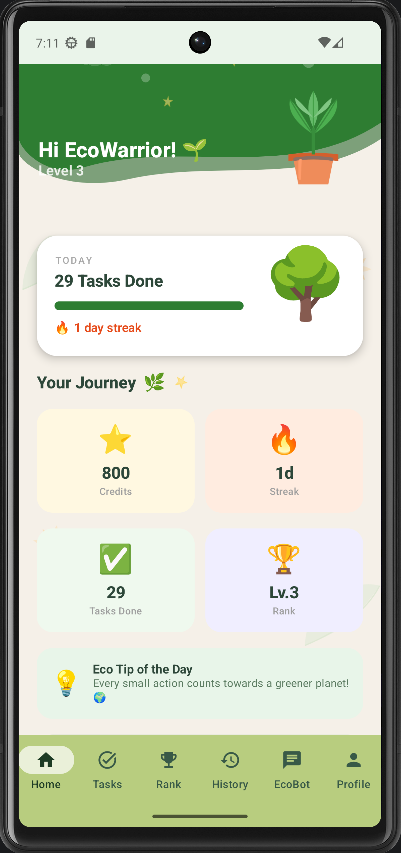
Home dashboard gives users a quick view of their level, credits, streak, and overall eco progress.
-
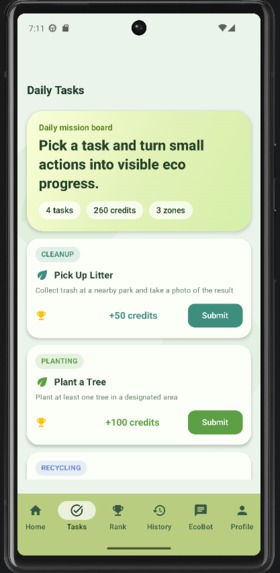
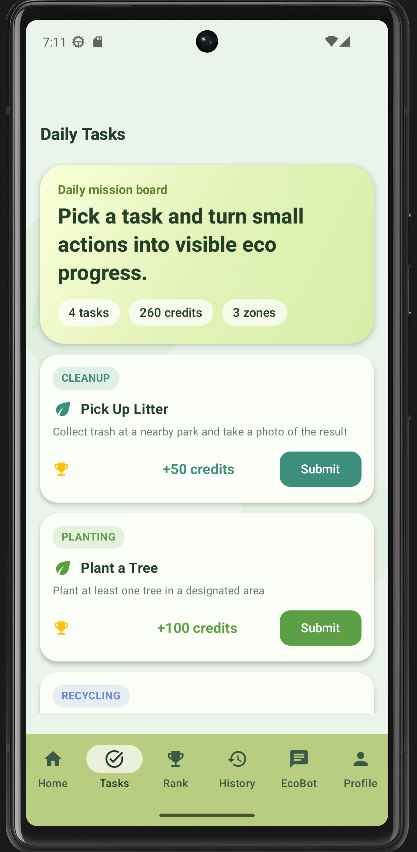
Tasks screen lists daily eco missions with rewards, helping users pick and complete real-world environmental actions.
Inspiration
We were inspired by a simple problem: people care about the environment, but it’s hard to stay consistent with real-world actions like picking up trash or contributing to community cleanup.
At the same time, games are incredibly effective at keeping people engaged through rewards, progression, and feedback loops.
So we asked: What if real-world positive actions were as engaging as playing a game?
That idea became EcoQuest
What it does
EcoQuest is a gamified mobile app that turns real-world environmental actions into a rewarding experience.
Users receive nearby or daily tasks (e.g., pick up trash) They complete the task in real life and submit photo proof The system uses AI to verify the action Users earn credits, levels, and streaks for successful submissions An AI assistant helps guide users, explain results, and suggest next actions
The result is a loop: discover → act → verify → reward → repeat
How we built it
We built EcoQuest as a full-stack system with mobile, backend, and AI integration:
Mobile Kotlin (Android) Camera integration for capturing task evidence Task feed, submission flow, and chat UI Backend Kotlin + Spring Boot REST API for tasks, submissions, rewards, and assistant Structured for async verification and scalable services Cloud & AI (Azure) Blob Storage → store user-uploaded images Cosmos DB → store users, tasks, submissions Service Bus → handle async verification pipeline Azure AI Vision → analyze and validate images Azure OpenAI → power the assistant chat experience
We started with mock services to unblock frontend work, then progressively integrated real Azure services.
Challenges we ran into
Verification is hard Determining whether a user actually completed a real-world task from an image is non-trivial. We had to design a hybrid approach using rule-based checks + AI. Async flow complexity Submission → upload → verify → reward required careful state management and coordination between services. Balancing speed vs. architecture In a hackathon setting, we had to decide when to mock vs. when to build real integrations. Mobile + backend coordination Keeping API contracts stable while both sides were developing in parallel required discipline.
Accomplishments that we're proud of
Built a complete end-to-end flow: login → task → submission → AI verification → reward Successfully integrated: image upload to cloud AI-based verification (Azure Vision) AI assistant (Azure OpenAI) Designed a system that is: scalable modular extendable to other real-world tasks beyond environmental actions Delivered a working demo, not just a concept
What we learned
AI is powerful, but needs strong system design around it Raw AI output isn’t enough—you need rules, validation, and fallback logic. Gamification works best when feedback is immediate and clear Building in parallel requires: clear API contracts mock-first development strong communication Real-world problems introduce uncertainty that pure software doesn’t have
What's next for ecoQuest
Improve verification accuracy using: better prompts multi-step AI validation potentially combining image + location + history Expand task types: recycling community service fitness & wellness Add social features: friends challenges team competitions
Built With
- azure-ai-vision
- azure-openai
- cosmosdb
- kotlin

Log in or sign up for Devpost to join the conversation.