
✨ Inspiration
In my hometown, Ghayl Ba Wazir (Hadramout), we face a dual challenge: water scarcity and the sharp rise in energy costs (diesel). As an Accounting student, I didn't see a water well as just a source of irrigation; I saw it as a "Fixed Asset" suffering from poor management and data waste. From this, the idea of EcoPump AI was born—a smart system that doesn't just monitor pumps, but transforms them into digitally managed assets to ensure financial and environmental sustainability.
🚀 What it does
EcoPump AI is a comprehensive management system based on the Internet of Things (IoT) and Artificial Intelligence. It is installed on water pumps (whether solar-powered or diesel) to perform the following:
- Smart Automation & Control: Automatically starting and stopping the pump based on available water levels and actual demand.
- Protective Safeguarding: Preventing "Dry-Run" scenarios that lead to motor burnouts.
- Instant Financial Auditing: Monitoring fuel consumption and calculating the Return on Investment (ROI) from solar energy in real-time.
🛠️ How we built it
We developed a complete technical infrastructure consisting of:
1️⃣ The IoT Network (Sensors):
Ultrasonic Water Level Sensor: - Function: Accurately measuring the distance between the sensor and the water surface in both the tank and the well.
- Result (Smart Control): Full control over the operation cycle; it gives an automatic "Stop" command as soon as the tank reaches full capacity to prevent waste, and a "Start" command when the water reaches the minimum level, in addition to protecting the well from over-extraction.
ACS712 Current Sensor: - Function: Measuring the intensity of the current passing to the motor and monitoring electrical loads.
- Result: Immediate protection of the pump from burnout due to sudden power surges, and detecting electrical faults before they escalate.
YF-S201 Water Flow Sensor: - Function: Measuring the volume of water exiting the pump in real-time.
- Result: Verifying pump efficiency; if the motor is running without water flow, the system stops operation immediately to prevent "Dry-Running" which destroys the pump impellers.
LDR (Light Dependent Resistor): - Function: Monitoring the intensity of solar radiation available during daylight hours.
- Result: Improving the system's decision-making process for an automatic shift to solar power, reducing reliance on diesel during peak solar times.
Fuel Sensor: - Function: Monitoring the remaining fuel level in the engine tank.
- Result: Providing accurate data for financial auditing, preventing theft or tampering, and issuing smart alerts before fuel runs out.
2️⃣ The Brain (Processing & Connectivity):
Utilizing the ESP32 chip to process data and send it over the internet, with a 30A Relay system to execute automatic start/stop commands for heavy pump loads based on sensor readings.
3️⃣ Dashboard (Software Platform):
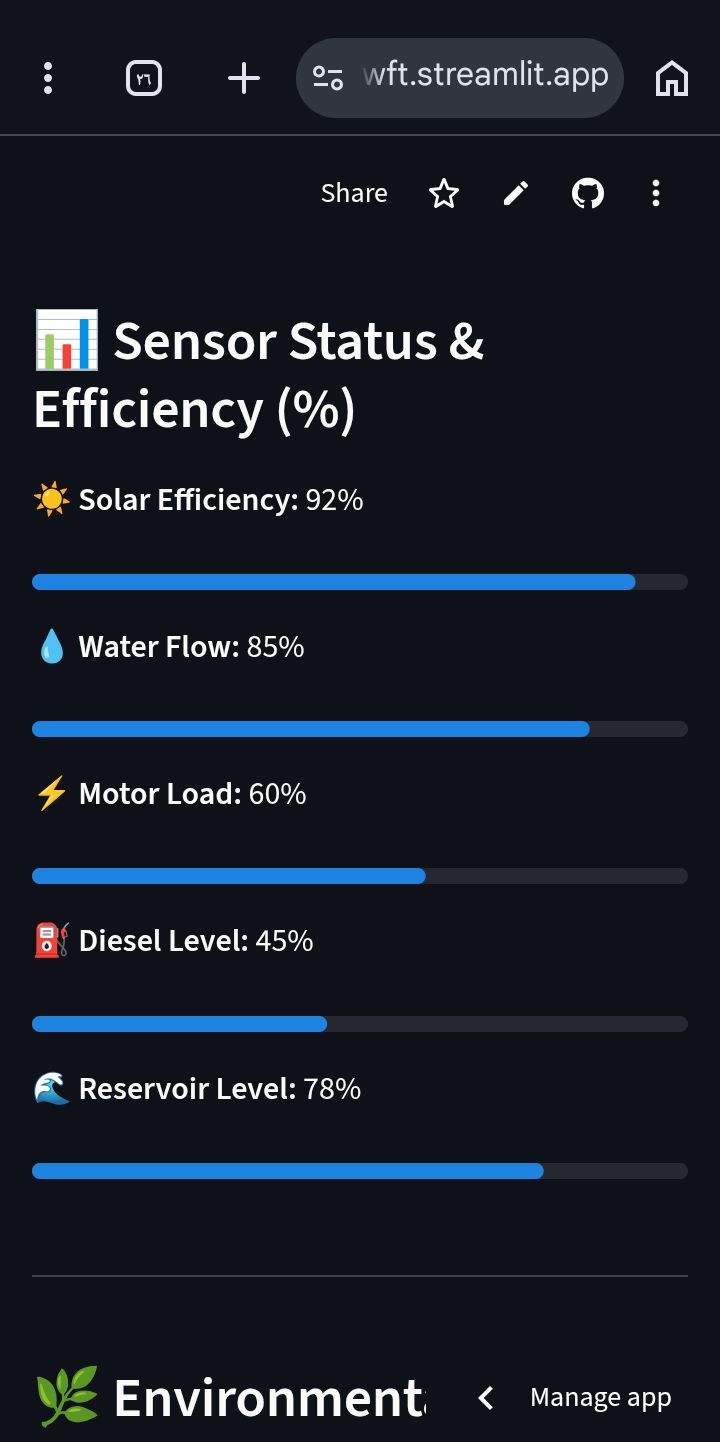
Developing a software interface using Python & Streamlit that translates engineering data into easy-to-understand accounting and financial reports for farmers and project managers.
📈 Impact
- Reducing Costs: Significantly lowering maintenance costs by preventing motor burnouts (saving over 400,000 YER per pump).
- Resource Efficiency: Reducing diesel consumption by up to 30% through smart energy optimization and precise tank level control.
- Community Sustainability: Securing continuous water supplies for the residents of Ghayl Ba Wazir and supporting charitable water projects with accurate data.
- Reducing Faults & Water Interruptions: Through real-time knowledge of the water level in the tank, shutting down the pump at the minimum limit, and sending an immediate alert to the well owner to take necessary action.
🔮 Next Steps
We aim to transform this prototype into a smart network of wells linked to Predictive AI, where the system can predict maintenance needs months before a failure occurs, and expand the project to include all wells in the region to support "Smart Agriculture."
💼 Business Vision & Economic Feasibility (Start-up Logic)
As an Accounting student, I engineered EcoPump AI not just as a technical tool, but as a comprehensive Asset Efficiency & Financial Audit System.
- Market Need: Thousands of water pumps in developing regions operate without any oversight, leading to massive operational waste and financial leakage.
- Financial Sustainability (ROI): With a low implementation cost of only 140,000 Yemeni Rial, the system achieves a full Capital Recovery (Payback Period) within just 45 days. This is calculated based on a minimum daily saving of 2 liters of diesel through smart scheduling and waste prevention.
- Asset Protection: Beyond fuel savings, the system prevents a potential loss of 400,000 Yemeni Rial (the cost of motor replacement) by mitigating "Dry-Running" and electrical surges. This makes the Return on Investment (ROI) instantaneous upon the very first successful protection event.
- Scalability: Designed as a "Plug-and-Play" solution, EcoPump AI is built for rapid deployment, turning rural water management into a sustainable, data-driven, and profitable business model.
Built With
- and-30a-relay.-languages:-python
- current-sensor-(acs712)
- github
- hardware:-esp32
- numpy.-tools:-arduino-ide
- plotly-(financial-visualization)
- sql.-frontend/dashboard:-streamlit.-libraries:-pandas
- ultrasonic-sensor-(hc-sr04)
- water-flow-sensor-(yf-s201)

Log in or sign up for Devpost to join the conversation.