Inspiration
Every year, millions of animals are injured, endangered, or displaced due to human activity and environmental changes. Yet, many people who want to help don’t know how or where to start. We were inspired to create EcoGuardian to bridge this gap, empowering individuals to take meaningful action for wildlife conservation through technology, community, and innovation.
What it does
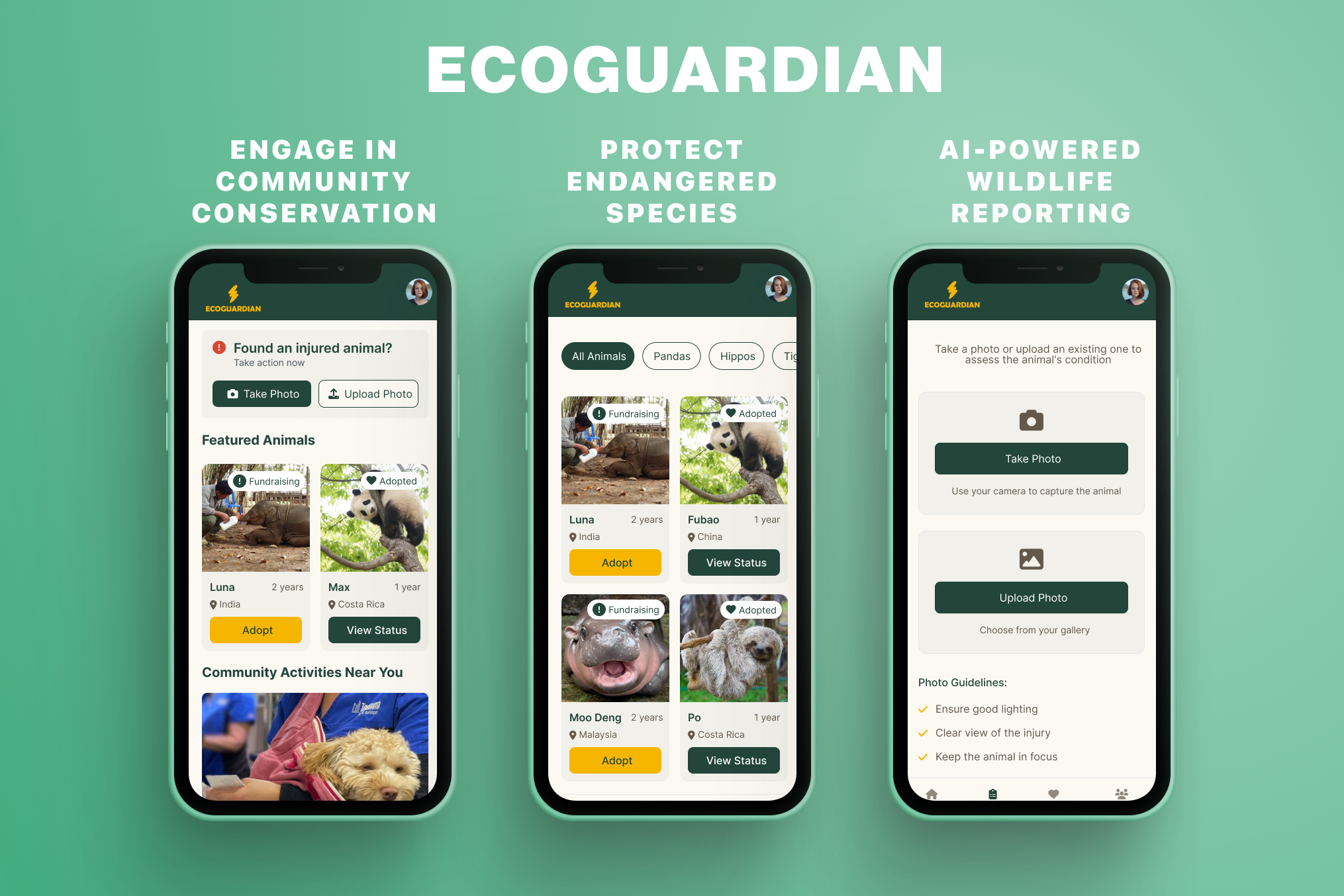
EcoGuardian is a digital platform that empowers users to:
- Report Wildlife in Distress: Upload photos of injured or endangered animals for species identification using computer vision, receive guidance from a custom-trained AI model, and connect with local conservation organizations.
- Adopt or Sponsor Endangered Animals: Financially support conservation efforts and receive updates on the animal’s status and habitat.
- Engage in Community Conservation Efforts: Discover local volunteer opportunities, track contributions, and connect with like-minded individuals.
- Support Individuals Transitioning to Independence: Through volunteer opportunities and community engagement, EcoGuardian empowers individuals looking to get involved in conservation. By providing tools, guidance, volunteer opportunities, and a support network, the platform helps users transition into environmental advocacy and build connections with like-minded individuals.
By combining AI, computer vision, and community-driven initiatives, EcoGuardian fosters a collaborative approach to wildlife protection and environmental sustainability.
How we built it
- Frontend: Typescript, React, Axios
- Styling: Tailwind CSS
- Backend: Node.js, Express.js
- Database: MySQL for user data, adoption records, and conservation opportunities
- AI/ML: TensorFlow for computer vision (species identification) and FastAPI for connecting the AI model to detect animals
- Tools: GitHub for version control, Figma for wireframes & prototypes and UI design
Challenges we ran into
- AI Model Accuracy: Training the computer vision model to accurately identify a wide range of species in diverse environments was challenging. We developed a custom-trained AI model using TensorFlow for species identification, leveraging computer vision to analyze and categorize wildlife in distress. This AI-driven approach enhances rescue efforts and conservation strategies without relying on pre-trained models.
- User Experience: Balancing simplicity with the need for advanced features (e.g., AI guidance, AR integration) was a design challenge.
- Data Privacy: Safeguarding user data while maintaining seamless functionality required robust backend architecture.
Accomplishments that we're proud of
- Successfully integrating AI-powered, real-time species identification and wildlife reporting.
- Developing a scalable backend and database to handle user data, adoption records, and volunteer activities efficiently.
- Building a user-friendly platform that combines reporting, adoption, and volunteerism in one place.
- Creating a community-driven ecosystem that connects users with local conservation organizations.
What we learned
- How to leverage AI and computer vision to solve real-world conservation challenges.
- The power of community engagement in driving meaningful environmental impact.
- The challenges of balancing technical complexity with ease of use, and the significance of user-centered design in creating a platform.
What's next for EcoGuardian
- Expand AI Capabilities: Improve species identification accuracy and add support for more endangered animals.
- AR Integration: Allow users to "see" their adopted animals in the wild using augmented reality.
- Gamification: Introduce badges, leaderboards, and rewards to encourage user engagement.
- Global Reach: Partner with international conservation organizations to expand the platform’s impact.
Eligible Hackathon Tracks
- Challenge: Create an application to promote wildlife conservation amidst climate change
- Challenge: Develop a resource that supports individuals transitioning to independence, providing tools, guidance, and community connections
- Bounty: Your solution involves an AI/ML model trained by your team using a dataset of your choice (no pre-trained models are used)
Built With
- axios
- express.js
- fastapi
- figma
- git
- github
- mysql
- node.js
- python
- react
- tailwind
- tensorflow
- typescript


Log in or sign up for Devpost to join the conversation.