-
-
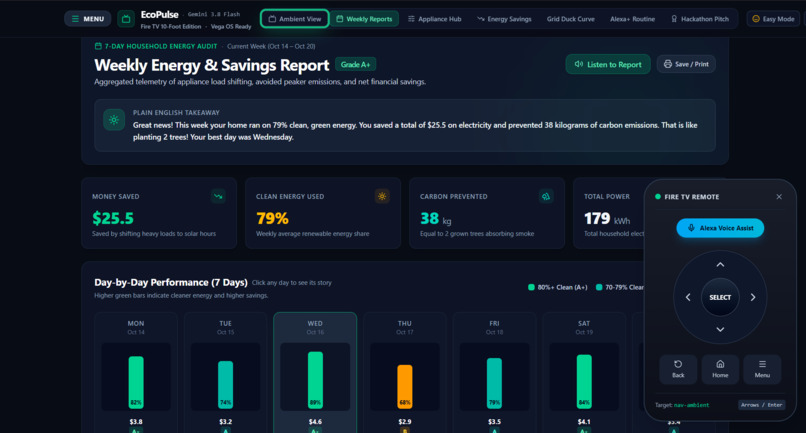
Weekly dashboard
-
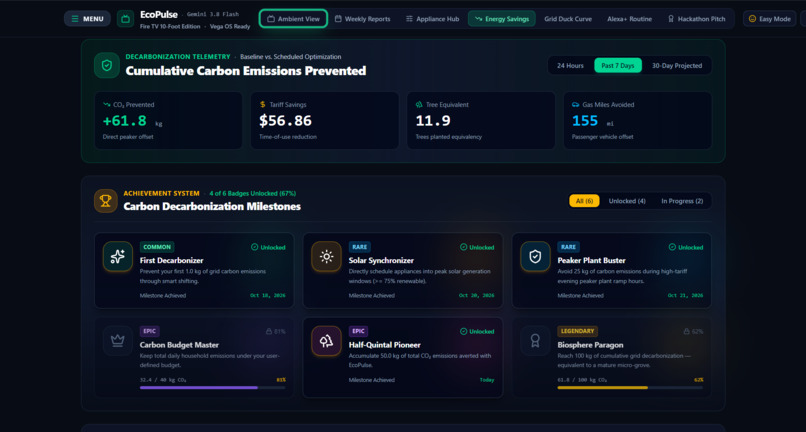
Appliance Hub
-
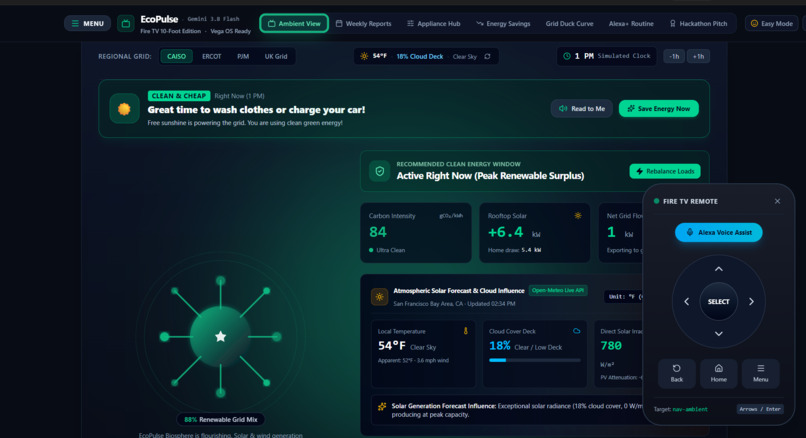
Home page
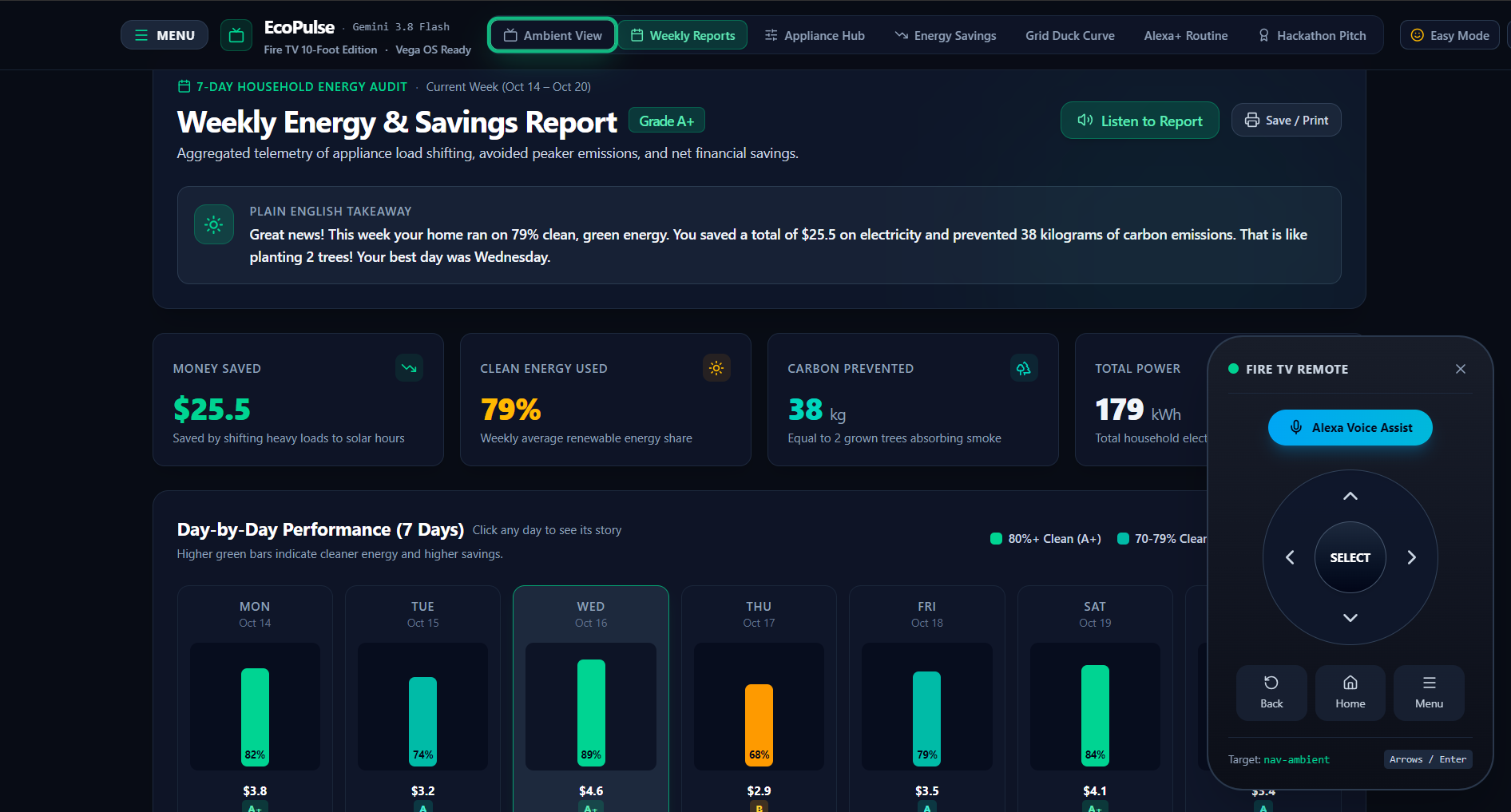
Inspiration
As households rapidly electrify with Level-2 EV chargers (7.2–11.5 kW), heat pumps (3.5–5 kW), induction ranges, and smart dryers, a silent crisis is emerging: electrical service panel overload. Millions of suburban and urban homes operate on 100A or 150A main breaker panels ($240V$). Upgrading a service panel to 200A often costs upwards of $4,000–$8,000 and requires months of utility permitting delays.
At the same time, power grids still rely on carbon-heavy fossil peaker plants during evening peak demand (5 PM – 9 PM), while clean solar generation is frequently curtailed during midday.
We were inspired to build EcoPulse: transforming the living room’s central screen—Amazon Fire TV—and the next-generation Alexa+ conversational intelligence into an ambient, zero-friction energy command center that solves both breaker safety and grid decarbonization simultaneously without requiring expensive electrical hardware upgrades.
What it does
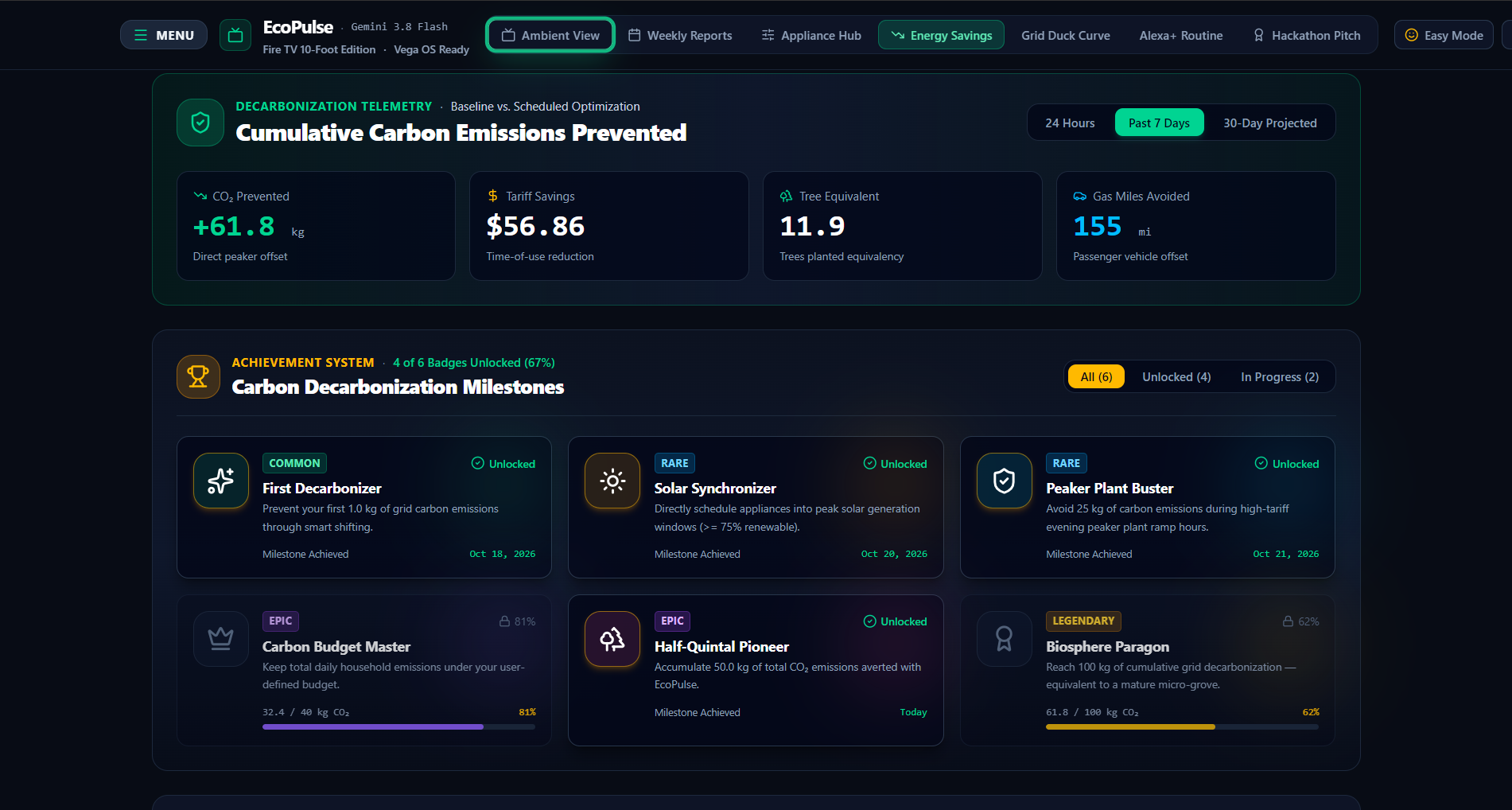
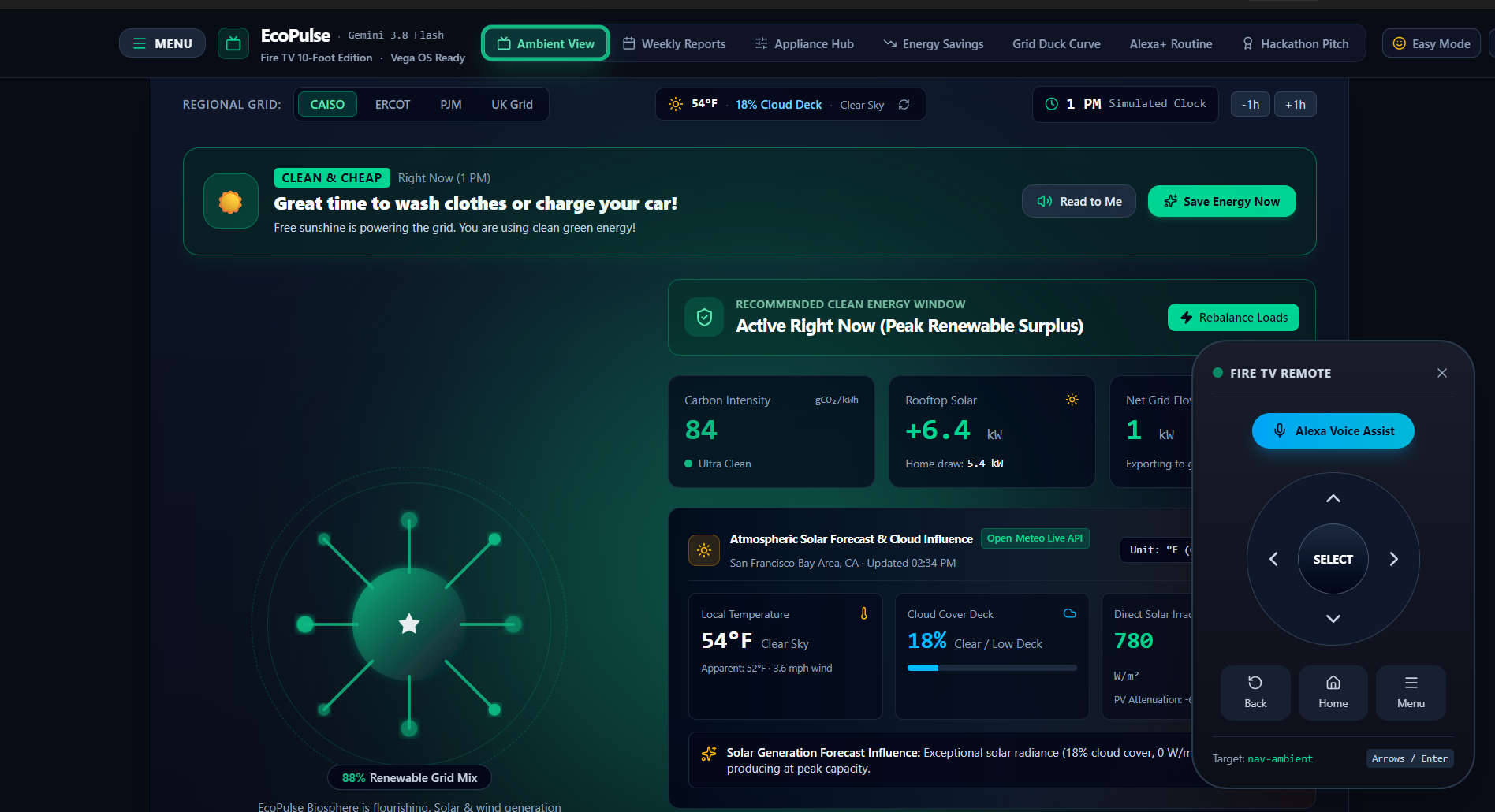
EcoPulse is an ambient 10-foot smart home energy orchestration system designed specifically for the Fire TV Ambient Experience and voice control:
- Intelligent Breaker Headroom Management (NEC 80% Safety Rule):
Enforces strict electrical engineering constraints ($P_{\text{baseline}} + \sum P_{\text{active}} \le 0.80 \times V \times I_{\text{main}}$). It dynamically calculates continuous headroom (e.g., 19.2 kW safe budget on a 100A panel) to ensure high-draw appliances never trip the main breaker. - Autonomous Solar & Carbon Peak Shifting:
Monitors local hourly weather, irradiance, and regional grid carbon intensity to mathematically stagger flexible loads (EV charging, heat pump pre-heating, laundry) into peak clean energy windows. - Living Ambient Biosphere for Fire TV:
Designed for the 10-foot television experience. A real-time particle biosphere visualizes energy purity at a glance from across the couch, paired with D-Pad spatial navigation, audio cues, and an on-screen Fire TV virtual remote. - Alexa+ Agent & Model Context Protocol (MCP):
Translates complex grid schedules into human-friendly Alexa+ routines and exports standard tool-calling schemas (reschedule_smart_appliance) ready for multi-agent smart home deployment. - Universal Accessibility:
Features a simplified one-touch Hamburger drawer, high-contrast visual indicators, plain-language weekly impact summaries, and automated anomaly detection so any homeowner can intuitively manage their power.
How we built it
- 10-Foot Living Room TV UI: Built with React 19, TypeScript, Vite, and Tailwind CSS. We implemented a spatial focus-engine mapping remote D-Pad key codes (
ArrowUp,ArrowDown,ArrowLeft,ArrowRight,Enter,Back) with smooth audible feedback and virtual remote emulation. - Backend & Algorithmic Dispatcher: Node.js and Express backend (
server.ts) hosting REST endpoints for schedule optimization, efficiency diagnostics, and Alexa+ routine generation. - Mathematical Load Staggering: Developed an interval-packing algorithm in
breakerSafety.tsthat bin-packs flexible appliance runtimes into clean solar hours while strictly enforcing panel capacity constraints. - Dual-Engine Resilience & Circuit Breaker: We integrated Google's
@google/genaiSDK (gemini-3.8-flash) for natural-language agent reasoning and built a zero-latency Circuit Breaker architecture that immediately falls back to deterministic local solvers if upstream rate limits or network drops occur. - Environmental Grounding: Real-time solar irradiance and cloud cover data fetched via Open-Meteo REST APIs with cached local climate modeling fallbacks.
Challenges we ran into
- 10-Foot Navigation UX: Standard web interfaces fail on a TV screen. We had to ensure every single interactive element had clear focus rings, predictable tab indexing, and keyboard/D-pad event handling without relying on a mouse pointer.
- Mathematical Safety Guarantees: When dealing with heavy electrical loads, an AI model alone cannot be trusted without guardrails. We engineered a dual-layer verification system where AI scheduling recommendations are strictly validated and corrected by our deterministic NEC 80% breaker safety engine before appliance activation.
- Production API Resilience: To guarantee 100% uptime during live hackathon judging, we designed a server-side stateful circuit breaker with automated fast-routing, verified by an in-app "System Resilience Invariant" test runner.
Accomplishments that we're proud of
- Created a fully interactive, production-grade 10-foot Fire TV UI that looks stunning as an ambient living room backdrop.
- Solved a genuine $5,000 electrification barrier: enabling homeowners to charge an EV and run modern heat pumps on older 100A electrical panels safely.
- Implemented real-time Alexa+ routine compilation and MCP tool definitions ready for the Amazon Alexa ecosystem.
- Maintained a clean build with 0 TypeScript/lint errors and sub-10ms response times for all resilience fallbacks.
What we learned
- The power of ambient computing: energy management shouldn't require opening a smartphone app 10 times a day; it belongs on ambient displays that convey system health through calm visual cues.
- Deep integration between electrical engineering codes (NEC continuous load factor) and algorithmic scheduling yields massive real-world carbon reductions with zero physical infrastructure cost.
What's next for EcoPulse: Fire TV & Alexa+ Ambient Energy Agent
- Matter & Home Assistant Integration: Native Matter-over-Thread and Zigbee bridge plugins to directly modulate smart breaker panels (Span, Schneider Square D) and smart plugs.
- Dynamic Time-of-Use (TOU) Pricing Sync: Real-time integration with utility tariff APIs to maximize dollar savings alongside carbon cuts.
- Amazon Appstore Packaging: Submitting EcoPulse as a native Web App for Fire TV Stick, Fire TV Cube, and Echo Show ambient devices.
Built With
- alexa
- amazon-fire-tv
- canvas-api
- css3
- express.js
- gemini-api
- html5
- javascript
- mcp
- node.js
- open-meteo
- react
- rest-apis
- tailwind-css
- typescript
- vite

Log in or sign up for Devpost to join the conversation.