-
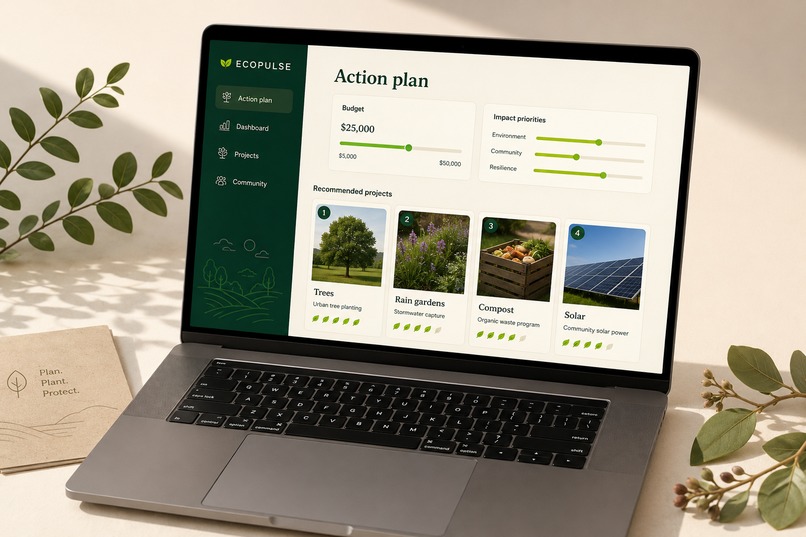
EcoPulse climate action dashboard
-
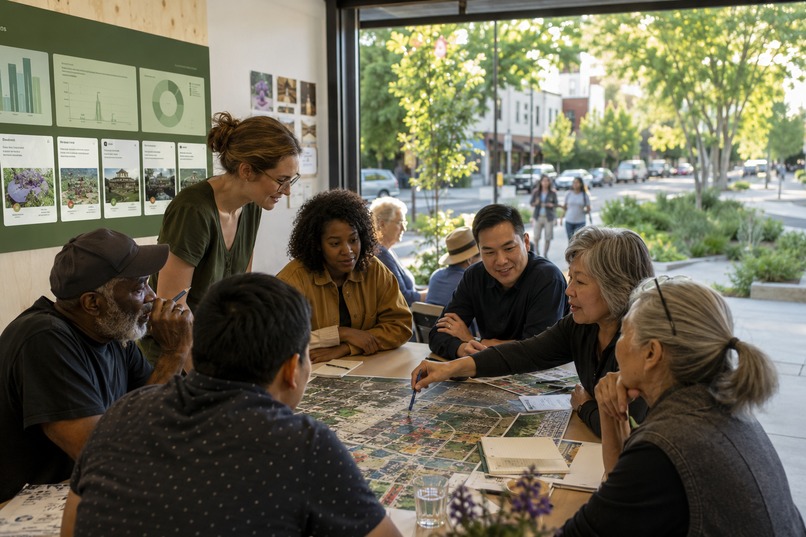
Neighbors plan greener streets together
-
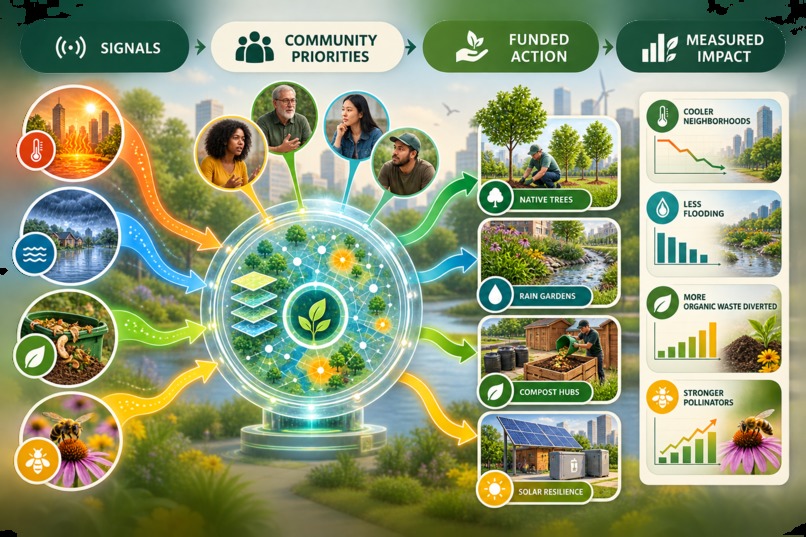
EcoPulse from signals to measured impact
-
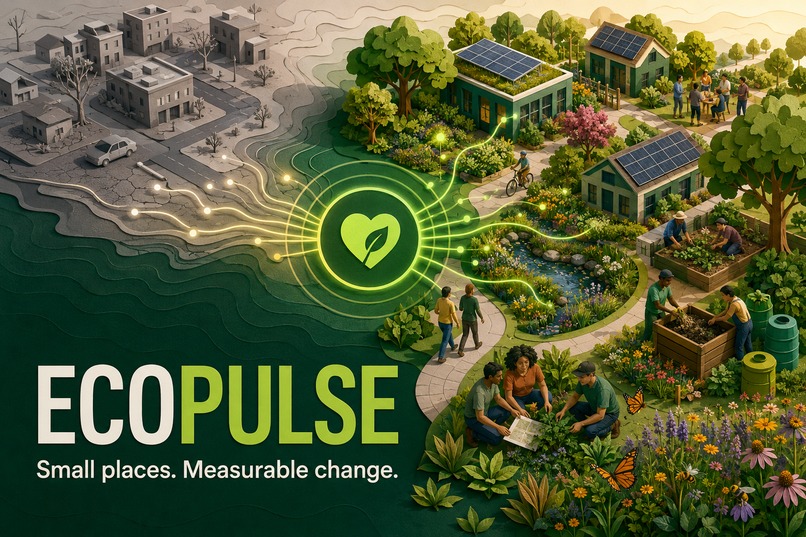
EcoPulse From heat to green
Inspiration
Communities are surrounded by environmental data—heat readings, flood reports, waste audits, energy usage, and wildlife observations—but turning that information into practical action remains difficult. Climate dashboards often describe a problem without helping residents decide what to fund, while complex planning models can be too expensive or difficult to understand.
We created EcoPulse to bridge that gap. Our goal was to give communities a transparent tool that answers a practical question: Given our budget and priorities, which environmental actions should we take first?
What it does
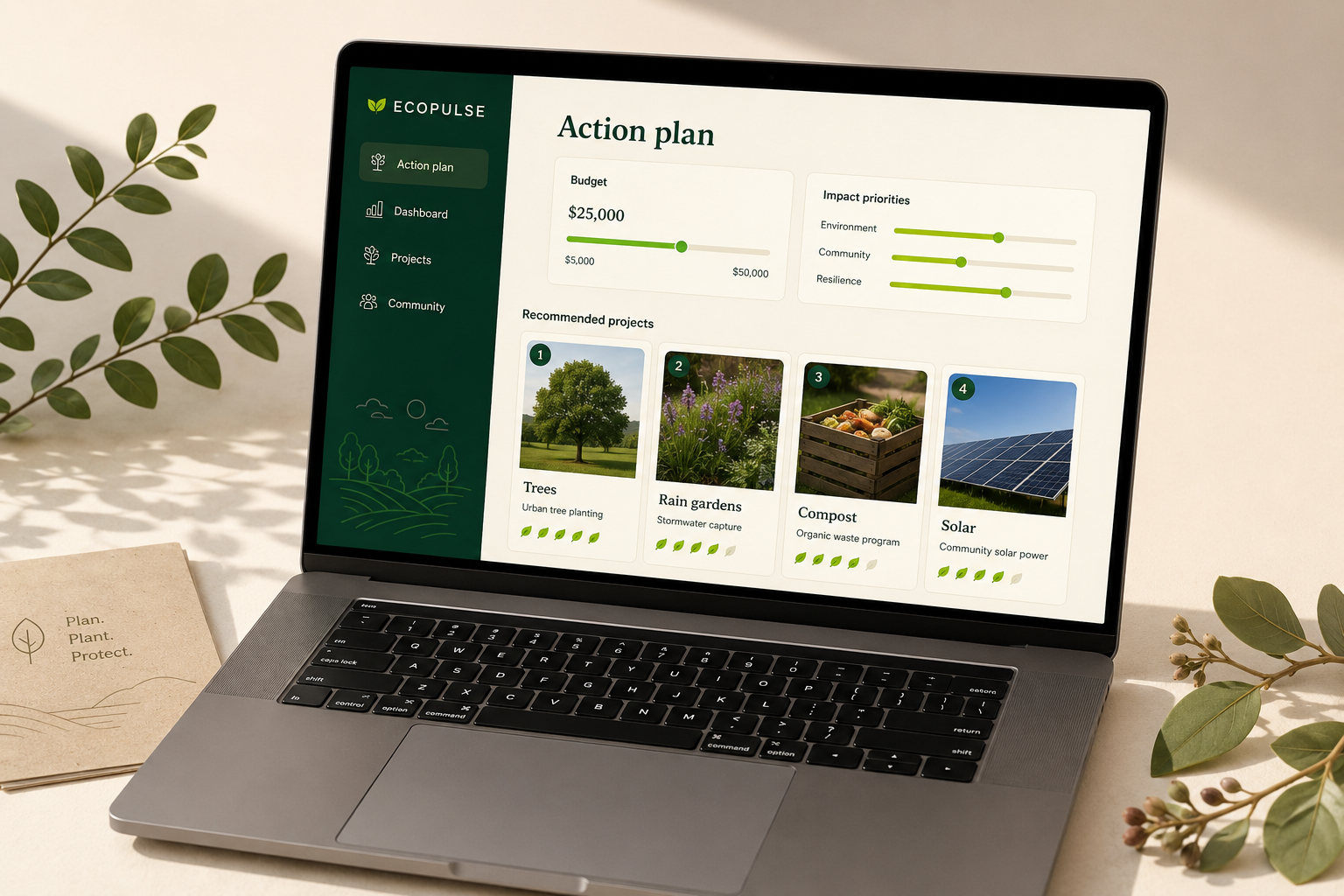
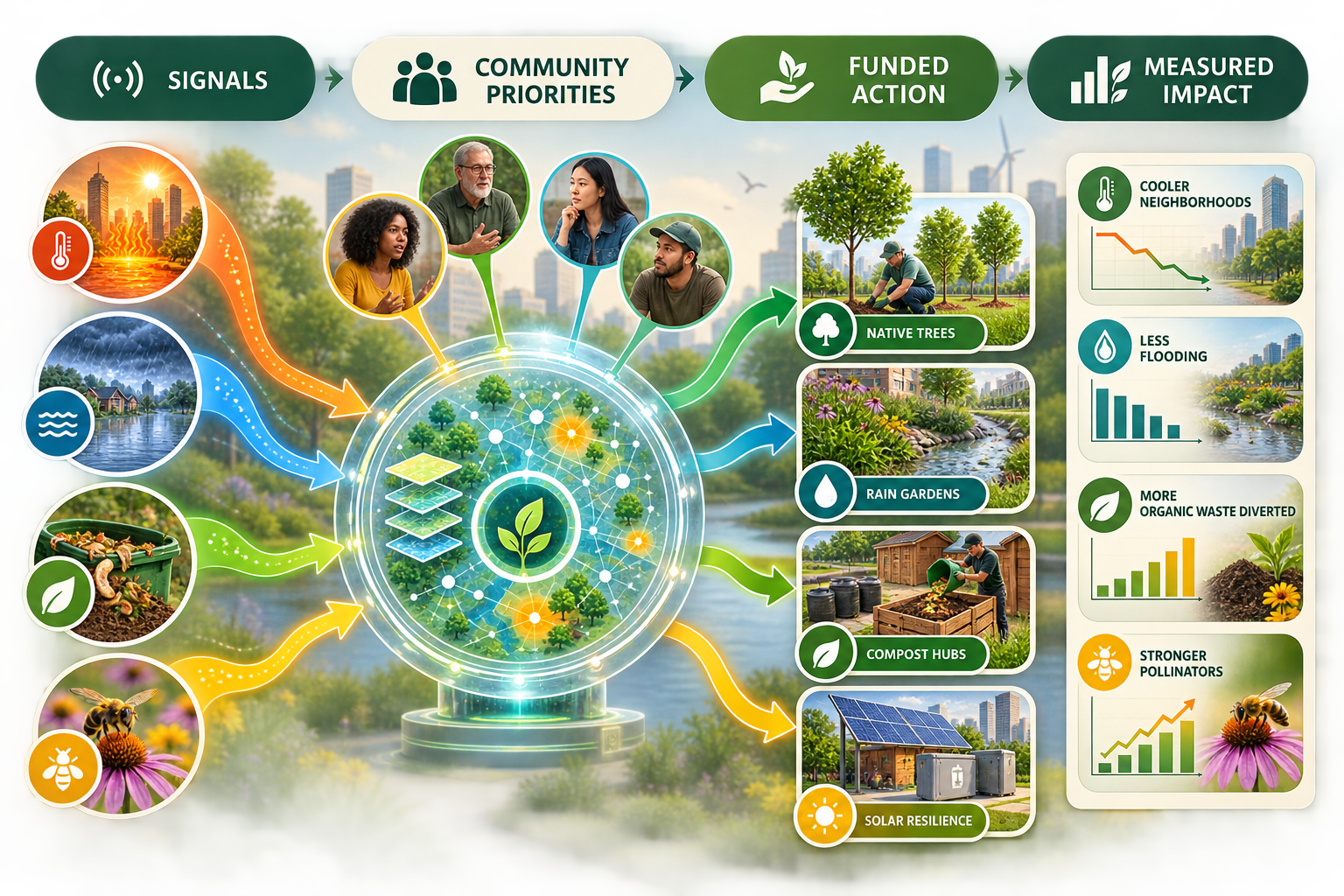
EcoPulse is an interactive climate-action simulator that transforms local environmental signals into a prioritized, budget-conscious action plan.
Users can:
- Set a community improvement budget.
- Adjust priorities for carbon reduction, water conservation, biodiversity, and climate resilience.
- Instantly generate a portfolio of recommended environmental projects.
- Compare expected impact, implementation cost, and measurable outcomes.
- Understand why every action was selected.
- Explore community signals such as heat islands, flooding, organic waste, and declining pollinator activity.
The current for each action is calculated using a transparent weighted-impact model:
$$ S(a)=\frac{\sum_{i=1}^{n} O_{a,i}P_i}{\sum_{i=1}^{n}P_i} $$
Here, $O_{a,i}$ represents an action’s expected outcome for category $i$, while $P_i$ represents the priority assigned to that category by the community. EcoPulse then considers cost efficiency and selects the highest-impact combination of projects that remains within the available budget.
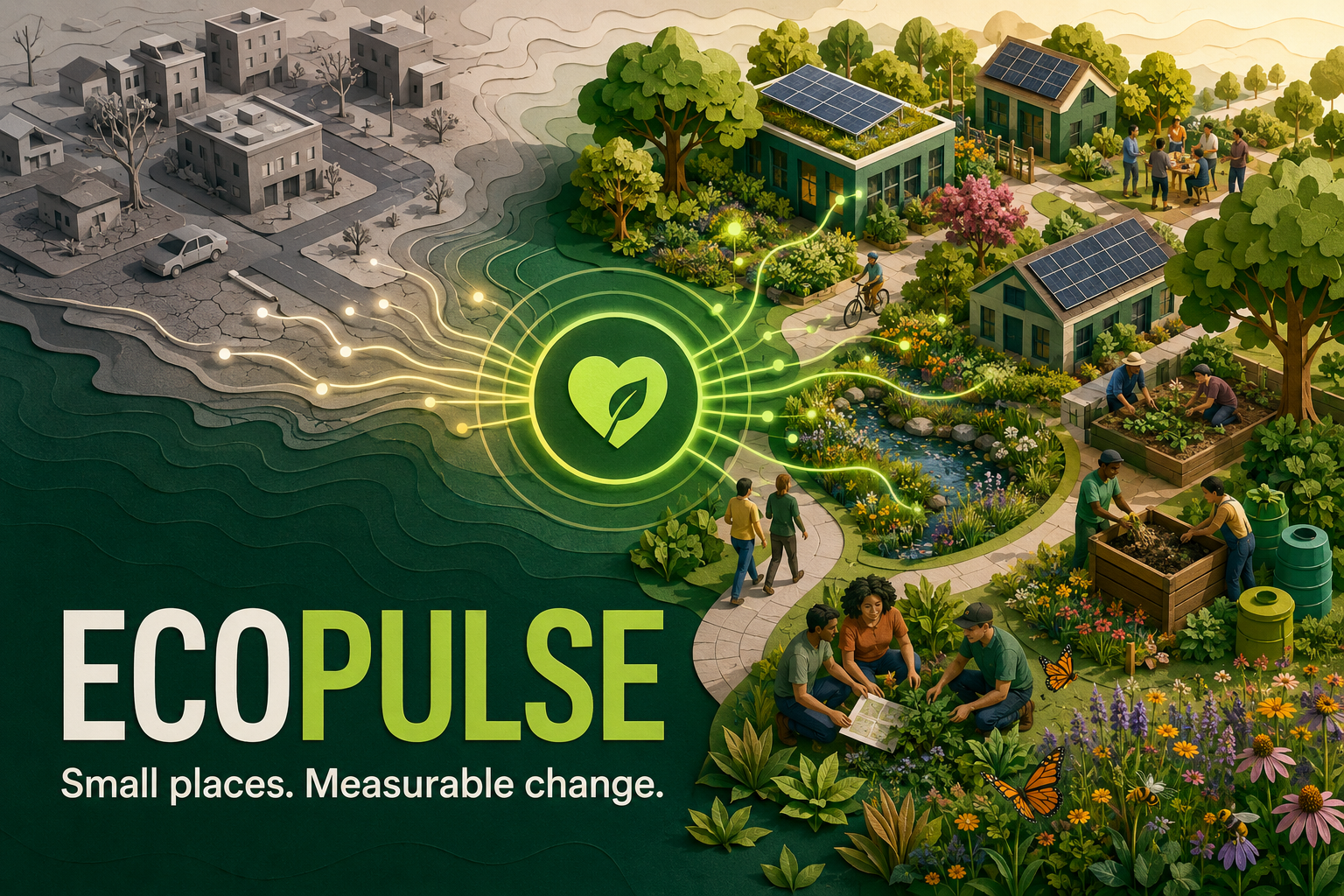
The current demonstration uses Riverbend, Arizona, a fictional but realistic neighborhood facing increased temperatures, recurring flooding, excessive organic waste, and declining pollinator populations.
How we built it
We built EcoPulse as a responsive web application using React, JavaScript, Vite, and CSS. The interface uses Lucide React icons and a custom environmental design system that works across desktop and mobile devices.
The recommendation engine contains a catalog of potential interventions, including:
- Planting native shade trees.
- Constructing rain gardens.
- Creating community compost hubs.
- Installing solar power and battery storage.
- Restoring pollinator corridors.
Each intervention includes its estimated cost, environmental scores, implementation description, and measurable success metric. The engine calculates a weighted score from the user’s priorities, ranks projects by impact per dollar, and builds a portfolio without exceeding the selected budget.
We deliberately made the scoring engine deterministic and explainable. This allows residents, judges, and decision-makers to inspect the assumptions, reproduce the results, and discuss whether the selected priorities reflect the community’s needs.
We also created automated tests to verify that portfolios remain within budget, environmental actions receive valid scores, and changes in community priorities affect the recommendations.
Challenges we ran into
One major challenge was balancing simplicity and realism. Environmental planning involves uncertainty, long-term maintenance, geographic constraints, and social considerations, but including every variable would have made the hackathon prototype difficult to understand.
We addressed this by focusing on four clear impact dimensions while designing the system so that additional constraints and data sources can be added later.
Another challenge was preventing the recommendation engine from feeling like a black box. Instead of using unexplained AI-generated suggestions, we created a visible scoring model and provided concrete outcome metrics for every intervention.
We also had to design an interface that presented budgets, environmental signals, rankings, and impact estimates without overwhelming users. Iterating on the visual hierarchy helped us create an experience that feels approachable while still communicating meaningful information.
Accomplishments that we're proud of
We are proud that EcoPulse goes beyond raising awareness and helps users move from environmental signals to practical decisions.
Our most important accomplishments include:
- Building a fully functional and responsive prototype.
- Creating recommendations that react instantly to changing budgets and priorities.
- Ensuring that every generated portfolio stays within its financial limit.
- Making the recommendation logic transparent and explainable.
- Connecting every proposed action to a measurable environmental outcome.
- Designing the platform for community meetings, schools, nonprofits, and local governments.
- Building an extensible foundation that can later incorporate real environmental datasets.
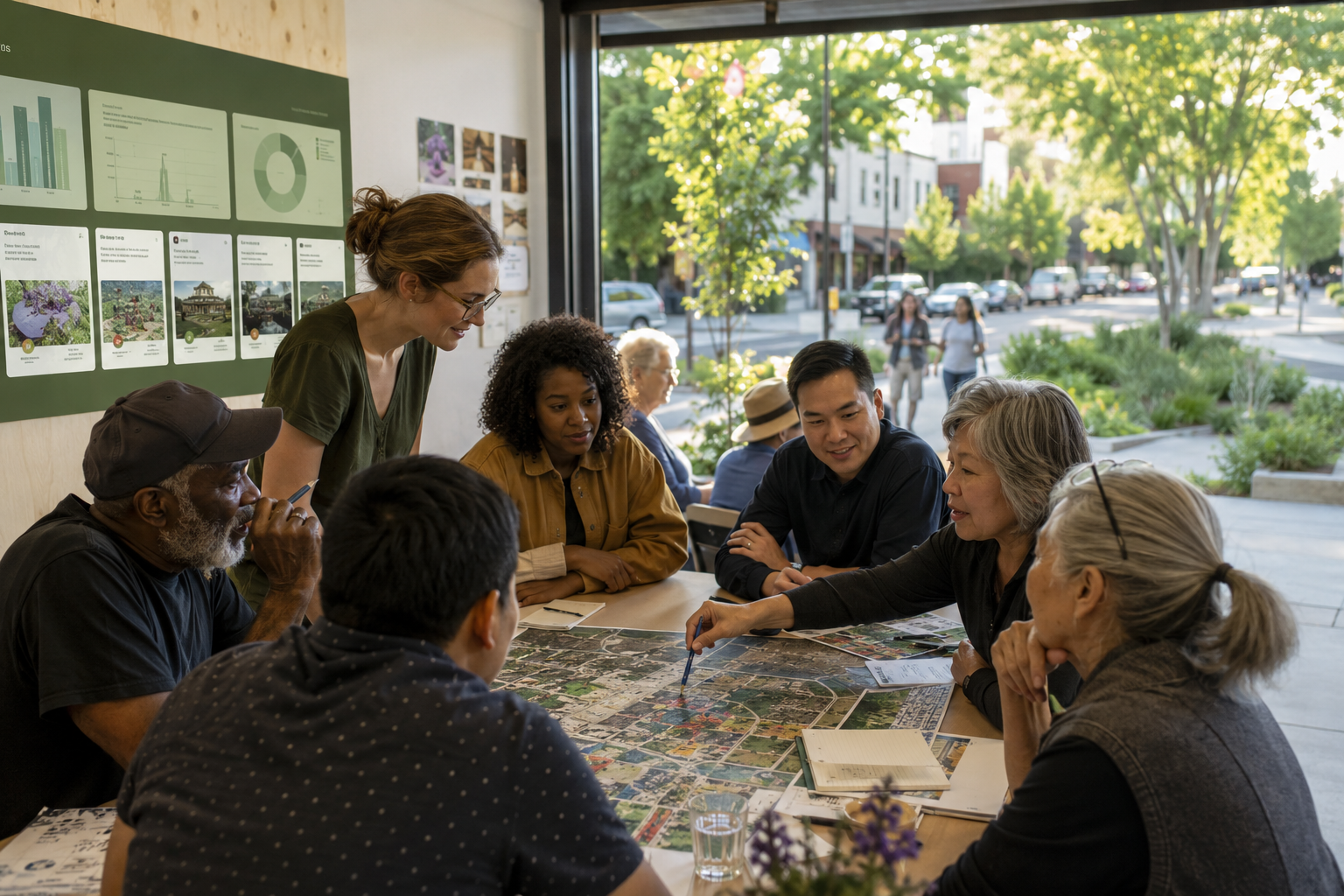
Most importantly, EcoPulse makes climate planning feel participatory. It gives communities a shared space for discussing trade-offs instead of presenting them with a predetermined answer.
What we learned
We learned that the most valuable environmental technology does not simply provide more data—it helps people understand that data and use it to make decisions.
We also learned that explainability is especially important when technology influences public funding. A recommendation becomes more useful when residents can see its cost, expected benefit, underlying priorities, and limitations.
From a technical perspective, we learned how to design a lightweight optimization engine, connect it to an interactive React interface, and test its behavior across different budgets and priority combinations.
Finally, we learned that community participation should be part of the system itself. Local residents possess knowledge that may not appear in official datasets, such as frequently flooded intersections, unsafe walking routes, or disappearing wildlife.
What's next for EcoPulse
Our next step is to transform EcoPulse from a sample scenario into a platform that communities can configure with their own data.
Planned features include:
- CSV and GeoJSON data imports.
- Interactive maps of heat, flooding, tree canopy, and habitat.
- Multilingual resident reporting.
- Evidence sources and confidence ranges for every estimate.
- Multi-year budgets and maintenance-cost modeling.
- Equity and accessibility considerations.
- Alternative planning scenarios and side-by-side comparisons.
- Community comments, voting, and approval workflows.
- Printable reports for meetings and funding applications.
- Before-and-after environmental impact tracking.
We also plan to collaborate with neighborhood associations, schools, urban forestry organizations, watershed groups, and municipal sustainability teams. These partnerships would help us validate our scoring assumptions and test EcoPulse using real community challenges.
Our long-term vision is for EcoPulse to become a shared environmental decision platform where communities can identify problems, compare solutions, secure support, and measure the results—moving together toward a healthier and more resilient planet.
Built With
- biodiversity
- climate
- cloudflare
- css3
- html5
- javascript
- node.js
- optimization
- sustainability
- vite

Log in or sign up for Devpost to join the conversation.