-
-
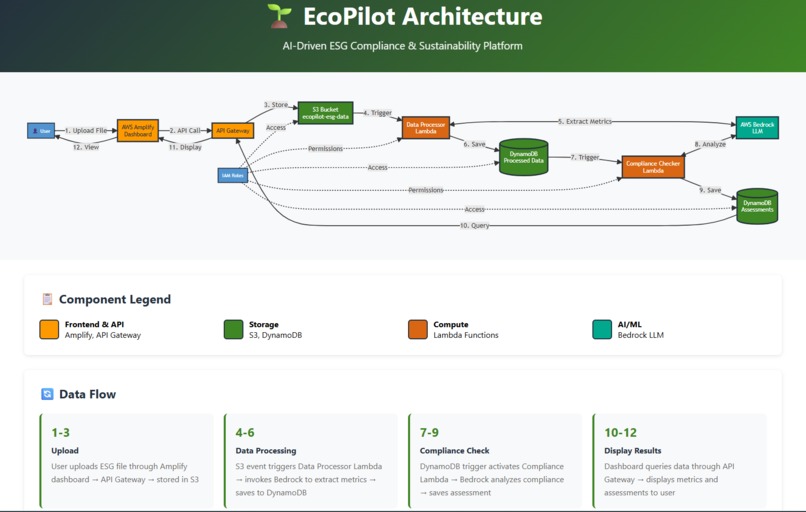
Architecture Diagram
Inspiration
The inspiration for EcoPilot came from the growing need for accessible sustainability and ESG (Environmental, Social, and Governance) tools. Small and medium-sized businesses often struggle to measure and report their environmental impact due to the complexity of data formats, ranging from invoices and IoT sensors to sustainability reports.
We wanted to build something agentic — an AI system that not only analyzes environmental data but also reasons about compliance gaps and recommends actions. EcoPilot was born out of the belief that AI can make sustainability compliance intelligent, automated, and accessible.
What it does
EcoPilot is an LLM-driven sustainability and compliance optimization agent built entirely on AWS.
It automates the process of:
- Ingesting ESG Data (PDF, CSV, IoT streams)
- Extracting key environmental metrics using an LLM hosted on AWS Bedrock
- Evaluating compliance risks and identifying inefficiencies
- Recommending actionable improvements
Example Scenarios
- Small Business Owner: uploads a PDF sustainability report → EcoPilot extracts metrics → highlights emission risks → generates an action summary.
- Factory CEO: uploads IoT sensor logs → EcoPilot detects anomalies → flags inefficiencies → recommends operational improvements.
In short, EcoPilot transforms raw sustainability data into compliance insights and actionable intelligence autonomously.
How we built it
⚙️ ESG Compliance Workflow
Amazon S3 → AWS Lambda → DynamoDB → Amplify Dashboard
Amazon S3
- Stores uploaded files (PDFs, CSVs, IoT data).
- Configured with folder structure, lifecycle rules, and secure access policies.
- Stores uploaded files (PDFs, CSVs, IoT data).
AWS Lambda Functions
- Data Processor Lambda
- Triggered by new file uploads to S3.
- Uses AWS Bedrock to extract ESG-related metrics.
- Saves processed data to DynamoDB.
- Triggered by new file uploads to S3.
- Compliance Checker Lambda
- Runs automatically after data processing.
- Evaluates compliance gaps and stores assessments in DynamoDB.
- Runs automatically after data processing.
- Data Processor Lambda
Amazon DynamoDB
- Serves as the central data store for extracted metrics and compliance assessments.
- Optimized for fast, scalable access by the dashboard and backend services.
- Serves as the central data store for extracted metrics and compliance assessments.
AWS Amplify Dashboard
- Provides a front-end interface for users to upload files and view sustainability insights.
- Integrated with backend services for real-time data visualization.
- Provides a front-end interface for users to upload files and view sustainability insights.
Amazon API Gateway
- Exposes backend endpoints with full CORS support.
- Configured for Lambda proxy integration to streamline request handling.
- Exposes backend endpoints with full CORS support.
Challenges we ran into
One of the early challenges was LLM overmapping. The initial prompt used by the data processor Lambda was too permissive. It attempted to extract and map every detected field from uploaded documents, including many that were irrelevant to ESG analysis. This led to noisy outputs and bloated DynamoDB entries. To address this, I refined the prompt to focus exclusively on sustainability-related metrics, such as emissions, energy usage, and governance indicators. This significantly improved precision and reduced downstream processing overhead.
Another issue surfaced during front-end integration: CORS misconfiguration. The Amplify dashboard couldn’t communicate with the backend due to restrictive API Gateway settings. We had to explicitly re-enable all necessary headers and HTTP methods, ensuring full CORS support and seamless Lambda proxy integration. This unlocked real-time data flow between the dashboard and backend services, restoring full functionality for file uploads and metric visualization.
Accomplishments that I'm proud of
This was my first time using AWS, and I dove straight into building a fully automated, multi-Lambda pipeline that integrates LLM reasoning with real-time data ingestion and compliance evaluation. The system successfully extracts key ESG metrics from both PDF and CSV files using AWS Bedrock, feeding structured outputs into DynamoDB for downstream analysis. On the front end, I created a working Amplify dashboard that visualizes compliance assessments, allowing users to upload documents and instantly view sustainability insights. The entire workflow—from ingestion to visualization—is now orchestrated through AWS services, and it’s been a rewarding deep dive into cloud-native automation.
What I learned
Throughout this project, I explored how to combine LLM reasoning with AWS serverless infrastructure to build autonomous workflows that ingest, process, and visualize ESG data with minimal human intervention. One of the most critical lessons was the importance of prompt engineering, crafting domain-specific instructions that guide the LLM to extract only relevant metrics like carbon footprint, energy usage, and governance indicators. On the infrastructure side, managing IAM policies and Lambda triggers required careful attention to ensure both security and seamless automation. I also had to troubleshoot integration issues between AWS Amplify, API Gateway, and Lambda, especially around CORS headers and deployment configurations to enable smooth communication between the front end and backend services. Finally, I learned to balance automation with interpretability, making sure that AI-generated outputs are not only accurate but also understandable to non-technical users who rely on the dashboard for actionable sustainability insights.
What's next for EcoPilot – AI Sustainability Compliance Agent
Looking ahead, I plan to incorporate LangChain and explore Retrieval-Augmented Generation (RAG) to dynamically fetch up-to-date ESG compliance documents and provide real-time compliance visibility for companies. I also want to integrate Amazon SageMaker for predictive analysis, enabling the system to highlight potential sustainability risks before they escalate. To support broader use cases, I’ll expand data type compatibility to include Excel files, JSON APIs, and supplier data feeds, making the pipeline more flexible and enterprise-ready.
Built With
- amazon-dynamodb
- amazon-web-services
- amplify
- api
- api-gateway
- bedrock
- github
- iam
- javascript
- lambda
- python
- react
- s3
- visual-studio

Log in or sign up for Devpost to join the conversation.