EcoPilot AI — Beyond Energy-Saving Advice
Inspiration
I wanted to build something more meaningful than a conventional AI chatbot. Electricity consumption is influenced by dozens of everyday decisions, yet many energy-saving solutions provide generic tips without helping users understand the mathematics behind potential savings.
This inspired me to explore a different approach: What if AI could mathematically optimize everyday energy decisions instead of simply recommending them?
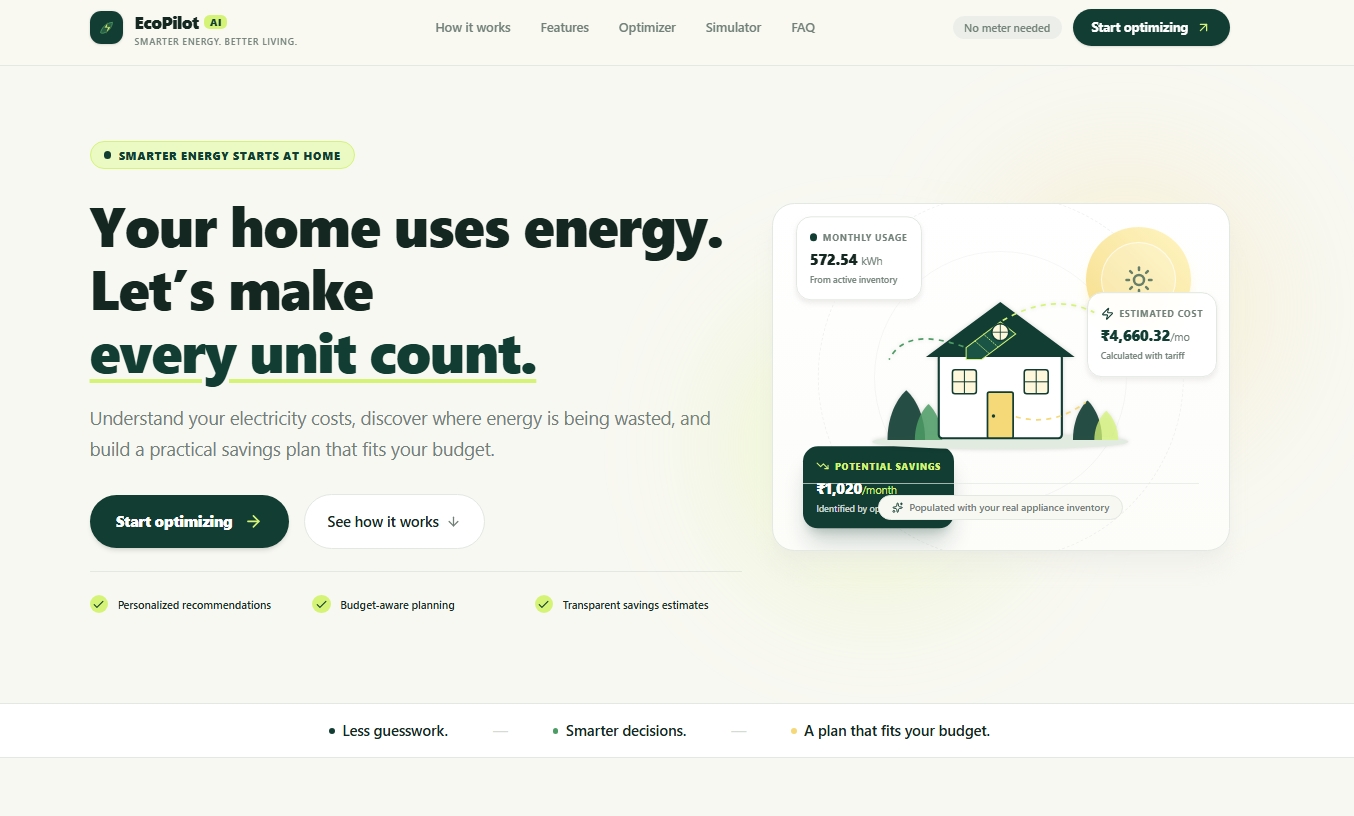
That question led to EcoPilot AI, an energy-saving copilot designed to combine conversational AI, mathematical modelling, and interactive simulations to help households make smarter, data-informed decisions.
What it does
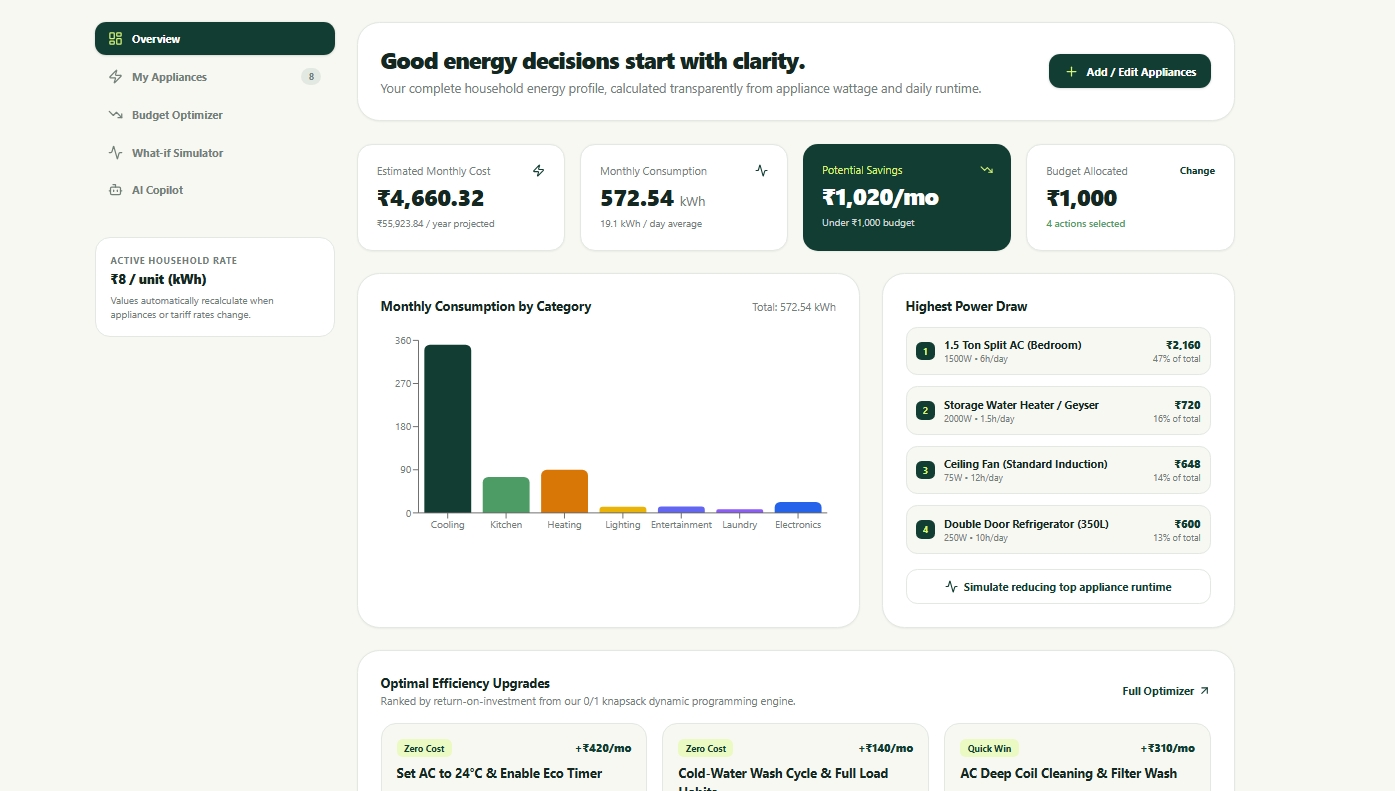
EcoPilot AI aims to transform household energy data into actionable insights through a calculation-driven approach.
Its proposed core capabilities include:
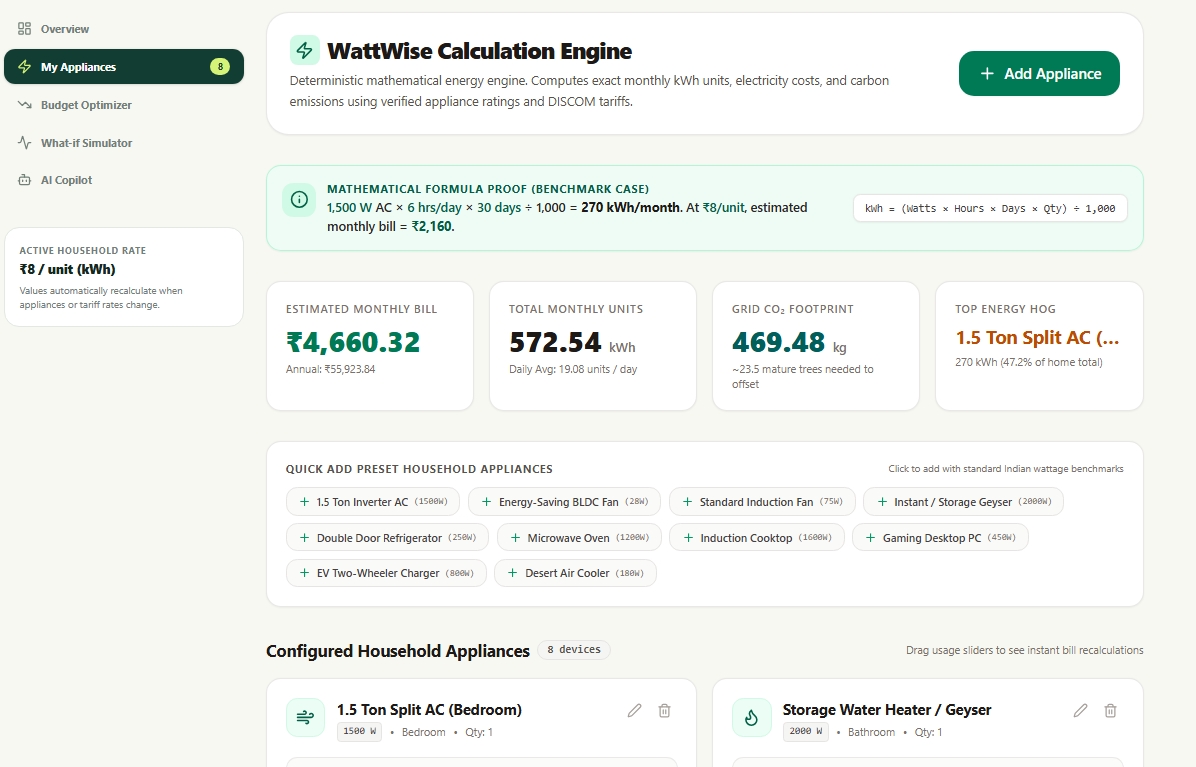
- WattWise Engine: Calculates estimated electricity consumption, monthly costs, and potential savings using appliance power ratings, usage hours, and electricity tariffs.
- Smart Plan Optimizer: Evaluates energy-saving actions against a user's budget to identify promising combinations of changes.
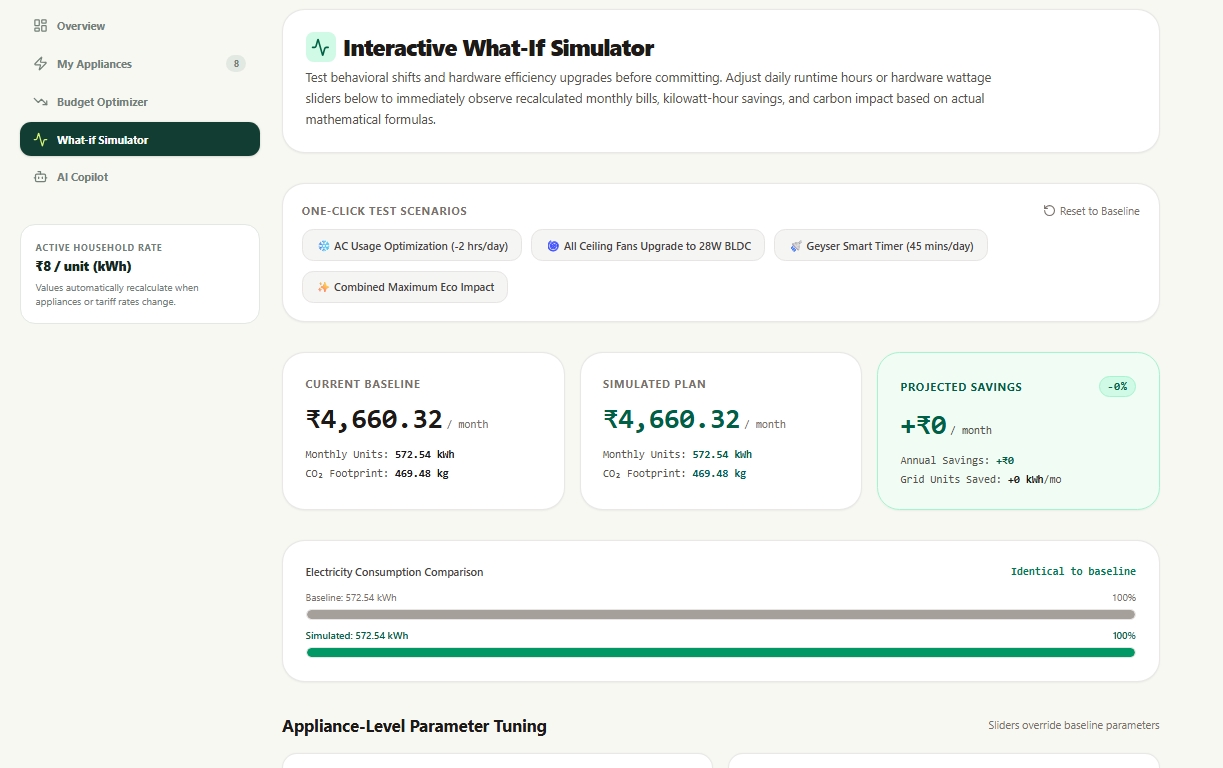
- What-If Simulator: Allows users to change appliance usage assumptions and compare estimated consumption and costs before and after a proposed action.
For example, a user could ask, “How can I reduce my electricity bill without spending more than ₹500?” The system is designed to evaluate eligible actions, estimate their potential impact, and explain the reasoning behind its recommendations.
The goal is to make energy-saving decisions measurable, explainable, and practical rather than relying on generic AI-generated advice.
How I built it
I designed EcoPilot AI around a modular architecture that separates numerical computation from conversational intelligence.
The energy calculation engine is based on the following mathematical model:
$$ E = \frac{P \times h \times d}{1000} $$
where (P) represents appliance power in watts, (h) represents daily usage hours, and (d) represents the number of days. The resulting energy consumption (E) is measured in kilowatt-hours (kWh).
Estimated electricity cost can then be calculated as:
$$ C_{\text{monthly}} = E_{\text{total}} \times T $$
where (T) represents the electricity tariff per kWh.
For budget-based planning, the optimization problem can be expressed as:
$$ \max \sum_{i=1}^{n} x_i S_i $$
subject to:
$$ \sum_{i=1}^{n} x_i K_i \leq B $$
$$ x_i \in {0,1} $$
Here, (S_i) represents the estimated monetary savings from an action, (K_i) represents its upfront cost, (B) is the user's budget, and (x_i) indicates whether an action is selected.
This simplified model illustrates how an optimization algorithm could select a combination of actions that maximizes estimated savings within a budget.
The planned technology stack includes Python for calculations and optimization, an interactive web interface for visualizing scenarios, and Model Context Protocol (MCP) with Streamable HTTP for exposing structured tools to an AI assistant. Amazon Bedrock may optionally support natural-language explanations if successfully integrated.
The intended design keeps numerical calculations separate from AI-generated text, making assumptions easier to inspect and results easier to validate.
Challenges I ran into
One important challenge was understanding that estimated energy savings are not the same as real-world measurements. Actual results depend on appliance efficiency, usage patterns, electricity tariffs, and household conditions.
Another challenge was balancing competing objectives. The cheapest action may not deliver the greatest savings, while the action with the highest estimated benefit may require a larger upfront investment.
I approached this as an optimization problem rather than a simple recommendation task. The objective is to compare costs, potential benefits, and user constraints while clearly communicating uncertainty.
Accomplishments that I'm proud of
I am proud of turning an everyday sustainability problem into a measurable computational problem.
Rather than treating AI as the entire solution, EcoPilot AI is designed around a calculation-first approach in which mathematical logic evaluates energy scenarios and conversational AI helps explain the results.
The concept brings together energy modelling, budget-aware planning, interactive simulations, and a tool-oriented AI architecture to make energy decisions more understandable.
What I learned
This project helped me understand how mathematical modelling can make AI applications more useful and accountable.
I explored the importance of defining objective functions, representing constraints, separating deterministic calculations from language-model responses, and communicating assumptions transparently.
I also learned that a good sustainability tool should help people understand not only what action to take, but also why it may be beneficial and how its estimated impact is calculated.
What's next for EcoPilot AI
My next goal is to develop and validate a working prototype.
Planned improvements include implementing and testing the optimization algorithm, adding household-specific appliance profiles, visualizing alternative energy-saving plans, and introducing more detailed scenario comparisons.
I also want to explore real energy-data integrations where authorized data sources are available, while keeping simulated results clearly distinguished from measured outcomes.
My long-term vision is to make EcoPilot AI a practical decision-support system that combines mathematical reasoning and conversational AI to help households make smarter energy choices.
Less guesswork. More measurable decisions. Smarter energy use.


Log in or sign up for Devpost to join the conversation.