EcoNeuron: AI-Powered Neuromorphic Environmental Sensors for Real-Time Climate Adaptation
Project Story
Inspiration
The increasing frequency and devastating impact of extreme weather events served as the primary catalyst for EcoNeuron. We were particularly moved by the statistic that over 2.6 billion people lack access to effective early warning systems. Traditional environmental monitoring solutions often fall short, being energy-intensive and slow to respond. This stark reality ignited our passion to explore how cutting-edge technologies, specifically neuromorphic computing, could create a more proactive, energy-efficient, and accessible solution for climate adaptation. Our goal was to build a system that could detect subtle environmental shifts in real-time, providing crucial lead time for vulnerable communities to prepare and respond.
What it does
EcoNeuron is a proof-of-concept prototype demonstrating an AI-powered environmental monitoring system utilizing simulated neuromorphic sensor data. It aims to provide real-time climate adaptation insights through:
- Simulated Nuanced Data Collection: It generates synthetic data mimicking the highly efficient, multi-state output of a neuromorphic sensor, capturing subtle environmental changes like temperature, humidity, and atmospheric pressure.
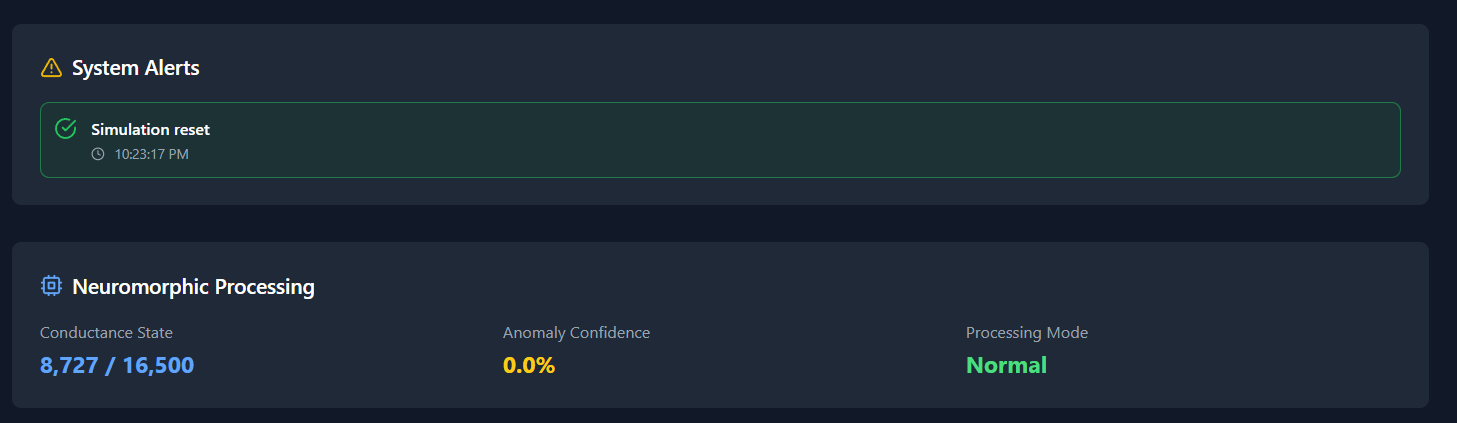
- Edge-like Anomaly Detection: A lightweight processing module identifies critical environmental anomalies (e.g., rapid pressure drops indicating a storm) right at the "source" (simulated edge).
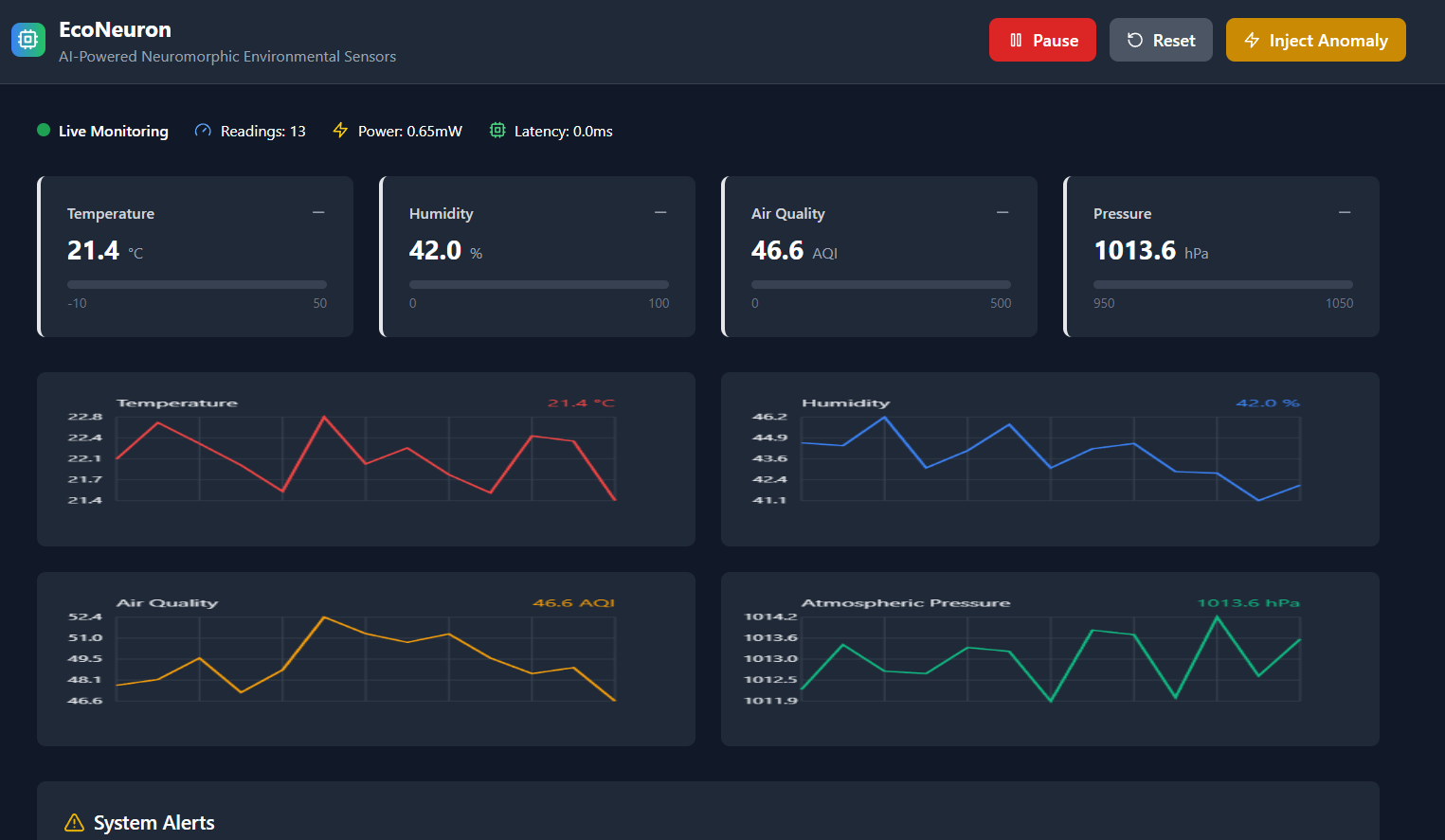
- Real-time Visualization & Alerting: The system transmits this processed data in real-time to a central web dashboard. The dashboard dynamically displays environmental parameters and provides immediate, clear visual alerts when an anomaly is detected, enabling rapid response.
Essentially, EcoNeuron showcases how we can move towards more resilient and responsive environmental monitoring by leveraging next-generation computing paradigms.
How we built it
Our development journey for EcoNeuron focused on creating a functional, end-to-end prototype within a WebContainer environment, simulating the complex interactions of a real-world IoT system:
- Simulated Sensor Data Generator: We started by crafting a JavaScript-based module to realistically simulate the output of a neuromorphic environmental sensor. This generator was designed to produce nuanced data streams for various parameters (temperature, humidity, air quality, atmospheric pressure) over time. Critically, we engineered it to inject controlled "anomaly" data points, such as sudden and sustained pressure drops, to simulate impending storms. This allowed us to thoroughly test our detection mechanisms.
- Edge Processing Simulation: Next, we developed a JavaScript module that acts as our "edge processor." This component receives the continuous stream of simulated sensor data. Its primary role is to perform initial, low-latency analysis—filtering, aggregating data over short intervals, and applying a lightweight anomaly detection rule. For instance, if a specific parameter exceeds a predefined threshold for a continuous duration, it flags that as an anomaly, mimicking energy-efficient processing on an edge device.
- Real-time Data Transmission with Bolt: A cornerstone of our project was integrating with Bolt's real-time APIs. This crucial step enabled us to securely and efficiently transmit the processed (or raw, depending on the test scenario) simulated sensor data from our "edge" simulation to our central visualization dashboard. We ensured data was pushed continuously, or at very short intervals, to maintain true real-time communication.
- Interactive Web Dashboard: We then built a responsive web dashboard using standard HTML, CSS, and JavaScript. This dashboard dynamically displays the incoming simulated environmental data using intuitive charts and gauges. Our focus was on creating clear visual alerts: when an anomaly is flagged by the edge processing, the dashboard immediately changes indicators (e.g., a red flashing light, a prominent notification banner, or a change in graph color) to alert the user. The entire system was developed and orchestrated within a WebContainer, providing an isolated and easily shareable prototyping environment.
Challenges we ran into
Building EcoNeuron, despite its simulated nature, presented several intriguing challenges that pushed our problem-solving skills:
- Simulating Neuromorphic Nuance: The core concept of neuromorphic computing involves highly parallel, low-precision processing with many states. Translating this into a believable data simulation that wasn't just random noise but showed meaningful, subtle variations was complex. We iterated significantly on our data generation algorithms to accurately reflect this "16,500 conductance states" concept.
- Optimizing Real-time WebContainer Performance: While WebContainers are powerful, ensuring truly continuous, low-latency data flow from the simulated edge to the dashboard required careful management of update frequencies and data payload sizes. We had to balance simulation realism with browser performance.
- Designing Clear & Actionable Alerts: Simply displaying data isn't enough; the system needed to communicate anomalies effectively. We experimented with different visual cues to ensure that alerts were immediate, unambiguous, and intuitively conveyed the severity of the detected environmental shift without overwhelming the user.
Accomplishments that we're proud of
We're incredibly proud of several key accomplishments with EcoNeuron:
- Successfully Simulating a Cutting-Edge Concept: We managed to translate the abstract principles of neuromorphic computing into a tangible, observable data simulation, making a complex concept understandable and demonstratable.
- End-to-End Real-time Data Pipeline: We built a complete, functional prototype that showcases the entire data flow from generation to visualization, leveraging Bolt's real-time APIs effectively. This demonstrates a robust architecture for future IoT applications.
- Intuitive Anomaly Alerting: We created a dashboard that not only displays data but also intelligently flags and visualizes critical environmental anomalies, which is crucial for early warning systems.
- Hackathon Feasibility & Scalability: We proved that complex, impactful ideas like EcoNeuron can be prototyped efficiently within a hackathon timeframe using tools like WebContainers, while laying a clear foundation for future scaling with real hardware.
What we learned
The EcoNeuron project was a profound learning experience, offering insights far beyond just coding:
- Deep Dive into Advanced Technologies: We gained a much deeper understanding of neuromorphic computing's potential in resource-constrained environments and the architectural considerations for edge computing.
- Importance of Data Fidelity in Simulation: We learned that the quality and nuance of simulated data are paramount for a prototype to accurately convey a system's true capabilities. Realistic data makes for a convincing demonstration.
- Strategic Prototyping: The project reinforced the value of using environments like WebContainers for rapid prototyping and iterative development, allowing us to focus on core logic without getting bogged down by infrastructure setup.
- The Power of Real-time Systems: We solidified our understanding of how real-time data communication can revolutionize critical applications like climate adaptation and disaster preparedness.
What's next for EcoNeuron
The future of EcoNeuron is exciting! We envision several key developments:
- Integration with Real Sensor Data: The immediate next step is to explore integrating EcoNeuron with actual environmental sensor data, moving beyond simulation to real-world deployment.
- Advanced Anomaly Detection Algorithms: We plan to incorporate more sophisticated AI/ML algorithms for anomaly detection on the edge, enabling the system to learn and adapt to environmental patterns.
- Predictive Modeling: Leveraging historical data, we aim to build predictive models that can forecast potential extreme weather events or environmental degradation, not just react to current anomalies.
- Community Integration: Exploring partnerships with local communities or NGOs to deploy pilot projects and gather user feedback for further refinement.
- Open-Sourcing & Collaboration: We intend to open-source the project to foster collaboration and allow other developers to contribute to and expand EcoNeuron's capabilities.
Built With
- chart.js-for-data-visualization.-platforms:-webcontainers-(for-prototyping-and-deployment-environment)-apis:-bolt's-real-time-apis-(for-data-transmission)-concepts:-neuromorphic-computing-simulation
- css-(with-potential-for-python-for-more-complex-simulations-or-backend-if-expanded)-frameworks/libraries:-potentially-a-lightweight-javascript-framework-for-the-dashboard-(e.g.
- data
- edge-computing-principles
- html
- languages:-javascript
- or-vanilla-js-for-simplicity)
- react
- real-time
- vue


Log in or sign up for Devpost to join the conversation.