Inspiration
The president of the US has proposed a target of achieving 80 percent clean electricity by 2030 and in today's data-driven era of escalating energy demands, the imperative for renewable resources has never been more pressing. As global energy consumption continues to surge, the reliance on AI-powered, sustainable solutions becomes paramount. EcoNet.ai leverages AI to optimize energy utilization, reducing costs, enhancing efficiency, and mitigating environmental impact. Using predictive analytics, our platform promotes sustainable development globally, paving the way for a resilient and eco-friendly future.
What it does
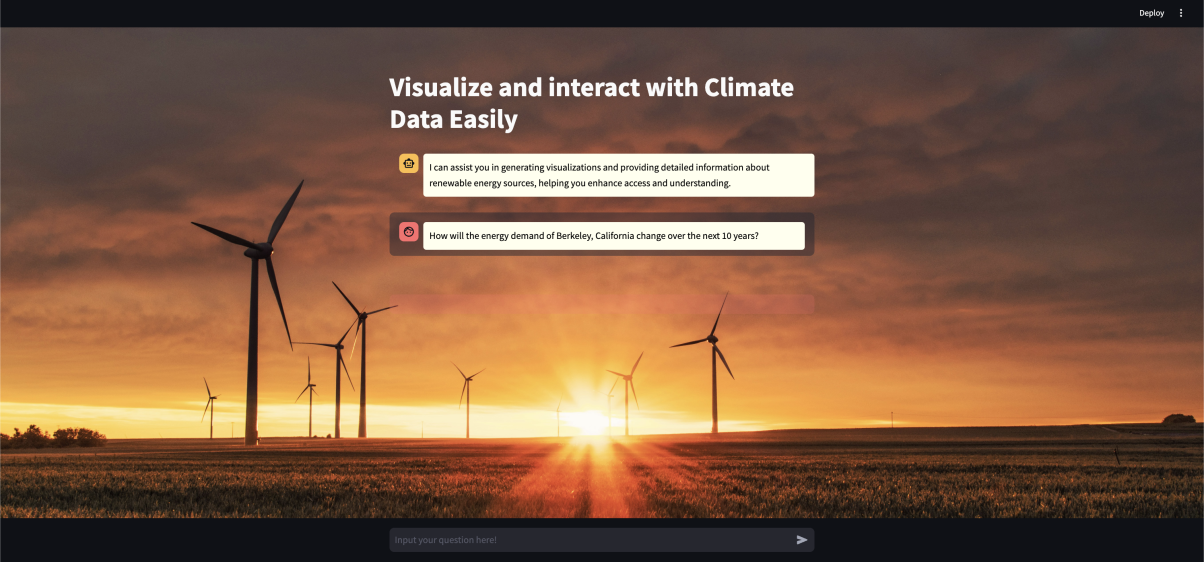
EcoNet.ai is a cutting-edge platform using AI-driven geospatial analysis and deep learning to optimize renewable energy deployments. By identifying optimal locations for solar arrays and wind farms ,and allowing users to easily analyze past and future climate data. It reduces energy costs and supports data-driven decision-making for governments and corporations. This leads to significant cost savings, improved sustainability, and economic growth. The system's neural networks and real-time data processing provide adaptive, future-proof energy solutions.
How we built it
We built EcoNet.ai using a suite of AWS services to optimize renewable energy installations. AWS Bedrock , while DynamoDB managed complex geospatial data. Amazon S3 provided storage for our vast datasets and we used PyTorch to do time series predictions. This integration of AWS technologies ensured scalability, reliability, and intelligent resource management, enabling EcoNet.ai to deliver actionable AI-driven insights for sustainable energy initiatives.
Challenges we ran into
Developing EcoNet.ai involved several challenges, Efficient API querying through DynamoDB required iterative optimization and predictive caching. Hyperspectral satellite imagery was impractical due to long processing times, and incomplete government datasets hindered reliable data sourcing for our models.
Accomplishments that we're proud of
Our team engineered a cutting-edge AI model using machine learning to optimize renewable energy placement by analyzing factors like terrain, local energy demands, and grid infrastructure. Our data-driven solution leads in the field, and we are proud that it can revolutionize energy accessibility and sustainability, potentially transforming communities globally through intelligent resource allocation and adaptive planning.
What we learned
Through this project, we gained invaluable experience applying machine learning and AI to real-world sustainability challenges. We deepened our understanding of renewable energy systems and their optimal placement, enhancing our skills in big data analytics, predictive modeling, and large-scale data processing for next-generation energy solutions.
What's next for EcoNet.ai
EcoNet.ai's future plans include:
- Leveraging AI and ML for real-time, hyper-localized insights in renewable energy planning.
- Expanding globally.
- Improving data collection processes.
- Using computer vision to analyze satellite imagery for precise land-use planning.
These solutions will help governments, corporations, and communities make informed, AI-assisted decisions, speeding up the global transition to sustainable energy sources.
Built With
- amazon-dynamodb
- figma
- python
- pytorch
- streamlit


Log in or sign up for Devpost to join the conversation.