Inspiration
Climate change and pollution are growing global challenges. I was inspired to build EcoMind AI after seeing how difficult it is for individuals and organizations to access actionable environmental insights in real time. I wanted to create an autonomous AI agent that could analyze environmental data, predict pollution trends, and suggest eco-friendly actions to make a tangible impact on sustainability.
What it does
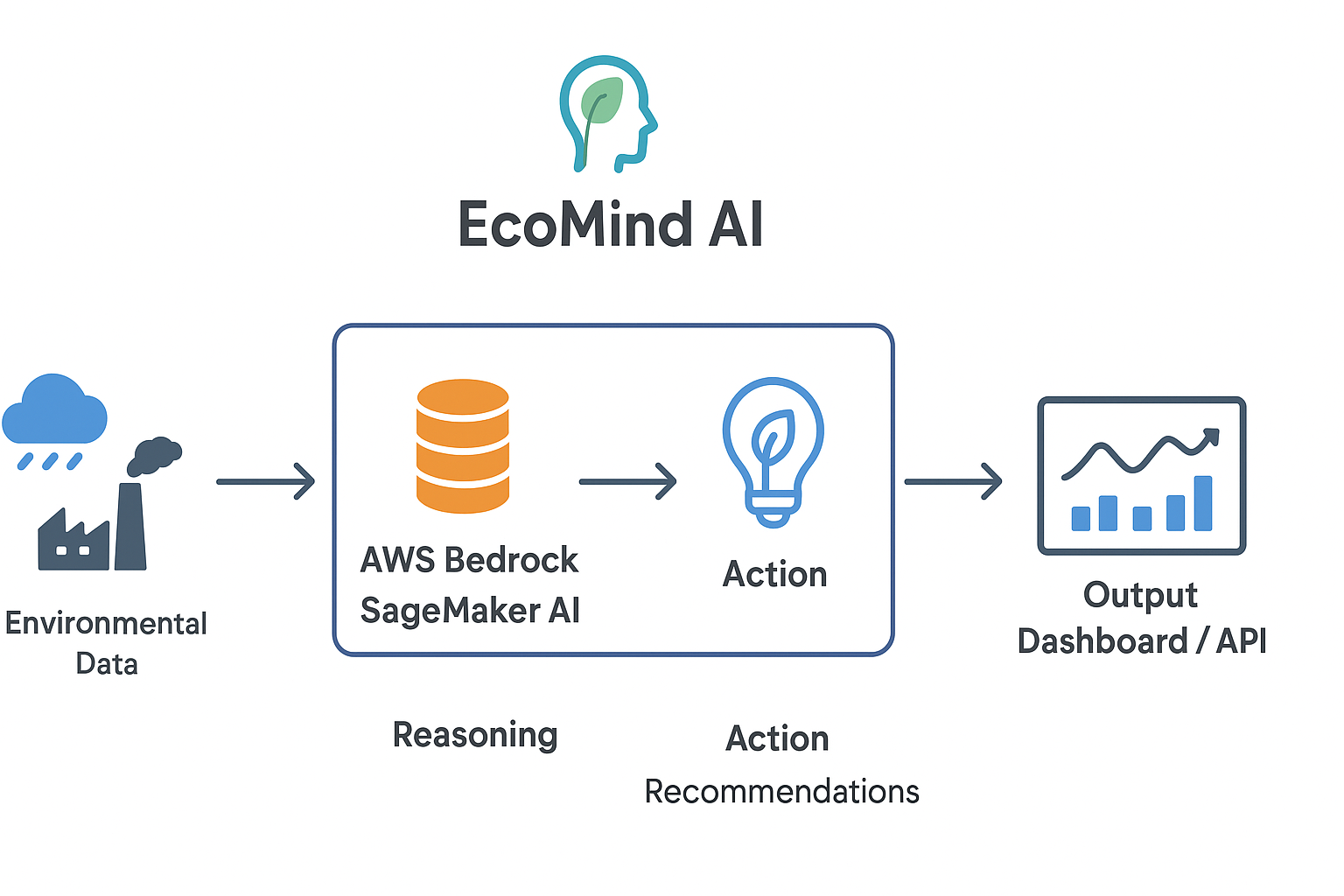
EcoMind AI autonomously collects and analyzes environmental data, predicts pollution trends, and provides actionable eco-friendly recommendations. It can alert users about high-risk areas, suggest ways to reduce energy consumption, and support organizations in making sustainable decisions.
How we built it
Data Collection: Aggregated real-time pollution data and historical environmental datasets via APIs.
AI & Reasoning: Deployed a Large Language Model on AWS Bedrock and leveraged SageMaker AI to interpret complex patterns.
Automation: Used AWS Lambda for scheduled data processing and Amazon S3 for storage.
Decision Logic: Designed autonomous reasoning workflows to generate recommendations without human input.
Challenges we ran into
Integrating multiple AWS services efficiently for a seamless agent workflow.
Handling incomplete or noisy environmental data for accurate predictions.
Ensuring the AI agent’s reasoning was scalable and reproducible.
Accomplishments that we're proud of
Built a fully autonomous AI agent capable of reasoning and acting on environmental data.
Successfully integrated AWS Bedrock LLMs with external APIs for real-time insights.
Created a workflow that is scalable and can be extended to other sustainability domains.
What we learned
How to architect autonomous AI agents using AWS Bedrock, SageMaker AI, and Lambda.
Effective techniques for integrating real-time data sources and handling noisy datasets.
How to balance autonomous reasoning with reliability and reproducibility in AI systems.
What's next for EcoMind AI
We plan to expand EcoMind AI to monitor global environmental metrics, integrate predictive modeling for climate events, and provide personalized sustainability recommendations to individuals, communities, and organizations.

Log in or sign up for Devpost to join the conversation.