-
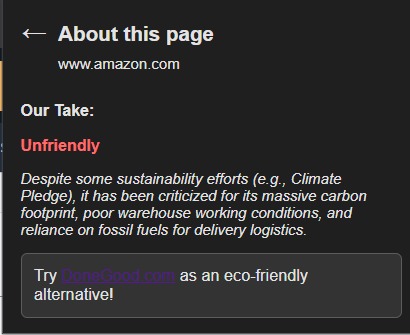
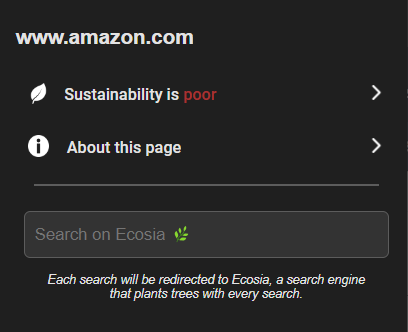
The about this page on Amazon.com
-
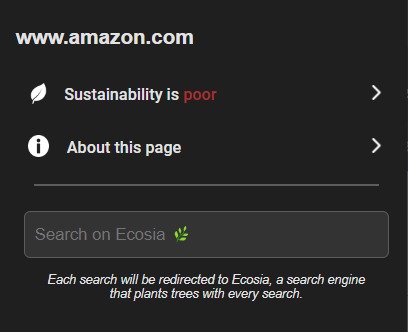
EcoMeter extension when used on Amazon.com
-
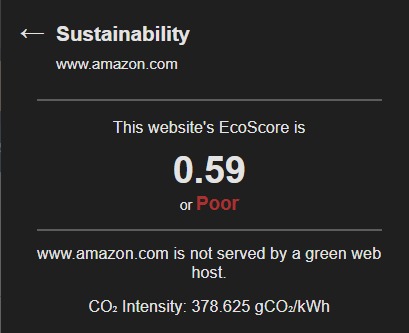
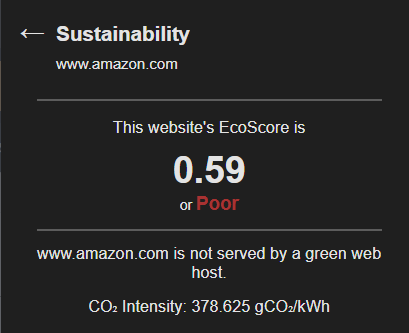
The calculated EcoScore for Amazon.com
Inspiration
The inspiration for EcoMeter came from a growing awareness of the environmental impact of the internet. As a daily user of various websites, we realized that while digital technology is a powerful tool, it comes with hidden costs—particularly its contribution to carbon emissions. With more businesses and individuals building their online presence, we felt it was important to create a tool that helps users understand the sustainability of the websites they visit. We wanted to make it easier for developers, companies, and everyday users to gauge their online carbon footprint and take steps toward reducing it.
What it does
EcoMeter is a Chrome extension that evaluates the sustainability of websites in real time. Here’s how it works:
- Real-time Carbon Footprint Analysis: When a user visits a website, EcoMeter analyzes various factors such as data transfer, hosting provider, and media content to calculate the site’s carbon footprint.
- Sustainability Score: The extension provides an easy-to-understand score that reflects the environmental impact of the website.
- Actionable Insights: Along with the score, EcoMeter offers potential more sustainable website choices.
- Comparison to Benchmarks: Users can see how the website compares to industry benchmarks for sustainable web practices.
- Instant Feedback: The analysis runs in the background and provides results without interrupting the browsing experience.
How we built it
We built EcoMeter as a Chrome extension to make it easily accessible to users while they browse. Here's an outline of the key steps we followed:
- Research & Planning:
- We started by researching existing tools to understand the key metrics for evaluating website sustainability.
We defined the features we wanted in EcoMeter: real-time sustainability scoring, recommendations for improvements, and a simple, user-friendly interface.
Frontend Development:
We developed the extension using HTML, CSS, and JavaScript.
We designed the UI to be minimal and intuitive, ensuring users could quickly view a website’s sustainability score without distractions.
Backend & API Integration:
For data collection, we integrated the GreenWeb Dataset API, which provides data on a website’s carbon footprint based on factors like data transfer and energy use.
The backend handles requests to the API and processes the data to generate actionable insights.
Testing & Refining:
We tested the extension across various websites, from small blogs to large e-commerce platforms, to ensure the tool worked across a wide range of digital environments.
Feedback from early testers helped me refine the scoring system and improve user engagement.
Challenges we ran into
Building EcoMeter was not without its challenges. One of the main hurdles was ensuring the accuracy of the sustainability score. Website sustainability depends on multiple factors—such as the server’s energy source and the website’s design choices—that are not always easy to quantify in real time.
Another challenge was educating users. Many users won't immediately understand why website sustainability matters, so part of the project involved making the impact of carbon emissions from online activities more visible. We had to balance providing detailed data with offering actionable, easy-to-understand feedback.
Lastly, integrating with third-party APIs and managing data flow in a seamless manner was a technical challenge. Making sure the extension worked consistently while providing real-time insights without slowing down browsing speed required optimization and iteration.
Accomplishments that we're proud of
We are proud of successfully developing an extension that analyzes a website’s carbon footprint in real time without slowing down the user’s browsing experience. In addition, we designed a clean, intuitive interface that allows users to instantly understand a website’s sustainability score and take actionable steps toward reducing their environmental impact. We are also pleased to know that through this project, we also raise awareness about the hidden carbon emissions behind websites, making it easier for users and developers to consider their environmental impact.
What we learned
Throughout the development of EcoMeter, we gained a deeper understanding of how data transfer, web hosting, and website design choices can significantly affect a site’s carbon footprint. We learned how small changes, such as optimizing images or switching to green hosting services, can reduce emissions and improve overall sustainability.
In addition to the technical aspects, we also learned about the challenges in raising awareness about environmental issues in the digital space. Many users are unaware of how their online activities contribute to emissions, and it became clear that education is a crucial part of the solution.
What's next for EcoMeter
The future of EcoMeter is exciting, with several key developments possible:
- Expanded Metrics: We plan to include more detailed sustainability metrics, such as tracking energy efficiency of media content, scripts, and third-party integrations used by websites. This will provide a deeper analysis of a site's environmental impact.
- Partnerships with Web Developers: We aim to collaborate with web development platforms (like WordPress and Wix) to offer built-in sustainability assessments and suggestions. This will help developers optimize their websites directly within their workflows.
- Custom Reports for Businesses: A premium version of EcoMeter will provide businesses with detailed sustainability reports, offering tailored recommendations on how to reduce their online carbon footprint. This can serve as a valuable tool for companies seeking to align with green initiatives.
- User Engagement: We plan to build a community feature where users can track their own web browsing habits over time, see the cumulative environmental impact of their web usage, and compare with others to encourage sustainable browsing behavior.
By continuing to enhance EcoMeter, we hope to empower users to take charge of their digital carbon footprint and foster a culture of sustainability across the web.

Log in or sign up for Devpost to join the conversation.