Inspiration
One of our grandmothers has a garden that grows more food than she can use, leading to unnecessary waste. It’s not a lack of effort, but a lack of accessible ways to share food. What if there were a simple, local way to give it away before it spoils? That idea sparked EcoLink—a platform to reduce waste, connect communities, and make sustainable living a shared effort.
What it does
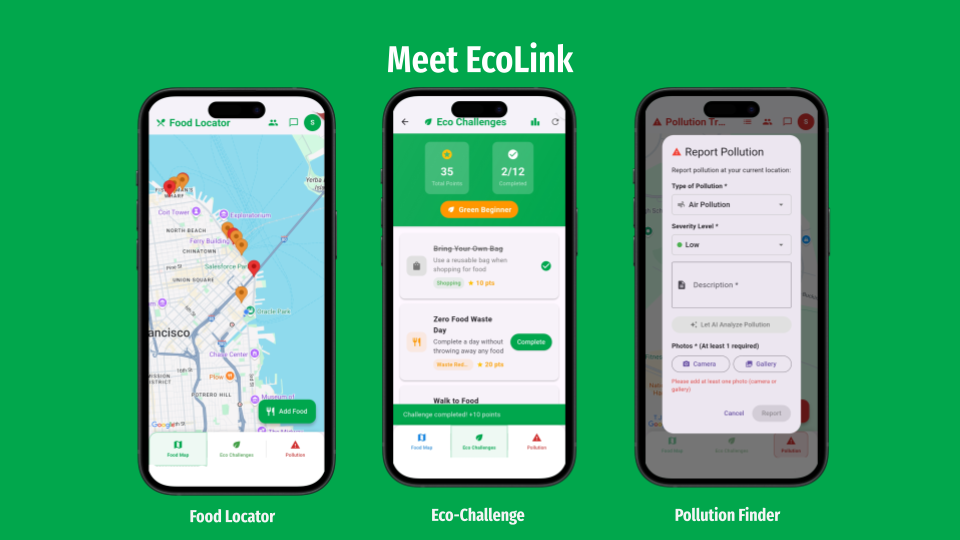
EcoLink has 3 main tabs. The first tab is the food locator. This lets users take a picture of extra food that would otherwise be going into the trash. This can be anything from extra fruit from a tree at home to leftover grocery store produce. Any user who has an account and is signed in can upload a listing with the name, description, and pictures of the food. Alternatively, they can take a picture and let AI write the description and name for them after analyzing the photo. These listings are placed on a map that is updated in real time as new listings are created. There is a list view where the user is able to sort by distance, name, and date posted. They can also set a radius for where they want to search for specific listings. Furthermore, users can message other users by using our app's chat feature, where they can talk about the details of certain listings. Our second tab is the eco-challenges tab. In this tab, users can see a list of several eco-friendly challenges they can complete. They can sort these challenges by challenge type. There is a friend system in the app, allowing users to send and accept friend requests. There is a leaderboard to compete for points against your friends in the eco-challenge screen, giving a competitive incentive for users. Lastly, there is a pollution reporter tab. This tab allows users in a community to report different types of pollution. This works in a similar way to the food locator screen, where users can take pictures and write descriptions themselves, or let AI analyze the photos and write the descriptions for them. When multiple pollution markers are placed close to each other, the markers will cluster up, allowing users to see hotspots of pollution in order to target cleanup events in the community.
How we built it
We used:
- The Flutter framework in Dart to build both the backend and the frontend
- The Google Maps API for the pollution and food maps
- The Google Sign-In API to handle user identification
- Google Gemini API for AI picture analysis
- Firebase for our database
Challenges we ran into
- Authentication for multiple users on different devices
- Storing the data in a way that is fast, easy to use, and cheap
Accomplishments that we're proud of
- Integration with multiple APIs and Firebase
- Fast and responsive app
- Ability for users to share photos and messages about food and pollution, with a relatively quick time between a user’s post and another user being able to view the post
- Login system and AI analysis to increase efficiency.
What we learned
We learned how to:
- Use Firebase and various Google APIs
- Problem solve errors that came up
- Code effectively and efficiently as a team under time pressure
What's next for EcoLink
- Reward Integrations: EcoPoints earned through challenges or reports could be redeemed at sustainable local businesses or used for community perks.
- Community Challenges & Events: We'll expand team-based eco challenges and support local cleanups with push alerts and leaderboard features.
Built With
- dart
- firebase
- flutter
- google-gemini
- google-maps


Log in or sign up for Devpost to join the conversation.