EcoLens
- Project name: EcoLens
- Team name: Pink Pixel
- Team members: Jessica Doering
- Demo video link: https://youtu.be/s3EjDCPtkrY
- Repository link: https://https://github.com/pinkpixel-dev/ecolens
- Hosted app link: https://ecolens.pinkpixel.dev
Problem Statement
What real-world problem are you solving?
EcoLens addresses the lack of transparency in everyday consumer products. The vast majority of consumers want to make sustainable purchasing decisions, but they don’t have the time or accessible information to do so. As a result, even the best of intentions don’t allow them to make informed choices at the checkout.
This is where EcoLens comes in and provides users with a quick and easily understandable sustainability report based on the image of the product or the name of the product.
Which UN Sustainable Development Goal does it address?
EcoLens primarily addresses:
- SDG 12: Responsible Consumption and Production
It also supports:
- SDG 13: Climate Action
- SDG 8: Decent Work and Economic Growth
- SDG 15: Life on Land
The strongest alignment is with SDG 12.8, which is concerned with ensuring that all people everywhere have access to relevant information and awareness for sustainable development and lifestyles in harmony with nature.
What is your idea or tool?
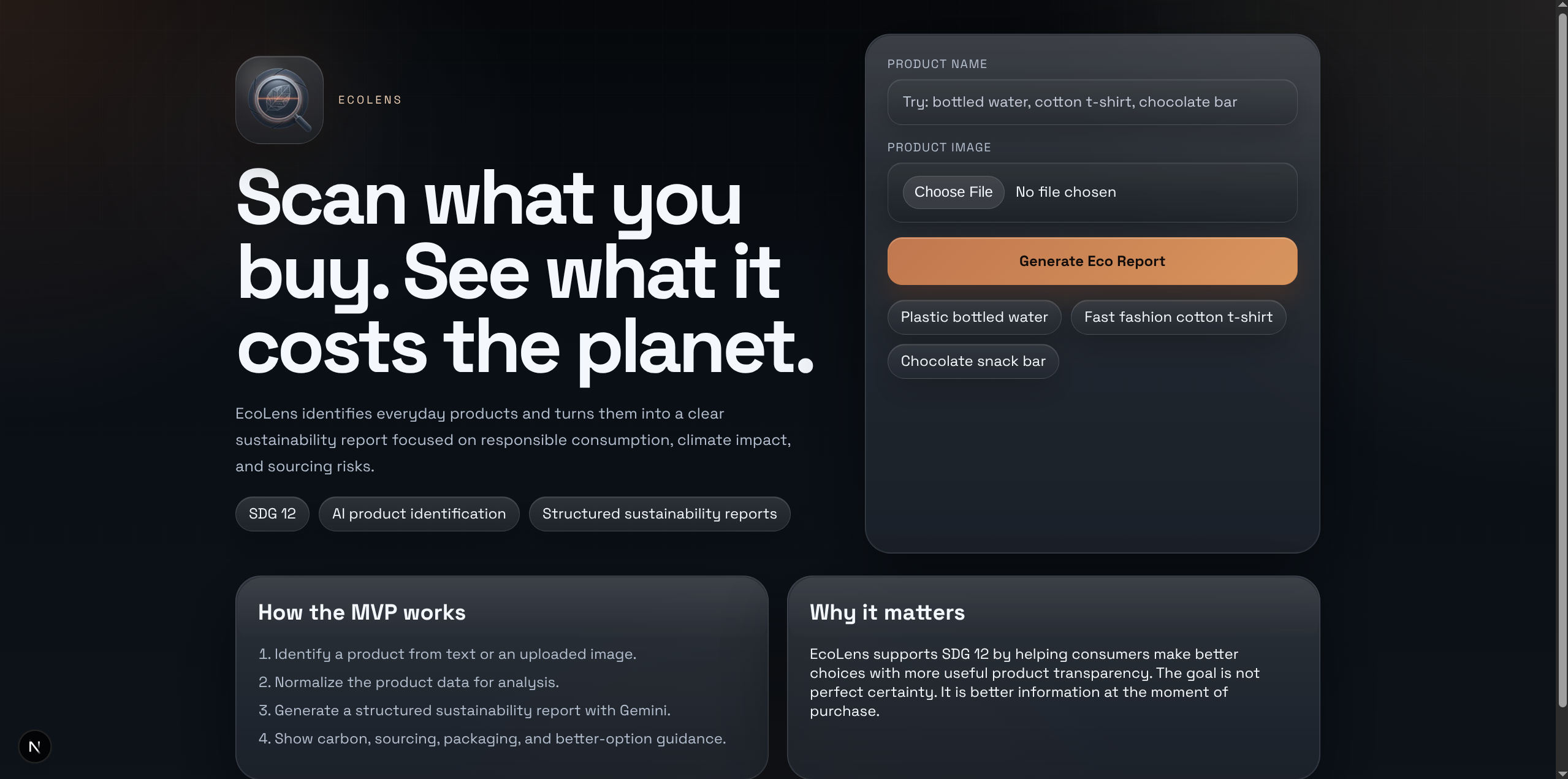
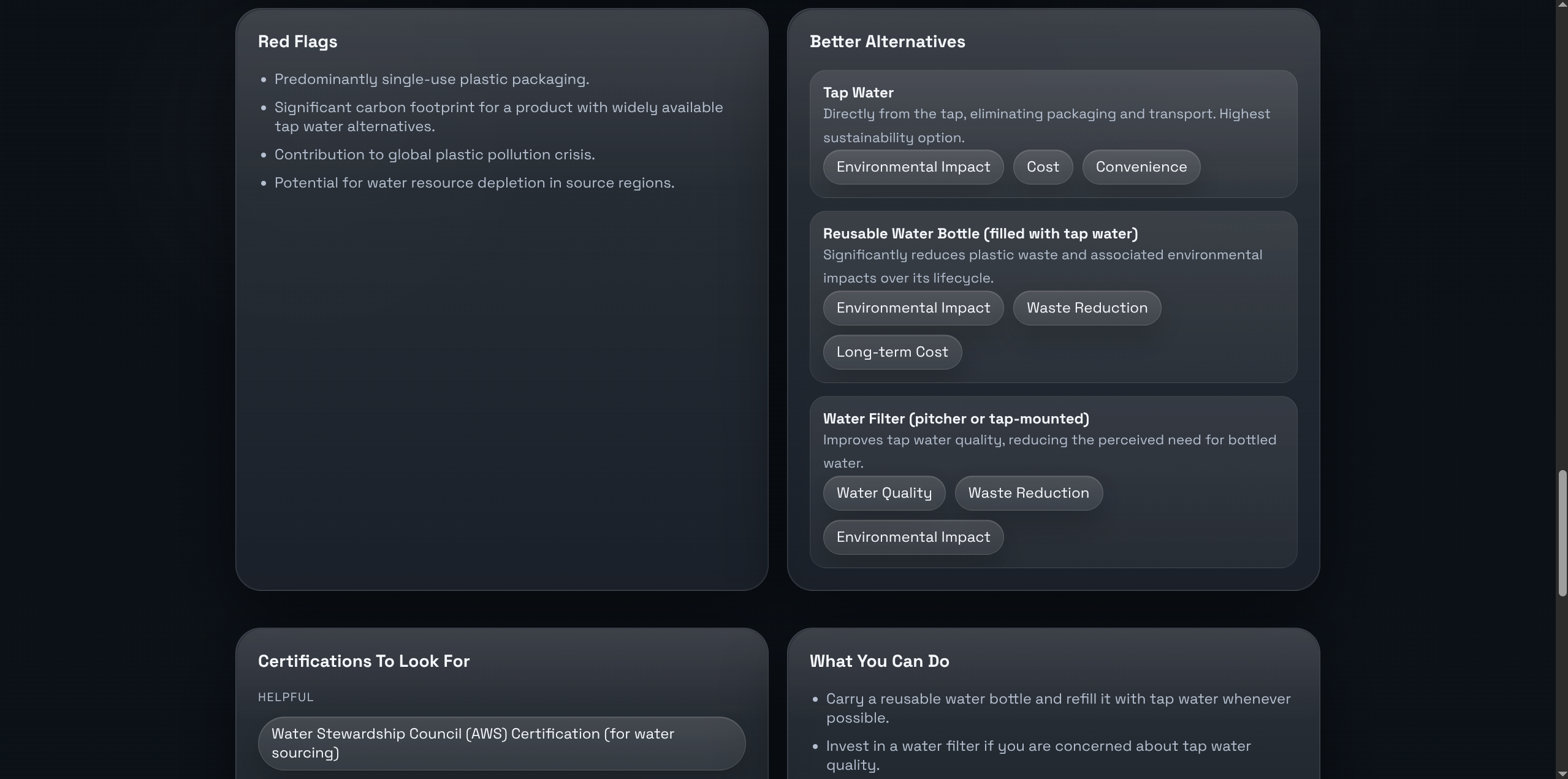
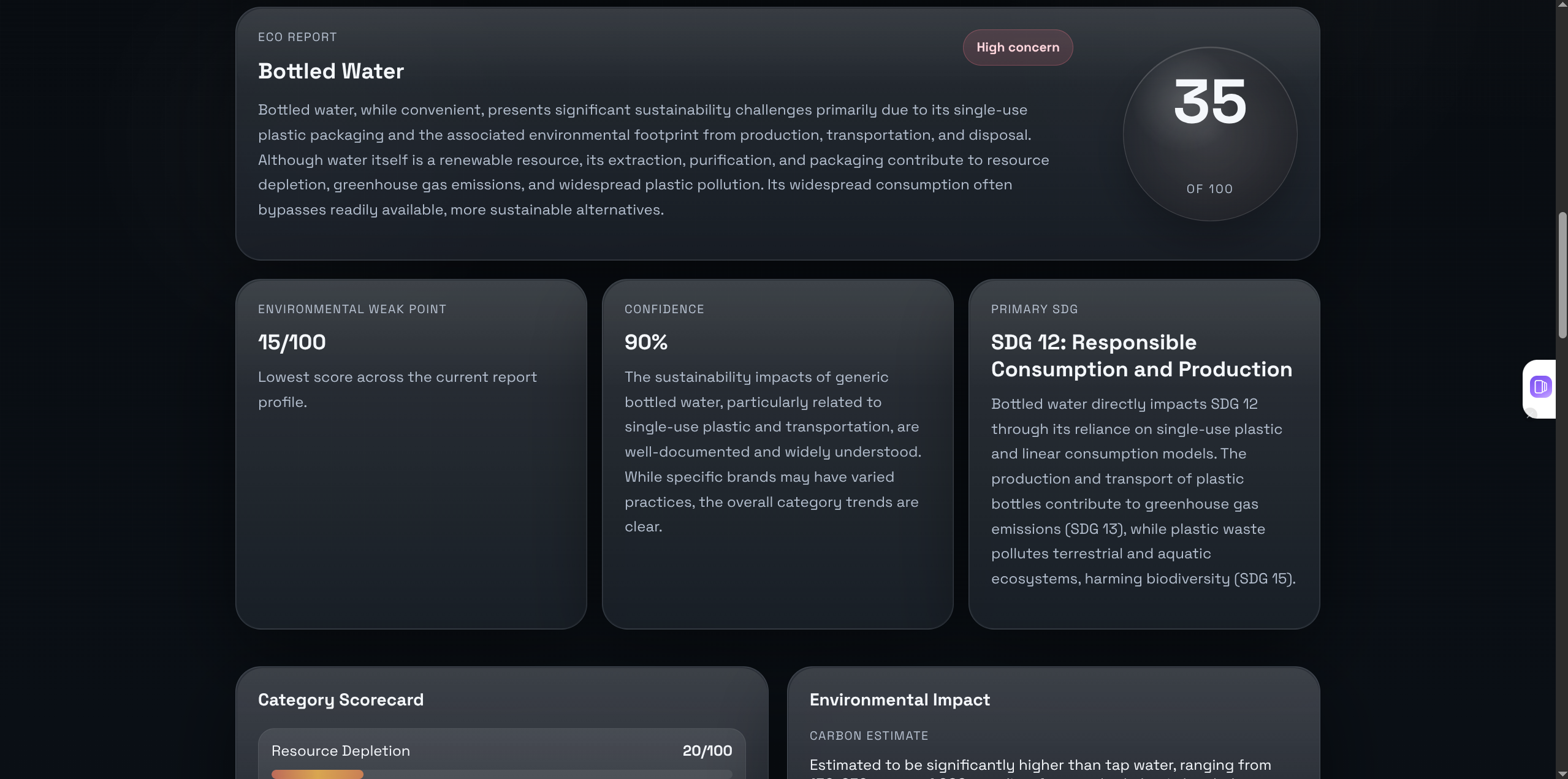
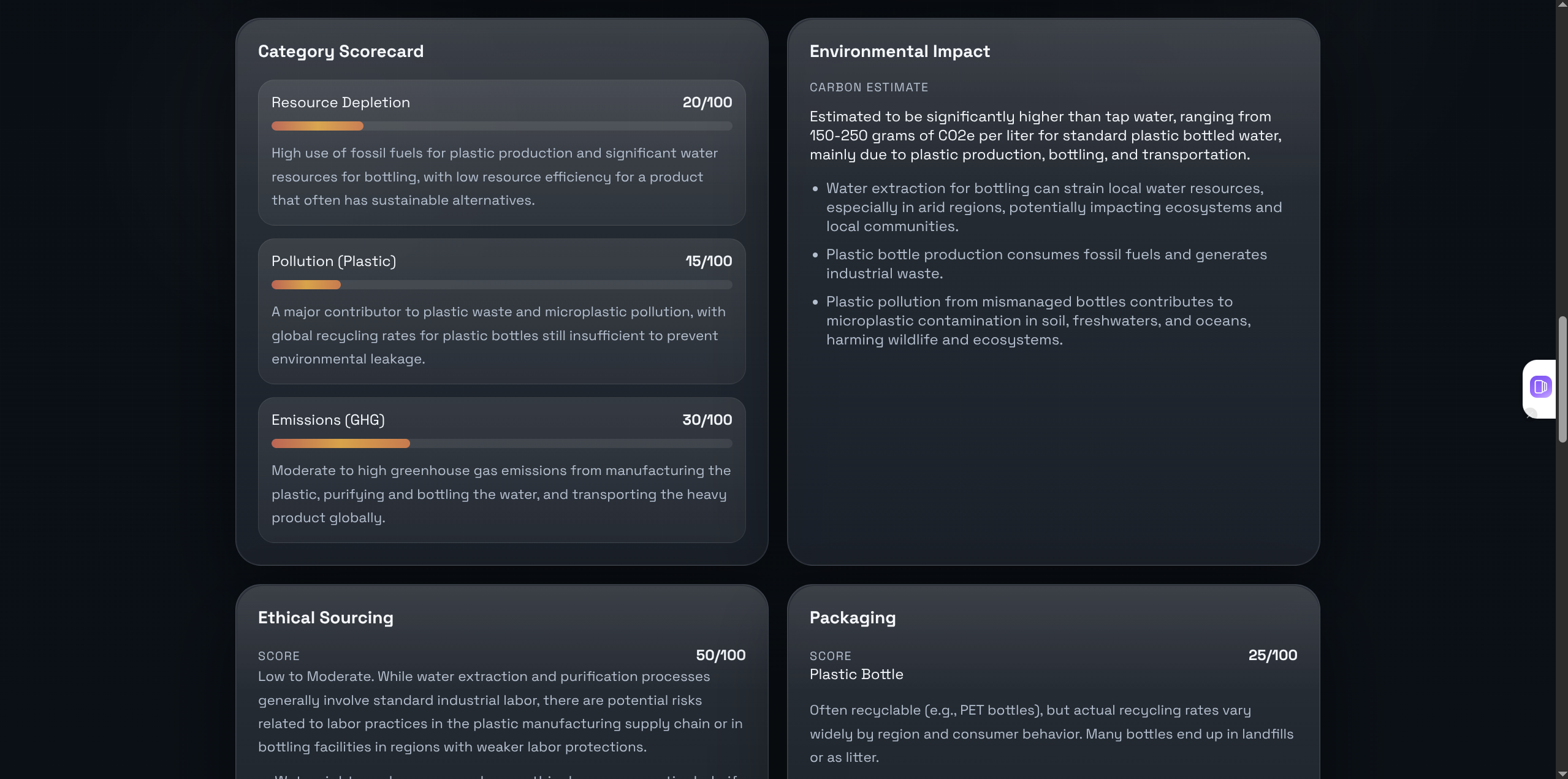
EcoLens is a web-based application through which users can enter a product and get a sustainability impact report generated by AI. The impact report generated by EcoLens is intended to be easy to consume quickly and in the moment of decision-making. Rather than being swamped by data, users can easily consume their results by being divided into useful categories such as environmental impact, ethical sourcing, packaging concerns, potential red flags, and better alternatives.
The app is designed to have a simple user flow:
- The user uploads a product image or enters a product name.
- The product is recognized and standardized.
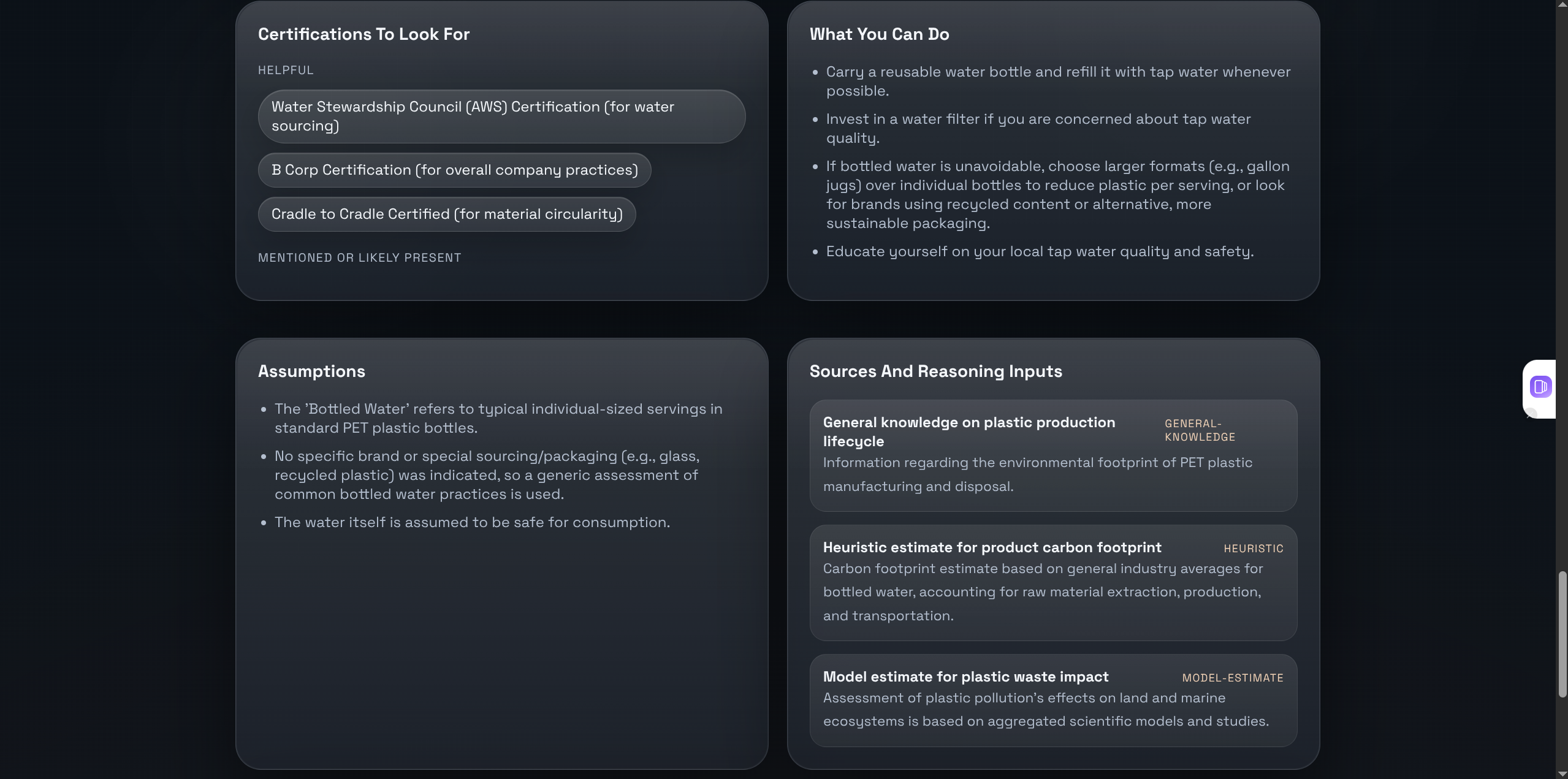
- A structured sustainability report is produced by EcoLens.
- The user receives the results in the form of scores, risk, and recommendations.
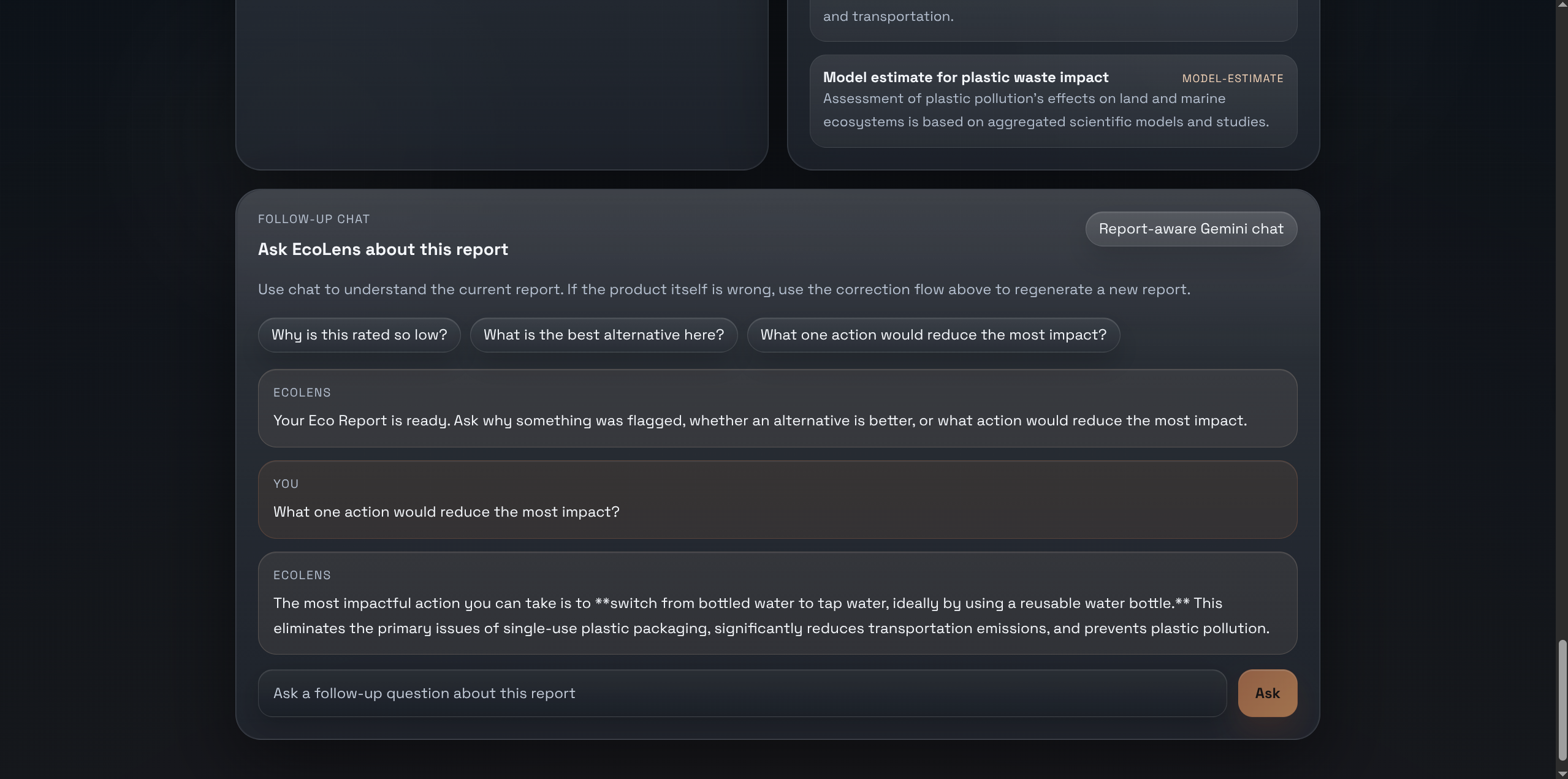
- The user is able to ask additional questions using a contextual chat feature.
How does it use AI?
EcoLens uses AI in 3 ways:
Product identification The AI interprets the product image or typed text and transforms it into a structured product object.
Sustainability reasoning The AI analyzes the product and produces a structured sustainability report with category scores, assumptions, flags, and recommendations.
Context-aware follow-up chat Once the report is generated, users may pose follow-up questions like "Why is this product rated so low?" or "What is the best product?" The AI answers these questions using context rather than starting from scratch.
Impact
How will your solution help people or the planet?
EcoLens can assist people in making better-informed purchasing decisions by allowing them to use sustainability factors in a more useful way. Rather than expecting people to research various materials, labor practices, packaging waste, and carbon impact through a variety of sources, EcoLens brings all of this together in one easy-to-read report.
This can help:
- Reduce the use of high-impact single-use products or products that are wasteful
- Educate people about ethical concerns related to sourcing
- Encourage people to make better purchasing decisions
- Make sustainability information more accessible to average consumers
- Encourage better consumption habits over time
The planetary value comes from being able to impact many small decisions at a large scale. If people can understand the environmental and ethical trade-offs associated with many products, over time, demand can shift to better materials, packaging waste, and sourcing practices.
Why is it meaningful by 2030?
By 2030, sustainability goals would not only depend on the efforts of governments and businesses but would also require consumers to be more aware. Some of the biggest climate and waste-related issues are related to consumption patterns, especially with regard to packaging, fashion, food, and household products.
EcoLens would be relevant by 2030 as it would be contributing to one of the most accessible tools for creating systemic change, and this is through informed decision-making. This is very close to the achievement of SDG 12 in the long term.
Abstract
EcoLens is a responsible consumption scanner powered by AI, designed to assist consumers in becoming responsible consumers. Consumers can either upload an image of the product or simply type the name of the product. The AI will then recognize the product, followed by a detailed report on sustainability. Consumers can access information about the environmental, ethical, and packaging aspects, along with suggestions for more sustainable options. EcoLens utilizes Gemini for product understanding, sustainability, reasoning, and follow-up chats. Next.js, TypeScript, and Zod establish a solid base for the application. This application contributes to achieving SDG 12 by promoting sustainability among consumers.
Introduction
What is the problem?
Consumers are surrounded by products that range from environmentally friendly to detrimental, yet the vast majority of purchasing decisions are made with almost no information. Sustainability reports, certifications, and supply chain information are readily available, yet they can often be hard to understand, inconsistent, or not readily available to the average consumer.
Why is it important?
This is an important issue because, at the end of the day, the cumulative effect of consumption can have significant effects on the environment. Packaging, materials, supply chain, and manufacturing can have significant effects on the overall sustainability of products. Without information, consumers can unknowingly make purchasing decisions that are counter to their values or the values of the world at large.
What UN SDG target are you trying to achieve?
EcoLens is primarily focused on SDG 12.8, which is ensuring that people have the necessary information and awareness to live a sustainable lifestyle. The project also indirectly supports climate action and ethical labor practices by allowing users to consider the overall impact of their purchasing decisions.
Background Research
What research did you do?
The project is based on research into:
- The United Nations' sustainable development goals, particularly SDG 12
- Types of consumer concerns regarding sustainable products
- The role of packaging, sourcing, and materials in determining a product's impact
- How AI can help bridge the gap between complex knowledge and everyday decision-making
- How to design a minimum viable product for a hackathon-style project
I also researched how to present a product analysis in a way that is easily understandable and presentable for a short interaction.
What existing tools or data did you explore?
The kinds of resources that I researched are:
- The capabilities of the Gemini API in multimodal product understanding and reasoning
- Zod for JSON schema validation
- Next.js and React for full-stack web development
- Example sustainability data and certification concepts that were raised in the planning phase, such as food or materials data, CO2 estimate references, and Fair Trade certification
The project focuses on the structured AI reasoning and assumptions rather than the full database integration.
Solution Description
Explain your idea clearly
EcoLens is an AI-powered sustainability explainer for everyday products. A user provides a product as text or image input, and the system generates a report from that input in a consumable format. The report is not just a mysterious number; it provides an explanation of the product from various perspectives, enabling the user to understand what is happening.
The product experience is all about consumability:
- Identify the product
- Summarize the sustainability profile
- Raise red flags
- Provide better alternatives
- Provide next steps
- Answer follow-up questions naturally
What technologies and algorithms did you use?
The project utilizes the following technologies:
- Next.js 16 for the web application and API routes
- React 19 for the user interface
- TypeScript for end-to-end type safety
- @google/genai for integration with the Gemini platform
- Zod for schema validation and typed JSON contracts
The system design utilizes a two-pass AI pipeline as the foundation of the system. The two-pass AI pipeline is defined as:
Identification Pass The AI processes the input product and generates a normalized product object.
Analysis Pass The AI utilizes the normalized product object to generate a structured sustainability report.
How does AI help you solve the problem?
The power of AI makes EcoLens feasible within a hackathon-sized project because it can:
- Interpret image/text inputs in flexible ways
- Infer the likely product category and composition
- Create structured summaries about sustainability
- Explain complex tradeoffs in simple language
- Support follow-on questions in natural language
It would take significantly more work to build a system that can accept different product inputs and still return personalized explanations without the power of AI.
Design And Implementation
Architecture or system design
EcoLens employs the following lightweight full-stack architecture:
- Frontend input form receives user input, either product name or image.
- POST /api/identify sends user input to Gemini, where it is validated against a typed schema for the product.
- POST /api/analyze sends the normalized product object to Gemini, where it is validated against the typed schema for an EcoReport, using schema definition language with Zod schema library.
- Frontend displays the EcoReport divided into sections for better user experience and clarity for judges.
- POST /api/chat facilitates follow-up Q&A based on the current report.
This architecture is lightweight while providing a robust contract between AI output and user interface.
What code, models, or datasets did you use?
Code and frameworks used:
- Next.js App Router
- React
- TypeScript
- Zod
- ESLint
AI model and services used:
- Gemini via @google/genai
Internal data structures used:
- typed product identification schema
- typed EcoReport schema
- typed chat request and response schemas
Project assets and examples used:
- local JSON fixtures for demo product identification and report outputs
Potential or conceptual data inputs considered in the planning stage:
- sustainability reference datasets
- certification frameworks
- CO2 estimate references
- ethical sourcing heuristics
Screenshots, diagrams
I have included 6 screenshots of my application in action.
Include the full file to your code
I have attached a .zip export of my codebase.
Conclusion
One of the best aspects of EcoLens is how it shows the power of using AI to promote more sustainable consumption. Instead of relying on users to make sense of disjointed product information and complex supply chains, it provides a useful layer of decision-support at the point of purchase. The project is a great fit with SDG 12 and shows how multimodal AI and careful UX design come together to create an educational resource that’s also highly relevant to the real world. As a hackathon MVP, it’s focused, interactive, and easy to demonstrate, but also suggests a potentially impactful result by 2030.
References
- United Nations. Sustainable Development Goals. https://sdgs.un.org/goals
- Google AI. Gemini API documentation. https://ai.google.dev/
- Next.js Documentation. https://nextjs.org/docs
- React Documentation. https://react.dev/
- Zod Documentation. https://zod.dev/
Built With
- eslint
- next.js
- react
- typescript
- zod


Log in or sign up for Devpost to join the conversation.