-
-
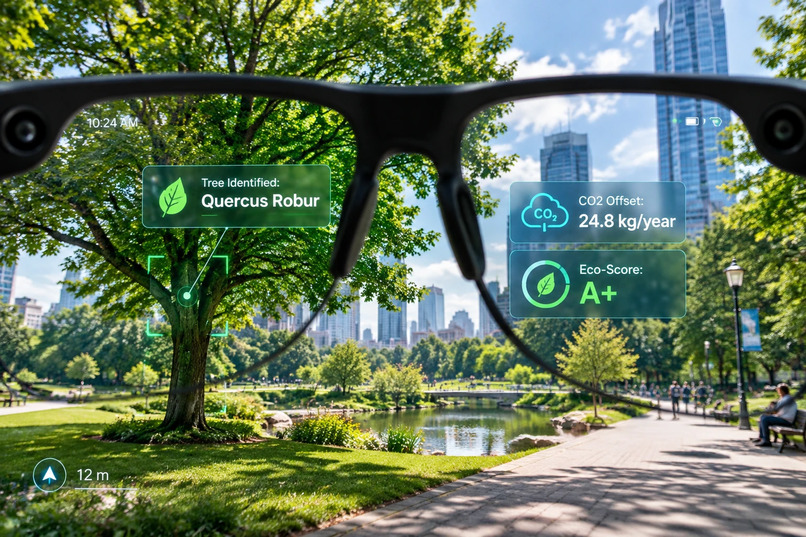
EcoLens AR Smart Glasses HUD & Spatial Carbon Offset Preview
Inspiration
As urban density accelerates globally, connecting city dwellers with the tangible ecological value of surrounding flora has never been more urgent. We wanted to leverage spatial computing to transform invisible environmental data into clear, glanceable insights. EcoLens AR was designed to turn Snap Spectacles into an intuitive environmental HUD that instantly identifies urban trees and quantifies their carbon offset in real time.
What it does
EcoLens AR provides a seamless augmented reality experience for smart glasses wearers:
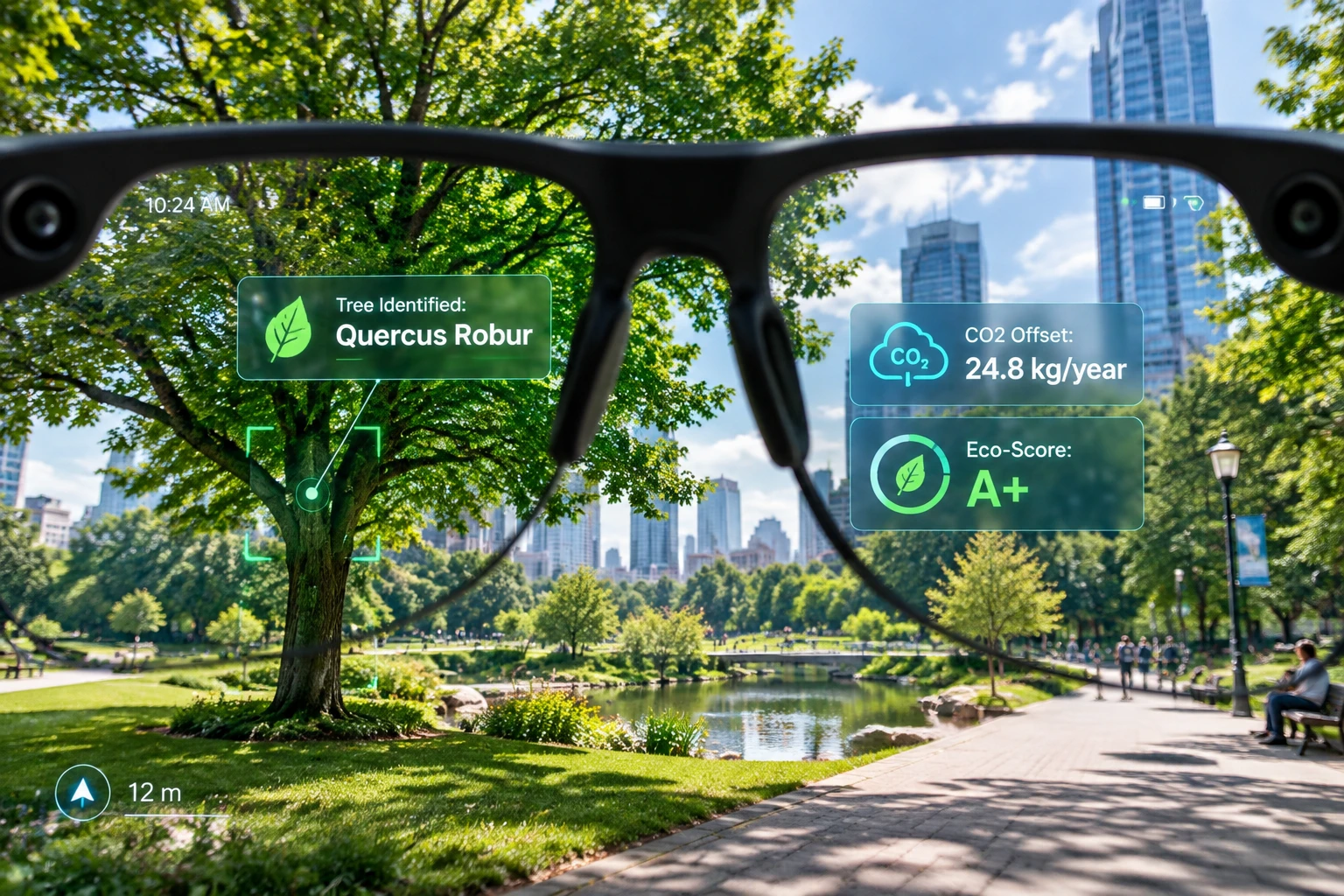
- Spatial Flora Identification: Uses computer vision to recognize tree species in the user's field of view and anchors persistent holographic labels in 3D physical space.
- Dynamic Carbon Modeling: Computes annual carbon dioxide absorption metrics ($\text{kg}\,\text{CO}_2/\text{year}$) using crown volume, species taxonomy, and environmental factors.
- Urban Eco-Score: Evaluates and displays live microclimate sustainability scores for city parks and green corridors.
How we built it
We engineered EcoLens AR adhering strictly to the Devpost Learn AR with SPECS Skill Pack:
- Scope & PRD: Architected spatial UI constraints, minimal-obstruction HUD guidelines, and real-time inference specs.
- Technical Specifications: Configured Snap Lens Studio integration workflows, spatial depth anchoring, and tree biomass algorithms.
- CLAD & AI Generation: Developed the core Lens components, asset definitions, and JavaScript managers using AI-driven spatial code generation.
Challenges we ran into
Designing spatial user interfaces for outdoor AR glasses presents critical legibility challenges. Ambient daylight and changing backgrounds can easily wash out HUD cards. We resolved this by adopting semi-transparent dark-glass backing panels paired with high-contrast fluorescent typography and dynamic depth-adaptive scaling.
Accomplishments that we're proud of
- Seamlessly integrating environmental science equations into low-latency spatial HUD cards.
- Designing an unobtrusive user experience that respects peripheral human vision while walking through urban parks.
- Building a modular codebase ready for field testing on Snap Spectacles hardware.
What we learned
We learned the nuances of designing for hands-free smart glasses versus handheld mobile AR: visual minimalism and glanceability are paramount. Spatial UI must inform without distracting from the natural environment.
What's next for EcoLens AR - Spatial Carbon & Urban Flora HUD
- Integrating municipal OpenTree map data via real-time Web APIs.
- Community citizen science features allowing citizens to flag diseased or drought-stressed urban flora directly to local urban planners.
- Multi-user spatial synchronization for guided ecological walking tours.
Built With
- ai
- ar
- computer
- javascript
- python
- snap-lens-studio
- vision

Log in or sign up for Devpost to join the conversation.