Inspiration
A few key observations inspired us. First, climate change education often feels abstract and distant for young people. It's a huge, global problem that's hard to connect to your daily life. Second, a lot of educational content is passive, like reading a textbook or watching a documentary. We wanted to create something interactive and personal. Finally, we saw the incredible potential of AI to personalize learning and make complex data understandable. We asked ourselves: what if we could use AI to show someone exactly how their actions, right in their own neighborhood, connect to the health of the entire planet?
What it does
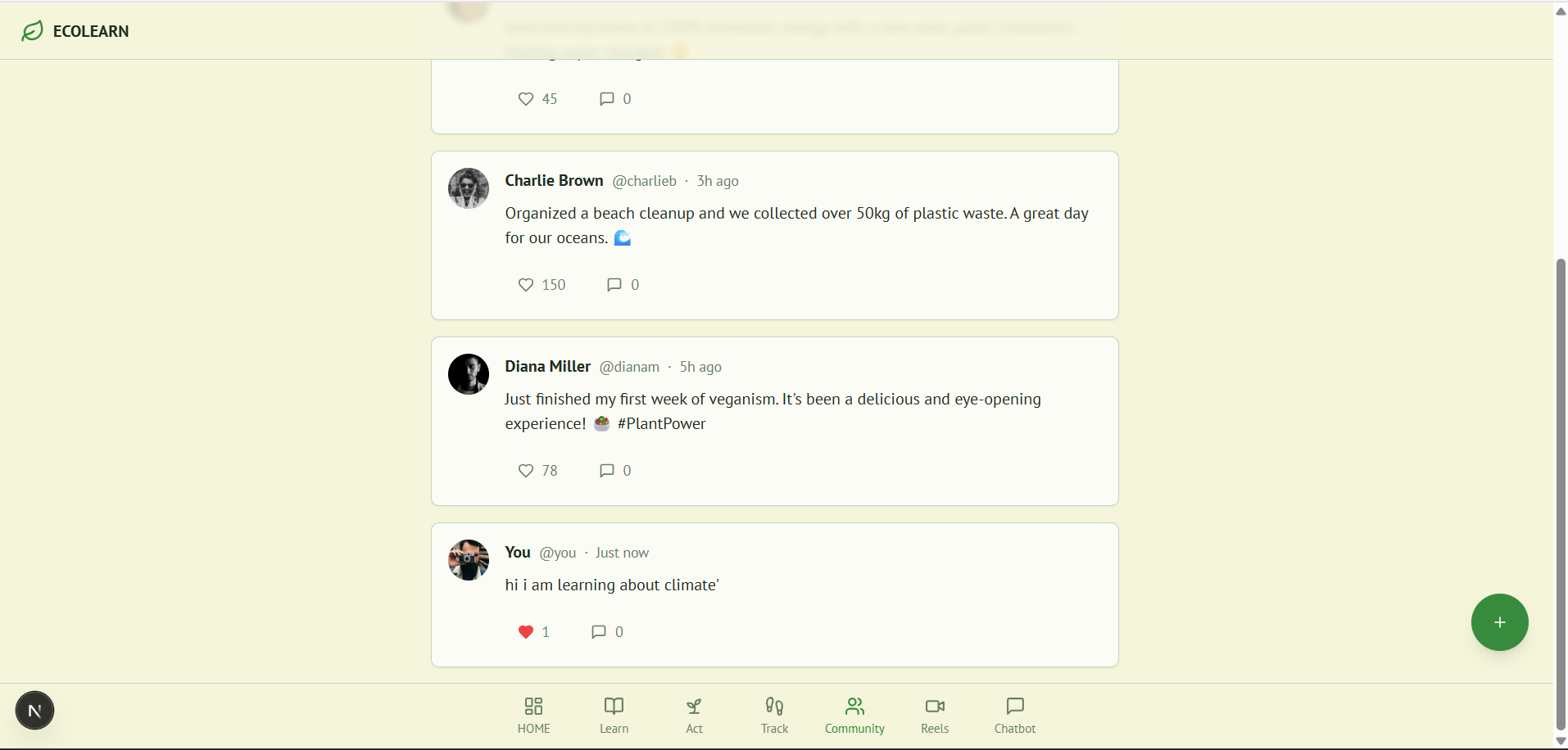
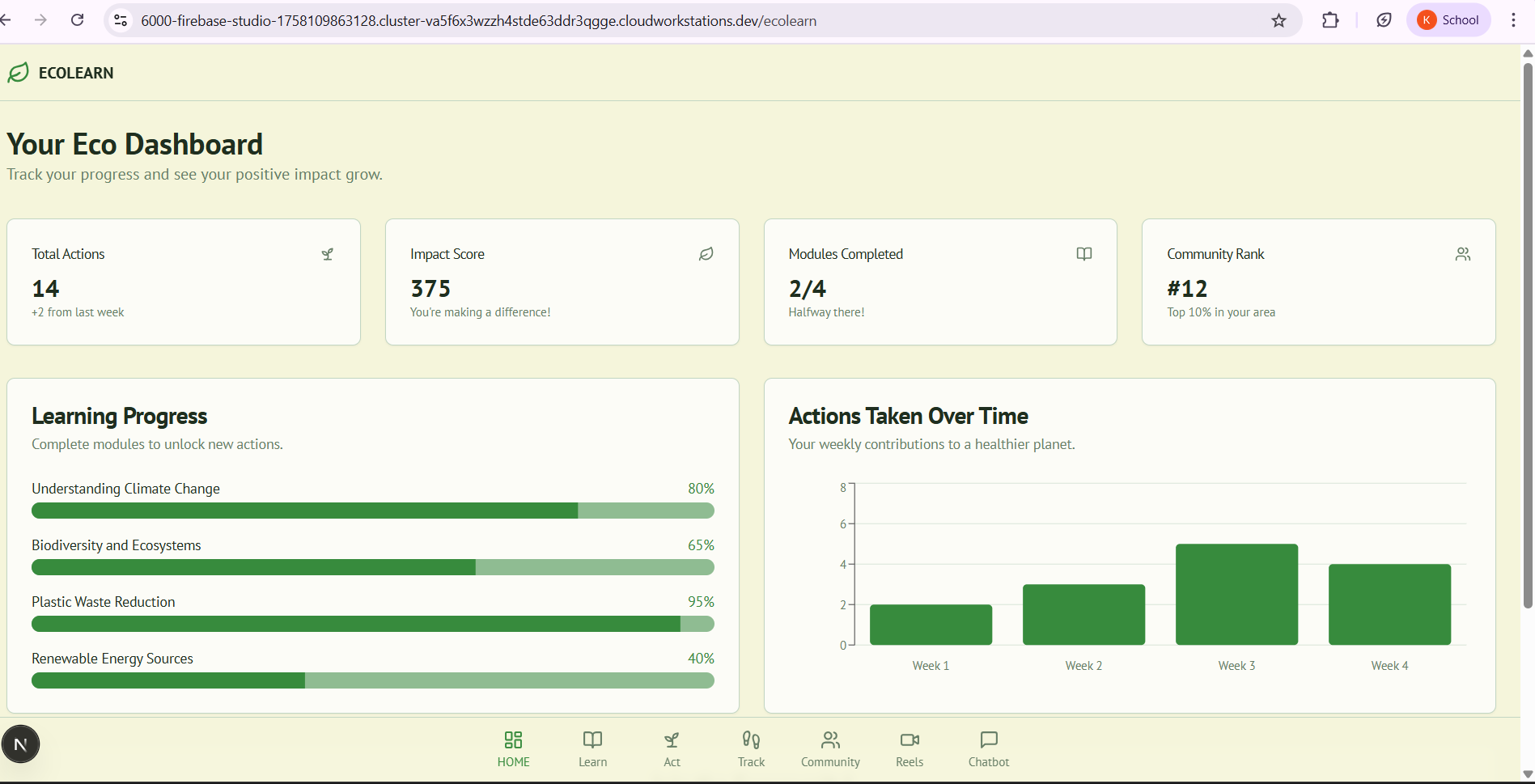
EcoLearn is a mobile-first, AI-powered platform that turns climate education into a personal and actionable journey. When you start, you create a virtual "Eco-Home" tied to your real-world location. This Eco-Home is a living simulation, and its health reflects your learning progress and actions.
The platform has four main modules:
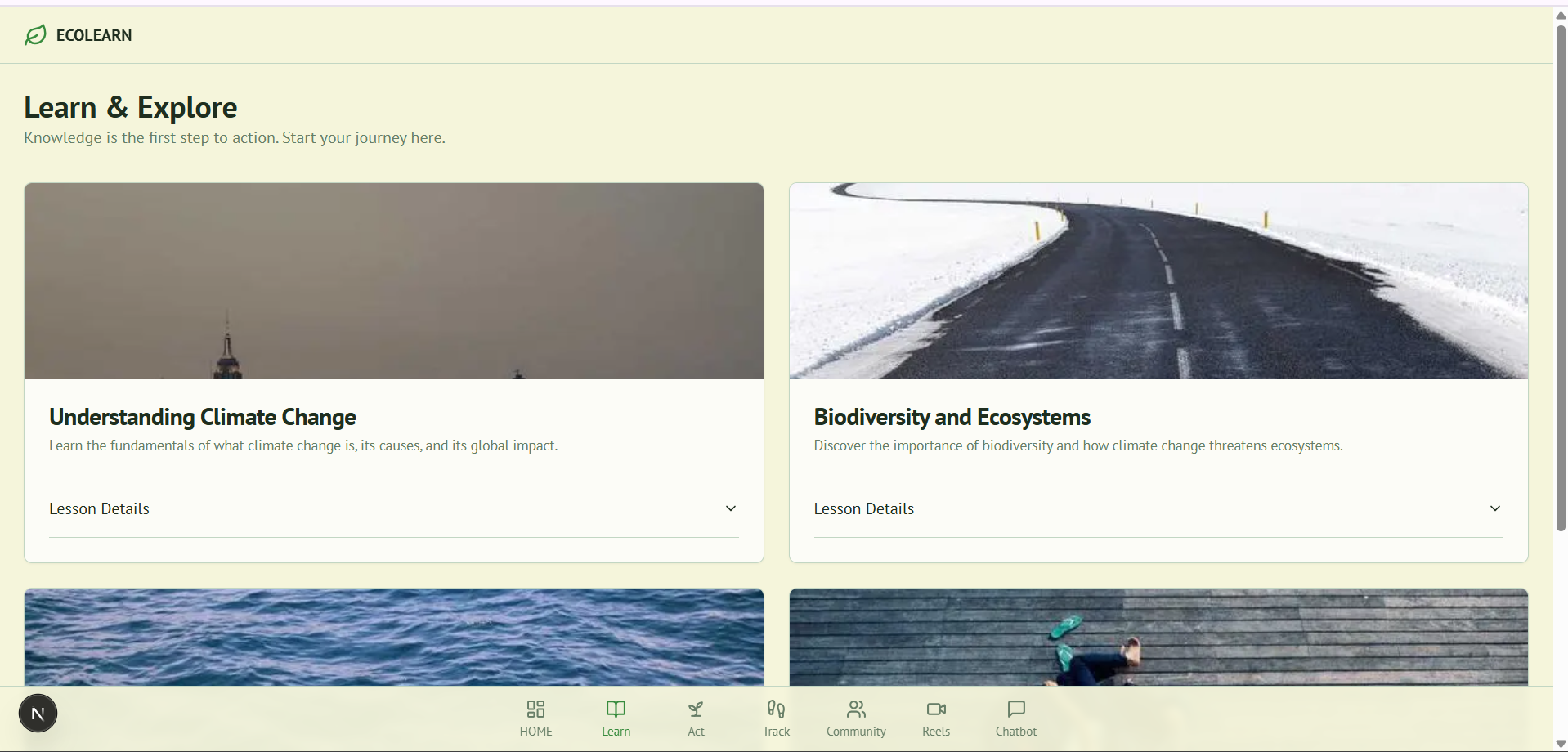
Learn: Bite-sized lessons on topics from renewable energy to biodiversity, all using interactive visuals.
Explore: A global map where you can see real-time data and the effects of climate change in different regions, from melting glaciers to deforestation.
Act: This is our favorite part. The app uses AI to suggest personalized, local actions you can take, like finding a recycling center near you or tips on saving water specific to your climate.
Simulate: Our Climate Sandbox lets you experiment with different solutions. You can "add" a solar farm to a virtual city and see the long-term impact on air quality and your Eco-Home.
How we built it
We built EcoLearn as a cross-platform mobile application using a React Native front end, which allowed us to deploy to both iOS and Android. For the back end, we used Python and a Flask framework. The core AI components were built using several different tools. We used a machine learning model for the personalization engine, training it on open-source environmental data and simulated user behavior. For the interactive Climate Sandbox, we integrated a predictive AI model that processes data from various public APIs, including NASA's Earthdata and NOAA, to create realistic simulations. Our chatbot tutor is powered by a fine-tuned Large Language Model (LLM). We also used Figma for our design and wireframes to ensure the user experience was intuitive and engaging from the start.
Challenges we ran into
Our biggest challenge was making complex climate science simple and accurate. We had to figure out how to take massive datasets and present them in a way that's not overwhelming but also not dumbed down. Another significant hurdle was integrating the different AI models so they could work together seamlessly—for example, making sure the personalization engine and the Climate Sandbox could "talk" to each other to create a cohesive experience. We spent a lot of time debugging and optimizing to get the simulation to run smoothly on a mobile device without lagging.
Accomplishments that we're proud of
We're most proud of creating a product that makes climate action feel empowering, not just depressing. Getting the Climate Sandbox to work—where a user can "see" the impact of their actions in a virtual world—was a huge win. We're also really proud of the AI-powered personalization engine. We've managed to build something that feels like a personal tutor, not just a generic app. Seeing our first successful simulations and the clean, intuitive interface we designed are big accomplishments for our team.
What we learned
We learned that the most effective way to teach a big, scary topic like climate change is to make it local and personal. We also learned a lot about integrating different types of AI and how crucial a well-designed user experience is for a data-heavy app. Building this project taught us that you can use cutting-edge technology to solve real-world problems in a way that's engaging and even fun.
What's next for EcoLearn
Our next immediate step is to expand our content and localize it for additional regions around the world. We want to add more languages to the chatbot and incorporate more diverse data to make the simulations even more realistic. We'd also love to build a feature for classrooms, allowing teachers to use EcoLearn as a tool to track student progress and spark group projects. The ultimate goal is to get this in the hands of as many young people as possible and start a global movement of informed climate action.


Log in or sign up for Devpost to join the conversation.