-
-
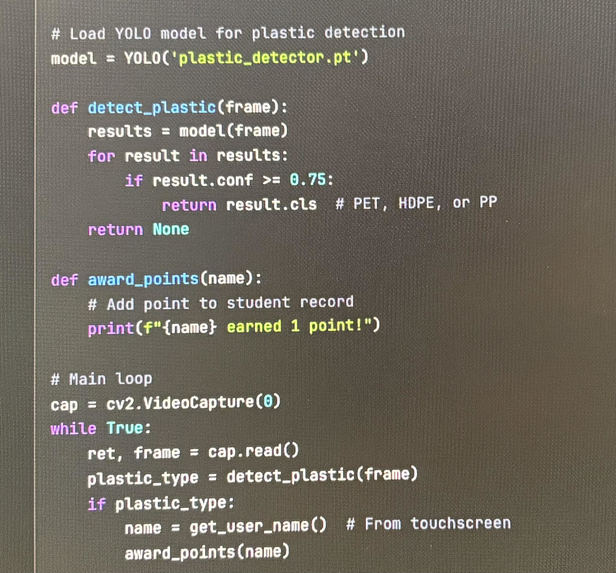
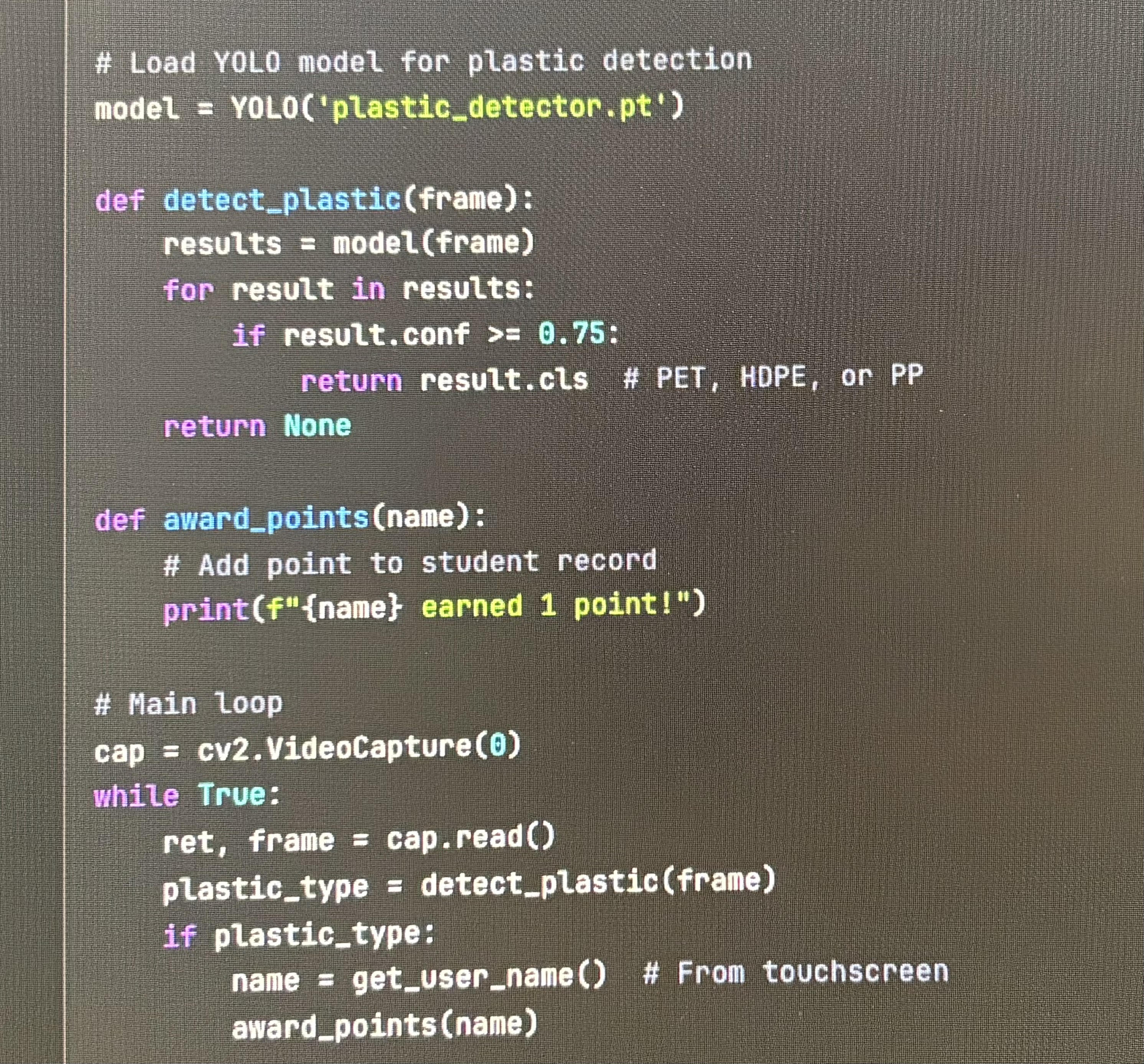
main detection loop for EcoKiosk plastic classification process
-
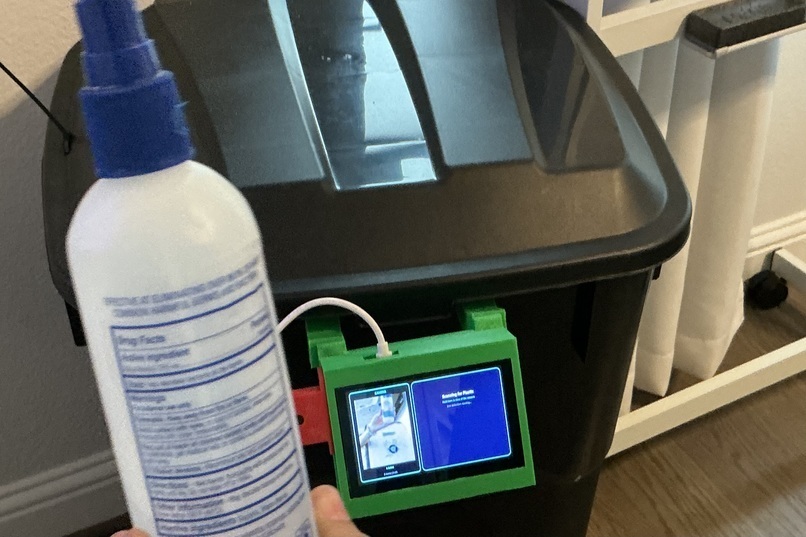
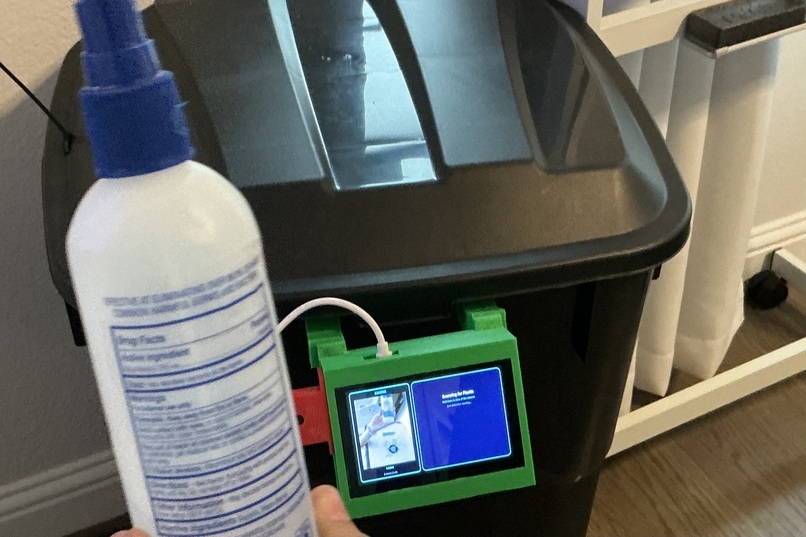
This is the final product prototype being used to scan a plastic items. The machine uses comptuer vision to seperate recyclable items apart.
EcoKiosk: AI-Powered Recycling Machine for Schools
Problem Statement
What real-world problem are you solving?
Students in schools across Northern Dallas are not recycling. Every lunch period, plastic bottles, food containers, and packaging end up in the trash. The issue is not a lack of knowledge. Most students understand what recycling is. The problem is indifference. Traditional recycling bins do nothing to engage students. There is no feedback, no recognition, and no incentive. Without a reason to act differently, most students choose the easiest option and throw everything away.
The data reflects what is seen in school cafeterias every day. Texas disposed of more than 41.3 million tons of municipal solid waste in fiscal year 2024 across 206 active landfills. The average Texan produces 7.24 pounds of trash per day. The state recycling rate is about 22.7 percent across all materials, but plastic recycling is much lower. Nationwide, only about 5 percent of plastic waste is actually recycled, down from 9 percent in 2018. The infrastructure exists, but behavior has not caught up. [7][9][10][11]
Which UN Sustainable Development Goal does it address?
SDG 12: Responsible Consumption and Production
- Target 12.5 — By 2030, substantially reduce waste generation through prevention, reduction, recycling, and reuse.
- Target 12.8 — By 2030, ensure that people everywhere have the relevant information and awareness for sustainable development and lifestyles in harmony with nature.
EcoKiosk directly supports SDG 12.5 by turning recycling into an active and rewarding experience instead of a passive option. It also supports SDG 12.8 by helping students learn what is recyclable through real-time interaction instead of posters or lectures. [5][6][14]
Your Solution
What is your idea or tool?
EcoKiosk is an AI-powered recycling kiosk that rewards students for recycling. A student holds a plastic bottle or container in front of the camera. The system checks whether it is a real recyclable item. The student then enters a name on the touchscreen and immediately earns reward points. The full interaction takes about 10 seconds. The hardware cost is under $150, which makes the system realistic for schools to adopt.
How does it use AI?
EcoKiosk uses a YOLOv8 computer vision model trained on recyclable plastics. The model runs locally on a Raspberry Pi 5 using INT8 quantization for fast edge inference. It identifies three common categories of recyclable plastics:
| Resin Code | Name | Examples |
|---|---|---|
| PET (1) | Polyethylene Terephthalate | Water bottles, soda bottles |
| HDPE (2) | High-Density Polyethylene | Milk jugs, detergent bottles |
| PP (5) | Polypropylene | Yogurt containers, bottle caps |
The AI system includes several reliability features:
- Dynamic brightness normalization to handle different cafeteria lighting conditions
- Center-region detection filtering to reduce false positives
- Temporal persistence checking so the item must remain visible before points are awarded
- Confidence thresholding at c >= 0.75 to ensure accuracy
Everything runs locally on the Raspberry Pi 5. No cloud connection is required. [1][2][4][12]
Impact
How will your solution help people or the planet?
- Increases recycling by giving students an immediate reason to participate
- Reduces plastic waste sent to landfills in the Dallas Fort Worth area
- Teaches students what materials are recyclable through direct interaction
- Keeps costs low enough for public schools with limited budgets
- Works fully offline, which makes it reliable and easier to maintain
- Can be replicated by other schools as a low-cost model
Why is it meaningful by 2030?
SDG Target 12.5 focuses on reducing waste generation through recycling and reuse by 2030. Texas alone disposed of more than 41.3 million tons of waste in 2024, and plastic recycling rates remain extremely low. One of the biggest barriers is not infrastructure alone. It is behavior, especially among younger generations. [6][7][9][10]
EcoKiosk focuses directly on that behavior gap. If deployed across schools in the Dallas Fort Worth metroplex and later across Texas, it could help build recycling habits early. Students who form these habits in school are more likely to carry them into adulthood. Over time, that creates a compounding effect. Each recycled item may seem small, but at scale it leads to meaningful environmental impact.
Technical Report
Title Page
| Field | Details |
|---|---|
| Project Name | EcoKiosk: AI-Powered Recycling Station for Schools |
| Team Member | Sofia Bouazizi |
| UN SDG | SDG 12: Responsible Consumption and Production |
| Project ID | Env1498 |
| Category | Environmental Science |
Abstract
EcoKiosk is a low-cost, AI-powered recycling kiosk designed to increase student participation in recycling in schools across Northern Dallas, Texas. Texas disposed of more than 41.3 million tons of municipal solid waste in 2024, while only about 5 percent of plastic is recycled nationwide. EcoKiosk addresses this gap by using a YOLOv8 computer vision model running on a Raspberry Pi 5 to identify common recyclable plastics in real time. When a valid recyclable is detected with high confidence, the student enters a name on a touchscreen and instantly receives reward points.
Key technical features include INT8 model quantization for fast edge inference, brightness normalization for variable lighting, and a simple touchscreen flow designed for real-world use. The complete system costs under $150, making it practical and scalable for schools. EcoKiosk supports UN SDG Target 12.5 by reducing waste through recycling and Target 12.8 by increasing awareness through everyday interaction. [1][4][5][6][7][10]
Introduction
What is the problem?
Plastic waste is one of the clearest and most persistent environmental challenges in the United States. In Texas, the issue is especially significant because of the state’s size and continued population growth. Texas disposed of over 41.3 million tons of municipal solid waste across 206 active landfills in fiscal year 2024. The average Texan produces 7.24 pounds of trash per day. While the state’s total recycling rate is around 22.7 percent, plastic recycling is much lower. Nationally, only about 5 percent of plastic waste is actually recycled, which is down from 9 percent in 2018. [7][9][10][11]
The problem is especially visible in schools. Every lunch period, plastic bottles and food containers go into the trash. Students are not necessarily against recycling. In many cases, they are simply not motivated to do it. Traditional recycling bins provide no feedback, no recognition, and no reason to care. Without some kind of incentive, most students default to convenience.
Why is it important?
Texas is growing rapidly, and waste volumes continue to increase with population growth. Although landfill capacity still exists, that capacity is not evenly distributed and will not last forever. Landfills also contribute to greenhouse gas emissions, including methane. Without changing behavior, better infrastructure alone will not close the recycling gap. [7][9]
What UN SDG target are you trying to achieve?
EcoKiosk supports SDG 12: Responsible Consumption and Production. Specifically, it addresses Target 12.5, which focuses on reducing waste through recycling and reuse, and Target 12.8, which focuses on improving awareness and education around sustainable lifestyles. By engaging students daily through an interactive AI system, EcoKiosk helps build recycling habits and material awareness at a young age. [5][6][14]
Background Research
What research did you do?
Research for EcoKiosk focused on three main areas: waste management statistics in Texas, behavioral research on recycling incentives, and edge AI deployment on low-cost hardware.
Waste statistics: Data from the Texas Commission on Environmental Quality, the U.S. Environmental Protection Agency, and the CleanHub Plastic Perspectives Report showed that Texas disposed of 41.3 million tons of waste in FY2024, the average Texan generates 7.24 pounds of trash each day, and only about 5 percent of plastic is recycled nationwide. [7][9][10][11]
Behavioral research: Studies on gamification and incentive-based behavior change show that immediate rewards are much more effective than delayed or abstract encouragement, especially for students. Point systems and visible rewards are more likely to influence daily behavior than passive reminders.
Edge AI research: Technical research focused on deploying YOLOv8 on ARM-based hardware, using INT8 quantization to improve speed and efficiency, and building an OpenCV-based preprocessing pipeline that could perform well under inconsistent lighting conditions. [1][2][4][12]
What existing tools or data did you explore?
- YOLOv8 by Ultralytics for real-time object detection
- OpenCV for camera input and preprocessing
- PyQt5 for the touchscreen interface
- Raspberry Pi OS for deployment on low-cost hardware
- A custom image dataset of approximately 2,000 labeled images of PET, HDPE, and PP plastics
- TCEQ waste data for official Texas disposal and recycling statistics
- EPA plastics data for national recycling rates by material type
Solution Description
Explain your idea clearly
EcoKiosk is a standalone system that verifies recyclable items and rewards students instantly. A student shows a plastic item to the camera. The YOLOv8 model classifies the item in real time. If the item is identified as PET, HDPE, or PP plastic with confidence of 0.75 or higher, and the detection remains stable briefly, the system switches to a name-entry screen. The student enters a name, and points are immediately stored in a local SQLite database. The full interaction takes about 10 seconds.
What technologies and algorithms did you use?
| Technology | Role | Why This Choice |
|---|---|---|
| YOLOv8n | Object detection | Strong accuracy to speed ratio for edge deployment |
| INT8 Quantization | Model optimization | Smaller model and faster inference on ARM CPU |
| OpenCV | Camera input and preprocessing | Standard computer vision library with Raspberry Pi support |
| PyQt5 | Touchscreen UI | Responsive and reliable Linux GUI framework |
| SQLite3 | Points storage | Embedded local database with no server needed |
| NumPy | Image normalization | Fast array operations for preprocessing |
How does AI help solve the problem?
AI is what makes EcoKiosk practical. Without AI, every item would need to be checked manually, which would make the system slow and inconvenient. The model allows the kiosk to automatically identify recyclable plastics in real time without supervision. It also helps reduce false positives by combining image preprocessing, confidence thresholds, and persistence checks. Because all inference runs locally on the Raspberry Pi, the system remains fast, private, and reliable even without internet access. [1][2][4][12]
Design and Implementation
Architecture and System Design
EcoKiosk uses a modular three-layer design for simplicity, reliability, and low cost.
| Layer | Components | Technology |
|---|---|---|
| Presentation | Touchscreen UI, camera preview, success screen | PyQt5 |
| Application | State machine, frame loop, points manager | Python 3.11 |
| AI and ML | Object detection, preprocessing, confidence filtering | YOLOv8, OpenCV, NumPy |
| Hardware | Camera capture, display output, enclosure | Raspberry Pi 5, Pi Camera 3 |
Application Flow
- The camera continuously captures frames
- Every third frame is sent to the YOLOv8 model after preprocessing
- If a recyclable item is detected with confidence of at least 0.75, a short timer begins
- If the detection remains stable, the name-entry screen appears
- The student types a name and submits it
- Points are awarded and saved in SQLite
- The system resets to the scanning screen
Hardware Bill of Materials
| Component | Purpose | Cost |
|---|---|---|
| Raspberry Pi 5 | Main computer running the kiosk | ~$60 |
| Pi Camera Module 3 | Captures images for AI classification | ~$25 |
| ELECROW 5 inch touchscreen | Displays interface and accepts input | ~$40 |
| 3D-printed enclosure | Holds the hardware in a portable shell | ~$15 |
| Total | Under $150 |
Software Dependencies
| Package | Version | Purpose |
|---|---|---|
| Python | 3.11 | Core runtime |
| PyQt5 | 5.15+ | Touchscreen GUI |
| OpenCV | 4.8+ | Camera input and image processing |
| Ultralytics | 8.0+ | YOLOv8 model inference |
| NumPy | 1.24+ | Image array operations |
| SQLite3 | Built in | Local points database |
AI Model
The AI model is a fine-tuned YOLOv8n variant trained on a custom dataset of recyclable plastics. It detects three classes:
| Resin Code | Name | Examples |
|---|---|---|
| PET (1) | Polyethylene Terephthalate | Water bottles, soda bottles |
| HDPE (2) | High-Density Polyethylene | Milk jugs, detergent bottles |
| PP (5) | Polypropylene | Yogurt containers, bottle caps |
The model uses INT8 quantization for better performance on the Raspberry Pi 5. Input images are resized to 320 x 320 and normalized before inference to handle inconsistent lighting conditions.
Technical Challenges and Solutions
Inference Speed
| Optimization | Before | After | Improvement |
|---|---|---|---|
| Input Resolution | 640 x 640 | 320 x 320 | 4x fewer pixels |
| Weight Format | FP32 | INT8 | Smaller and faster model |
| Frame Sampling | Every frame | Every 3rd frame | Lower compute load |
| Overall Inference | Over 2000 ms | About 400 ms | About 5x faster |
Lighting Variability
The model performed well in controlled testing but struggled under cafeteria lighting. This was improved by augmenting training data, adjusting camera exposure, and adding brightness normalization.
False Positives
False detections were reduced by increasing the confidence threshold, requiring persistence, and limiting detection to the center of the frame.
User Experience
The interface was simplified to remove unnecessary steps. Detection leads directly to name entry and point assignment.
Conclusion
EcoKiosk shows that low-cost edge AI can be used effectively in a real school environment to promote recycling through incentives and interaction. The system reliably identifies common recyclable plastics after optimization for speed, lighting, and accuracy.
Texas disposed of more than 41.3 million tons of waste in 2024, and the average Texan generates 7.24 pounds of trash per day. Nationwide, only about 5 percent of plastic is recycled. EcoKiosk addresses this gap at the behavioral level by replacing indifference with incentive and directly supports SDG Target 12.5. [6][7][9][10]
Key lessons learned:
- Edge AI requires careful optimization
- User experience matters as much as model accuracy
- Hardware debugging requires patience and testing
- Keeping the system simple was critical
- Real-world testing revealed important issues early
Future work:
- Deploy EcoKiosk in more schools and measure impact
- Integrate with school reward systems
- Open source the project
- Add a leaderboard for competition
- Expand detection to more recyclable materials
References
[1] Ultralytics. YOLOv8 Documentation. Ultralytics, 2024. https://docs.ultralytics.com/
[2] OpenCV Team. OpenCV Library. OpenCV, 2024. https://opencv.org/
[3] Riverbank Computing. PyQt5 Reference Guide. 2024.
[4] Raspberry Pi Foundation. Raspberry Pi 5 Documentation. 2024. https://www.raspberrypi.com/documentation/
[5] United Nations. SDG 12: Responsible Consumption and Production. 2015. https://sdgs.un.org/goals/goal12
[6] United Nations. Target 12.5. 2030 Agenda. https://globalgoals.org/goals/12-responsible-consumption-and-production/
[7] Texas Commission on Environmental Quality. Municipal Solid Waste in Texas 2024. https://www.tceq.texas.gov/
[8] TCEQ. Economic Impacts of Recycling. 2017.
[9] Take Care of Texas. State of Waste in Texas. 2024. https://takecareoftexas.org/
[10] U.S. EPA. Plastics Data. 2024. https://www.epa.gov/
[11] CleanHub. Plastic Perspectives Report 2024. https://www.cleanhub.com/
[12] Ultralytics YOLO GitHub. 2023. https://github.com/ultralytics/ultralytics
[13] SQLite Documentation. 2024. https://www.sqlite.org/docs.html
[14] UNEP. Goal 12 Overview. 2024. https://www.unep.org/

Log in or sign up for Devpost to join the conversation.