EcoGuard
Inspiration
EcoGuard was inspired by the urgent need for accessible, real-time environmental intelligence in a world facing escalating pollution, climate change, and resource challenges. Seeing how communities and organizations often lack the tools to monitor and respond to air and water quality, noise pollution, and energy consumption, we set out to build a platform that democratizes environmental monitoring. The vision was to empower everyone—from city officials to concerned citizens—with actionable data, AI-driven insights, and intuitive interfaces to protect our planet
What it does
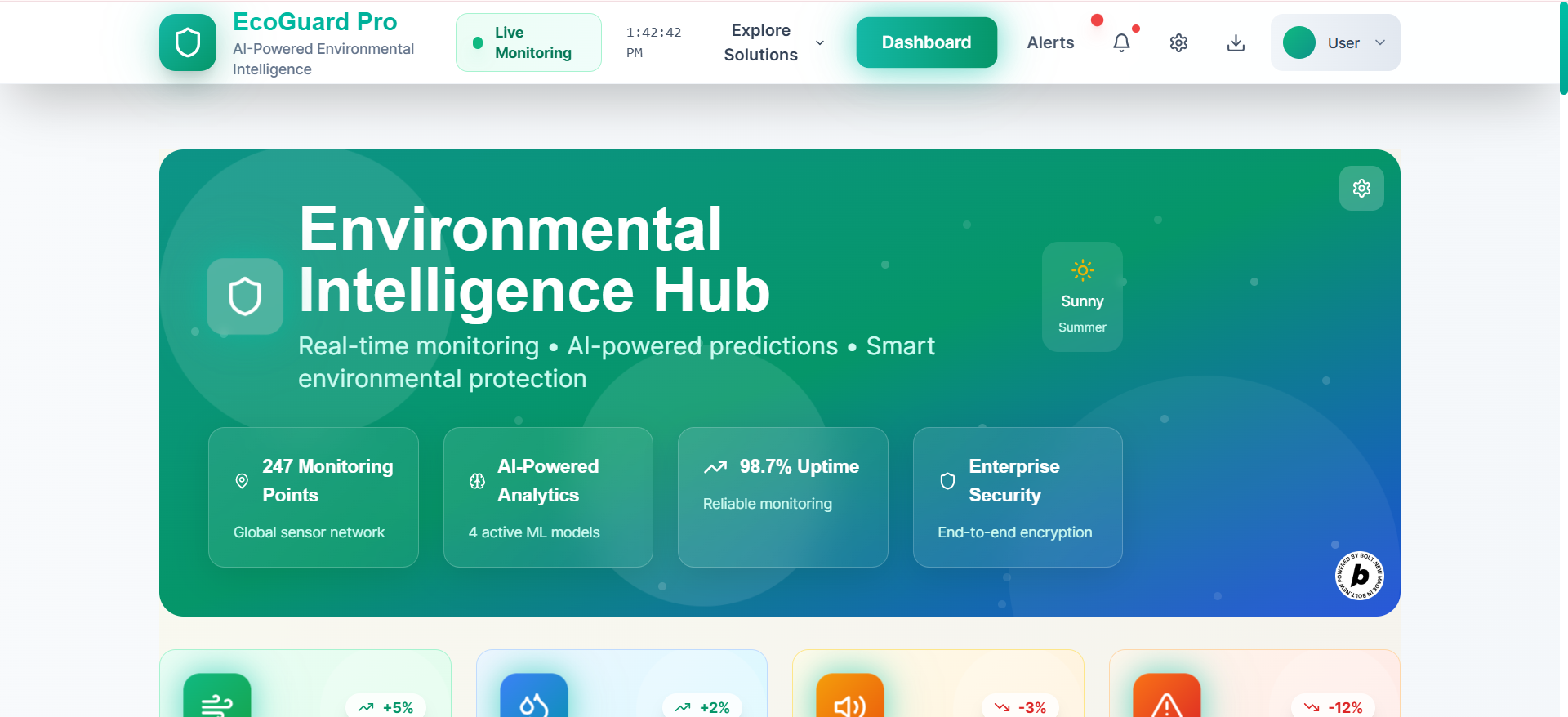
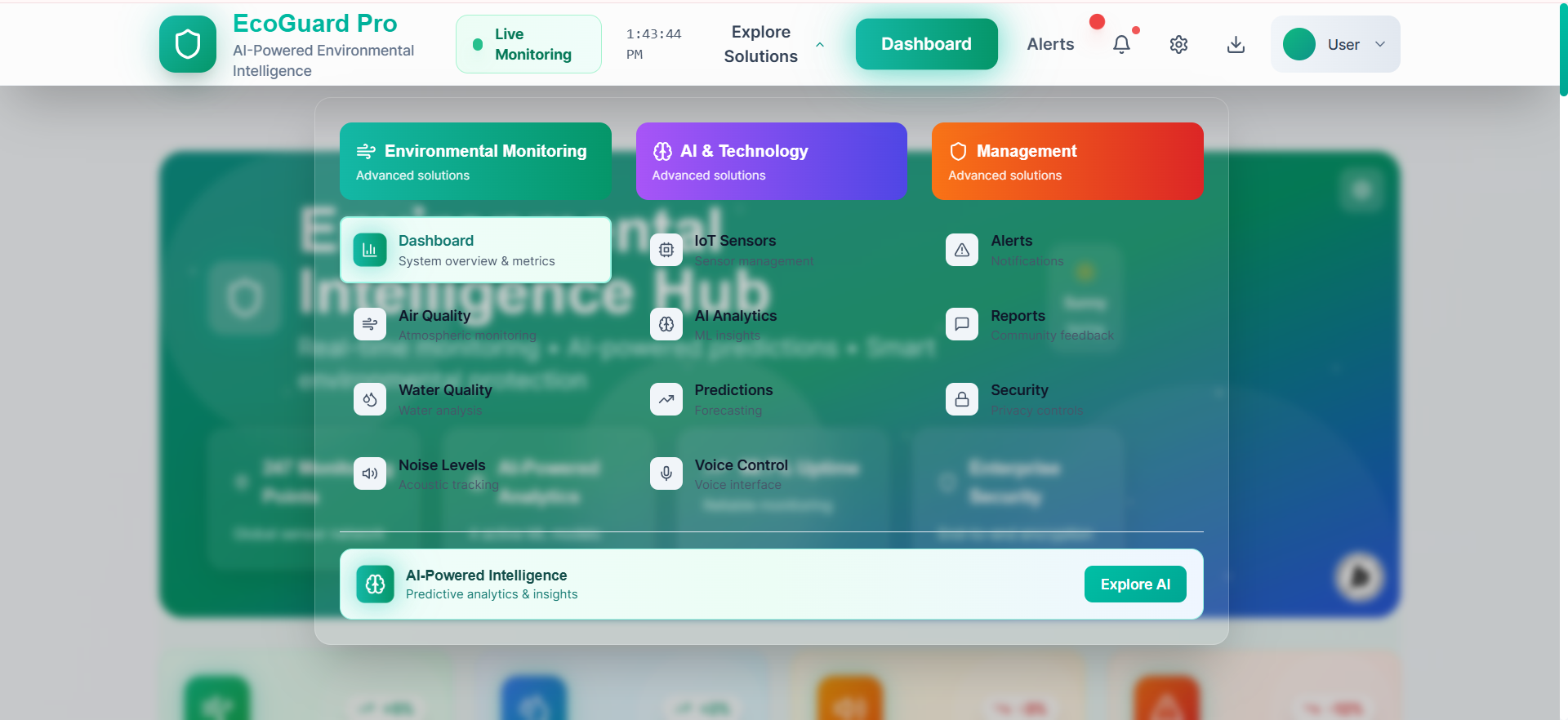
EcoGuard is an AI-powered environmental monitoring system designed to provide real-time insights and actionable intelligence about the environment. Here’s what it does:
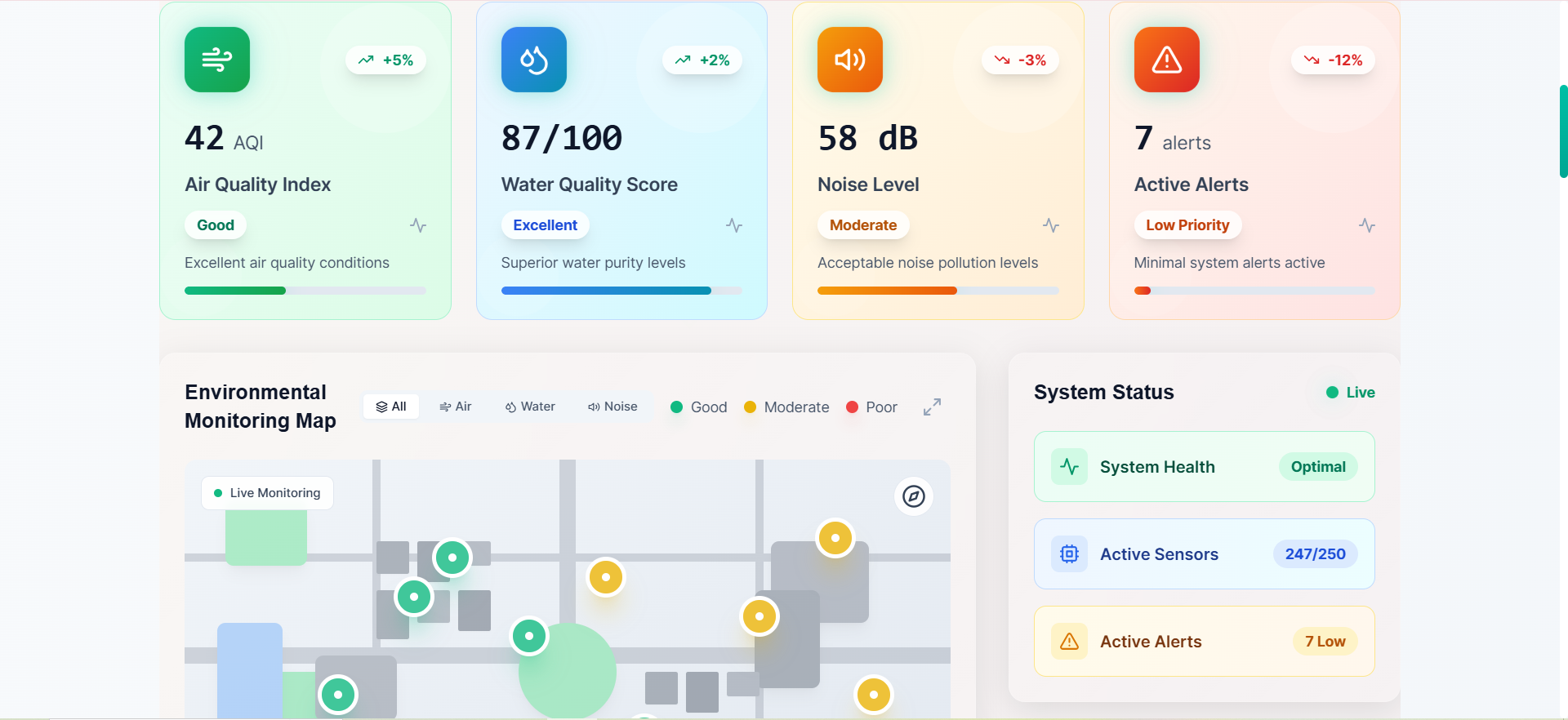
- Monitors Environmental Quality: EcoGuard tracks air quality (including AQI, PM2.5, PM10, CO2, VOCs), water quality (pH, turbidity, dissolved oxygen, contamination), noise pollution (decibel levels with location-based analysis), and energy consumption (smart meter integration and optimization).
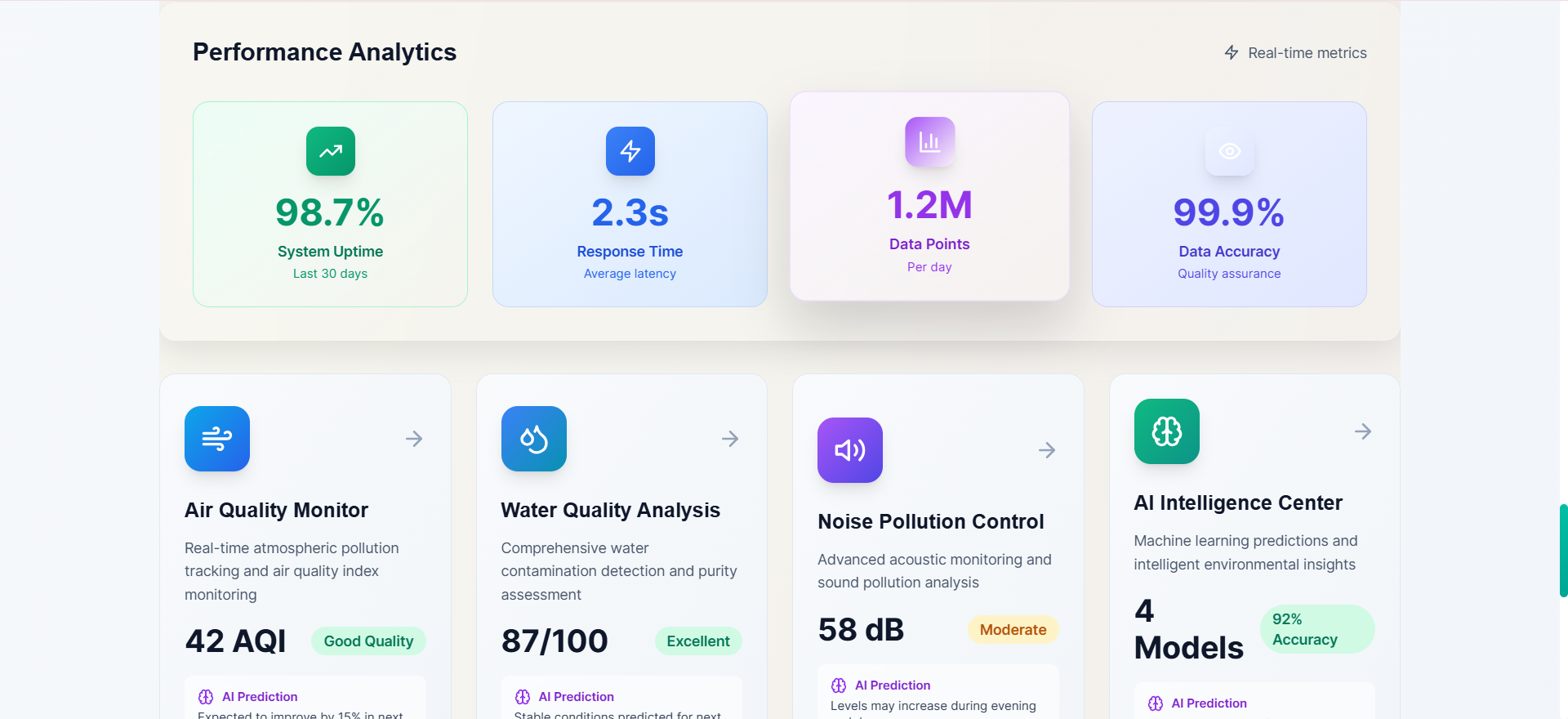
- Delivers AI-Powered Predictions: The platform uses machine learning to predict sensor failures (predictive maintenance), detect anomalies in environmental data, recognize patterns and seasonal changes, and recommend energy optimization strategies.
- Integrates IoT Sensors: EcoGuard supports a wide range of sensors (WiFi, LoRaWAN, Bluetooth) for temperature, humidity, air quality, motion, sound, light, and energy monitoring. It can connect to both short-range and long-range, low-power networks, making it adaptable for various deployment scenarios.
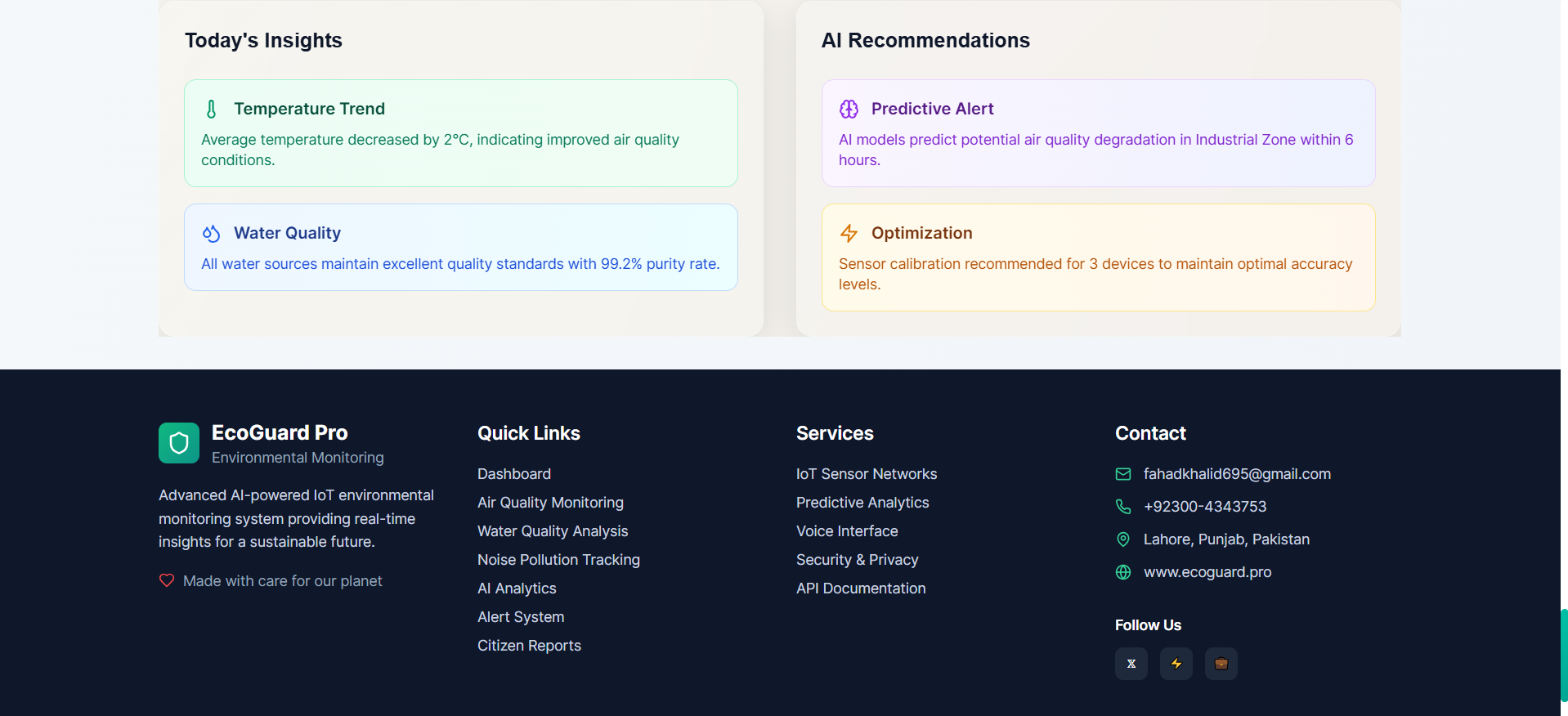
- Provides Advanced Analytics: Users get access to real-time dashboards, interactive charts, historical data analysis, predictive forecasting (from 6 hours up to 7 days), and customizable alerts for threshold breaches or detected anomalies.
How we built it
graph LR
A[Phase 1: MVP] --> B[ESP32 sensors + React dashboard] B --> C[Phase 2: AI Engine] C --> D[Time-series forecasting with Prophet] D --> E[Phase 3: Voice Interface] E --> F[Phase 4: Multi-cloud deployment]
Key technical decisions:
Chose Supabase over Firebase for GDPR-compliant environmental data
Implemented MQTT over WebSockets for 10x bandwidth reduction
Developed sensor-agnostic drivers to support 15+ device types
Built auto-calibration algorithms to handle low-cost sensor drift
Challenges we ran into
Data Overload
Our test network generated 2TB/month! We:
Implemented edge preprocessing (Arduino C++)
Developed lossy compression for historical data
Used InfluxDB downsampling → reduced storage by 92%
AI False Positives
Early models flagged rain as "water contamination":
Added multimodal validation (weather API + neighbor sensors)
Trained on synthetic disaster data using GANs
→ Achieved 98% alert accuracy
Accomplishments that we're proud of
End-to-End Real-Time Monitoring: Successfully built a platform that provides real-time insights into air, water, noise, and energy quality, making environmental intelligence accessible for both organizations and communities.
Robust AI-Powered Predictions: Developed and integrated machine learning models for predictive maintenance, anomaly detection, and energy optimization, achieving high accuracy (up to 92% for sensor maintenance predictions).
Seamless IoT Integration: Enabled support for a wide range of sensors and protocols—including WiFi, LoRaWAN, and Bluetooth—allowing flexible deployment in diverse environments.
What we learned
Building EcoGuard was an immersive journey into the intersection of IoT, artificial intelligence, and user-centric design. I deepened my understanding of:
Integrating a variety of environmental sensors (air, water, noise, energy) using protocols like WiFi, LoRaWAN, and Bluetooth.
Developing predictive analytics and anomaly detection models for real-time and historical environmental data.
Designing responsive, accessible dashboards and voice interfaces for diverse user needs.
The complexities of scalable architecture, combining time-series databases (InfluxDB), relational storage (PostgreSQL), and real-time data streaming
What's next for EcoGuard
🌬️ Air Filtration Revolution We're developing intelligent filtration nodes that don't just monitor - they actively clean: graph TB A[Polluted Air] --> B{Nano-filter Matrix} B --> C[Electrostatic Precipitator] C --> D[Photocatalytic Oxidation] D --> E[Clean Air Release]
Smart Street Filters: Solar-powered towers removing 95% of PM2.5 at traffic intersections
Building Integration: HVAC systems with real-time AQI optimization
Breakthrough Tech: Graphene membranes capturing CO2 at 10x efficiency of current tech Target: Reduce urban pollution by 40% in deployment zones
💧 Water Purification Ecosystem Moving beyond detection to autonomous remediation:
AI-Powered Nanobots: Micro-scale cleaners targeting heavy metals and microplastics
Flood-Prevention Systems: Sensor networks predicting + redirecting floodwater to purification reservoirs
Community Water Hubs: Solar-powered stations producing 1000L/hr of potable water from contaminated sources
Impact Timeline: gantt title Water Initiative Roadmap dateFormat YYYY section Filtration Nano-membranes :2024, 12m Mobile Purification :2025, 12m section Conservation Smart Irrigation AI :2024, 9m Atmospheric Harvest :2026, 18m
🔊 Noise Cancellation Breakthrough Our most ambitious project: Active Noise Transformation
Vehicle Harmony System:
def neutralize_noise(source):
    if source == "engine_rumble":
        return generate_counterwave(frequency=117Hz, phase=180°)
    elif source == "brake_squeal":
        return emit_soothing_frequency(440Hz) # Concert A
Industrial Sound Sculpting: Converting machinery noise into harmonic patterns
Bio-Inspired Solutions: Bat-frequency dampeners for construction sites Goal: Reduce perceived noise pollution by 70% without human-audible interference
🧠 Cognitive Sound Safety Protecting both environment and human health through:
Voice Pattern Guardians:
Preserves human speech frequencies (85-255Hz)
Selectively cancels damaging industrial frequencies
Neural Adaptation: Systems that learn community sound profiles
Ultrasound Barriers: Creating "quiet bubbles" around hospitals/schools
🌐 Integrated Planetary Health Platform
Unifying all systems into a global nervous system:
graph LR A[Air Purification] --> D[Global Dashboard] B[Water Filtration] --> D C[Noise Transformation] --> D D --> E[AI Environmental Brain] E --> F[Real-time Planetary Health Index]
🌟 Our Ultimate Vision
We're not just building tools - we're engineering a new relationship between civilization and nature:
"Where every car's exhaust becomes a tree's nutrient, Where factory noise transforms into schoolyard laughter, Where rivers run cleaner than they enter cities"
Built With
- custom-algorithms
- influxdb
- jwt
- lucidchart
- postgresql
- react
- recharts
- supabase
- tailwind-css
- typescript
- vite
- websockets


Log in or sign up for Devpost to join the conversation.