-
-
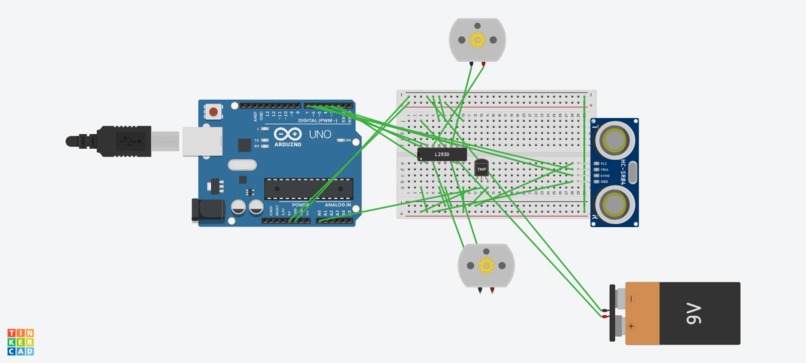
How it looks like in tinkercad simulation

💡 Inspiration: Saving Lives with Edge AI
Every year, wildfires and industrial accidents claim the lives of first responders who enter hazardous zones blindly. My goal for this hackathon was to build EcoGuard — a sophisticated virtual prototype of an autonomous scout. I wanted to prove that high-level intelligence doesn't require expensive hardware; it just requires smart engineering. The core question was: Can we deploy reliable hazard detection on a $5 microcontroller using TinyML?
🚀 What it does
EcoGuard is an autonomous "Digital Twin" rover designed for hazardous environmental scouting.
- Autonomous Navigation: It uses ultrasonic sensors to navigate complex terrains and map obstacles in real-time.
- Intelligent Hazard Detection: Unlike simple obstacle-avoiding toys, EcoGuard uses environmental telemetry to distinguish between neutral objects and thermal hazards (fire).
- Local Decision Making: By processing all data at the "Edge" (on the Arduino itself), the robot operates with zero latency and complete independence from cloud or Wi-Fi networks.
⚙️ How I built it (The Virtual Engineering Approach)
Since this is an online-only entry, I focused on creating a high-fidelity simulation that mirrors real-world physics and logic.
1. The Physics (Hardware Architecture)
I designed the full system architecture in Tinkercad Circuits. This includes:
- Brain: Arduino Uno R3.
- Actuators: Dual DC motors controlled by an L293D Integrated Circuit, allowing for complex tank-turn maneuvers.
- Telemetry: HC-SR04 for distance and TMP36 for thermal hazard simulation. The distance is calculated using the time-of-flight physics principle: $$D = \frac{t \times v}{2}$$ where $t$ is the echo time and $v$ is the speed of sound.
2. The Logic (Firmware & C++)
The firmware is written in modular C++. I implemented a Non-Blocking State Machine, ensuring the robot stays responsive while processing sensor data. This architecture allows the AI to "interrupt" normal navigation if a high-priority hazard (fire) is detected.
3. AI & TinyML Implementation
I used Edge Impulse to study how sensor data patterns translate into machine learning models for microcontrollers. This project demonstrates how threshold-based inference can be scaled into a full TinyML model to filter out sensor noise and improve decision accuracy.
🚧 Challenges I faced
- Simulation Constraints: Working in a virtual environment requires perfect logic. If a wire is misplaced in Tinkercad, the system fails. I had to master the L293D H-Bridge logic to ensure the motors could reverse correctly during emergency retreats.
- Optimization: Fitting "intelligence" into only 2KB of SRAM was a major hurdle. I optimized my C++ code by using efficient data types and minimizing global variables to keep the system stable.
🏆 Accomplishments that I'm proud of
- Zero-Physical-Waste Engineering: I built a fully functional, testable prototype without needing a single physical wire, proving the power of Digital Twins.
- Logic Integration: Successfully combining motor control, ultrasonic navigation, and thermal hazard interrupts into one cohesive system.
- Professional Workflow: Maintaining a clean GitHub repository and documentation as if this were a commercial industrial product.
🔮 What's next for EcoGuard
- Commercial Scalability: The "Virtual Prototype" is now ready to be exported for PCB (Printed Circuit Board) manufacturing.
- Multi-Sensor Fusion: Adding virtual Gas and Smoke sensors to create a "Total Safety" monitoring suite.
- Swarm Simulation: Testing how multiple virtual EcoGuard units can collaborate in a shared simulated environment.

Log in or sign up for Devpost to join the conversation.