-
-
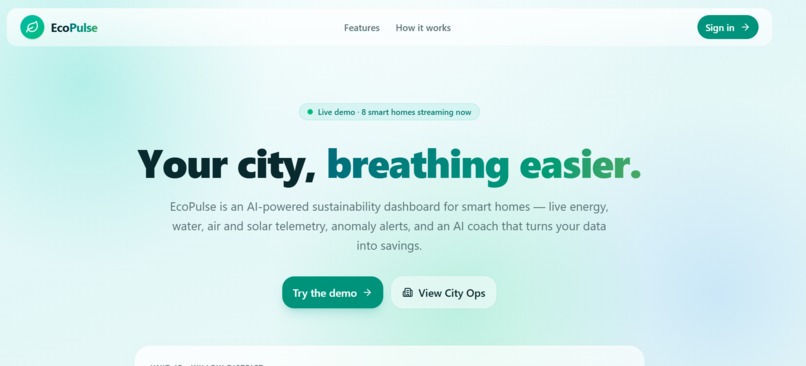
Landing Page
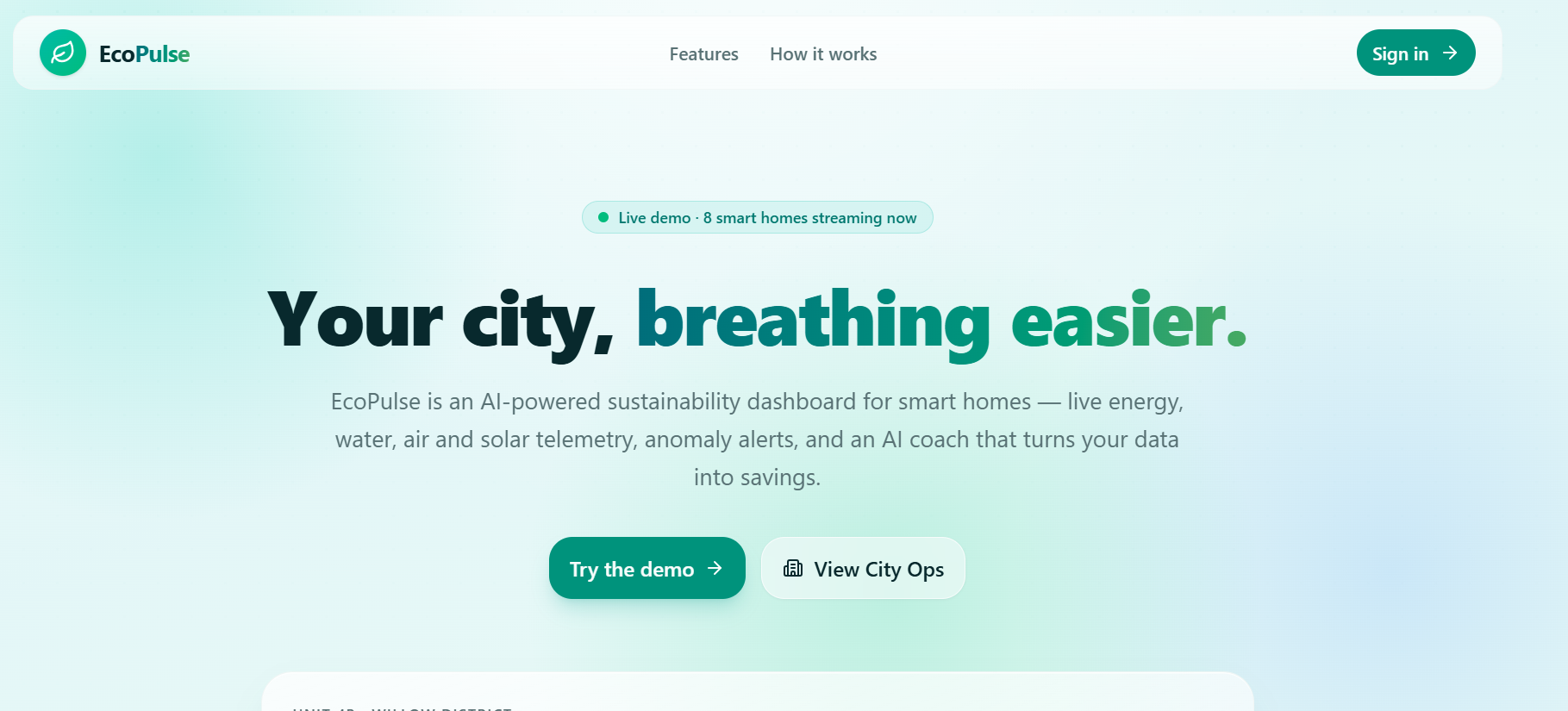
About the project
Inspiration Cities are full of "smart" infrastructure — meters, sensors, grids — but almost none of that data reaches the people living in it. A homeowner has no idea their fridge is drawing 3x normal power until the bill arrives. I wanted to close that loop: turn invisible sensor data into something a person can actually act on, in plain language, in real time.
What it does EcoPulse is an AI-powered sustainability dashboard streaming live energy, water, air quality, and solar data from smart homes across a simulated district.
My Home — live energy/water/solar/cost tracking with instant anomaly detection (unusual power draw, possible leaks). AI Insights — reads a home's actual recent data and generates specific, personalized savings tips (e.g. "shift laundry to your solar peak, save ~$2.10/day"), regenerable on demand. Gamification — points, streaks, and a neighborhood leaderboard. City Ops — the same data zoomed out into a district-wide view: total draw, solar output, air quality, a live load map, and a real-time anomaly feed across all homes.
How I built it I built EcoPulse [with Freebuff — fill in your actual stack]. With no physical hardware, I built a background simulator generating realistic sensor data for eight homes — daily curves, not random noise — so anomalies would stand out against a believable baseline. The AI Insights engine generates recommendations computed from each home's real simulated data rather than static advice. Guest login was deliberate: no signup friction, live data within seconds.
Challenges I ran into Getting simulated data to feel real was harder than expected — naive randomness made every chart look like noise, so I had to model realistic daily curves per home. [Add your own real pain point — AI latency, tuning anomaly thresholds, UI staying readable with constant live updates.]
What I learned [One or two honest sentences — e.g. how much design work goes into making fake data feel real, or what you learned prompting an LLM for consistently specific output.]
What's next Replacing the simulator with real smart-meter APIs (Shelly, Sense, or utility feeds), piloting with real households, and evolving anomaly detection into predictive alerts that flag problems before they spike.
Built With
- react
- supabase
- tailwind


Log in or sign up for Devpost to join the conversation.