-
-
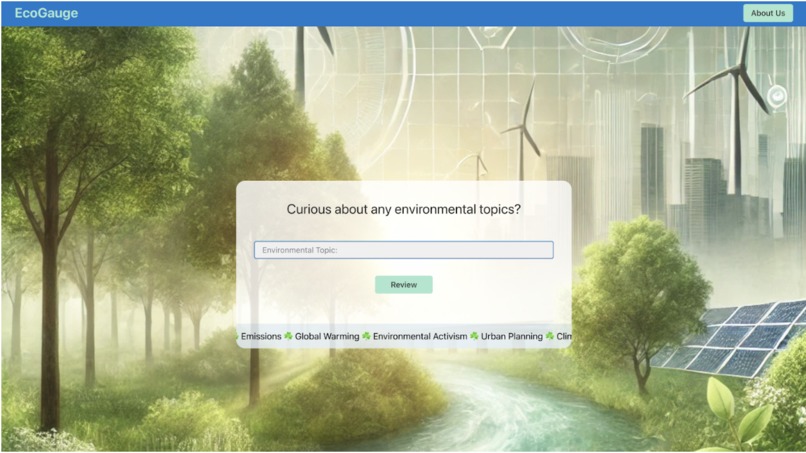
Front Page
-
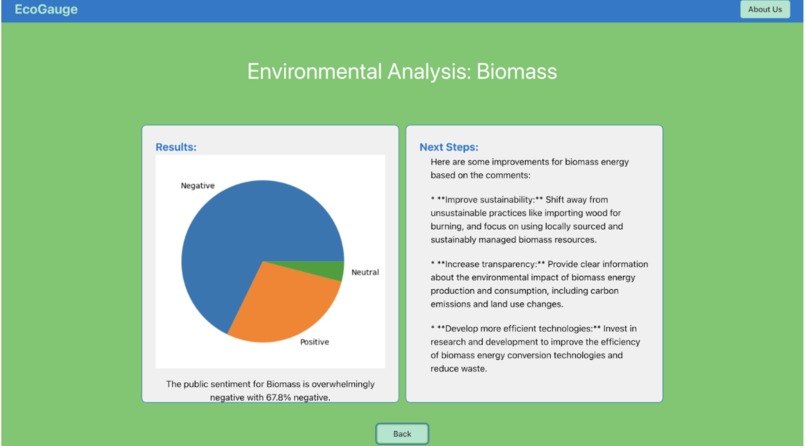
Results Page
-
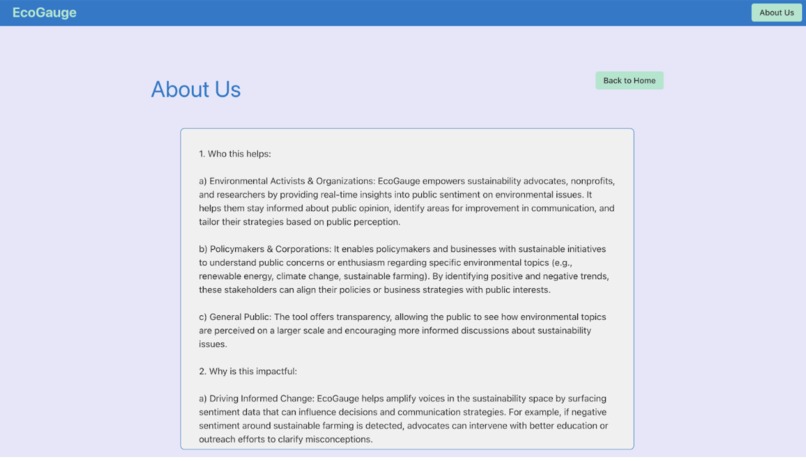
About EcoGauge


Inspiration
Our inspiration for EcoGauge stems from the growing concern around climate change and environmental sustainability. We recognized that while there are many discussions about sustainability happening across online platforms, it's challenging for individuals, organizations, and policymakers to easily gauge public sentiment on key environmental topics. We wanted to create a tool that empowers environmental advocates and decision-makers by providing clear, data-driven insights into how the public feels about pressing issues like renewable energy, conservation, and sustainable agriculture.
What it does
EcoGauge empowers sustainability advocates, nonprofits, and researchers by providing real-time insights into public sentiment on environmental and sustainability-related issues. The application measures whether online communities correlate the topic at hand to be positive, negative, or neutral and offers actionable steps to improve public sentiment by analyzing the constructive comments related to the sustainability issue.
How we built it
We utilized BeautifulSoup, Selenium, and Pandas to scrape and pre-process Instagram threads data to collect string comments. Simultaneously, we trained a scikit-learn SVM model using 10,000 Amazon reviews to capture the wide range of sentiments. Then, we inputted the cleaned threads into the model and used a TF-IDF vectorizer to turn strings into numerical data based on text frequency and return a classified sentiment. We used Matplotlib to display a distribution of sentiments and Gemini API to analyze constructive comments and offer constructive feedback. Lastly, we used Reflex to design the frontend with Python and present our product in a clean and organized manner.
Challenges we ran into
One of our main challenges was to web scrape information and turn it into data that we can feed into our trained sentiment analysis model. This was difficult as we had to find which social media platform both fit with goals and compatible with our program. Another challenge we ran into was linking the frontend and backend. Though we used Reflex to simplify frontend development by using Python for web development, we struggled with populating data such as the Matplotlib chart. We also struggled to convert the product in local host format to being deployed for external use.
Accomplishments that we're proud of
We are proud that we were able to combine our skills and apply it to something actually impactful to the environmental community. As it is our first hackathon, we wanted to create an impactful application that helps a specific community after realizing how underrepresented the general public is in policy making and larger decisions. As the importance of sustainable action grows, we hope our product will give policymakers convenient access to insights on public opinion.
What we learned
With this being our first hackathon, we learned how to adapt in high pressure environments. While trying to create the best project in only 48 hours, we were forced to learn new skills such as Reflex. We also learned many non-coding aspects of creating a product from start to finish such as navigating git and file structure.
What's next for EcoGauge
Though EcoGauge was designed to tackle the lack of awareness regarding sustainability, we see avenues to scale the application into other industries beyond sustainability. EcoGauge can be particularly beneficial for public figures, who can gauge public sentiment on themselves by using our tool to aggregate the most common points of feedback. Generally, any industry where the collection of public opinion is useful can be a new door for EcoGauge!
Built With
- beautiful-soup
- gemini
- matplotlib
- python
- reflex
- scikit-learn
- selenium
- tfidf


Log in or sign up for Devpost to join the conversation.