-
-

Logo
-
Landing page when not on product
-
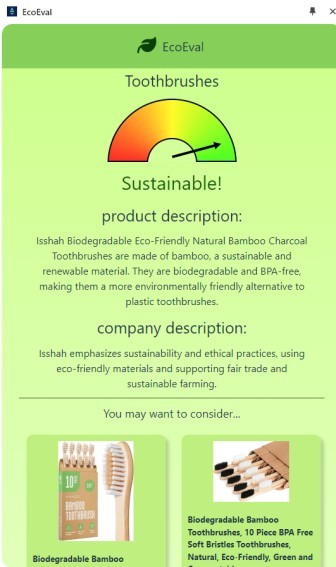
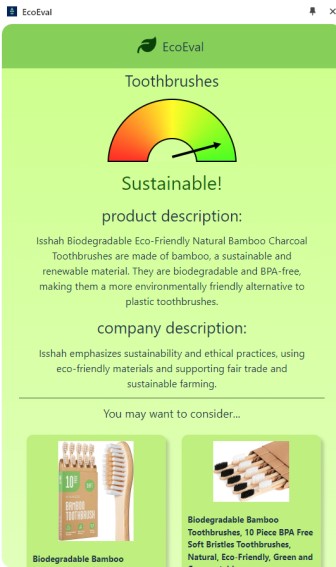
When viewing a sustainable product
-
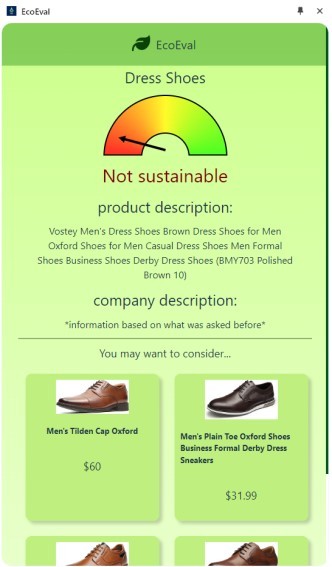
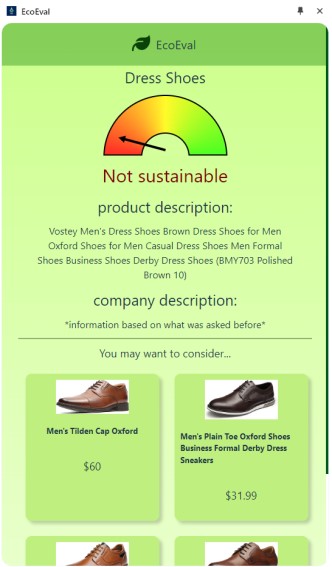
When viewing a non-sustainable product

Inspiration
Driven by our collective aspiration to promote a greener planet through mindful consumerism, we conceptualized EcoEval. We recognized a gap in the market for a comprehensive, user-friendly tool that could provide online shoppers with detailed sustainability profiles of the products they’re considering. While existing solutions like ‘CarbonCheck - Discover Sustainable Products’ offer valuable insights into a product’s carbon footprint, we felt they only told half the story. We wanted to consider other factors such as the materials used and the manufacturing process. EcoEval was born out of this desire to provide a more holistic view of a product’s environmental impact, turning every online shopping experience into an opportunity for positive change.
What it does
EcoEval, our Chrome extension, presents users with a detailed sustainability profile of the product they’re currently viewing. This profile includes a sustainability sentiment, a breakdown of the product’s sustainable attributes (like the materials used), an overview of the manufacturer’s sustainability ethos, and suggestions for alternative sustainable products.
How we built it
We start by extracting product information, including its name and manufacturer, from the URL of the user’s current tab. We then leverage Google’s Gemini to generate a sustainability rating, a summary of the product’s sustainable aspects, a description of the manufacturer’s sustainability values, and the product type. Using the product type, we perform web scraping with BeautifulSoup on langchain-community to find related sustainable products. All this information is then sent to our frontend, which is built with React, to be displayed to the user.
Challenges we ran into
One of the main challenges we faced was in the realm of frontend development, specifically with the creation of our Chrome extension. Our choice to develop a Chrome extension was driven by our desire to provide users with a seamless shopping experience. We wanted to avoid the inconvenience of having to navigate away from their shopping page to a separate webpage. With our extension, sustainability information is just one click away and allows for live comparison as users browse products.
However, developing a Chrome extension was a new experience for our team. We had to quickly familiarize ourselves with the unique aspects of Chrome extension development. This included understanding various Chrome extension features such as popups, side panels, and tab detection. We also had to learn how the side panel communicates with the webpage, and how to control the frontend of the side panel and the main page separately.
Another challenge was ensuring that our extension would work seamlessly across different websites, given the variability in website structures. We had to ensure that our extension could accurately extract product information from various websites, which required us to develop robust and flexible code.
Despite these challenges, we are proud of what we have accomplished. We believe that the decision to create a Chrome extension significantly enhances the user experience of EcoEval, making sustainable shopping more accessible and convenient for all. We look forward to continuing to improve and expand upon what we have built.
Accomplishments that we're proud of
We are proud that we were able to use new technologies (i.e. Gemini) and the knowledge we learned from different workshops about Gen AI, and use it to generate useful information (i.e. summary of how sustainable the product materials are) about sustainability. Because it is also our first time developing a chrome extension, we are proud that we were able to learn quickly about different features chrome extensions offer, how interactions between the webpage and the side panel works, and be able to adjust our frontend design as we explore more suitable features for our project.
What we learned
We learned to use different technologies through various sponsored workshops. Considering the technologies we learned from the workshops (i..e. Google Gemini) and the existing technologies that we already know how to use (i.e. React, Beautiful Soup), we decided which ones are more suitable for our project. We also researched and learned to use new technologies (i.e. oxylabs scrapper APIs).
What's next for EcoEval?
While our current focus is on providing sustainability reports for products sold on Amazon, we plan to extend our support to other platforms. We also aim to enhance the accuracy of our system by incorporating the latest news articles about a company’s sustainability practices. We’ve found that while many companies claim to have ethical and eco-friendly practices, it’s often through media criticism that their failures to act on these claims are exposed. By integrating the Gnews API and further developing our Gemini prompt, we hope to provide more accurate information. We’re also considering a points and rewards system based on how much a user spends on eco-friendly products, which would depend on partnerships with eco-friendly companies. Currently, we provide three sustainability responses (yes, maybe, or no), but we hope to create a database for more statistical evaluations of a company based on different parameters. With this database, we aim to train a model to provide a score-based response rather than a sentiment analysis-based response.
Built With
- beautiful-soup
- css
- figma
- flask
- gemini-api
- html5
- javascript
- langchain-community
- oxylabs-scrapper-api
- python
- react
- vite

Log in or sign up for Devpost to join the conversation.