Introduction
Leo, a regular at the university cafeteria, couldn't ignore the heaps of food being wasted daily. Disturbed by the unnecessary waste, he envisioned a solution that not only managed waste better but also incentivized reduction. When given the opportunity at IDC 20204, him and his team devised a system that encourages a culture of sustainability by rewarding minimal food waste, setting our crosshairs on cafeteria food waste around the world.
Challenges Addressed:
Leo's firsthand experience was crucial in identifying the key challenges we wanted to address in order to design a tailored, impactful solution.
Firstly, our solution had to address the root of the problem in cafeterias, namely the excessive food waste created by students. We devised a reward-based system that gave participants a percentage of their meal cost back to them depending on their proportion of food waste, which would be determined through a combination of weight and advanced imaging.
Secondly, our project needs a method of separating landfill materials and recyclables from biologically useful materials, such as bone and food waste. The project should be deliver a separated output of compostable and non-compostable waste, and if more waste separation is possible without added complexity, it should aim to do so.
Lastly, the design of the project needs to inviting, minimally invasive, and require a low amount of user input. This project aims to make throwing away and processing waste a less complicated, more rewarding task that yields more benefits with less work.
Inspiration
The design of our cafeteria-concentrated waste collection system was uniquely inspired by the marvels of nature, specifically drawing inspiration from tropical pitcher plants (Nepenthes). With a central reservoir that is filled with water once the first round of separation has occurred, our trash system separates the remaining waste through density differences. Materials that become waterlogged are usually organic materials and sink to the bottom of the reservoir. Oils rise to the top of the reservoir, where they can easily be separated using a top scraper.
And finally, leveraging the extraordinary visual capabilities of the mantis shrimp, UIUC's own Biosensors Lab has created an imaging platform capable of detecting faint spectral differences. Known for its hyperspectral vision, the mantis shrimp's eyes inspire the system's ability to distinguish between different types of cafeteria-concentrated waste materials, ensuring accurate sorting for recycling purposes. Source: SPIE Digital Library
Our Concept
Armed with our bio-inspired concepts and the challenges we needed to face, we decided to design a waste disposal system capable of multiple trash processing aspects in one product.
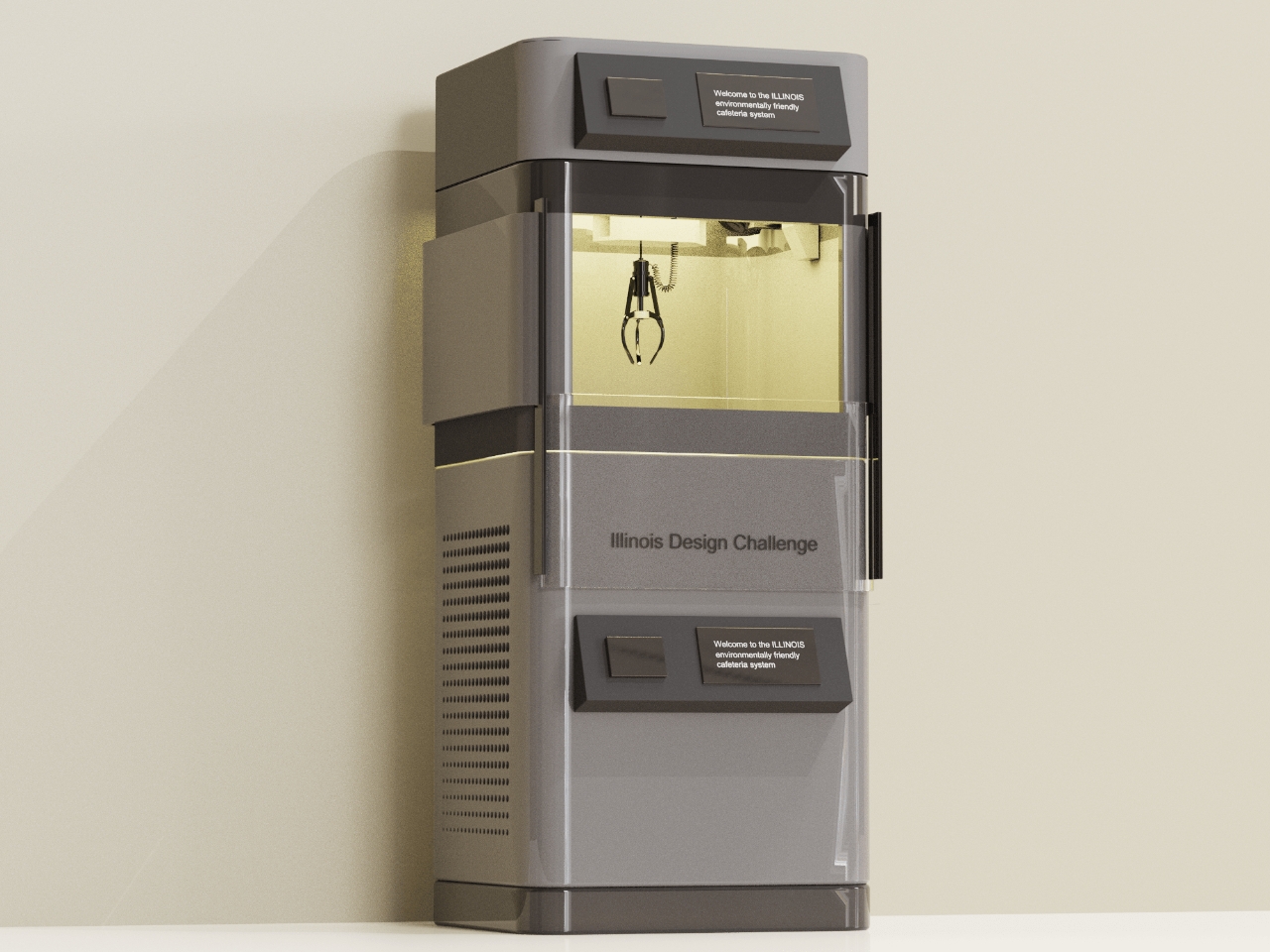
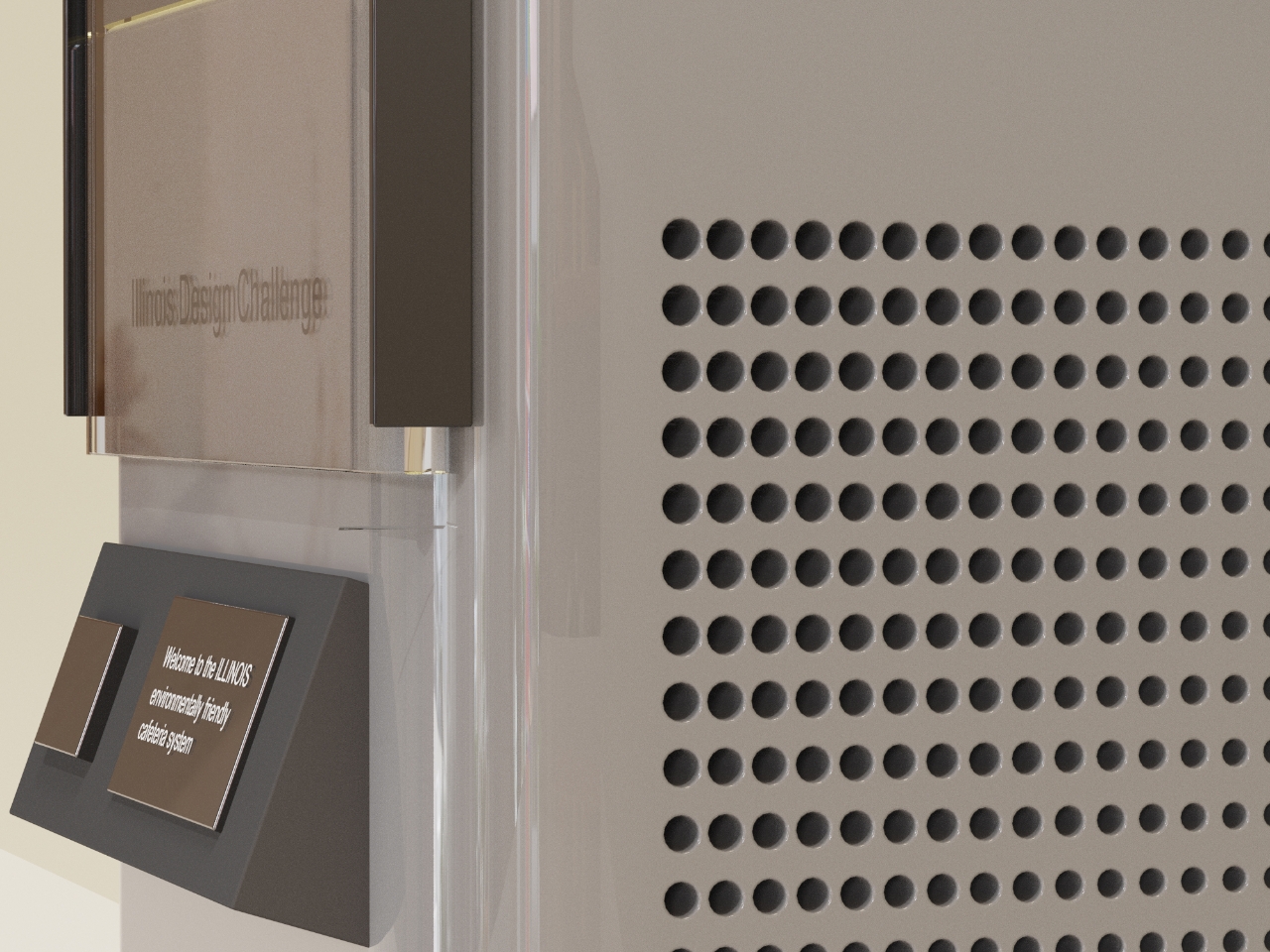
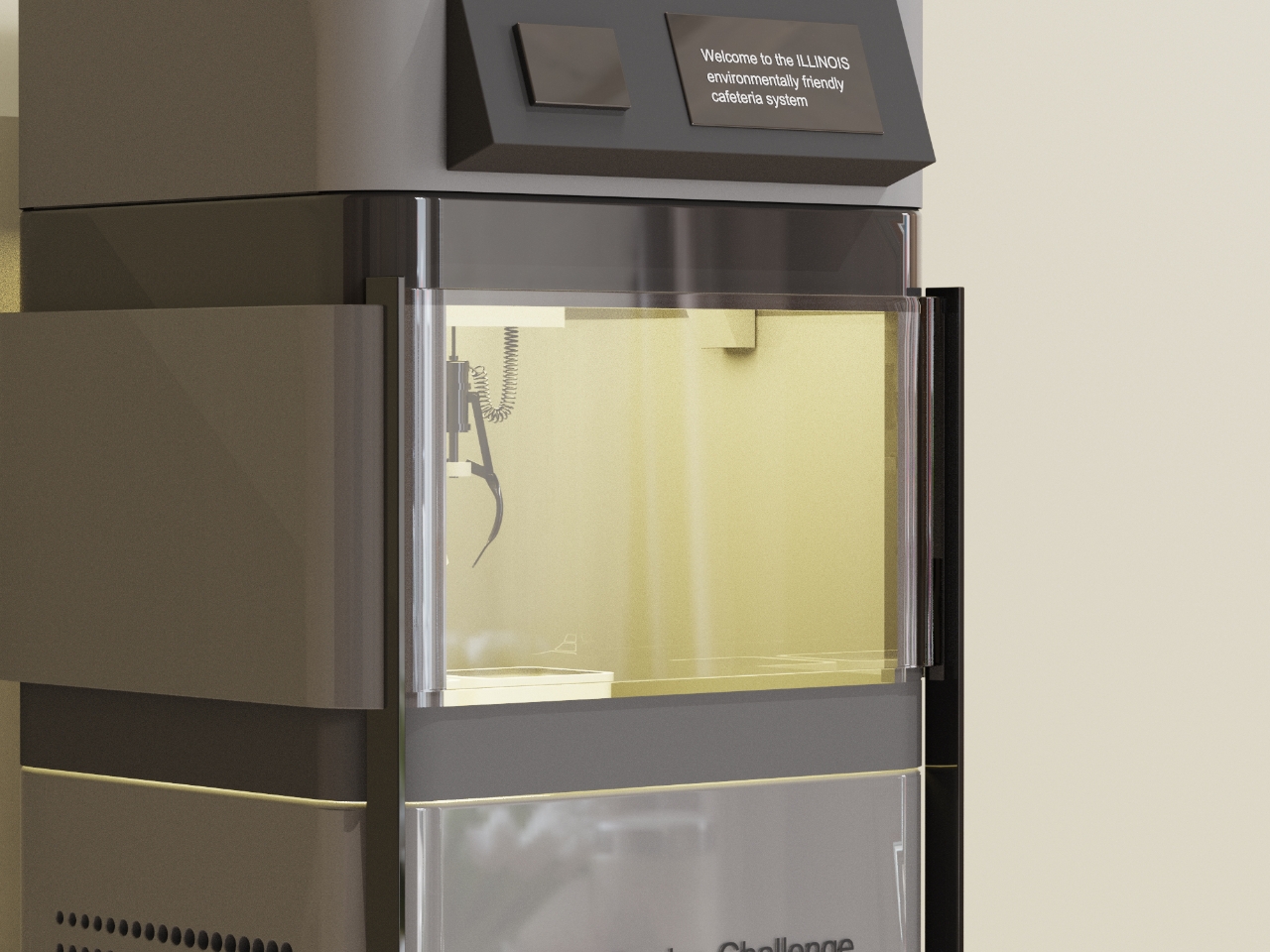
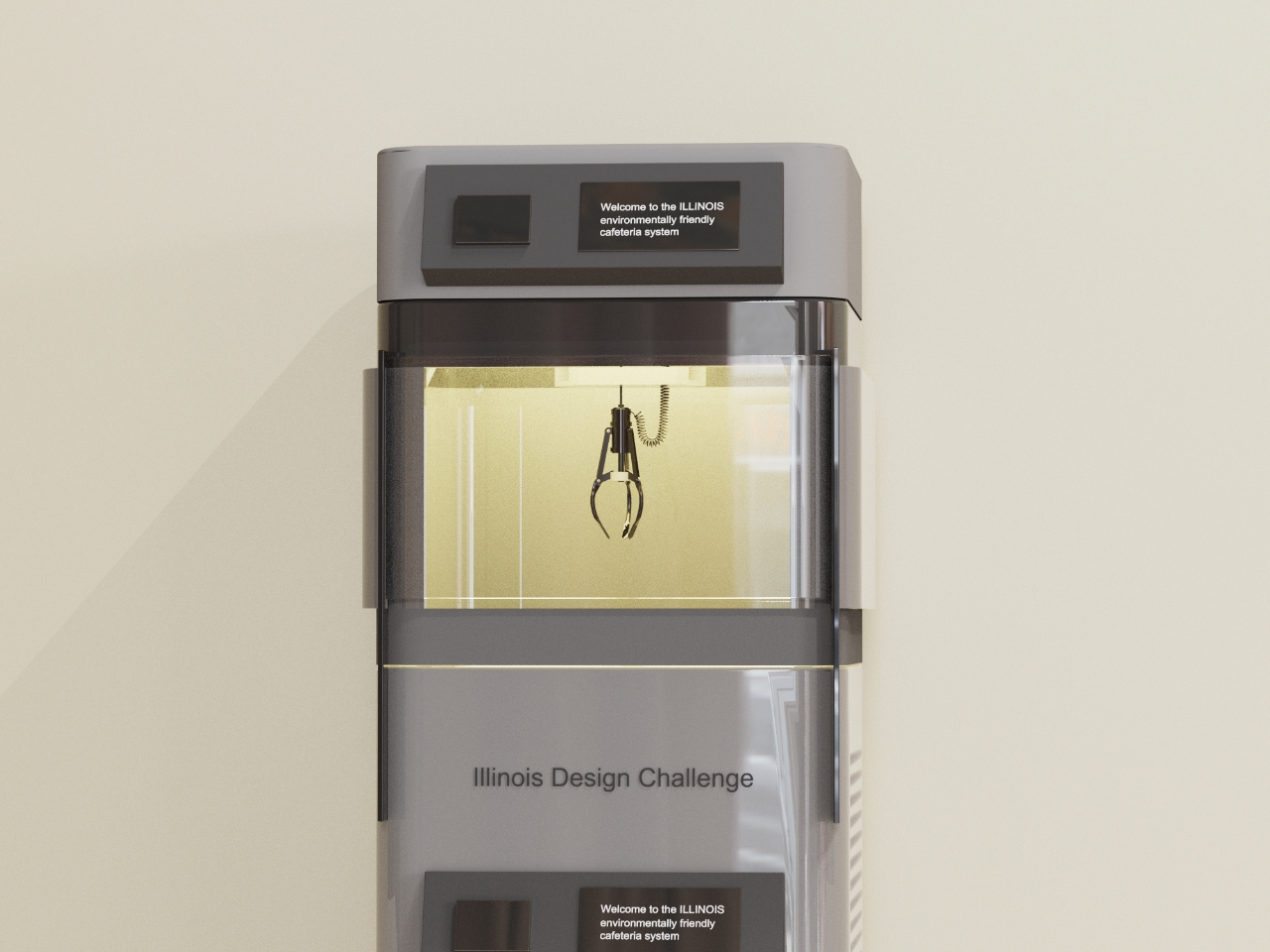
The general concept is broken down as follows. A student first swipes their card on the front card reader of the disposal unit, which slides open the motorized front door and lets the student scrape any waste onto the top plate. Either the top or bottom user interface can be used; this way kids, people with disabilities or anyone else that may find it difficult to reach the scanner can still use our product with ease. This plate has dual force sensors on the underside, allowing for an accurate total waste weight to be measured before waste is separated.
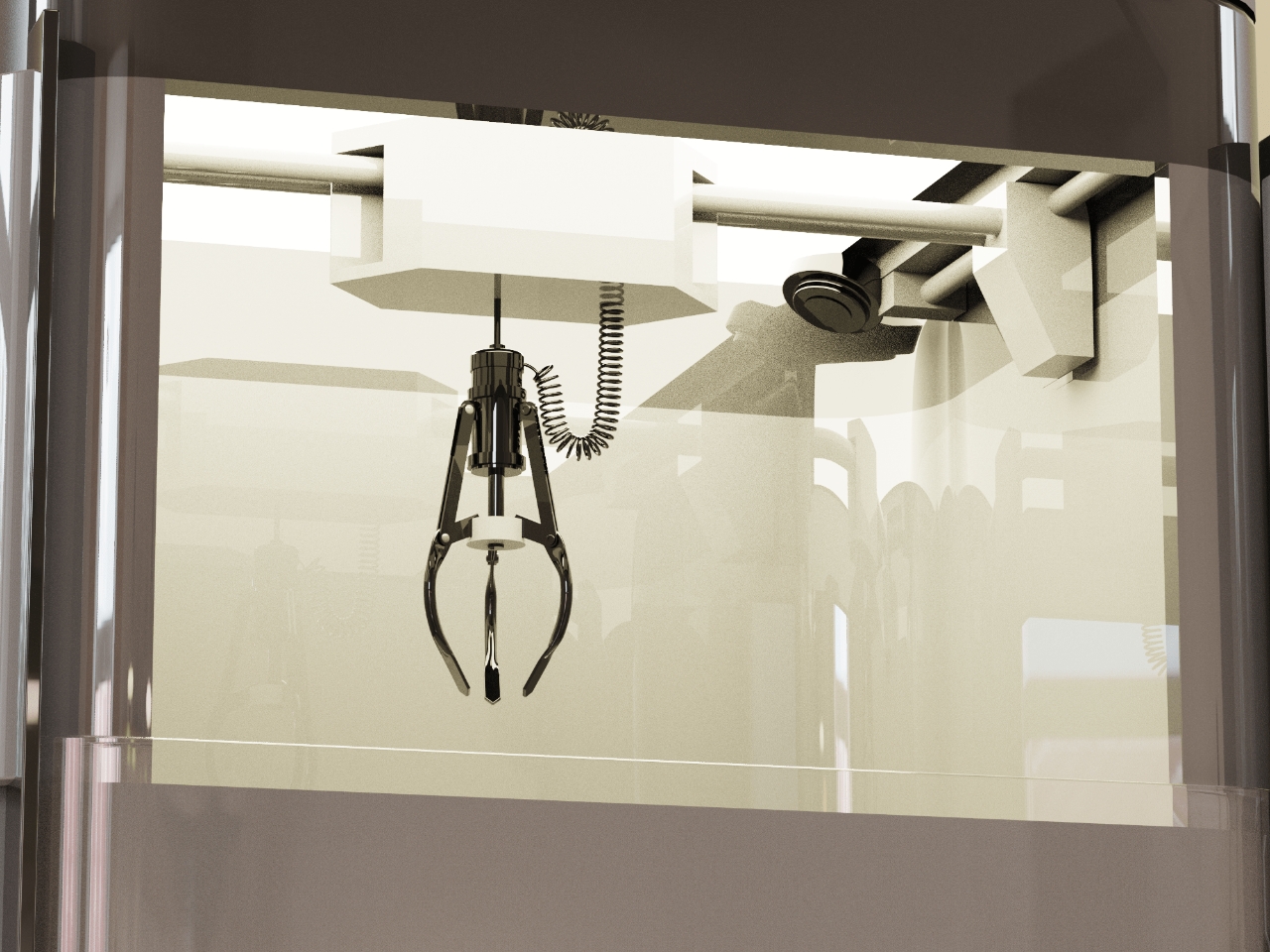
Above the plate is a 27-band Full Spectrum GSENSE camera with Stable Diffusion, trained to recognize different types of food waste and to differentiate between recyclable and non-recyclable plastics based off their spectral signature. Then using a grabber arm built into the top of the system can gradually sort out non-recyclable waste until only mostly food waste remains, almost like the claw game at arcades. The non-recyclable is placed into 3 chutes, each of which correspond to either recyclable plastics, non-recyclable plastics, or organic matter that can't be composted easily (bones, etc). The force sensors measure the remaining weight of the food waste to give a proportion of actual food waste versus total waste and applies a variable cash back to the student's iCard for that meal, with the amount depending on the proportion.
Using a hydraulic hinge built underneath the top plate, the remaining biological waste is dropped into a reservoir where density helps separate energy-dense oils from the remaining waste. Oil is also toxic to plant growth, and must be removed if the remaining waste is to be used as compost. A circular oil scraper constantly skims the surface for oil, depositing it into a separate container. The water is flushed at the of the day, leaving only compostable waste. The final step is a drying stage, where the bottom of the system heats up in order to remove odors, dry the waste out, and make removal of the compost easier.
Design Process
The many parts of our concept meant that it was imperative to have a strong idea of what our project would generally look like while also carefully considering the feasibility of not only every singular part, but all the parts working together. After conceptualizing the features our project would have, we decided how to implement said features.
For the material separation, we needed a method to separate all forms of waste effectively, which led us to consider waste characteristics that weren't purely visible. With two members of the team being a part of the Biosensors Lab at the ECE Department, we quickly pivoted towards using multispectral data, especially NIR data, to separate waste. In fact, NIR waste separation is already an established industry standard in waste management, while hyperspectral sensors allow for even higher accuracy when detecting different materials. Stable diffusion means that the detection scheme for labeling different types of materials only improves over time. The mechanical process of separating waste came down to a grabber arm, similar to the crane arm games at arcades due to its relative simplicity, ease of implementation and widespread availability due to aforementioned popularity at arcades.
The cashback aspect relied on multiple systems to maintain an accurate reading of waste proportion, and accuracy was particularly important since the result would be directly affecting the cash flow of the university. As such, our hyperspectral camera sensor and intelligent algorithms guaranteed unparalleled accuracy that only gets better. With precision force sensors, the remaining waste is accurately weighed and your cashback is automatically applied to your last meal through the built in WiFi module.
The oil extraction unit gave us trouble until we realized a reservoir format would be beneficial for waste separation using only density. Since oil is less dense than water, all oils would float to the top of the reservoir, meaning easy collection using a spinning arm propeller and a smaller oil container to deposit the oil into. To ensure longevity of the system while being cost effective, we plan to use high-strength acrylic for the reservoir.
The final waste is purely biological and will have mostly settled at the bottom. Once water is drained from the reservoir, the reservoir can be removed and the remaining waste can be easily used as compost. The heating system is also relatively simple, consisting of a bottom ceramic heating unit for efficiency and reliability.
With each feature roughly implemented, we moved on to the design stage, where mockups were drawn to explore different sizes and shapes. Once a mockup was agreed upon, we moved onto CAD, where the machine was fully conceptualized and the eventually rendered.
Preliminary Sketch Up Click here for image
Solution 1 Click here for image
Solution 2 Click here for image
Manufacturing
When deciding the materials used in our design, we went decided to create a high-quality product that would stand the test of time. With most trash cans being made of plastic or stainless steel, we thought it would be much more fitting for our design body to be made of stainless steel combined with ABS. Stainless steel would be used in areas with constant contact with liquids and waste, where its strength, durability, and resistance against corrosion would shine. ABS, being cost effective, highly impact resistant, and chemically inert means the rest of the body can be made of ABS for uncompromising build durability.
The top plate would be made of a sheet of stainless steel for optimal corrosion resistance and durability. The reservoir, as mentioned before, would be a high-strength acrylic cylinder, capable of withstanding the enormous pressure from the water while remaining unaffected by any chemicals and biological solvents in the waste mixture. The oil skimmer uses a stainless steel rotating arm to attract oil and deposit it without any oil getting absorbed by the arm.
Other parts can be bought from suppliers; for example, the construction of the entire grabber arm is extremely similar to that of a crane game arm at arcades. With some modifications, it can be easily used for our purposes.
BOM Click here for a spreadsheet
Challenges
Along with any other multidisciplinary project, effective communication between team members when communicating ideas and designs would often become confusing. Major specific terminology meant certain parts had to be explained in depth for full understanding across the team, which was imperative for successful work allocation. The scale of the project we decided on was also daunting, especially given the timeline and entries for the Open Design Challenge that we were working on concurrently. There were moments where we found that designs were lacking fundamental properties, like when our first iteration lacked an efficient food separation system. And when deciding on the final materials for ease of manufacturing, reliability, and longevity, it was difficult trying to balance all 3 factors while keeping the price reasonable.
Accomplishments
Our final product exceeded our initial concept for this competition; not only were we able to deliver a machine capable of separating waste while encouraging waste reduction, we were able to create a system that can categorize different types of plastics, create compostable waste, and even filter out oils for further use. Not to mention, we believe our final product makes the process kind of fun to watch, as our modified claw machine swoops in to sort out all your trash in real time. We hope that our design makes waste disposal a bit less gross and a lot more rewarding for everyone involved.
What We Learned
The journey of creating the EcoDropoff taught us the importance of looking to nature for solutions to modern problems. A lot of what we applied to our design originally came from biological constructs, whether it's breaking down organic matter in artificial "pitchers" or using hyperspectral cameras based off Mantis Shrimp. This project has also provided insights into user behavior and the effectiveness of reward systems in promoting initiatives. We've also learned that complex challenges like waste segregation can be addressed with innovative thinking and interdisciplinary collaboration. A design challenge like this needs the perspectives of all sorts of engineers to break it down into smaller, more digestible bits. And most importantly, design is truly for everyone; regardless of your major and expertise, everyone stands to learn a lot.
What's Next for EcoDropoff
Looking ahead, we aim to refine our system for handling a wider array of materials and to enhance user experience. Our controls platform has a lot to be improved towards, and given the right circumstances, we would like to build a fully working prototype and the corresponding software algorithms. We're also exploring partnerships with waste management organizations and student cafeterias at UIUC to expand our understanding of the issue, and inquire into whether our solution is truly feasible. A priority remains the continuous improvement of our sorting algorithms and the mechanical efficiency of classification. Ultimately, we aspire to create a broader impact by rolling out the EcoDropoff system across university campuses nationwide.
References
Xiao, W., Yang, J., Fang, H., Zhuang, J., & Ku, Y. (2019). A robust classification algorithm for separation of construction waste using NIR hyperspectral system. Waste Management, 90, 1-9.
T. York et al., "Bioinspired Polarization Imaging Sensors: From Circuits and Optics to Signal Processing Algorithms and Biomedical Applications," in Proceedings of the IEEE, vol. 102, no. 10, pp. 1450-1469, Oct. 2014, doi: 10.1109/JPROC.2014.2342537.
Wen Xiao, Jianhong Yang, Huaiying Fang, Jiangteng Zhuang,Yuedong Ku, "A robust classification algorithm for separation of construction waste using NIR hyperspectral system," Waste Management, Volume 90, 2019, Pages 1-9, ISSN 0956-053X, https://doi.org/10.1016/j.wasman.2019.04.036.
Built With
- adobe-creative-sdk
- keyshot
- procreate
- rhinoceros
- solidworks


Log in or sign up for Devpost to join the conversation.