-
-
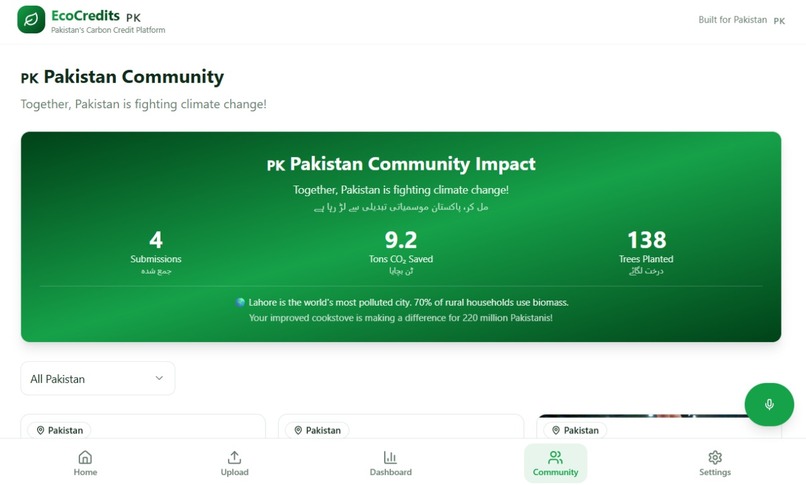
Landing Page
-
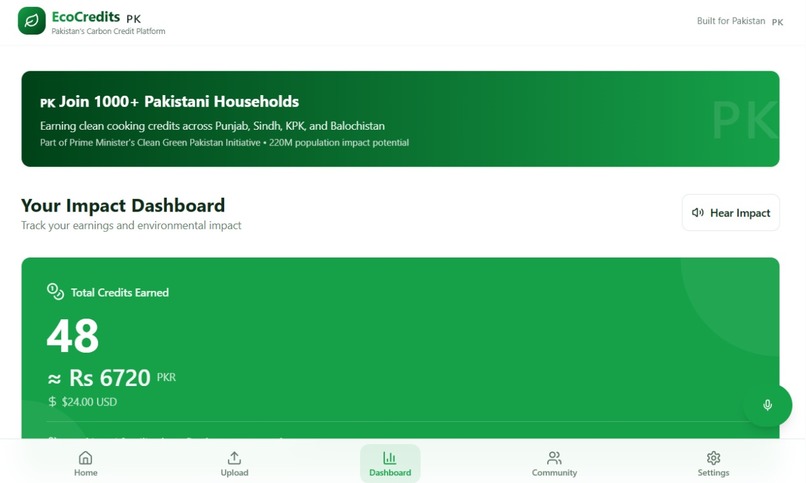
Community Impact Dashboard
-
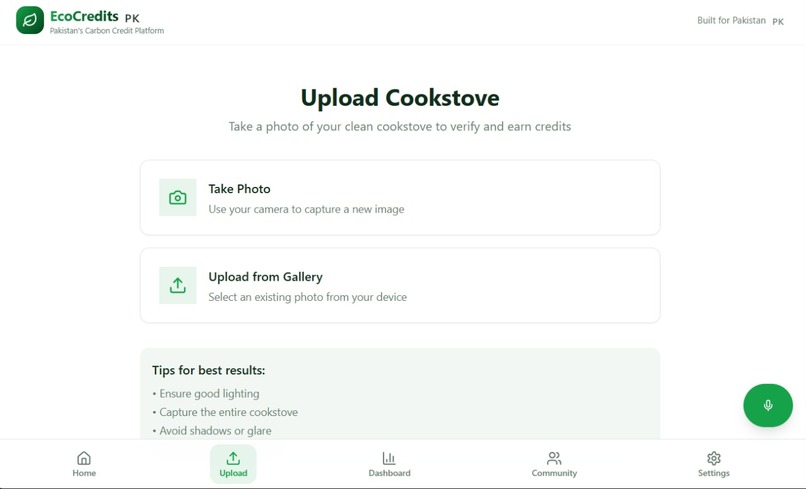
Upload page
-
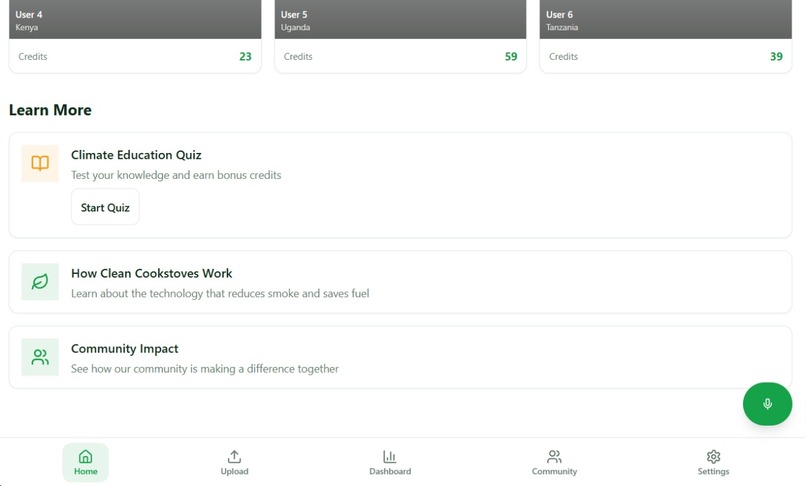
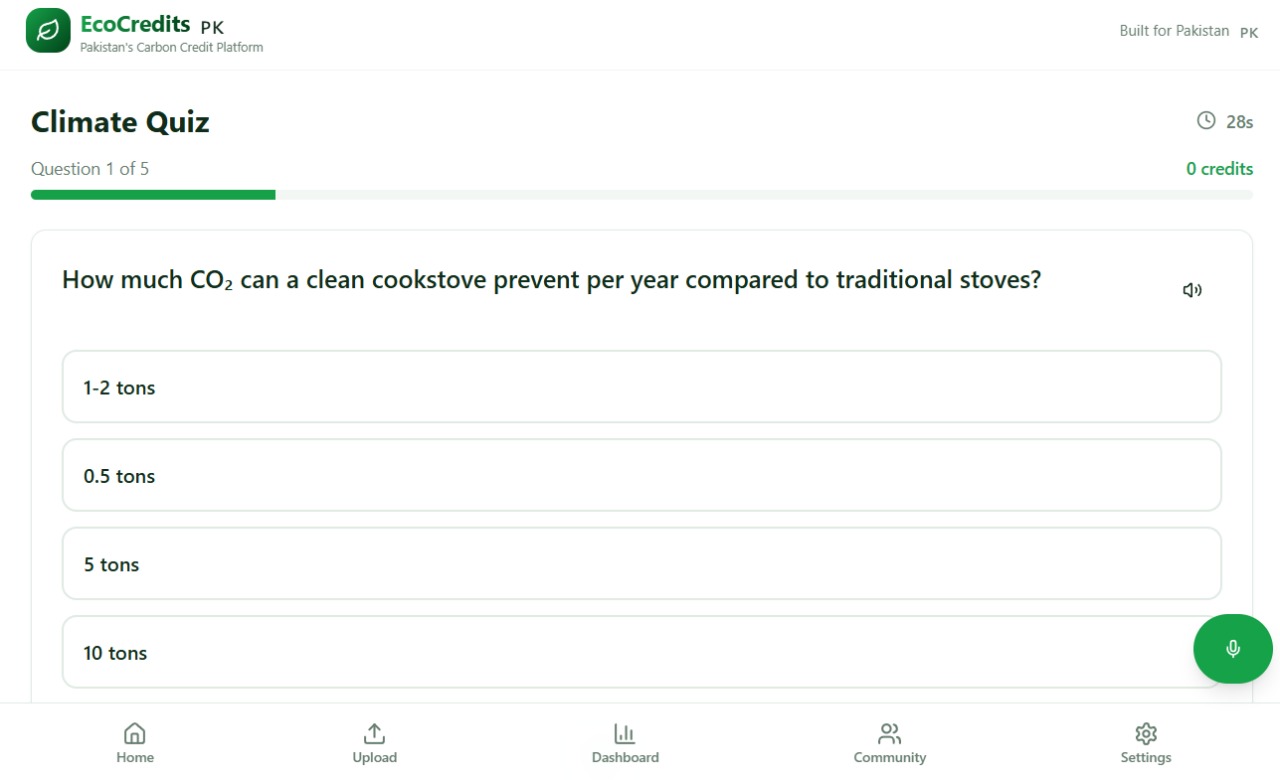
Additionaly features such as Climate Quiz, information about green stoves and community impact
-
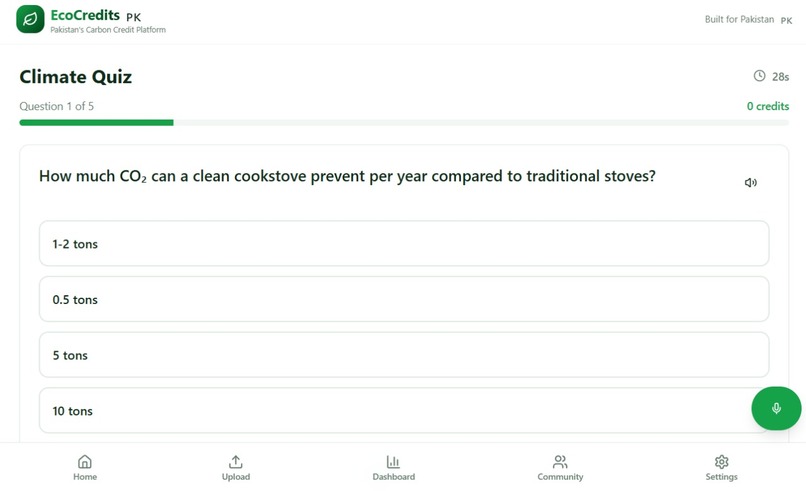
Interactive quiz to promote climate awareness
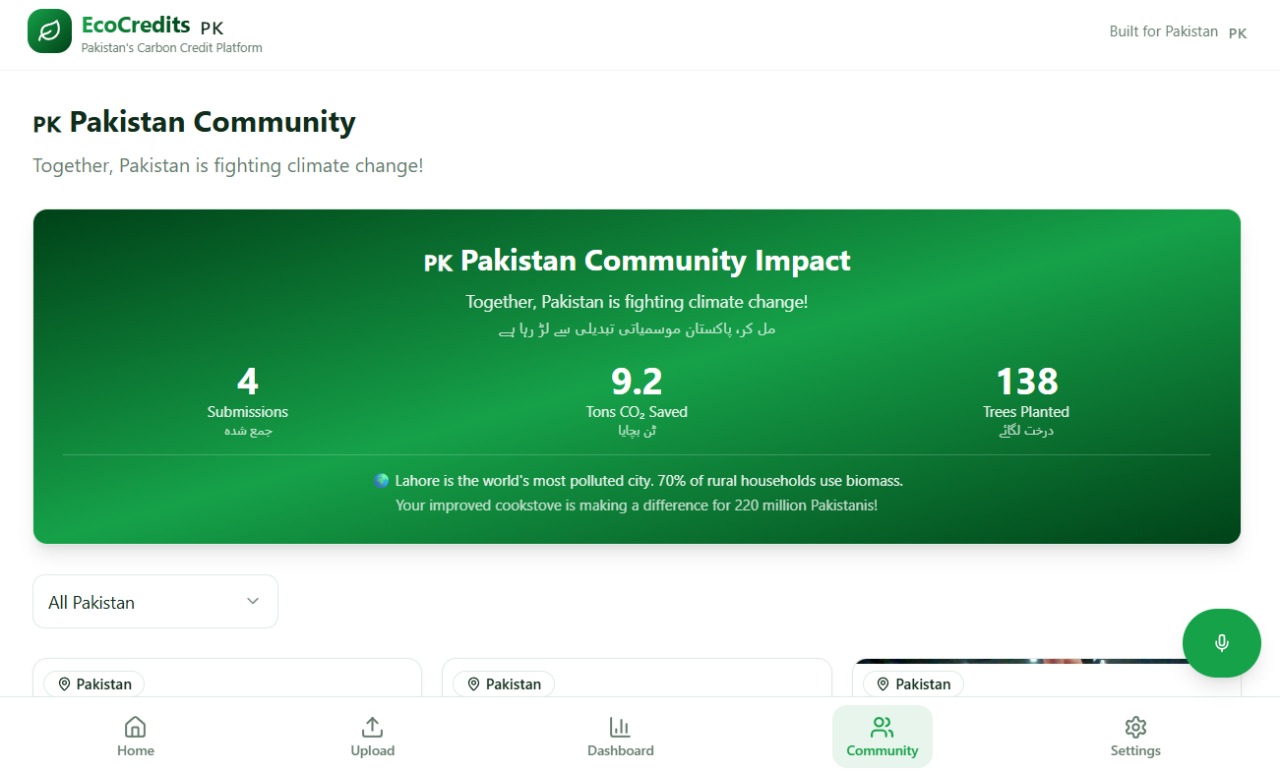
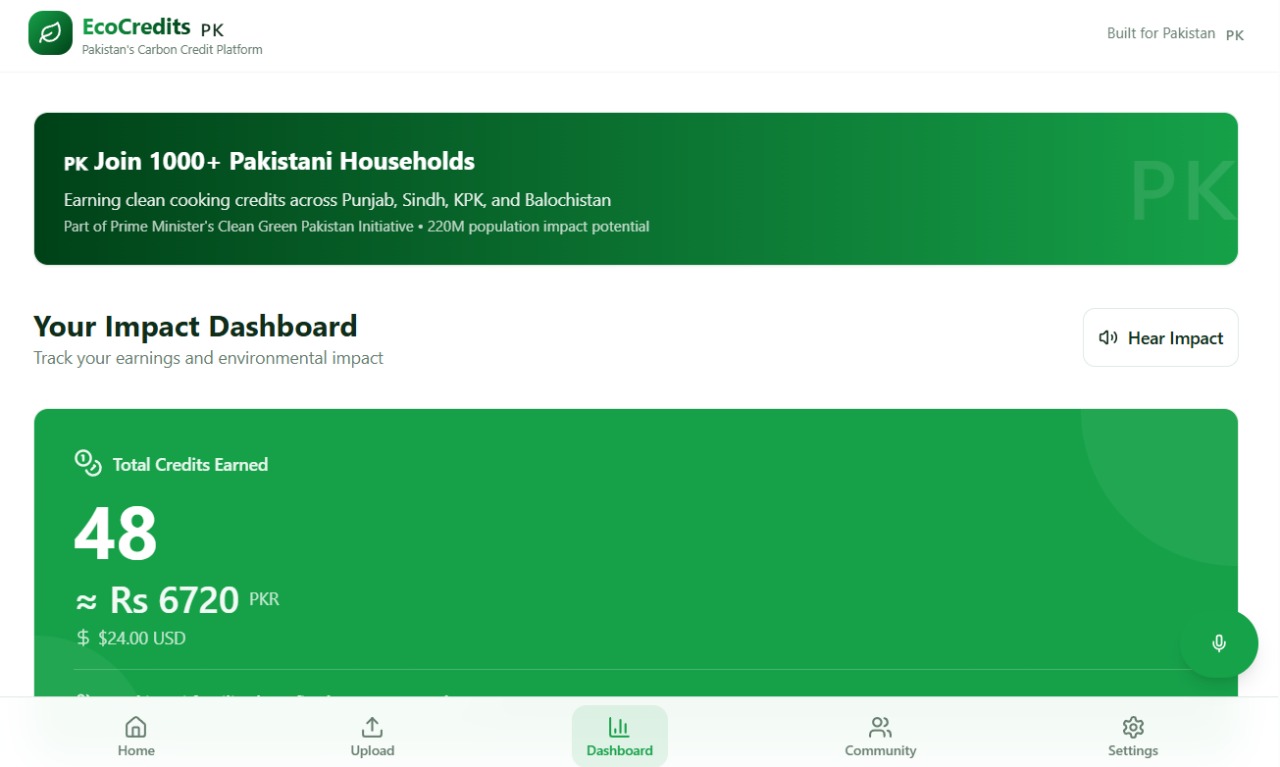

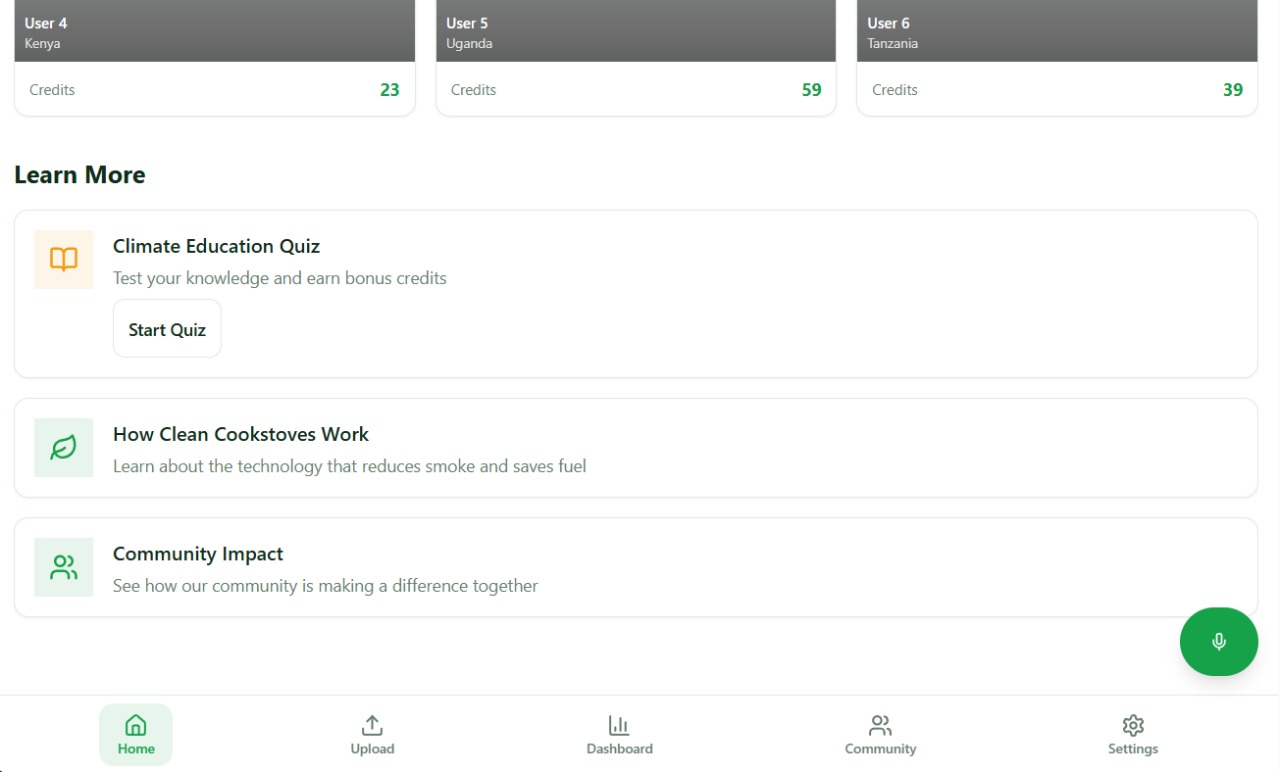
🌍 ecoCredits: Cooking Their Way to Climate Change
Inspiration
Our journey began with a simple yet alarming observation: millions of women in Pakistan cook over traditional chulha stoves every day — burning wood and coal, inhaling smoke equivalent to smoking 40 cigarettes daily, and spending hours in kitchens filled with toxic air.
The result is a triple crisis:
- Health Emergency: 128,000 people die annually from household air pollution.
- Climate Impact: 40 million inefficient stoves contribute up to 30% of national CO₂ emissions.
- Gender Inequality: Women bear the brunt of the health burden while remaining excluded from carbon markets and income opportunities.
We were inspired to turn this daily struggle into a source of empowerment. What if the same act of cooking could fight climate change and generate income for women? That’s how ecoCredits was born — a platform that transforms household energy transitions into verified, tradable carbon credits.
What it does
ecoCredits democratizes access to carbon markets through technology.
🌱 AI-Powered Verification: Women photograph their clean cookstove using our mobile app. A computer vision model instantly verifies stove type and condition — no auditors required.
☀ Scientific Carbon Accounting: Using NASA POWER climate data, the system calculates precise CO₂ reductions based on stove efficiency, family size, and regional conditions.
💰 Direct Economic Empowerment: Each verified reduction is converted into carbon credits, which are translated into Pakistani Rupees and deposited directly into the user’s account — creating sustainable income of 500–2000 PKR per month.
🗣 Inclusive Experience: Urdu-language voice guidance (via ElevenLabs API) ensures accessibility for low-literacy users.
In short: ecoCredits turns clean cooking into climate currency.
How we built it
Our solution combines AI verification, **scientific data integration, and **local cultural design to create an end-to-end platform.
🧩 Tech Stack
- Frontend: React + TypeScript + Tailwind CSS (mobile-first design for low-end smartphones).
- Backend: Supabase (PostgreSQL) for authentication, transactions, and real-time updates.
- AI Verification: Replicate API models to detect and validate clean cookstove images.
- Voice Support: ElevenLabs for natural Urdu narration.
- Data Integration: NASA POWER API for precise regional carbon offset calculations.
🔬 Scientific Foundation
Each stove’s emission reduction (( \Delta CO_2 )) is calculated using the formula:
[ \Delta CO_2 = (E_{baseline} - E_{clean}) \times U_f ]
where:
- ( E_{baseline} ) = emissions from traditional stove
- ( E_{clean} ) = emissions from improved stove
- ( U_f ) = household usage factor derived from NASA climate data
This ensures carbon credits are verifiable, replicable, and compliant with international carbon market standards.
Challenges we ran into
- Verification Costs: Traditional carbon audits were too expensive — we solved this using AI-based visual verification.
- Data Accessibility: Integrating climate datasets from NASA POWER required careful calibration for Pakistan’s regional baselines.
- Digital Divide: Many users lacked smartphone literacy; we overcame this with voice guidance and a visual-first Urdu interface.
- Financial Inclusion: Ensuring secure digital payments for women in rural areas required collaboration with local mobile money networks.
- Trust and Adoption: Building community confidence in “carbon credits” — an abstract concept — took user education and localized storytelling.
Accomplishments that we're proud of
- 🚀 Built Pakistan’s first AI-powered carbon credit verification system for household-level emissions.
- 💡 Integrated NASA POWER data for scientific credibility in real-time carbon calculations.
- 👩🌾 Empowered women by converting clean cooking actions into direct income streams.
- 🧭 Designed a fully Urdu-localized voice-guided experience for low-literacy users.
- 🌏 Demonstrated a model scalable to millions of households across South Asia.
At 100,000 households, ecoCredits can:
- Reduce 150,000–300,000 tonnes of CO₂ annually,
- Distribute $238.5 million directly to women,
- Achieve the same impact as planting 375,000–3.75 million trees.
What we learned
- Technology alone isn’t enough — cultural and linguistic context defines adoption.
- Scientific credibility drives trust — NASA data and transparent algorithms make invisible climate impact tangible.
- Inclusivity creates scale — designing for the most marginalized users unlocks mass participation.
- Behavioral incentives sustain change — when women earn money for climate-friendly habits, change becomes permanent.
We also deepened our understanding of how AI, data, and social equity can intersect to create measurable impact.
What's next for ecoCredits
Phase 1 (Months 1–3)
- Pilot in Lahore and Karachi with 10,000 users.
- Validate AI verification and credit calculations.
Phase 2 (Months 4–6)
- Expand to Islamabad, Peshawar, and Quetta.
- Partner with international carbon markets.
- Onboard 50,000 active users.
Phase 3 (Year 2)
- National rollout across Pakistan.
- Develop regional replication across South Asia and Sub-Saharan Africa.
Our long-term goal: Empower 10% of Pakistan’s households (4 million women) to collectively reduce 6 million tonnes of CO₂ annually, equivalent to removing **1.3 million cars from the roads.
💚 ecoCredits — Where Climate Action Meets Women’s Empowerment.
Built With
- elevenlabs
- loveable
- replicate
- supabase


Log in or sign up for Devpost to join the conversation.