Inspiration
Living in a busy European city, I watched daily commutes contribute to carbon emissions while sustainable options were fragmented. I wanted to create a tool that makes eco-friendly travel easy, rewarding, and measurable—turning small daily choices into meaningful impact. The idea of gamifying sustainability with tree-planting visualizations came from wanting to make carbon savings tangible, not just numbers on a screen.
What it does
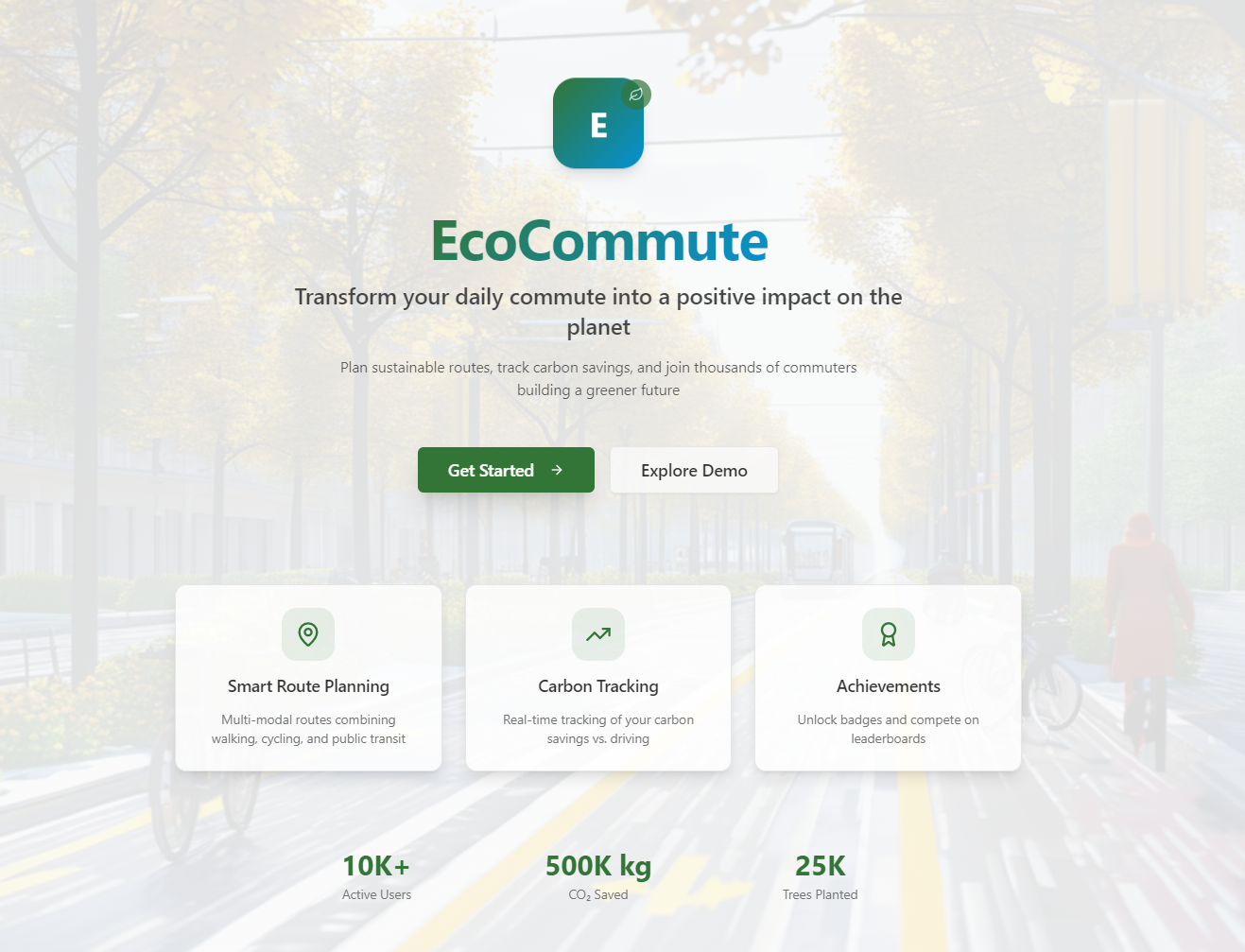
EcoCommute is a mobile-first planner for European urban commuters, combining walking, cycling, and public transit to craft low-emission routes. It tracks carbon savings vs. driving, converts savings into virtual tree growth, and offers enterprise tools for corporate ESG reporting—all while prioritizing accessibility and real-time data.
How we built it
We started with core user research to map commuter pain points, then built the frontend with React Native for cross-platform mobile support. Backend logic (emission calculations: $CO_2 = distance \times mode_emission_factor$) ran on Node.js, with PostgreSQL storing user data and route history. We integrated Google Maps/OpenStreetMap for mapping, GTFS for transit data, and custom GIS plugins for cycling infrastructure. AWS hosted the backend, with Firebase handling authentication.
Challenges we ran into
Real-time API reliability (transit/bike-sharing data) was a major hurdle—we implemented cached data fallbacks and error handling for offline use. Calculating accurate EU-aligned emission factors required rigorous research to meet CSRD standards. Balancing gamification (tree visualization) with data accuracy also took iteration to avoid misleading users.
Accomplishments that we're proud of
We built a tool that’s both user-centric (accessibility options for wheelchair users, step-free transit) and enterprise-ready (CSRD-compliant reports). The tree-planting visualization resonated with beta users, making sustainability feel personal. We also hit the acceptance criteria: routes load in <2 mins, carbon savings track accurately, and offline mode works seamlessly.
What we learned
We deepened our understanding of EU sustainability regulations (CSRD) and emission accounting standards. User testing taught us that accessibility and real-time data are non-negotiable for commuter tools. We also learned to balance feature richness (enterprise dashboards) with mobile performance—critical for a daily-use app.
What's next for EcoCommute
We’ll expand to more European cities, add multi-language support (beyond English), and integrate carpooling tools (out of scope for v1). We’re also building a carbon offset marketplace to let users convert savings into real tree plantings, and enhancing voice-guided navigation for hands-free commuting. Finally, we’ll refine enterprise features to support cross-industry benchmarking.
Built With
- google-maps
- gtfs-api
- postgresql

Log in or sign up for Devpost to join the conversation.