Inspiration
Every urban intervention creates tradeoffs. Changing a traffic light may improve movement in one direction while increasing queues elsewhere. A solution that performs well on one metric may perform poorly on another.
As students from VMA in Shenzhen, China, we wanted to explore a question close to home: before changing how a city operates, can we make the possible consequences easier to investigate?
Our team—Jason Wang, Jayden Liu, and Francis Pei—built Shenzhen EcoCity OS to connect urban data, AI-assisted research, simulation, and evidence-based decisions.
What it does
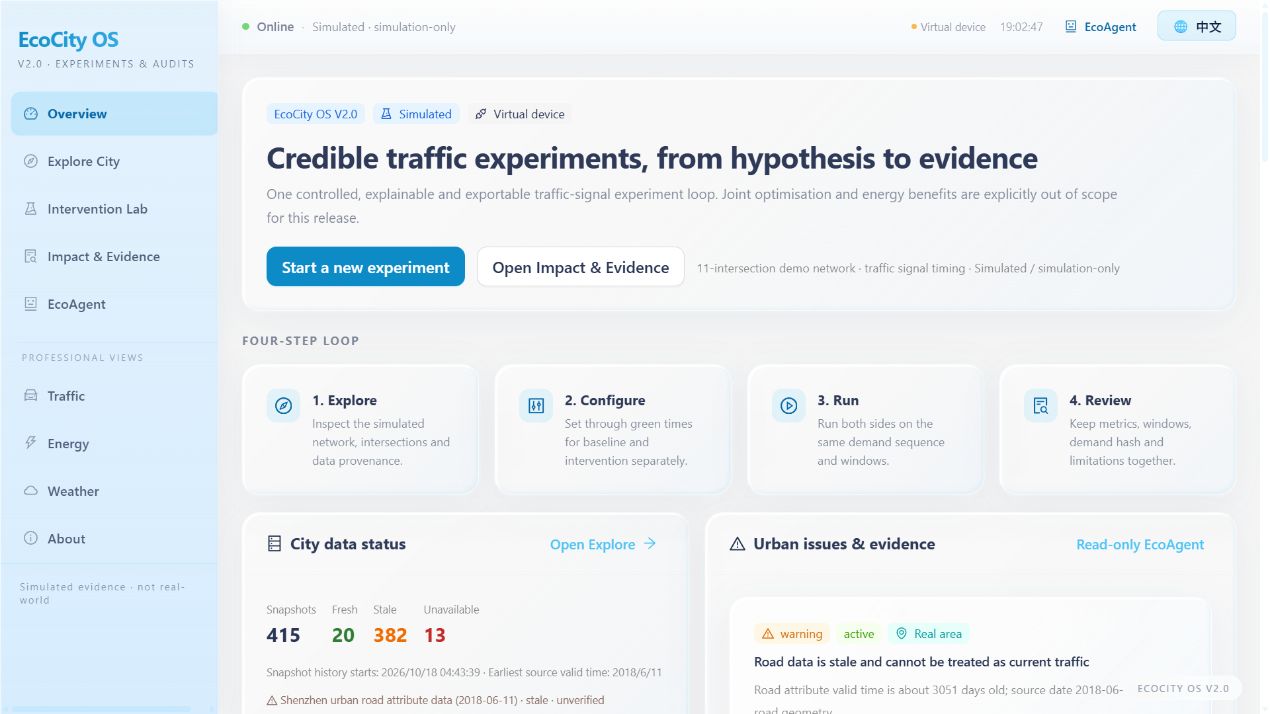
EcoCity OS helps users move through a research workflow: explore available data, investigate a problem, propose an intervention, compare results, and inspect the supporting evidence.
The platform includes:
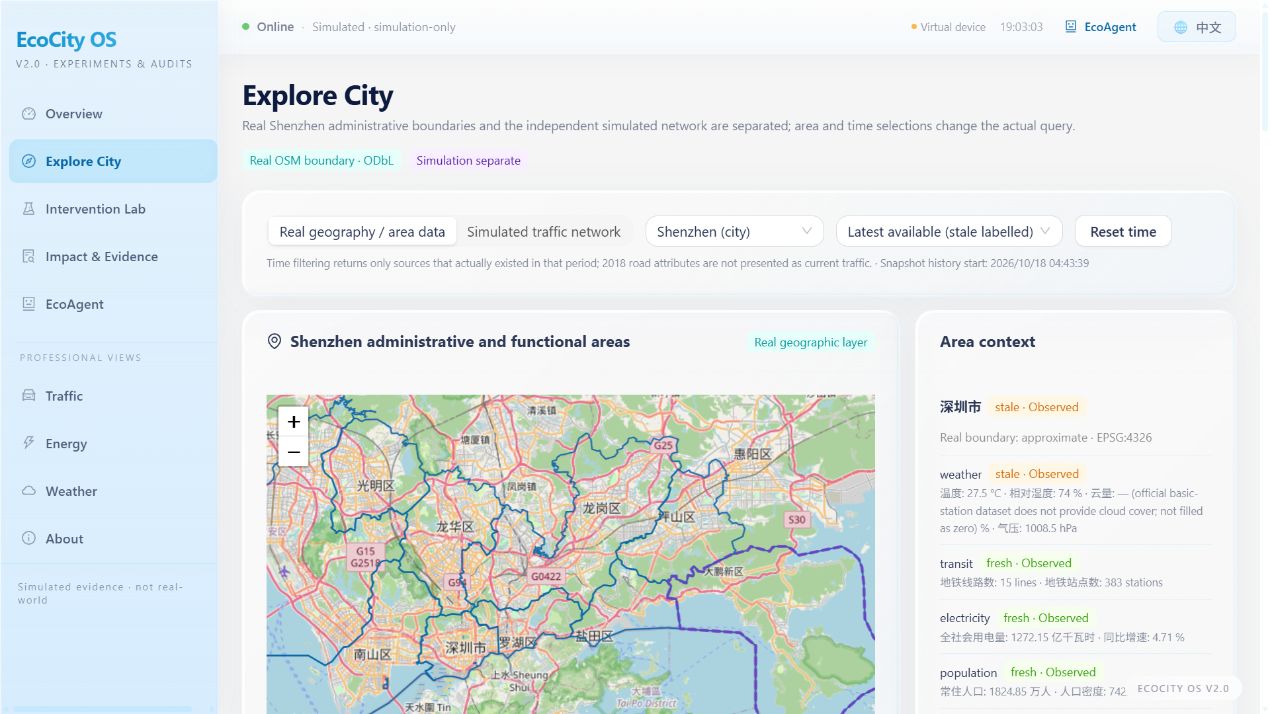
- Explore City: geographic context, official Shenzhen weather observations, published electricity statistics, and clear source and coverage labels.
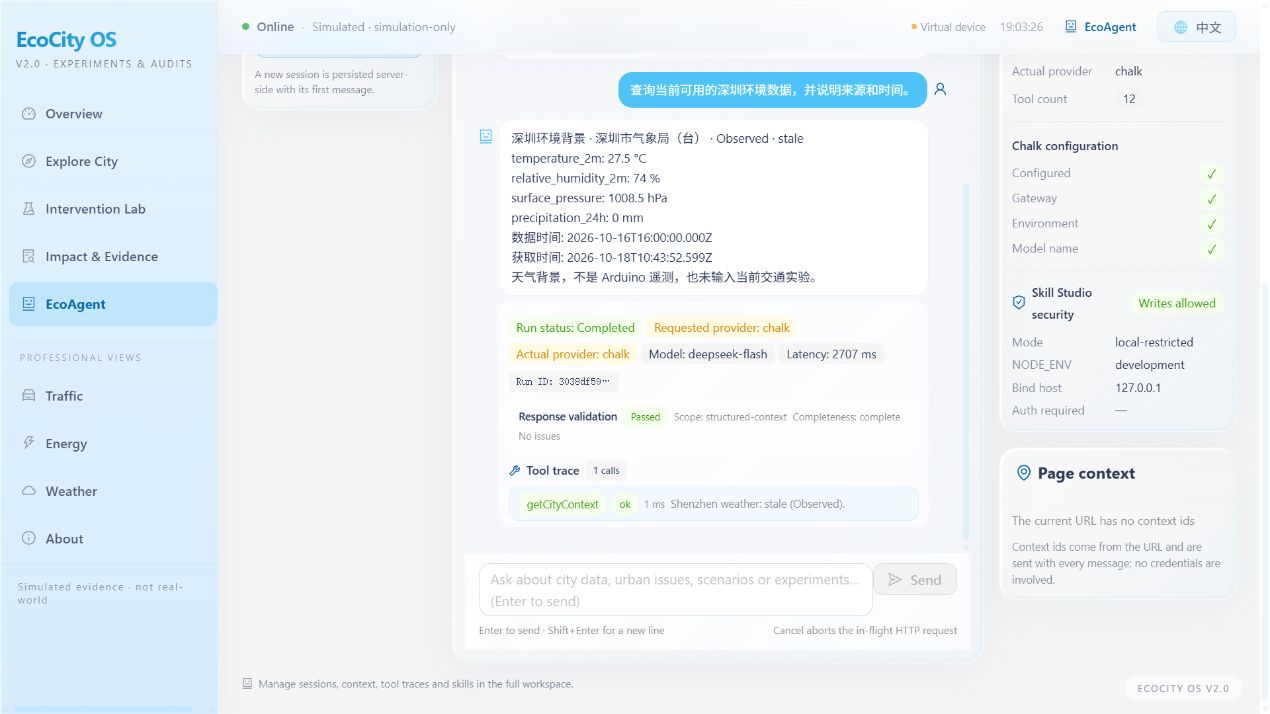
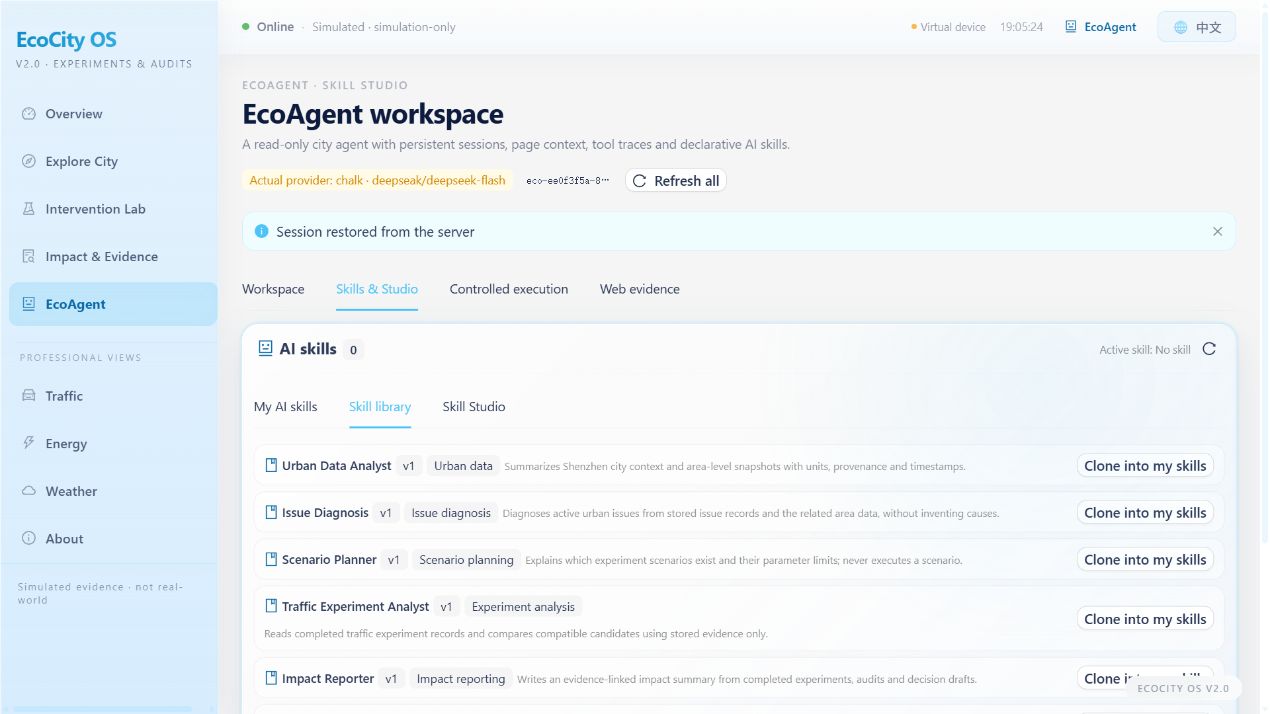
- EcoAgent: a Chalk-powered AI workspace with controlled tool calling, experiment access, and customizable declarative Skills.
- Web Evidence Intake: import a public webpage, review a structured summary and supporting excerpts, and confirm whether to save it as reported evidence.
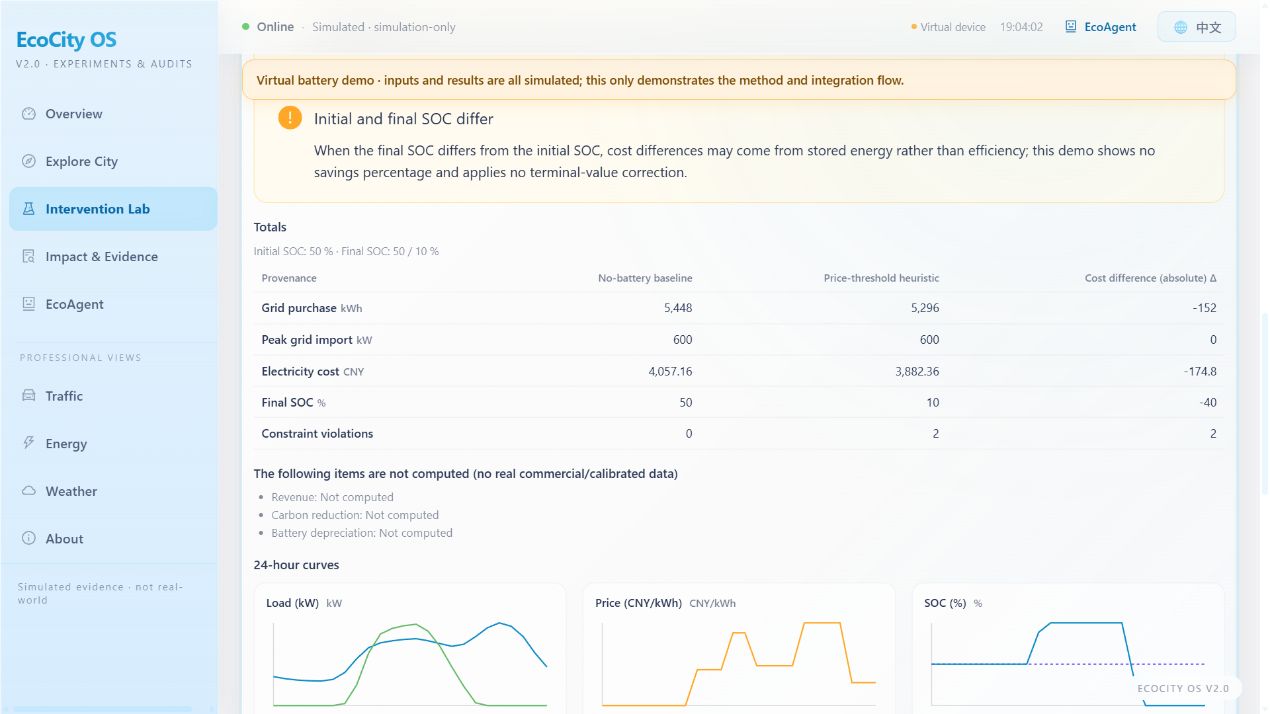
- Intervention Lab: reproducible traffic signal experiments and a separately labelled virtual battery dispatch demonstration.
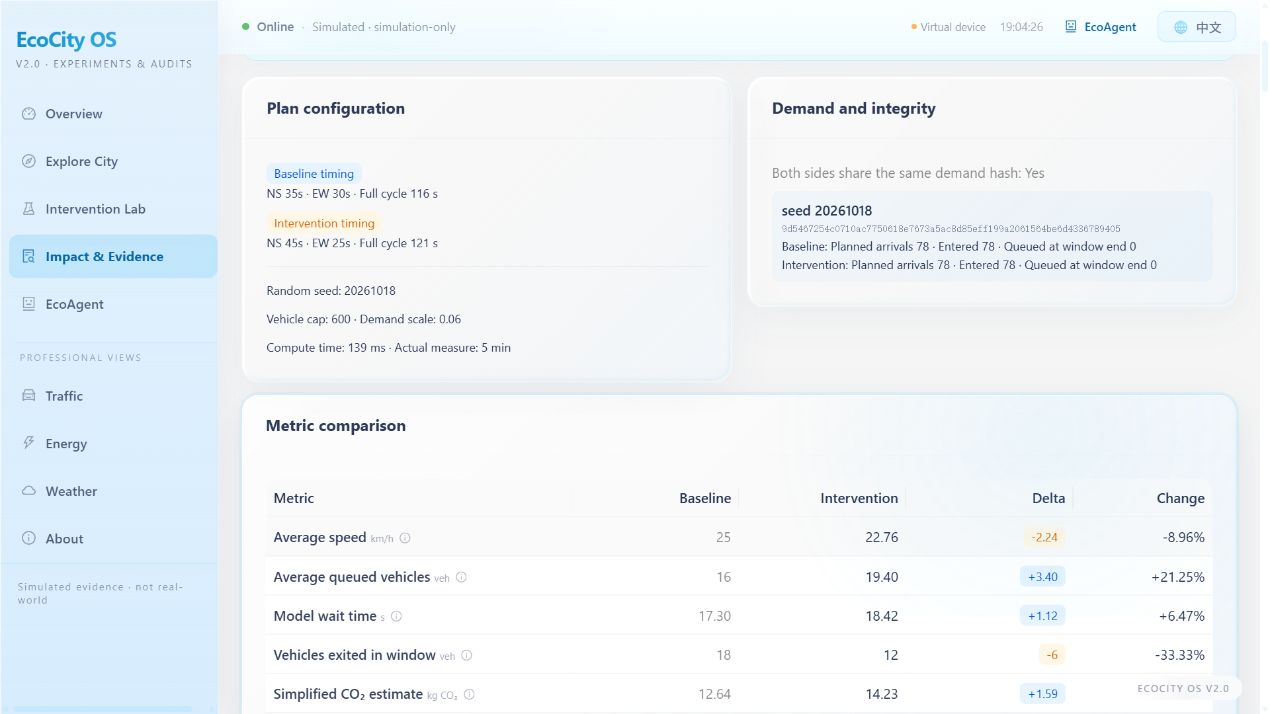
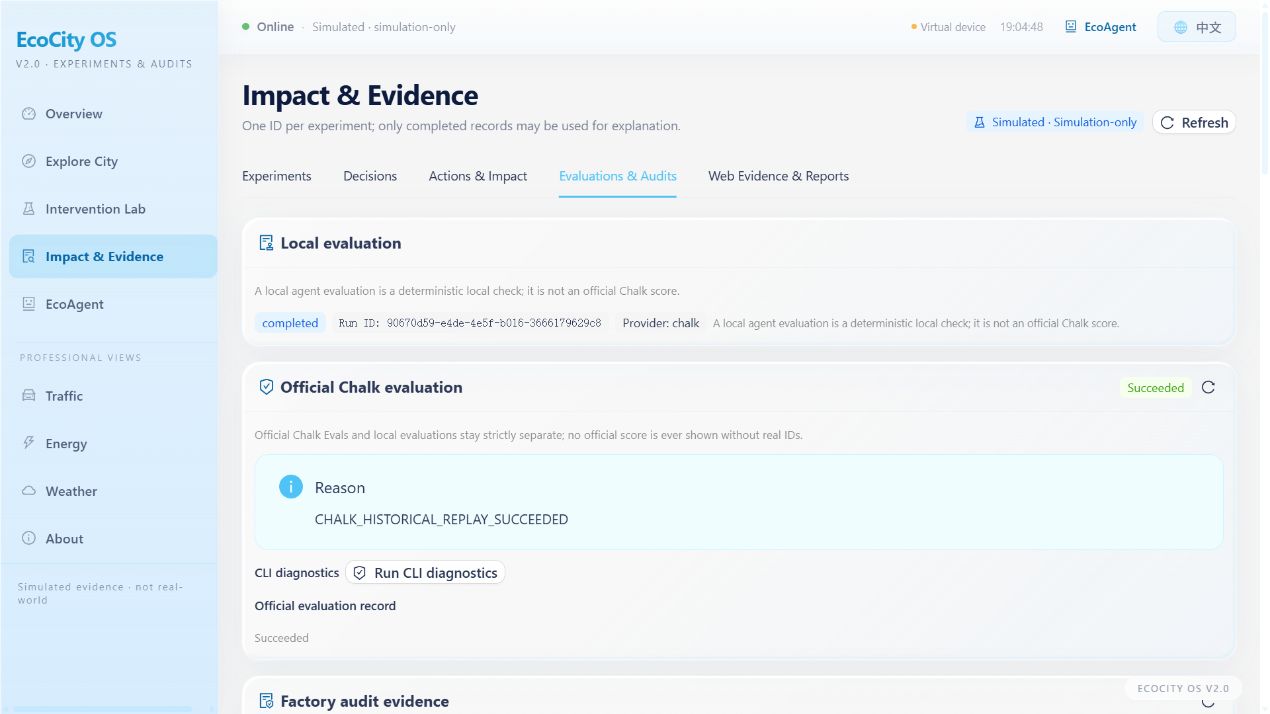
- Impact & Evidence: experimental results, compatible-scenario comparisons, decision drafts, audit records, and evaluation results.
Our intended users are urban researchers and, in the longer term, government teams investigating sustainable interventions. The current prototype runs locally and has not yet undergone external user testing.
How we built it
We extended an existing Smart City codebase with a more focused research and evidence workflow.
The frontend uses React, TypeScript, Vite, Ant Design, ECharts, and Leaflet. An Express backend manages APIs and Agent tools, SQLite stores records and evidence, and Socket.IO communicates execution progress.
EcoAgent accesses its configured model through Chalk Model Gateway. Tool arguments are validated on the server, and consequential operations require explicit user confirmation.
Traffic experiments use seeded vehicle demand. The baseline and intervention replay the same demand, with configuration, measurement windows, demand hashes, and metric definitions preserved for inspection.
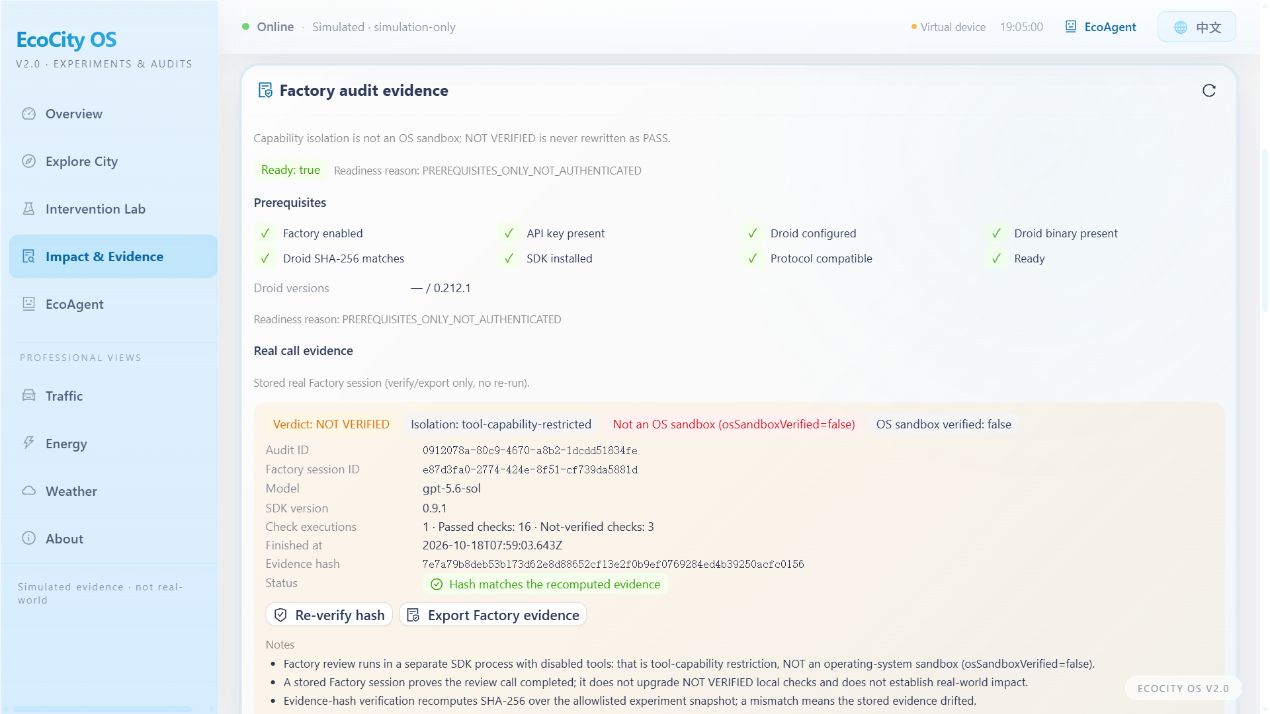
We integrated Factory Droid SDK for an independent review of stored experiment integrity. We also executed an official Chalk evaluation of frozen historical Agent records. That evaluation is historical replay, rather than a fresh end-to-end execution of EcoAgent.
Jayden focused on backend development. Francis focused on interface design and model-training work. Jason led product planning and coordinated integration review and quality verification.
Challenges we faced
Making comparisons meaningful
Early development exposed how easily differences in random demand, measurement windows, or parameter interpretation can undermine a comparison.
We addressed this with reproducible paired inputs, explicit metric definitions, versioned records, and compatibility checks. The system blocks unsupported rankings rather than forcing a recommendation.
Connecting AI services without overstating success
A configured API key does not prove that a complete Agent workflow works. We encountered authentication failures and a Factory CLI/SDK protocol mismatch that prevented restricted tool sessions from starting.
We tested authentication, session creation, tool execution, and persisted results separately. A compatible isolated CLI resolved the Factory integration issue, while failed attempts and unverified checks remained visible.
What we learned
We learned how to coordinate multiple AI development tools, implement Agent tool calling, and distinguish a plausible explanation from a claim supported by recorded evidence.
Codex supported planning, debugging, and quality review. DeepSeek Harness assisted implementation. Our team directed the product decisions, integration work, and validation process.
The most important lesson was that trustworthy decision support needs more than a convincing answer: it needs reproducible inputs, explicit assumptions, and evidence that can be inspected.
What we are proud of
We built a workflow where users can trace research from a source to an experiment and then to a decision draft.
We also preserved important boundaries. Official observations, reported news, estimated metrics, and simulated results remain distinct. Factory reviews do not establish real-world impact, and historical Agent evaluation scores do not prove universal model reliability.
What is next
Our next priorities are calibrated traffic inputs, authorized operational energy data, external user testing, and a securely deployed end-to-end Agent evaluation.
The current traffic network is synthetic, and the battery demonstration uses explicitly simulated inputs. We do not claim that the prototype has already reduced real-world congestion, electricity consumption, or emissions.
Our goal is to help people understand tradeoffs before making changes—and make the reasoning behind those decisions easier to review.
Built With
- codex
- deepseak
- factory
- node.js
- python
- typescript
