-
-
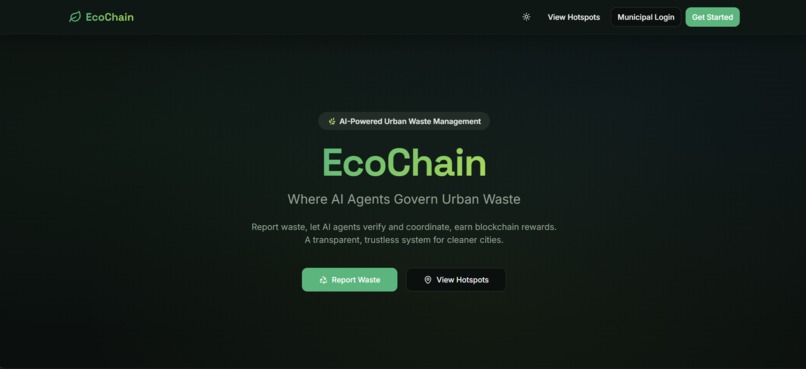
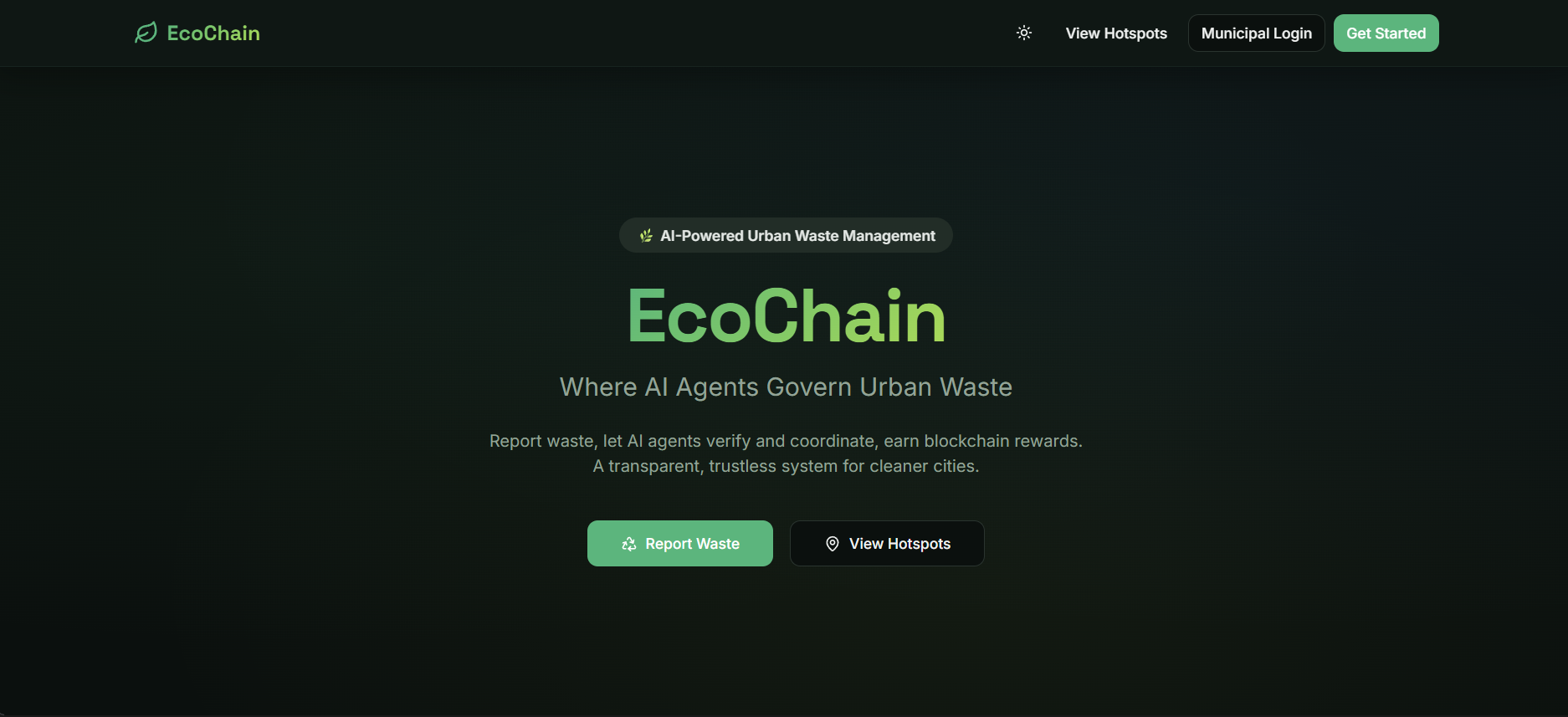
Main landing page for EcoChain, presenting its core mission: AI-governed urban waste management for cleaner cities.
-
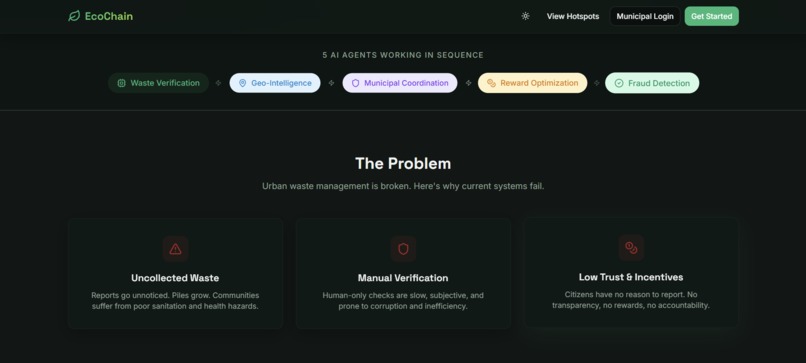
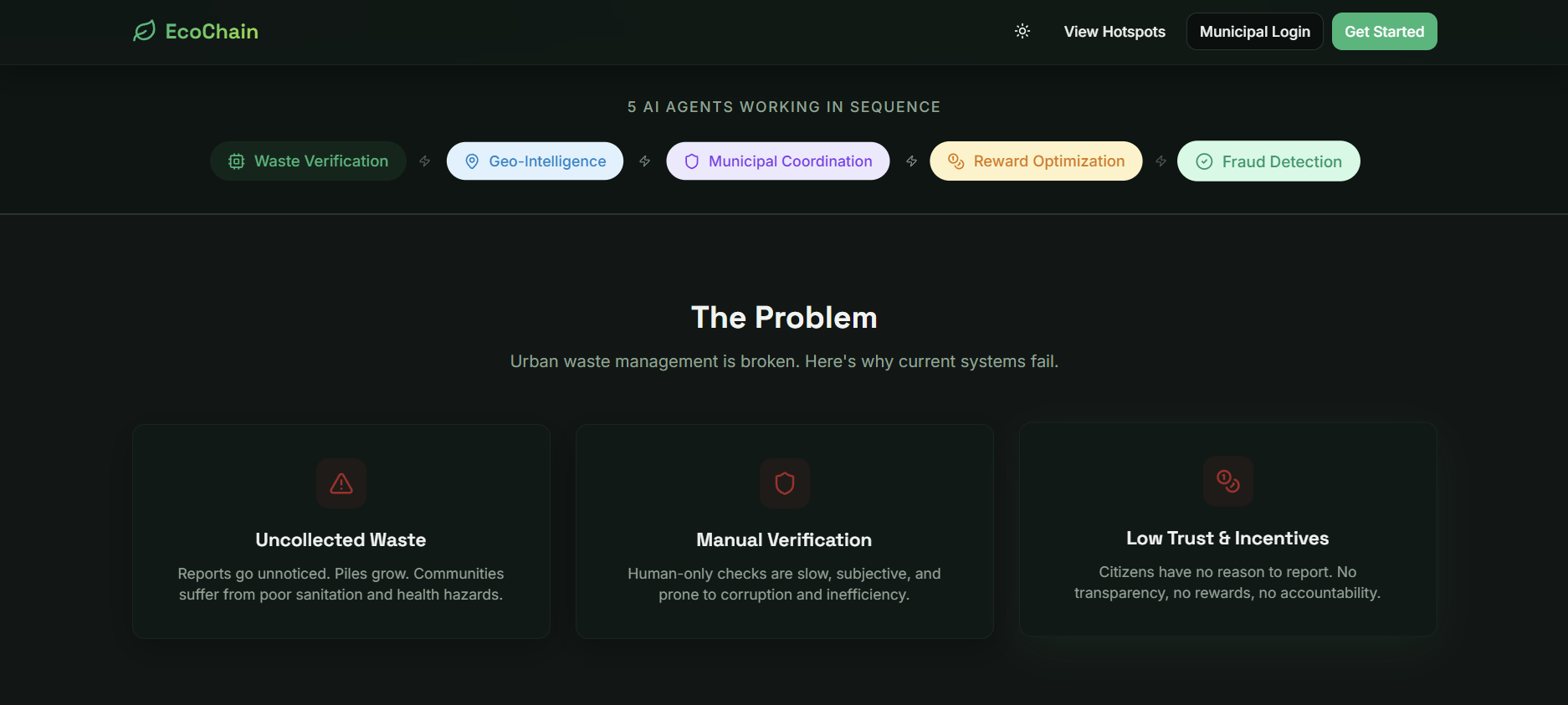
The Problem" page highlighting three systemic failures in urban waste management: uncollected waste, slow manual verification.
-
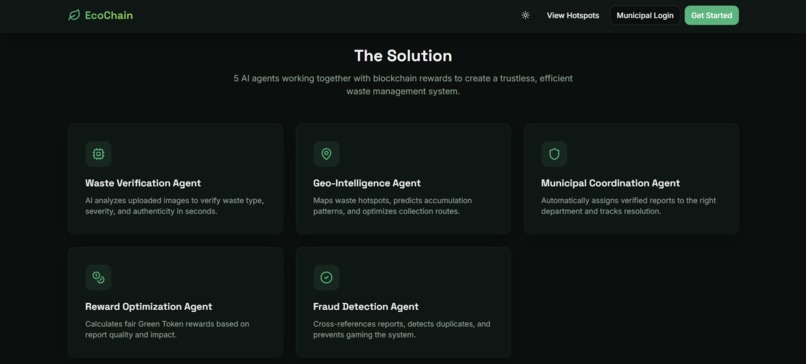
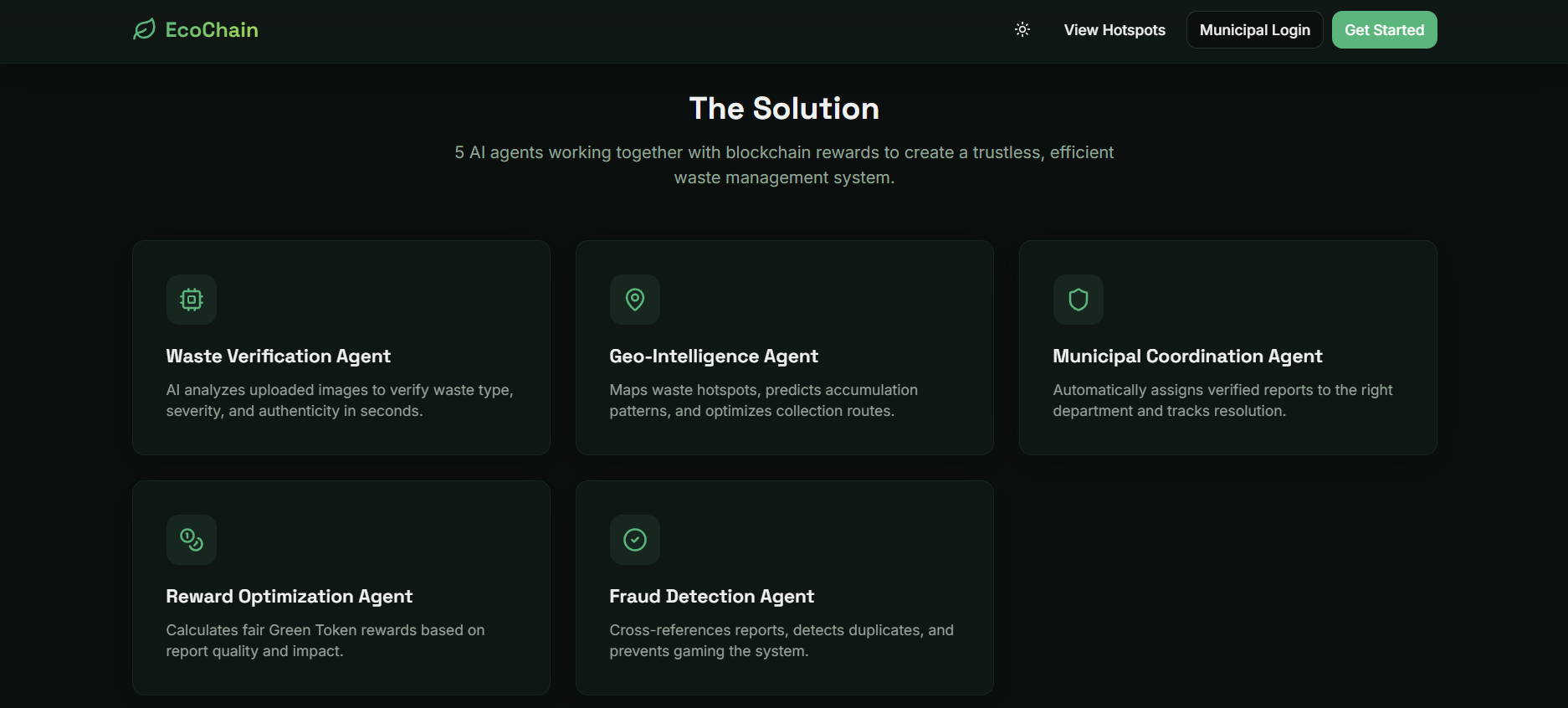
"The Solution" page introducing the five distinct AI agents that collaborate with blockchain to fix the urban waste problem.
-
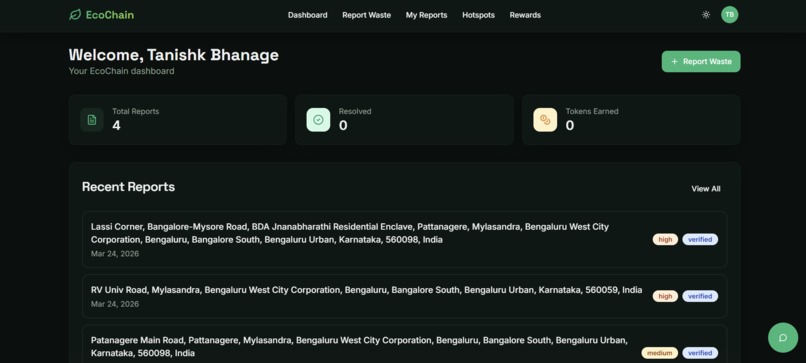
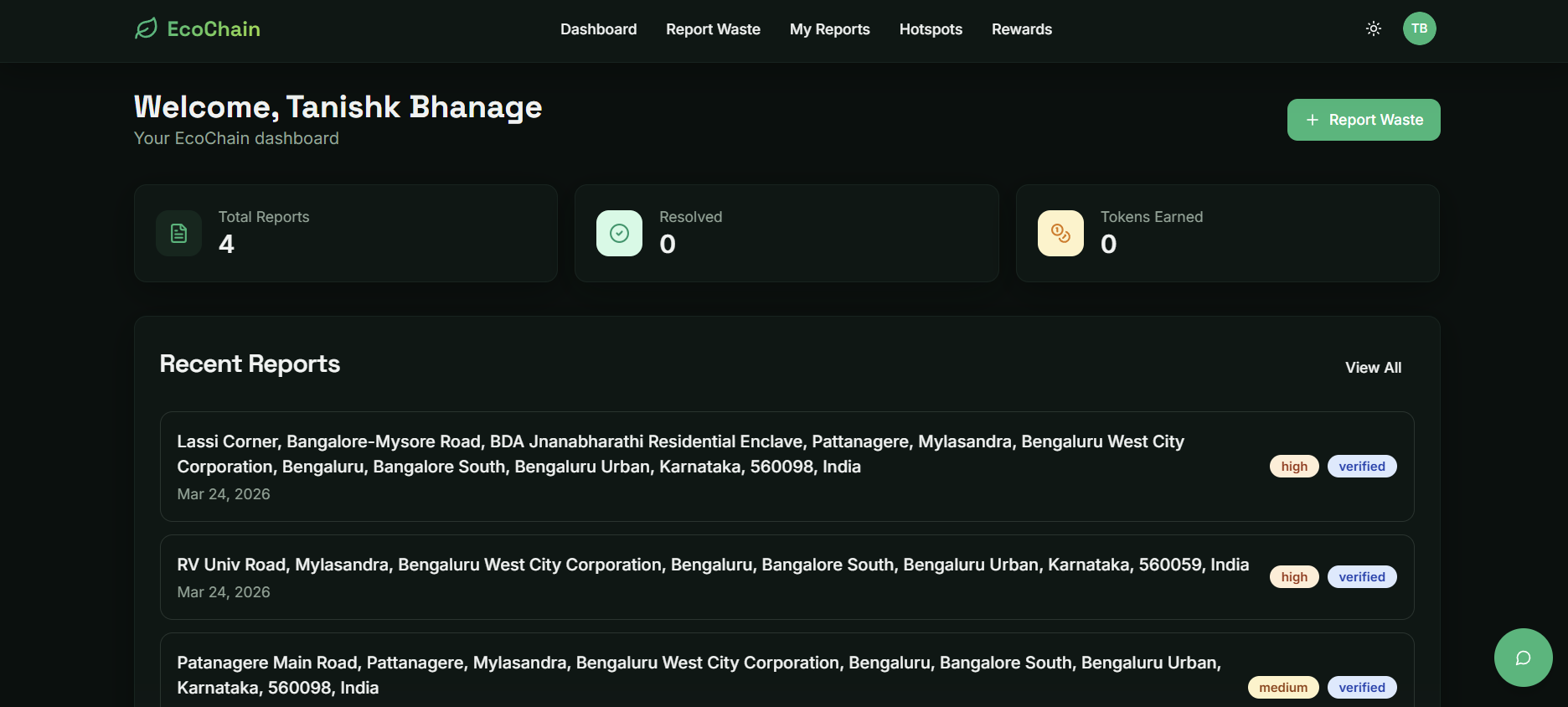
Image 2: Personalized user dashboard for Tanishk Bhanage, tracking total reports, resolution status, and earned Green Tokens.
-
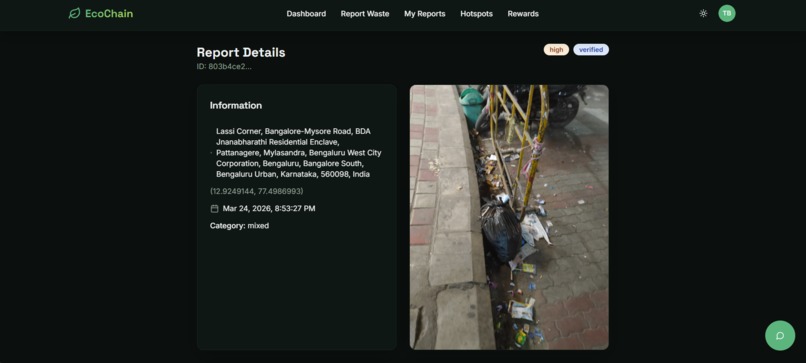
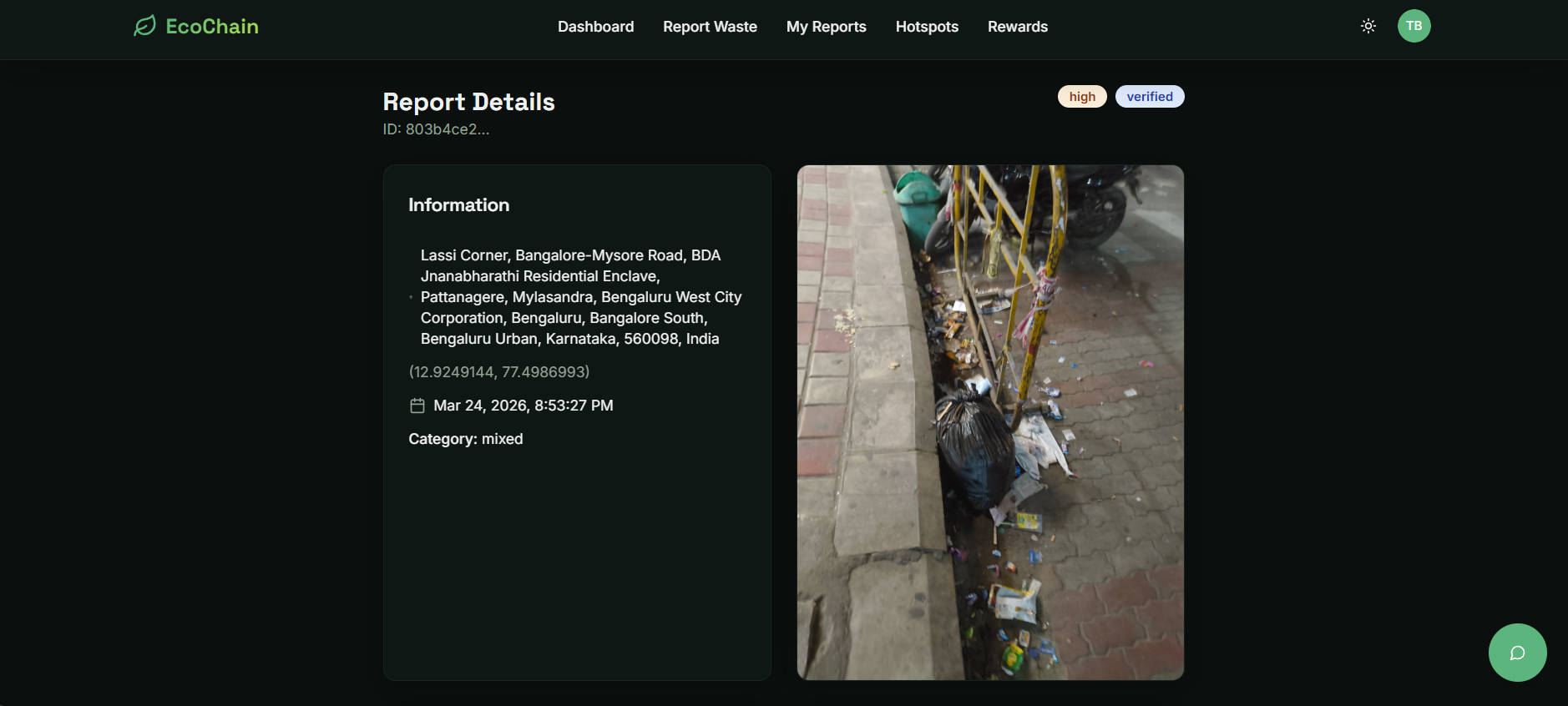
A detailed EcoChain report interface, displaying a verified 'high' priority incident of 'mixed' waste.
-
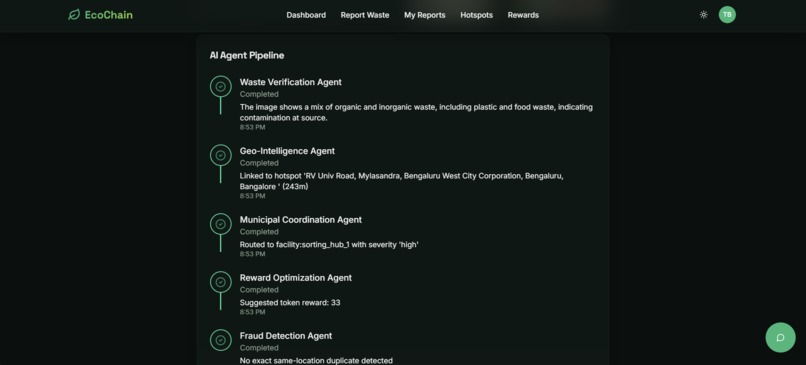
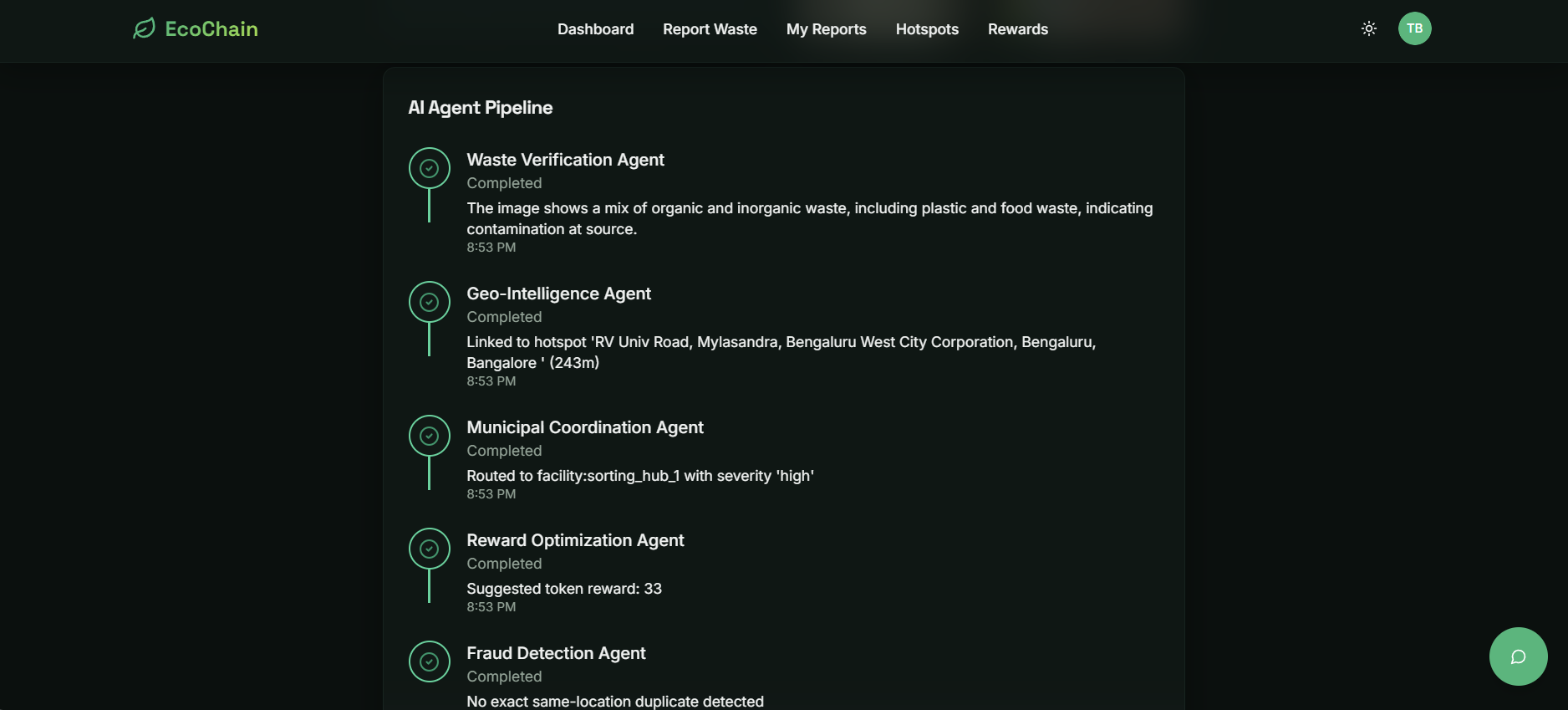
Image 1: Visualization of the successful five-step AI agent pipeline for processing a single waste report.
-
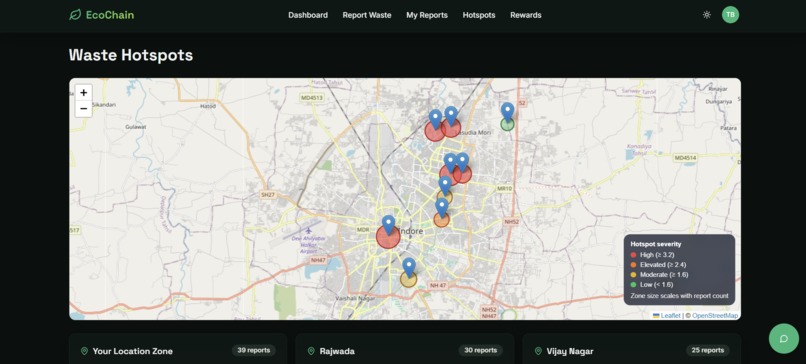
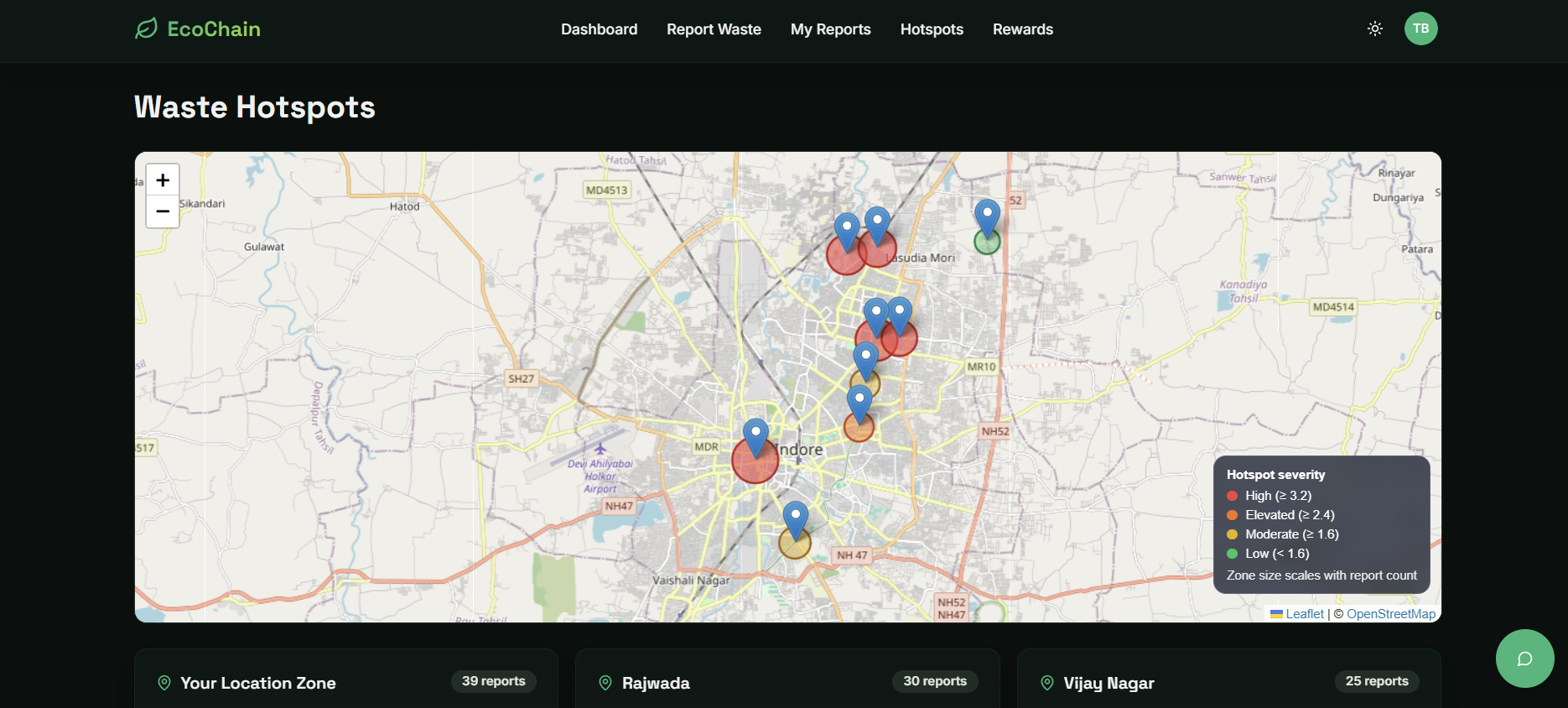
Interactive "Waste Hotspots" map displaying clusters of reported waste incidents by severity.
-
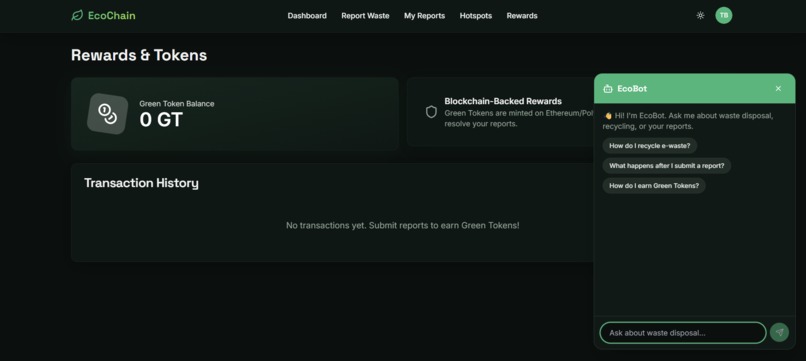
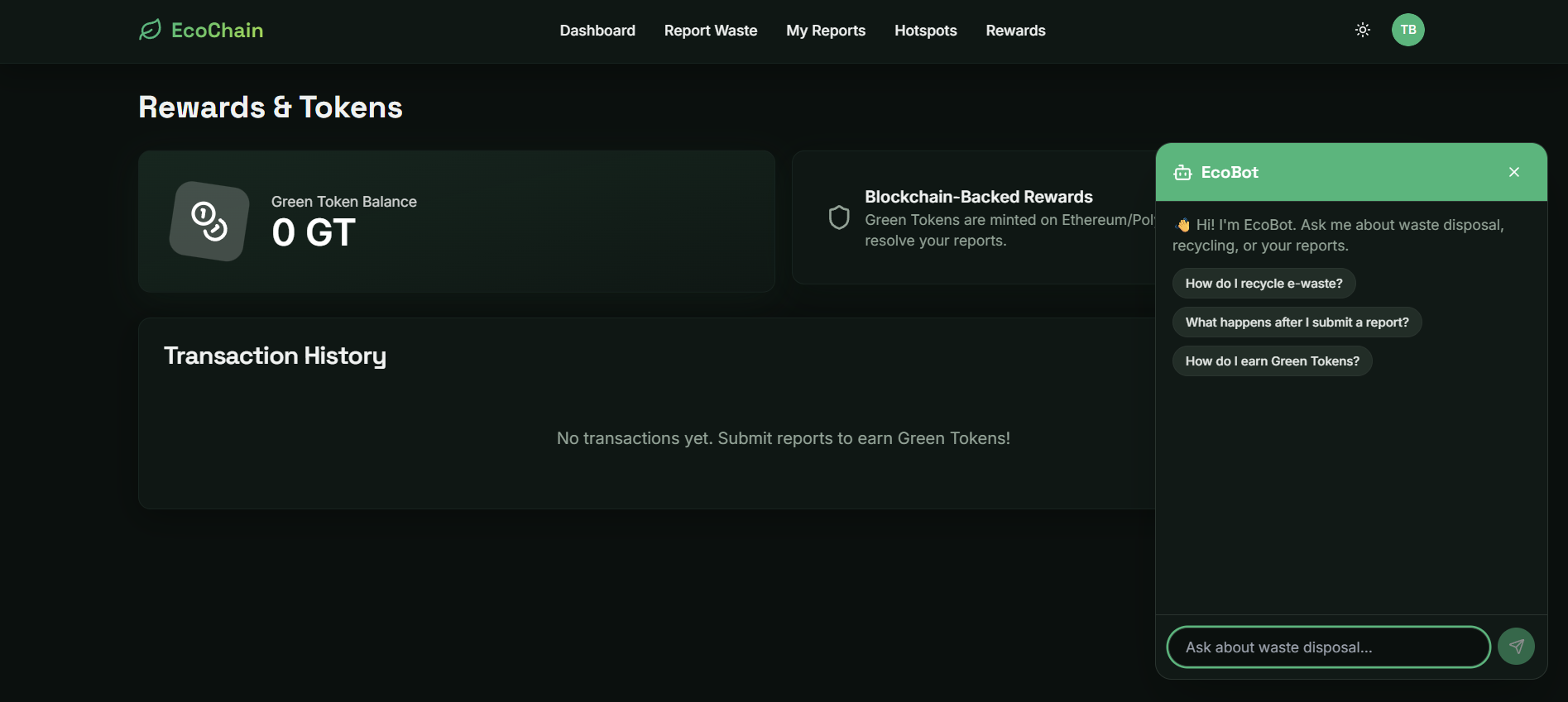
"Rewards & Tokens" interface showing a zero Green Token balance and a sample interaction with EcoBot.
Inspiration
Urban waste reporting in most cities still relies on slow, manual complaint systems that treat every report the same, whether it is a real overflowing dumpster or a fake photo from the internet. [page:1]
We wanted to build an intelligent layer that verifies images, understands geo‑context, and surfaces real hotspots so authorities can act where it matters most.
What it does
EcoChain is an AI‑powered urban waste intelligence system where citizens upload a photo and location, and a multi‑agent AI pipeline verifies whether it is real waste, classifies severity, and enriches it with geo‑intelligence.
The platform aggregates reports into red/yellow/green zones, gives municipal officers dashboards to filter and resolve cases, and converts resolved reports into Green Token rewards for genuine contributors.
How we built it
We built the web app using React, TypeScript, and Tailwind CSS, with shadcn‑ui and React Query to handle UI components and data fetching efficiently.
The backend is a Node.js/Express API that talks to an OpenAI‑compatible AI layer for vision and text models, and uses Supabase for auth, Postgres (with RLS), and storage of report images and hotspot data.
The frontend is deployed on Vercel and the backend on Render, wired together via environment variables such as VITE_API_BASE_URL and secure CORS configuration.
Challenges we ran into
Designing the multi‑agent AI pipeline so that verification, segregation, severity analysis, hotspot detection, reward suggestion, and fraud detection all work together without conflicts was non‑trivial.
Getting Supabase roles and RLS policies right for different users (citizens, municipal officers, planners, admins) while still allowing the backend service role to orchestrate everything took several iterations.
We also had to carefully handle image‑related edge cases, like detecting screenshots or stock images and rejecting them without breaking the user flow.
Accomplishments that we're proud of
We’re proud that EcoChain goes beyond a simple complaint form and actually converts raw reports into actionable intelligence via agents for verification, routing, and fraud detection.
The hotspot visualization and severity‑aware zones give a clear, map‑level snapshot of where the city needs to intervene first, instead of drowning in unstructured complaints.
Another win is the end‑to‑end flow: from citizen report to officer resolution to token transaction creation, all backed by a production‑oriented stack on Vercel, Render, and Supabase.
What we learned
We learned how to design an agentic AI system where each agent has a focused responsibility (waste verification, segregation, geo‑intelligence, rewards, fraud) instead of a single monolithic model.
Working deeply with Supabase taught us how to align database schema (reports, report_events, hotspots, token_transactions) with real municipal workflows while still enforcing security with RLS.
We also gained experience tuning prompts and logic for edge cases like mis‑segregated waste, duplicate reports near the same coordinates, and low‑quality / fake images.
What's next for EcoChain – AI-Powered Urban Waste Intelligence
Next, we want to plug the Green Token logic into a real on‑chain ERC‑20 contract so that rewards become transparent, portable, and auditable for citizens.
We plan to add richer analytics for city planners, including ward‑wise trends, time‑window comparisons, and predictive alerts for emerging hotspots.
We also aim to expand the mobile experience (via Expo) so field officers can capture resolution photos, update report status in real time, and sync seamlessly with the same Supabase backend.
Built With
- node.js
- react
- render
- shadcn
- supabase
- tailwind
- typescript
- vercel
- vite


Log in or sign up for Devpost to join the conversation.