-
-
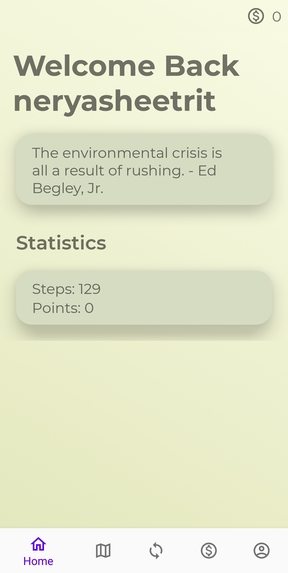
Main screen
-
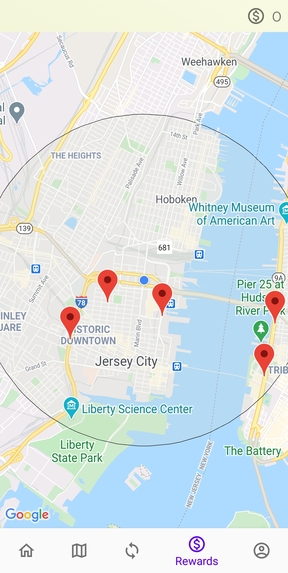
Discover local businesses
Before watching the video:
Please download and run the attached APK before watching the video (for android users) https://drive.google.com/file/d/176X6FqQZtD6AFuWvEgHDMGX5JTRGAQHy/view?usp=sharing
Inspiration
We, Team Ducky, wanted to address the Environmental challenge presented by MakeSPP.
What it does
Our product is an app that rewards and encourages environmental activity, in multiple manners: First of all, the app features a point system, so that whenever a user completes an environmental act (such as biking or walking instead instead of driving, throwing out trash, not using plastic cups, etc.) he gets a specific amount of in-app credits. Then, the credits can be exchanged for free things or discounts at stores (we’ll talk about our business model later). The point of the app is to make environmental change more approachable by using our reward system and by having a more various selection of actions, so there are very little excuses to not use it.
Business model:
Our model is based on a very simple principle: win-win-win. We want to achieve a win for the environment, a win for the people, and a win for the businesses. With COVID-19, businesses need help now more than ever, and we believe that we can help them. So, what is our model? Well, our model makes it so that the businesses can offer free things such as discounts, free items, etc., and they will actually make a profit by attracting customers. We can have a sticker, just like the ones that say “We support Google Pay”, that says “We support Ecocentric”. With that sticker, not only will businesses attract more customers since people will naturally come there to redeem their points, but the businesses will have a better reputation, since they are now considered more environmental and less of an “Evil corporation”. We also asked some local businesses in our area if they are willing to support us and they agreed to work with us and thought that it’s a good idea.
How I built it
We built our project using Android Studio (Java, XML), and hosted the database which the app connects to using Back4App. In order to make the app work, we also used the Google Maps and Google Activity Recognition API.
Challenges I ran into
During the hackathon, we ran into some tough problems with the Google Activity Recognition API. We tried solving it for hours, and couldn’t. Luckily, with the help of Josh Barry (a great mentor), we were able to overcome the obstacle and we got it working. Another problem we ran into was making a working map, which we all tried to do but couldn’t get to work. Eventually, we focused all our energy on it and we got it running. Also, a huge challenge we had to overcome was the fact that only one guy out of the whole team knew how to use Android Studio. We had to overcome that, by learning along the way. Luckily, we got the hang of it and started working on it together, to the point where (after some errors) we got everything working.
Accomplishments that I'm proud of
Since this is our first hackathon, we’re super proud of ourselves for making this product on time and keeping it bug-free! Also, 2 of our 3 teammates were previously unfamiliar with Android Studio, and had to learn to use it along the way.
What I learned
We learned that even when faced with a very strict and short time limit, we still had a lot of fun and managed to learn a lot. From Android Studio development to good project workflows, we learned that when we need to, we can put out a lot of work with performance that isn’t hindered by the rush. Also, we learned that competing in a hackathon based on another country’s time zone is not so bad, and that we can always make it work. We had a great time meeting and conversing with the community, and seeing that there are so many skilled and generous people, willing to help us any time.
What's next for Ecocentric
The next things we want to do is to expand into more environmental activities that our users can do, and develop the UI to be better. We want to prioritize the user experience, so that we can really make it as accessible to people as possible, and with that make a big change. We also wish to deploy the project and actually do some good with it. Our hope is to use this project to make a better environment.
Who did what
We all just did the main development parts on Android Studio, some people dealing with designs at one point and some with the backend and the algorithms at another.
Built With
- android
- android-studio
- google-activity-recognition-api
- google-maps-sdk
- java
- python
- xml


Log in or sign up for Devpost to join the conversation.